
Key Takeaways
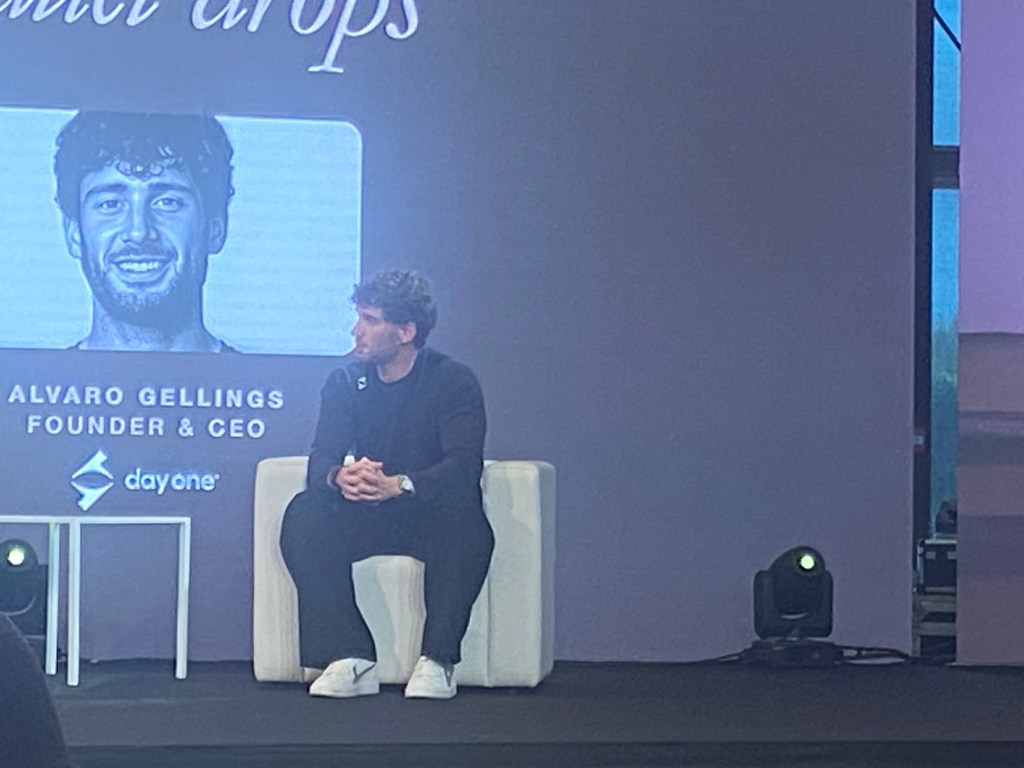
- Alvaro Gellings spoke at the OOAK Mastermind conference in Castelfalfi, Italy, in August.
- In 2021, he launched a fashion business called Ama Studios, which sold $1.4 million worth of products within the first hour of launch.
- In 2024, he created a sportswear company called Day One in partnership with German creator and endurance athlete Arda Saatçi.
He was the propelling force behind a massive ad campaign that garnered billions of organic views. Now Alvaro Gellings, a serial entrepreneur born and raised in Spain, is revealing his growth secrets.
Gellings recently spoke at the OOAK Mastermind conference in Castelfalfi, Italy. He talked about his business ventures and how he created multi-million dollar companies.
Before becoming deeply involved in the creator economy, Gellings built and scaled a gaming company that grew through paid advertising. It’s a concept familiar to many of the founders who were in the room. “That’s all I knew,” he says. “Buying reach and selling the product.”
Then, in 2021, he sold that company and moved into an apartment in Hamburg, Germany. By chance, he lived above a Twitch creator. At the creator’s birthday party, he had a conversation with a popular streamer that shifted his understanding of marketing.
“You have to buy your reach,” the streamer told him, according to Gellings. “I have the reach.”
That difference became the basis of Gellings’ next chapter. He began asking why brands were willing to pay creators so much, concluding that their influence must have substantial commercial value. He ended up founding a fashion business, Ama Studios, with two of Germany’s most popular online personalities, Trymacs and Amar. By collaborating with them, he learned just how powerful a creator-led launch could be.
Gellings planned the launch of Ama Studios in three months in 2021. In its first hour, Gellings says the business generated €1.2 million (about $1.4 million) in sales.
“I was like, ‘Wow, that’s insane,’” he recalls thinking as he sat at his laptop.
A new resolve
Ama Studios continued launching collections. The experience gave Gellings a new conviction: Creators could be much more than paid media channels. They could become the narrative engine behind a brand, especially in categories where consumers are not urgently searching for a product.
That belief later shaped Day One, the sportswear company Gellings launched with German creator and endurance athlete Arda Saatçi. Gellings knew that in sportswear, a product alone is rarely enough.
“Nobody’s looking for the next gym tank to buy,” he says. “Nobody’s in urgent need of the next T-shirt, the next socks, the next shoes. You have to create a story.”
From paid reach to gathering attention
Gellings had a background in clothing and understood product development, but he was looking for a way to test more ambitious growth and launch ideas. Sportswear was the obvious fit. He was passionate about the category and had been developing concepts for campaigns that could produce a broader cultural impact than conventional advertising.
He met Saatçi while discussing a possible investment in a sports-teaching app in 2024. At the time, Saatçi had about 100,000 followers, far lower than the 2.9 million he would later accumulate, but Gellings saw unusual potential. “He’s a superstar,” Gellings recalls thinking. “He’s super good in front of the camera, and he’s crazy in terms of sports.”
Within 48 hours, Gellings had put together a complete pitch: a deck, samples, models and a film illustrating the potential brand. His pitch to Saatçi was not primarily about equity or a traditional influencer partnership. It was about visibility.
“One thing I learned about being in constant contact with creators and influencers and celebrities,” Gellings says, “the one thing that they like more than money is audience and reach and being even more famous.”
His proposal was intentionally extreme: Saatçi would run from Berlin to New York, and the team would document the journey, turn it into long-form video content and then distribute clips across TikTok, Instagram, YouTube Shorts and other channels. Once he reached New York, Day One would launch.
The Berlin-to-New York concept established the creative logic that defined the business. The brand wanted to build a high-stakes story around a real athletic feat, let audiences follow it in public and attach itself to the journey rather than interrupting the audience with a conventional sales message.
The Cyborg Season campaign
Day One’s signature campaign became “Cyborg Season,” built around Saatçi’s ultra-endurance challenges. One of the most prominent efforts involved a 3,000-kilometer (1,864-mile) ultramarathon, with teams documenting his progress and converting the footage into a high-volume content operation.
Gellings says the company hired around 200 content clippers to repackage Saatçi’s material for short-form platforms. The team also activated its creator network, encouraging Twitch stars and other influencers to react to the content. This created a system: Official clips attracted audience attention, reactions generated further material, and eventually independent clipping accounts began distributing the content without direct involvement from the company.
“Everything you put his face on was going viral,” Gellings says.
According to Gellings, the campaign produced more than 1.5 billion impressions in German-speaking markets. Saatçi gained more than 800,000 followers in Germany during the campaign, while individual YouTube videos regularly drew 400,000 to 600,000 views.
The commercial impact was equally striking. On the day of Saatçi’s arrival, Gellings says Day One recorded close to $1 million in revenue. In the following days, the brand sold through its entire inventory. Gellings had started the company with a €500,000 ($582,517) personal investment to fund marketing and operations.
Across three Cyborg Season campaigns, Gellings estimates the company generated roughly 3.5 billion impressions. He also describes a later live-streaming peak that reached more than two million concurrent YouTube viewers, alongside 1.2 million viewers on Twitch. He says a YouTube livestream generated 50 million views, while TikTok live activity produced three billion likes.
The numbers helped make Saatçi a recognizable public figure in Germany, but they also exposed a strategic risk. A brand that depends entirely on one person can grow quickly, but it may be hard to sell, finance or sustain if that person leaves.
“You have a huge human risk,” Gellings says. “Nobody’s going to invest in you. What if he doesn’t want to do it anymore?”
His answer was not to remove the creator from the business. Instead, it was to reduce the creator’s share of the company’s total relevance over time. “Our goal is to increase the total amount of revenue,” he says, while ensuring “the top line is growing so much faster than the creator’s revenue.”
Building a brand that can stand alone
In his keynote speech, Gellings outlined a framework for creator-led companies to follow. In his view, “founder is the brand” comes first. Then, “the founder curates the brand.” Eventually, “the brand stands alone.”
Day One used premium seeding campaigns to move into its second phase. The company sent limited-edition boxes to athletes, footballers, musicians, streamers and other influential figures. One box included a fragment of a shoe Saatçi wore during an ultramarathon, displayed in glass with a numbered metal plate. Each recipient received a personalized video message and letter.
The goal was not merely product placement. Gellings wanted recipients to feel they owned a piece of the story. “They felt very honored,” he says.
The strategy gave Day One visibility beyond Saatçi’s own audience. High-profile recipients posted the packages, which positioned the brand among athletes and cultural figures who had not necessarily been involved in the original endurance campaign. In later editions, the packages became collector’s items, according to Gellings.
Spending more for brand relevance
The next step was to create brand-owned cultural moments. Day One helped create 99 Laps, an endurance event that brought together 100 elite athletes in late July. Competitors ran 99 laps of 1.2 kilometers (0.75 miles) each, with the slowest runner eliminated after each lap. The concept combined athletic competition with entertainment and spectacle.
Gellings says the event brought in about €400,000 ($467,152) in sponsorship revenue while costing around €450,000 ($525,546) to produce. That short-term loss was intentional. “We didn’t want to make money,” he says. “We wanted to create relevance for our brands.”
The event reportedly attracted 30,000 concurrent live viewers and generated an estimated 100 million to 200 million impressions. Athletes wore Day One gear, sponsors included brands such as Garmin and Blackroll, and the company positioned itself alongside established premium names in the endurance ecosystem.
That association was part of the strategy. “Whenever they thought Day One, I was like, Oh, Day One, Garmin,” Gellings says. “Day One is a premium brand.”
The company also used the event as a launch platform for its Ultra line, a high-performance collection designed for racing. Rather than announcing it through standard advertising, Day One showed elite runners wearing the pieces during the competition and directed viewers to register for launch updates.
For Gellings, this is the practical lesson of creator economy marketing: Use creators to accelerate awareness, but do not stop there. Build stories, communities, events, cultural associations and performance-marketing systems around that initial reach.
“The creator is the first step of the rocket,” he says. “It helps you reach a certain height super, super fast.” The ultimate objective for him, however, was to go further and create a sportswear brand that people recognize at the gym even if they have never heard of the founder or watched the original campaign.
“We’re still very early in the process,” he says. “I’m also at the very beginning of my entrepreneurial journey, even though I’ve been doing it for nine years now.”