
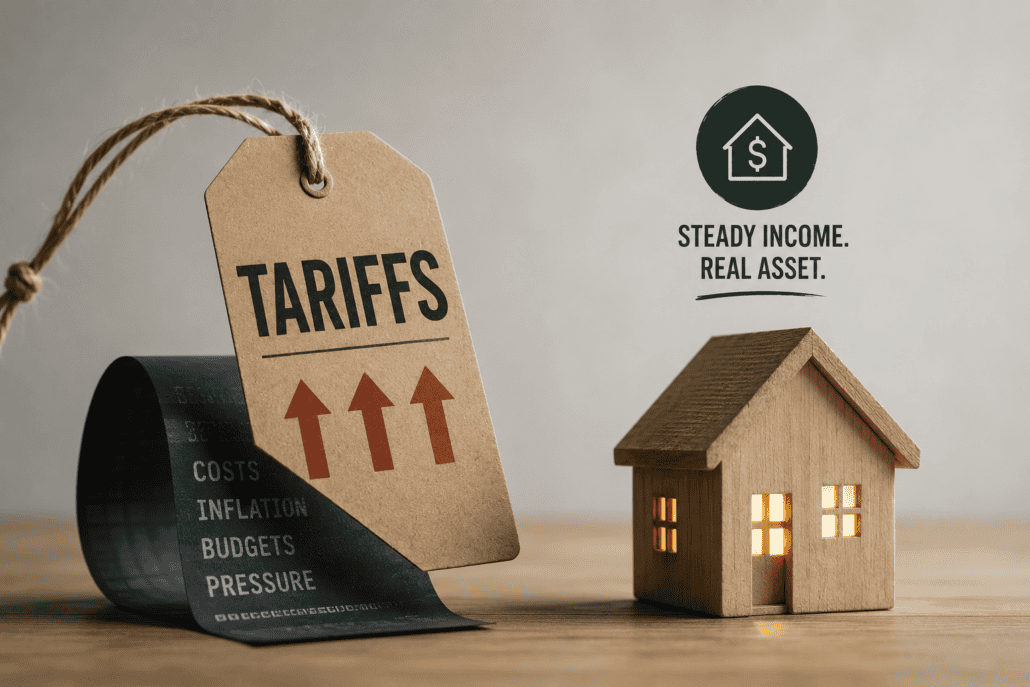
Goldman Sachs ran the numbers on Trump’s tariffs. Their finding: US companies and consumers collectively absorbed 82% of the tariff costs in October 2025. By July 2026, Goldman projects that 67% of the burden falls on consumers alone.
That’s not an abstract policy number. That 67% shows up in grocery bills, appliance prices and the monthly squeeze on household budgets that’s been compounding for the better part of three years now.
The Institute for Supply Management adds more texture to the picture. US manufacturing activity contracted for nine consecutive months through early 2026. Unemployment sits at a four-year high. Hiring slowed more sharply in 2025 than any year since the Great Recession, excluding the pandemic.
Most investors read headlines like this and wonder whether to rebalance their stock portfolio. Here’s why I think passive real estate investors are reading the same headlines and seeing something very different.
The conventional fear around tariffs and real estate runs like this: tariffs raise construction costs, higher costs reduce new supply and reduced supply worsens affordability. That chain of logic holds up.
Lumber, steel, aluminum and appliances all face import tariffs at various rates. The National Association of Home Builders put the tariff-driven cost increase per new single-family home at roughly $9,200 in early 2026. That doesn’t stop construction entirely. It slows it and shifts the economics toward higher-end builds where margins can absorb the hit.
The net effect: affordable and workforce housing supply tightens further while demand stays strong. People who can’t afford to buy keep renting. People who might have bought a $280,000 starter home find it now costs $310,000 and pencils differently at current mortgage rates. They rent instead.
That dynamic has been building since 2022. Tariffs accelerate it.
Here’s the number that matters most for passive real estate investors right now.
Median home prices nationally hover near all-time highs around $364,000, according to Zillow data from early 2026. The 30-year fixed rate still sits above 6%. Household income growth hasn’t kept pace with either of those numbers since the pandemic.
The result: a growing cohort of Americans who’ve become persistent renters. They’re not renting because they prefer it. They’re renting because the math on buying doesn’t work for them… and it won’t work in the near term regardless of what happens to interest rates.
That cohort needs somewhere to live. They want space… ideally a single-family home experience, or at minimum a well-maintained apartment in a neighborhood with decent schools and reasonable commutes. They’ll pay market rent for it. What they can’t do is produce a $60,000 down payment and qualify for a mortgage that costs more than their current rent.
Workforce housing in middle America serves exactly that cohort. The Clevelands, the Columbus’s, the mid-sized metros with diverse employment bases and median household incomes between $55,000 and $85,000. Deni and I have invested in several deals fitting that profile through the co-investing club over the past couple of years. The distribution yields have held consistently. The operators running those properties report waiting lists, not vacancy problems.
That’s the environment tariffs are reinforcing… not creating from scratch, but reinforcing and extending.