
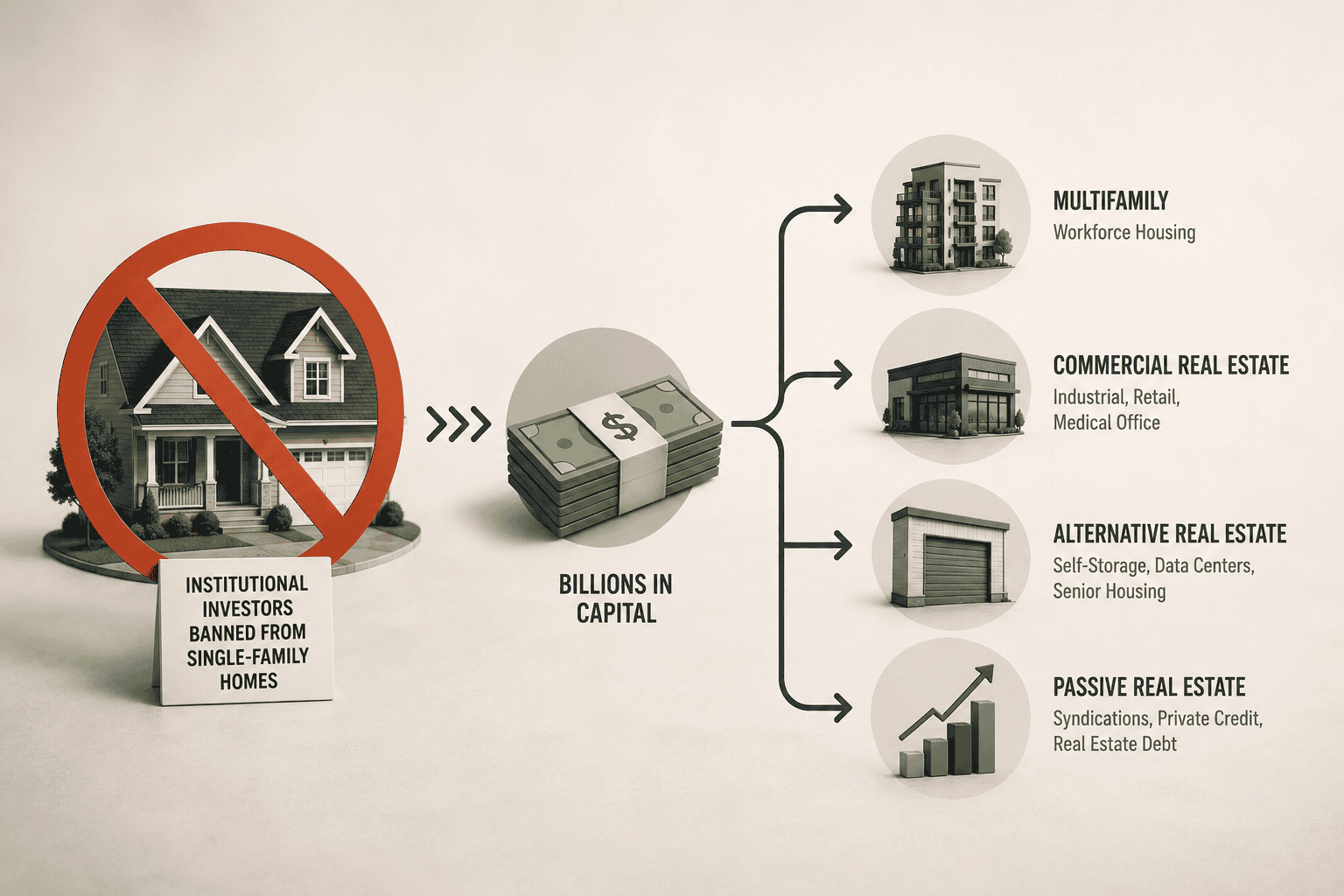
In March 2026, the US Senate passed the 21st Century ROAD to Housing Act 89 to 10. Bipartisan. Near-unanimous. The bill bans large institutional investors from buying single-family homes and forces them to offload what they’ve already accumulated.
Most of the coverage framed this as a win for first-time homebuyers. And sure, to some extent it is.
But there’s a second story buried inside this legislation that almost nobody covered. For passive real estate investors, it’s probably the more important one.
When institutional capital gets pushed out of a market it spent a decade growing inside of… it doesn’t disappear. It finds the next available lane. Understanding where it goes next tells you a lot about where the most interesting opportunities will show up over the next 18 to 36 months.
The legislation targets what it calls “large institutional investors” — entities with direct or indirect investment control over single-family homes at scale. In plain terms, we’re talking about the Invitation Homes and BlackRocks of the world.
Once the bill takes effect, those entities must divest their single-family portfolios. They get up to seven years to do it. Tenants in those properties get the right of first refusal to purchase before the home hits the open market. If no buyer steps forward within 60 days of public advertising, the compliance obligation lifts.
A few categories get carved out. REITs face different treatment under the tax code. Senior housing communities with residents 55 and older fall outside the scope. Properties acquired through foreclosure or loss mitigation sit in a separate lane.
But for the core institutional buy-to-rent playbook that emerged after 2012 — when firms started buying distressed single-family homes at scale and converting them to rentals — the model faces a structural shutdown.
The instinct to celebrate this as a housing affordability fix makes sense on the surface. Institutional investors accumulated hundreds of thousands of single-family homes over the past decade. Removing them as buyers should reduce competition and bring prices down.
The reality runs more complicated than that.
Even at their peak, institutional investors owned roughly 3% of single-family rentals nationally. Concentrated in specific Sun Belt metros — Atlanta, Phoenix, Charlotte, Dallas — their footprint reached 20% or more of local transactions in certain ZIP codes. But as a nationwide force on home prices, the math never fully supported the narrative that they were the primary driver of unaffordability.
What actually drives unaffordability is a structural undersupply of housing that’s been building for 15 years. Zoning restrictions. Construction costs. Labor shortages. NIMBYism at every level of local government. A bill that removes institutional buyers doesn’t add a single new unit of supply. It reshuffles who competes for existing inventory.
That’s a meaningful shift in specific markets. It’s not a structural fix.
Here’s the question that actually matters for investors paying attention.
A firm that built a $15 billion single-family rental portfolio over the past decade doesn’t decide to sit in cash. It has investors expecting returns. It has capital that needs to be deployed. It has infrastructure built around real estate as an asset class.
The most logical landing zones for that displaced capital are already visible in the data.
Multifamily and workforce housing. Institutional investors have been building exposure here alongside their single-family push for years. The affordability crisis that created the single-family rental boom also created persistent demand for rental apartments — especially workforce housing in middle America where median incomes can actually support the rent. That demand doesn’t go away when the bill passes. It intensifies. Deni and I have invested in several workforce housing deals through the co-investing club over the past 2 years — Cleveland multifamily properties that have been paying consistent 8% distribution yields and haven’t had a vacancy problem.
Commercial real estate adjacent to residential demand. Data centers, industrial properties near population centers, build-to-rent communities structured as multifamily rather than single-family. These sit outside the bill’s scope and offer the institutional-scale deal sizes that large funds require.
Passive syndication structures. The bill specifically carves out passive investors who own less than 25% of an entity that holds a single-family home. It targets control, not passive participation. That distinction matters for LP positions in syndications and investment club structures like ours.
The bill doesn’t remove institutional appetite for real estate. It redirects it. The question for smaller accredited investors is whether they can position themselves in the same lanes before the large capital wave arrives and compresses returns.