September 2025

Amazon CEO Andy Jassy Is Fighting Against Bureaucracy

Amazon CEO Andy Jassy Is Fighting Against Bureaucracy


Andy Jassy is trying to reset Amazon’s culture by getting rid of excess layers of middle management.

The Amazon CEO stated on Tuesday at the company’s annual conference for third-party sellers that he wanted to eliminate bureaucracy to help Amazon grow and innovate more quickly. Bureaucracy is not compatible with “startups” and “entrepreneurial organizations,” but it is “really easy to accumulate,” according to Jassy.

“I would say bureaucracy is really anathema to startups and to entrepreneurial organizations,” Jassy said at the event. “As you get larger, it’s really easy to accumulate bureaucracy, a lot of bureaucracy that you may not see.”

Related: Amazon Tells Thousands of Employees to Relocate or Resign

Jassy wrote in his latest annual shareholder letter in April that Amazon must “strive to operate like the world’s largest startup” by solving real customer problems, working quickly, reducing bureaucracy and being willing to take risks.

Jassy’s latest remarks on Tuesday follow Amazon’s attempts across the past year to flatten its organization and eliminate excess layers.

In September 2024, Jassy asked each team within the company to reduce the number of managers by at least 15%. A leaked guidelines document in January showed that Amazon accomplished this without layoffs by asking managers to increase their number of direct reports, pause hiring new managers, and demote some employees down a level to non-managerial positions.

Managers are now required to have at least eight team members as direct reports, an increase from the six that Amazon founder Jeff Bezos mandated in 2017, according to the document.

Jassy also introduced a “Bureaucracy Mailbox” last year to allow employees to email him examples of unwanted processes or rules that could be changed to help the company run more efficiently. Within a year, the mailbox received 1,500 emails, resulting in changes to 455 processes, Jassy said at Tuesday’s event.

Amazon CEO Andy Jassy on July 8, 2025. Photographer: David Paul Morris/Bloomberg via Getty Images

At a November all-hands meeting, Jassy reiterated that he wanted to make changes to middle management to keep the company competitive.

“The reality is that the [senior leadership team] and I hate bureaucracy,” Jassy said at the meeting. “One of the reasons I’m still at this company is because it’s not a political or bureaucratic place.”

Related: Here’s Why Companies Shouldn’t Replace Entry-Level Workers With AI, According to the CEO of Amazon Web Services

Jassy took over as Amazon CEO in 2021, following Bezos. Under his leadership, Amazon laid off 27,000 corporate employees and mandated that employees return to the office five days a week.

Despite complaints from employees and an initial shortage of desks, the return-to-office mandate took effect on Jan. 2.

Amazon states on its sustainability page that it employs 1.5 million people worldwide at the time of writing, making it the second-largest employer in the world.

Andy Jassy is trying to reset Amazon’s culture by getting rid of excess layers of middle management.

The Amazon CEO stated on Tuesday at the company’s annual conference for third-party sellers that he wanted to eliminate bureaucracy to help Amazon grow and innovate more quickly. Bureaucracy is not compatible with “startups” and “entrepreneurial organizations,” but it is “really easy to accumulate,” according to Jassy.

“I would say bureaucracy is really anathema to startups and to entrepreneurial organizations,” Jassy said at the event. “As you get larger, it’s really easy to accumulate bureaucracy, a lot of bureaucracy that you may not see.”

The rest of this article is locked.

Join Entrepreneur+ today for access.


Source link

Amazon CEO Andy Jassy Is Fighting Against Bureaucracy Read More »

Airbnb CEO Brian Chesky Is ‘Unhappy’ With Airbnb’s Growth

Airbnb CEO Brian Chesky Is ‘Unhappy’ With Airbnb’s Growth


Airbnb’s growth has slowed in recent years, says the company’s CEO, Brian Chesky, but he has a plan to remedy the situation.

In an interview on Tuesday at the Skift Global Forum conference, an event for the travel industry, Chesky noted that Airbnb experienced 40% growth in 2022, but that number declined to 18% in 2023 and then 12% in 2024. For the second quarter ending June 30, revenue growth was at 13%.

“I’m not happy about where the growth rate is at the company,” Chesky said at the event. “I think Airbnb should be growing significantly faster. It should at least be growing in the teens, and I aspire to run the kind of company that’d be growing at more than 20% one day.”

Related: Airbnb’s CEO Says He Personally Manages 40 to 50 Employees as Direct Reports: ‘A Lot of Work’

The problem, Chesky explained, was that the company lacked the foundation for sustainable growth and needed to “rebuild” itself entirely earlier this year to open the doors to new businesses.

“That’s what we’ve been doing,” Chesky said. “The final stage is now we reinvent ourselves.”

In May, Airbnb redesigned its app to include a new feature that allows guests to book services (such as massages, photography services, spa treatments, personal training, private chefs, and beauty treatments) and experiences (such as watching a comedy show or going on a boat sightseeing tour with local hosts). Chesky said the company hopes to grow its core business, vacation rentals, while “layering on” these services and experiences.

Chesky said on Tuesday that he believes Airbnb‘s new offerings will be “multi-billion-dollar businesses” at some point, per Business Insider.

Airbnb CEO Brian Chesky. Photo by Myunggu Han/Getty Images for Airbnb

He also stated in the interview that he believes Airbnb’s growth will accelerate next year, despite Airbnb’s history of “decelerating” growth, and reminisced about the company’s “hypergrowth,” when it was first founded in 2008.

“We grew the company like a rocket ship,” Chesky stated at the event.

Related: Airbnb Will Be the Place to Find Work After AI Takes Your Job, Says Its CEO: ‘Nobody Wants a Robot Answering the Door’

Airbnb is also leaning into AI. In August, Chesky stated on an earnings call that Airbnb would become an “AI-first application” over the next few years. The company began using AI for customer service in April, which reduced human customer service interactions by 15%. AI now handles tasks at the company like canceling reservations and helping with travel plans. Airbnb plans to expand the agent this year and give it more advanced capabilities, like the ability to search through a reservation to find specific details.

Airbnb had a market cap of over $76 billion at the time of writing. The company has over 5 million hosts.

Airbnb’s growth has slowed in recent years, says the company’s CEO, Brian Chesky, but he has a plan to remedy the situation.

In an interview on Tuesday at the Skift Global Forum conference, an event for the travel industry, Chesky noted that Airbnb experienced 40% growth in 2022, but that number declined to 18% in 2023 and then 12% in 2024. For the second quarter ending June 30, revenue growth was at 13%.

“I’m not happy about where the growth rate is at the company,” Chesky said at the event. “I think Airbnb should be growing significantly faster. It should at least be growing in the teens, and I aspire to run the kind of company that’d be growing at more than 20% one day.”

The rest of this article is locked.

Join Entrepreneur+ today for access.


Source link

Airbnb CEO Brian Chesky Is ‘Unhappy’ With Airbnb’s Growth Read More »

Zoom CEO: Best Tips for Running a Video Meeting

Zoom CEO: Best Tips for Running a Video Meeting


Zoom CEO Eric Yuan founded the video communications company in 2011 when he was 41 years old and took it public in 2019. As of September 2025, Zoom had a market cap of $25.66 billion.

But despite 15 years of daily practice, he still thinks video calls can be better, because the best meetings are when people “can be themselves,” he told The New York Times.

Here’s Yuan’s advice for making your Zoom calls more productive.

Be accessible

Yuan says that he has a Zoom meeting link in his email signature so that people can set up calls with him.

Related: 13 Leadership Lessons from Zoom Founder and CEO Eric Yuan

Preparation is key

Who you invite is as important as why you’re calling the meeting, Yuan said.

“Number one, you need to prepare: who to invite, who not to invite, and a very clear agenda,” Yuan said, per The Times.

Think about the vibes

Yuan said the second most important thing for a productive meeting is to make sure everyone can be themselves.

“Don’t be too nice, too polite,” Yuan said.In a Zoom call, people tend to be so nice. It’s becoming too formal. It’s OK to interrupt a little bit. And after the meeting, you need to have some follow-up.”

How to exit a call

Don’t be afraid to use the chat.

“Sometimes I just send a channel message: ‘Sorry, I got to do something.’ I use the chat a lot before I leave,” Yuan said.

Related: Zoom CEO Eric Yuan Cuts His Own Pay By 98% Amid Layoffs

Zoom CEO Eric Yuan founded the video communications company in 2011 when he was 41 years old and took it public in 2019. As of September 2025, Zoom had a market cap of $25.66 billion.

But despite 15 years of daily practice, he still thinks video calls can be better, because the best meetings are when people “can be themselves,” he told The New York Times.

Here’s Yuan’s advice for making your Zoom calls more productive.

The rest of this article is locked.

Join Entrepreneur+ today for access.


Source link

Zoom CEO: Best Tips for Running a Video Meeting Read More »

One Platform, Every AI Tool You Need for Life

One Platform, Every AI Tool You Need for Life


Disclosure: Our goal is to feature products and services that we think you’ll find interesting and useful. If you purchase them, Entrepreneur may get a small share of the revenue from the sale from our commerce partners.

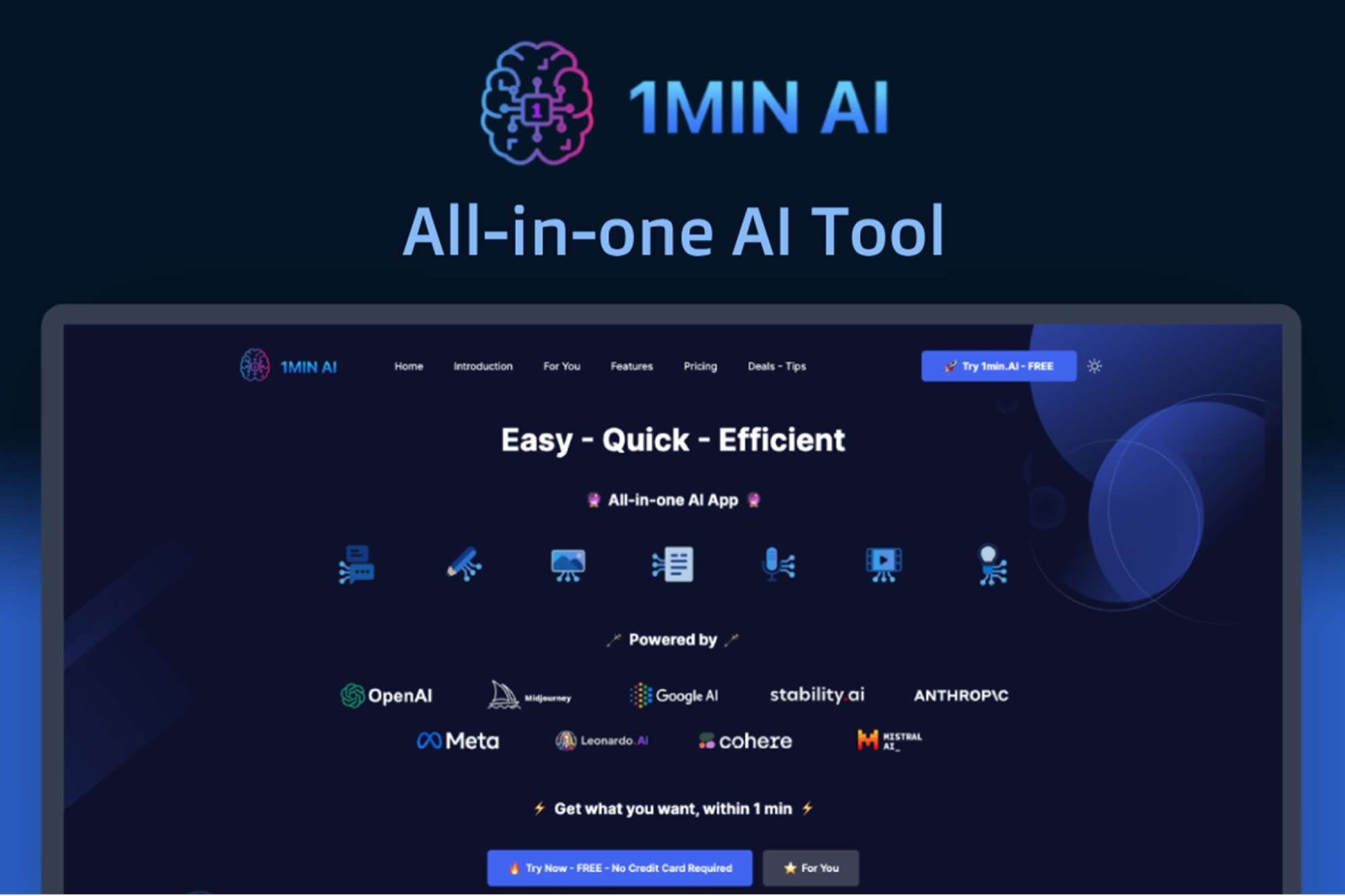
Running a business already means juggling enough plates—finances, clients, staff, strategy. The last thing you need is a half-dozen AI subscriptions, each doing one piece of the puzzle. That’s why 1min.AI was created.

This all-in-one AI platform gives you lifetime access to a wide range of AI tools—powered by models like GPT-4, Claude 3, Gemini, Llama, Cohere, and more—for a one-time payment of $99.99 (MSRP: $540). Instead of hopping between apps, you get streamlined support in a single dashboard built for business leaders.

What can it do? Pretty much everything you’d expect from a modern AI toolkit:

  • Content and marketing: Generate blog posts, rewrite copy, expand text, create social captions, and even tailor your brand voice.
  • Images and design: Produce visuals, remove or swap backgrounds, upscale graphics, or clean up product shots.
  • Docs and PDFs: Summarize reports, translate contracts, or extract key insights.
  • Audio and video: Convert speech to text, add subtitles, translate audio, or edit clips with ease.

Weekly updates ensure you’re always on the cutting edge—without paying recurring fees. Whether you’re a startup founder trying to scale lean or an established exec looking to cut costs, 1min.AI acts like an extra set of hands (or many of them) that never gets tired.

Smart businesses run on smart tools. With lifetime access to 1min.AI, you can finally stop chasing tools and start focusing on growth.

Get lifetime access to the 1min.AI Advanced Business Plan for a one-time payment of $99.99 (MSRP: $540) for a limited time.

1min.AI Advanced Business Plan Lifetime Subscription

See Deal

StackSocial prices subject to change.

Running a business already means juggling enough plates—finances, clients, staff, strategy. The last thing you need is a half-dozen AI subscriptions, each doing one piece of the puzzle. That’s why 1min.AI was created.

This all-in-one AI platform gives you lifetime access to a wide range of AI tools—powered by models like GPT-4, Claude 3, Gemini, Llama, Cohere, and more—for a one-time payment of $99.99 (MSRP: $540). Instead of hopping between apps, you get streamlined support in a single dashboard built for business leaders.

What can it do? Pretty much everything you’d expect from a modern AI toolkit:

The rest of this article is locked.

Join Entrepreneur+ today for access.


Source link

One Platform, Every AI Tool You Need for Life Read More »

Here Are the Top 50 Mistakes I’ve Seen Kill New Companies

Here Are the Top 50 Mistakes I’ve Seen Kill New Companies


I’ve seen many startups succeed, and many fail. I’ve consulted for and invested in lots of them. My previous startup, Anchor, navigated its own challenges and missteps; we were fortunate to survive them, and ultimately Spotify acquired the company in 2019.

Over the years, I’ve come to think of startups as a game of Minesweeper. Remember that game from early PCs? You’d start with a grid of clickable squares, with cartoon mines hidden throughout. Your job was to take a few guesses, gain some information about where the mines were, and logic your way through finding them all. Similarly, startup founders start with an empty board. And although nobody can know their locations, the mines are guaranteed to be there — and certain types of mines are common to every kind of business. A founder can save a lot of time, money, and energy if they know how to avoid these pitfalls from the very start.

After many years of navigating mines, I’ve identified the 50 most common ones. (I share lessons like this regularly in my newsletter — which you can find at my website, zaxis.page.) To be clear, this list is far from exhaustive. And while there are certainly exceptions, it can be a great shortcut for anyone leading a new initiative, at any sized company.

Related: The Path to Success Is Filled With Mistakes. Do These Four Things to Tap Into Their Growth Potential.

Ready to find your mines? Here they are.

1. Thinking you have all the answers

My favorite piece of advice for startup founders: You’ll be 90% wrong about your assumptions. The problem is that you don’t know which 90%. Therefore, do everything you can to challenge your convictions, and be willing to shed them or tweak them as needed. Rapid iteration and an open mind are two necessary ingredients for a successful startup journey.

2. Ignoring the impact of compounding

Meaningful long-term change takes time, be it learning new skills, obtaining new customers, or establishing a brand. The most underrated way to drive improvement is through incremental steps that compound over time. Einstein apocryphally called compound interest the “eighth wonder of the world.” Tiny changes each day multiply to astronomical gains, so long as you’re consistent and committed.

3. Disregarding the law of funnels

Any action a user or customer needs to take is considered the top of a “conversion funnel.” The goal is to get them to the bottom. One of the easiest ways to lose someone along that journey (a phenomenon known as churn) is to require them to go through too many steps. I call this the “Law of Funnels.” It states: “The more steps a user has to go through to do something, the less likely they are to complete it.”

4. Hiring based on experience

Startups have very little time and resources to focus on the wrong thing, but it’s impossible to predict what they will need to focus on. So don’t waste energy and precious hires on what a person has done in the past. It’s 97% irrelevant to what they will be doing in the future. Instead of hiring for relevant experience, hire people who are adaptable and good problem-solvers.

5. Focusing on scaling too early (see fig. 1)

Many startups overengineer and future-proof in the early days, which is almost certain to result in a tremendous waste of energy. At the start of the journey, there are very few knowns (see mistake No. 1). But one thing that is known is that there is a fundamental difference between the friction that prevents a product from taking off and the friction that prevents it from scaling.

Related: Failed Startups Made These 7 Marketing Mistakes — Are You Making Them, Too?

6. Wearing too many hats

In my favorite brainteaser of all time, 100 prisoners wear different colored hats and strategize ways to identify their own hat colors. A startup often has far fewer than 100 employees, but often has far more than 100 hats. Context-switching carries a real cost, and early-stage employees who fail to delegate responsibility often end up performing all tasks poorly. Find people you can trust to take some of those hats off your head, and bring them in early.

7. Comparing your work-in-progress to others’ finished works

One of the easiest ways to get discouraged while running the startup marathon is to compare your rough drafts and works-in-progress to polished success stories. All difficult tasks (be they entrepreneurial, creative, educational, etc.) require iteration and more iteration, revision and more revision. The mistakes along the way are countless, sure, but they are also priceless. Comparing a work-in-progress to the finished products we see every day is not only demotivating — it’s also disingenuous. It’s comparing a sapling to a fully grown tree.

8. Trying to solve unbounded problems

To be solved effectively and efficiently, problems must be segmented and bounded. First, split your intractable problems into small, digestible challenges with a single goal in mind for each. Second, ensure that their solution is bounded to a finite solution space. Not realizing this is almost always a recipe for wasted resources and disappointing outcomes.

9. Being frightened of incumbents

Founders are often scared to take on powerful incumbents, believing those paths to be dead ends. This is a mistake. Taking on a monopoly is often a missed opportunity with enormous upside, and with lower costs than you think. There are four main reasons: Monopolies have already proven the industry is viable and lucrative. They refuse to cannibalize their own dominance. They’ve institutionalized their inefficiencies. And perhaps most importantly, they have the most to lose from making mistakes. Startups, by contrast, have the most to gain.

10. Fearing the pivot

For most startups, there are only two viable outcomes. In the unlikely case, they will be a big success. In the more likely scenario, they will fail. Don’t stick to early product or strategy decisions that raise the likelihood of the latter. If your startup fails, the value of all your decisions will be zero — so do everything you can to maximize the likelihood of success. If that requires pivoting from what you know and are comfortable with, so be it.

Related: I Have Helped Founders Raise Millions. Here Are 7 Fundraising Mistakes I See Many Startups Making — And What You Need To Do Instead.

11. Thinking you need to be first

Passionate and creative thinkers often believe that in order to succeed, they need to be the first mover. This is wrong. Being the first mover is often a tremendous disadvantage. What matters is not being first but having consumers think you were first, all while benefitting from the courses charted by your forerunners.

12. Catering too much to existing users (see fig. 2)

Your existing users or customers are critically important; you wouldn’t have a business without them. But focusing too much on their needs necessarily comes at the expense of the audience you haven’t yet reached, and for whom you’re still struggling to showcase value. Catering to those who have reached the bottom of your funnel prevents you from serving the needs of those higher in the funnel, whose needs have not yet been served. This is the push and pull of product development, and there is a flip side to it. That’s the next mistake…

13. Catering too much to potential users (see fig. 2)

The danger outlined in mistake No. 12 swings the other way too. Neglecting to serve the needs of your existing users runs the risk of causing unnecessary churn. The cost of retaining customers you have already converted is substantially lower than the cost of obtaining new ones. Don’t be overly protective of the users you have, but don’t be overly dismissive either.

14. Not understanding employee motivation

Your employees are motivated by different things, and failing to recognize their different styles often leads to poor management as well as to employee dissatisfaction. I categorized people into a “Climber, Hiker, Runner” framework: Climbers are driven by the prospect of unlocking future opportunities. Hikers prefer to take on new challenges and learn new things. And Runners are happy when they can dive deep into what they’re good at. Approaching motivation this way has made me a better manager, and has helped me identify effective ways to keep employees happy.

15. Focusing too much on short-term gains

Successfully growing a startup is a marathon (see mistake No. 2). Short-term wins offer little beyond dopamine hits and the stroking of egos. In long-term success stories, accomplishing tough goals takes time but yields meaningful and lasting benefits. While it takes many short-term wins to get to the finish line, don’t miss the forest for the trees. Those incremental achievements are not the true goal. They are the means to an end.

Related: 7 Common Mistakes to Avoid When Scaling Your Business

16. Putting off hard conversations

Your life is divided into two parts: that which occurs before you have the awkward, unpleasant, or emotionally taxing conversation you’re putting off, and that which occurs after. Which would you rather extend? If it’s the latter, why not do everything in your power to cross the boundary right now?

17. Failing to recognize power laws

Power laws govern everything you do. Most of the work you put into your startup will yield little clear benefit. Most of the success you see will come from a handful of bets. Internalizing this phenomenon leads to better decision making, less emotional turbulence, and healthier, more sustainable businesses.

18. Overprotecting your idea

Have a brilliant idea and an NDA preventing anyone from peeking at it? You’re likely not doing yourself any favors. Truly successful companies win with superior execution, not superior ideas (see mistake No. 11). And by overprotecting your idea from being prodded and challenged, you’re weakening its probability of ever coming to fruition. Often, those individuals who frighten you as potential competitors are those whose feedback is most valuable. And if you fear them stealing the idea, be comforted in knowing that there is no shortage of great ideas in the world. There is, however, a dire shortage of people who know what to do with them.

19. Keeping interactions inside the office

Whether in person or remote, the value of having your team “break the ice” cannot be overstated. I mean that in two ways. First, it’s of course good for your colleagues to get to know one another (and hopefully like one another), which leads to happier employees and higher productivity. Second, when people let loose, it “breaks the ice” of the day-to-day mayhem of startup life — or what I like to call “a necessary thawing period.”

20. Getting too comfortable (see fig. 3)

There is a big difference between being at a local minimum and being at a global one. Yet from a day-to-day vantage point, they look the same. Any change in any direction means more work, more stress, and more risk. We must zoom out and look at the entirety of our options. Sometimes the best paths or strategies lie just beyond a hill we’re scared to climb.

Related: I Made These 3 Big Mistakes When Starting a Business — Here’s What I Learned From Them

21. Not putting things in perspective

When lost in the hustle and bustle of the early stages of a company, it’s important to remember that most stressful things don’t actually matter in the long term. They will do little to affect the eventual outcome, but they will heavily drain you in the near term. Please take regular moments to stop yourself, look at your small stressors, and ask if this really matters in life. It probably doesn’t.

22. Not quantifying goals

Goals without metrics are unbounded (see mistake No. 8). This makes them harder to achieve — and how will you know when you do achieve them? How will you hold yourself accountable when you’ve veered too far off course? Particularly when working as part of a team, quantifiable and measurable goals are of paramount importance to achieve any level of alignment.

23. Waiting to find a technical cofounder

Nearly everything I’ve needed to learn to become a technical cofounder, I taught myself (with the guidance of great mentors). You live in an age of wonders, where anyone can learn anything with incredible efficiency. Do not allow the search for a technical cofounder to prevent you from pursuing your dream. Become the technical cofounder yourself.

For instance: Are you interested in AI but think you’ll never understand how it works? Think again.

24. Looking for complicated answers when there may be simple ones

Often, problems that seem intractable have elegant and simple solutions. We are trained to look for complexity, and to value those perspectives that overcomplicate the world. Ignore that instinct! The greatest insights I had as a founder came from light-bulb moments when I realized things were simpler than I’d assumed, not more complicated.

25. Assuming there is only one path to success (see fig. 4)

While other people’s success stories can motivate and inspire you, they can also be dangerous. Everyone’s path is unique, and often meandering. Anyone who says that your journey to success must follow a single trajectory has never built a company of their own; they’ve merely studied other people’s.

Related: Business Owners: Are You Making These 10 Mistakes?

26. Not filtering out high-frequency noise

Most day-to-day problems are just noise. Sometimes it’s angry employees or customers. Sometimes it’s a deal gone bad or failing servers. Successful leaders adopt what I call a low-pass mentality. Just as low-pass filters in engineering absorb short-term shocks by filtering out the high-frequency ups and downs, a startup founder must filter out the noise and focus on solving long-term, systemic issues that will have a high impact.

27. Putting your eggs in one basket

As shown in mistake No. 1, you’ll be wrong about pretty much all your assumptions. So why risk your business on a single bet? Of course, it’s important to have convictions — but that doesn’t preclude you from simultaneously having other convictions, particularly at the very early stages. If the primary goal of a startup is to reach product-market fit quickly (see mistake No. 5), the risk of being wrong about your one big bet would be extremely costly.

28. Putting your eggs in too many baskets

Just as it is dangerous to wear too many hats (see mistake No. 6), it is similarly dangerous to tackle too many strategies at once. Successful leaders prioritize ruthlessly; that means tackling “critical” tasks before ones that are only “very important.” It means committing to seeing through strategies before expending energy on other ones. And it means rallying the whole team around a single milestone or goal, rather than splitting their attention and making everyone worse off because of it.

29. Underinvesting in long-term relationships

Most of the key turning points in my business career came through the strength of relationships fostered over many years. Small decisions to help others, to build trust, and to keep in touch can have a tremendous impact on your future in unpredictable ways. The worst-case scenario? Some wasted social energy. The best-case scenario? You open doors you never knew were there.

30. Failing to recognize recurring patterns

Despite all the unpredictable noise in business, there is an often-overlooked consistency between market cycles and the players within them. While it’s dangerous to place too much emphasis on individual success stories (see mistake No. 25), it is even more dangerous to overlook the cyclical nature of market dynamics. Human psychology is notoriously predictable — and notoriously forgetful.

Related: How to Turn Your Mistakes Into Opportunities

31. Not talking to other founders

As a founder myself, I overlooked the learned experience of other founders. There is so much guidance buried in their success stories. There is even more to take away from their failures. As I said at the top of this article, startups are like a game of Minesweeper. You can tackle a blank board and start clicking away, or you can put aside your ego and get help from those who have played that board before. If you choose the latter, the likelihood of success can skyrocket.

32. Focusing on vanity metrics

There is a reason they are called vanity metrics. Hitting them is the kind of short-term gain I advised you to disregard in mistake No. 15. Why achieve goals that look good but aren’t strategically important? Why care about the number of users if those users are a poor fit and don’t stick around? Why focus on time spent using your product if that number is only high because your product is hard to use (see mistake No. 3)? Identify your desired outcomes, and then find the metrics that actually map to those outcomes.

33. Misunderstanding the CAP principle

In computer science, there is a fundamental limitation on how database systems can be built. One can never achieve more than two of the following three goals: consistency, availability, and partition tolerance (or “CAP”). The same is true of companies, which will inevitably see a decline in one of these as they invest in the other two. For instance, when ensuring all teams can talk to each other (availability) and that there is always an individual who can be the “source of truth” for others (consistency), your ability to manage when an employee leaves or communication channels go offline (partition tolerance) drops considerably.

34. Never setting arbitrary deadlines

Arbitrary deadlines are a tool. Like most tools, they can be good or bad, depending on who’s using them and for what. Yet while there are many times a team needs the space to think, build, and iterate without undue pressure, there are just as many instances that benefit from the structure and direction provided by arbitrary deadlines. Importantly, arbitrary deadlines should be recognized as arbitrary, and they should be adjusted if needed. But that doesn’t diminish their power in aligning a team and incentivizing productivity. In the right circumstances, I’ve seen them work wonders.

35. Ignoring uncertainty principles

Early-stage entrepreneurship, as in quantum physics, presents an inescapable tradeoff. Resources (time, money, etc.) can be spent on investing in a specific strategy or on keeping open optionality; they cannot do both. I call this phenomenon the Startup Uncertainty Principle. It shows that the more you focus on the present, the less you’re able to prep for the future. And the more you prep for the future, the less effective you’ll be now. Companies that attempt to do both at once are fighting a losing battle.

Related: Common Mistakes First-Time Entrepreneurs Make and How to Stop Them

36. Not prioritizing low-hanging fruit

As shown in mistake No. 28, successful companies prioritize ruthlessly. When companies spread themselves and their employees too thin, they hurt productivity and morale. Of course, there is value in investing in longer-term projects with higher costs and higher rewards. Yet it is also critical to regularly prioritize easy wins and short-term opportunities that move the needle incrementally. In addition to laying the foundation for compounding improvements (see mistake No. 2), it will also reengage your teammates and keep morale high.

37. Overlooking unexplored markets

As founders and dollars race to build in competitive, high-growth markets, opportunities often exist in “hidden layers” of industry. Companies that focus there can ride waves of market growth while avoiding fierce competition, by turning potential competitors into actual customers. Some of the most valuable companies in the world have taken this approach (including the two most valuable) and it has paid dividends (literally).

38. Not relying on proven technology

New technological solutions to longstanding problems can be attractive. But the hidden downsides can surface much too late — often when you’re already dependent. New technologies can break, can go out of business, can have unexpected side effects. By contrast, longstanding problems tend to have proven longstanding solutions. While not as exciting to use, they work, and that’s what matters most.

39. Sugarcoating bad news

Managers sometimes believe that when things get hard — and they inevitably will, many times over — bad news is better delivered indirectly or with a positive spin. This is an innate human desire. But employees are smart. Being disingenuous about the state of the business or the rationale for business decisions will hurt your company over the long term. This applies to everything from layoffs to pivots to cutting perks. Your employees will see through the euphemisms, rendering your sugarcoating fruitless, and they will respect you less for your lack of directness.

40. Ignoring entropy

It’s a law of the universe that everything trends toward disorder. Knowledge and control are no different. No matter what, eventually you’ll be wrong. Your convictions will need to adapt as the world in which they exist evolves. The stable parts of your business will suffer from unexpected market dynamics, new competition, and shifting consumer attitudes. Those who succeed in the long term embrace entropy as a fact of life, and they know that they cannot hold anything too sacred for too long.

Related: 10 Mistakes I Made While Selling My First Startup (and How You Can Avoid Them)

41. Forgetting your only advantage

With limited time and limited resources, only so much can get done. A startup has every disadvantage relative to more well-funded incumbents, and only one advantage: speed. Leverage this. Big players are slow to move and slow to turn, like giant cruise ships. Startups are small and nimble sailboats that can race faster and turn on a dime when it matters.

42. Treating money like it isn’t fungible

A dollar is a dollar is a dollar. Every single dollar spent—no matter how it’s accounted for — is money not spent on something else. This is all the more reason to prioritize ruthlessly (see mistake No. 28). Resources have a habit of disappearing faster than you’d expect.

43. Not explicitly deciding how to balance productivity and alignment (see fig. 5)

Companies that overinvest in aligning their team members do so at the expense of productivity. Those that focus on productivity do so at the expense of alignment. The optimal balance depends on the company, its size, and its unique journey. But the important takeaway is that you are making this trade-off whether you explicitly choose the balance or not — so you might as well choose it.

44. Only talking to people you know

The “birthday paradox” shows that if you put 23 people in a room together, there is a 50% chance two will share the same birthday. By the same mathematical logic, if any conversation has even a 0.3% chance of being life-changing, then putting a few dozen people in a room together is virtually guaranteed to lead to some life-changing conversations. The takeaway? Meet more people. (Here’s a good way to do that.)

45. Working only from home

Startup stress can seep across any boundaries you’ve set. To drive both productivity and better mental health, don’t work exclusively from where you sleep and spend time with family. I say “exclusively” because I have seen startups achieve great success in a fully remote setup. Still, the early days of startups rely critically on serendipitous conversations and ideations — and that can only happen when employees are colocated. Get the team together now and then.

Related: 5 Marketing Mistakes Startups Must Avoid in Order to Survive

46. Working only from an office

Most founders I know get their best ideas when they’re not at work. There’s something about the change of scenery, the connections between unrelated neurons, and the exposure of a problem or challenge to a new environment. Whereas mistake No. 45 showcases why it’s important to sometimes bring your team together, this one recognizes that it’s equally important to take them out of their comfort zones and get them to interact in brand-new places and brand-new ways.

47. Forgetting to revisit whatever motivates you

When things get difficult (and they will), it’s important to reflect on the things that helped motivate you to start in the first place. Have it readily accessible—be it a movie or a podcast episode or a book or a soundtrack — and revisit it when you feel the morale drop. For me in my Anchor days, it was Daft Punk’s Random Access Memories. To this day, if I need a jump-start in motivational energy, I just put on that album and get to work.

48. Not taking pictures

You’re going to miss the early days. You’ll wish they were better documented. If things end up working out, you’ll look at those moments in time and say, “Wow, look how far we’ve come.” And if things don’t, you’ll say, “Wow, look how hard we worked. If I did that, I can handle anything.”

49. Assuming you have product-market fit

Product-market fit is the elusive transition point at which you realize who your customers are and what value you’re providing for them. Hardly anyone reaches this point without considerable effort, and the easiest way for a brand-new enterprise to fail is to assume they have reached this point when they have not. There are only two ways — talking to customers and looking at data — that can verify the milestone has been hit. Once there, things get considerably easier.

50. Thinking there are only 50 startup mistakes

I suppose I’m guilty of this one right now. No list of startup advice is exhaustive. Every new entrepreneurial journey is bound to uncover unique challenges. Yet that’s also part of the fun of the startup journey: You never know what’ll happen next.

A version of this article originally appeared on Nir Zicherman’s newsletter, Z-Axis.


Source link

Here Are the Top 50 Mistakes I’ve Seen Kill New Companies Read More »

How People Are Using ChatGPT: OpenAI Study

How People Are Using ChatGPT: OpenAI Study


Since its launch in November 2022, ChatGPT has changed the way people write emails, manage their social media accounts, and generate code. Now, a new report from ChatGPT-maker OpenAI is giving fresh insight into how people are really using the chatbot.

OpenAI’s researchers published a 64-page study on Monday with the National Bureau of Economic Research (NBER) that found nearly 80% of all conversations with ChatGPT were concerned with three categories: practical guidance, seeking information, and writing help. The study, which was based on more than one-and-a-half million ChatGPT messages sent from May 2024 to July 2025 by 130,000 users, is the largest of its kind to date.

Here’s what it found:

Related: ChatGPT’s New Update Can Create PowerPoint Presentations and Excel Spreadsheets for You

What Are ChatGPT’s Demographics?

ChatGPT’s demographics have changed in the years since its launch.

The percentage of male users has declined from 80% in the first few months after the chatbot’s drop in late 2022 to 48% as of June 2025, which makes the chatbot’s primary user base now primarily female.

Meanwhile, nearly half of all messages sent to the chatbot since launch were sent by users under the age of 26. Gen Z is embracing AI, with a survey conducted by International Workplace Group earlier this year finding that close to two-thirds of Gen Z respondents were teaching their older colleagues how to use AI.

OpenAI also announced on Tuesday that it was creating a different version of ChatGPT for teen users under the age of 18 that prioritized teen safety.

How Are People Using ChatGPT?

The most common use case was “practical guidance,” which is defined in the report as encompassing activities, such as tutoring, teaching, how-to advice, and coming up with creative ideas.

The next most popular category involved “seeking information,” which is labeled as searching for information about people, products, and current events, like conducting a web search.

The final popular use case included writing tasks that automatically generate emails and documents, and editing text. Writing was the most common use case at work, with an average of 40% of work-related messages on ChatGPT stemming from writing queries. Most requests asked ChatGPT to look at text the user had already written instead of creating something new. In other words, two-thirds of writing messages asked ChatGPT to edit, translate, critique, or modify text instead of generating new text.

“Writing dominates work-related tasks, highlighting chatbots’ unique ability to generate digital outputs compared to traditional search engines,” the study read.

Related: ChatGPT’s Creators Are Worried We Could Get Emotionally Attached to the AI Bot, Changing ‘Social Norms’

The study also classified messages another way, using three categories based on the kind of output the user was looking for: Asking, Doing, or Expressing.

“Asking” applies to nearly half of all messages sent to the chatbot (49%), which occurs when a user seeks information about a subject or a solution to a problem. “Doing” refers to tasks where a user wants an output, especially writing activities, and applies to 40% of all messages. “Expressing,” which refers to 11% of all messages, happens when a user communicates their views or feelings without asking for any information or action.

Based on these classifications, users were more likely to use ChatGPT to find answers to questions rather than to carry out tasks or express opinions. ChatGPT users tapping into the chatbot at work were most likely to use it to seek information and find information.

“Overall, we find that information-seeking and decision support are the most common ChatGPT use cases in most jobs,” the study reads.

Related: Is Your ChatGPT Session Going On Too Long? The AI Bot Will Now Alert You to Take Breaks

Despite discussion from tech leaders like Google CEO Sundar Pichai and Nvidia CEO Jensen Huang, it seems like vibe coding is still niche. The study found that comparatively few users were tapping into ChatGPT to code; only 4.2% of messages were related to computer programming, much less than 33% of all work-related conversations with competing chatbot Claude from Anthropic.

Also, only a small percentage of users were using ChatGPT for companionship or guidance on social issues. Less than 2% of ChatGPT messages were about relationships and personal reflection, per the study.

Since its launch in November 2022, ChatGPT has changed the way people write emails, manage their social media accounts, and generate code. Now, a new report from ChatGPT-maker OpenAI is giving fresh insight into how people are really using the chatbot.

OpenAI’s researchers published a 64-page study on Monday with the National Bureau of Economic Research (NBER) that found nearly 80% of all conversations with ChatGPT were concerned with three categories: practical guidance, seeking information, and writing help. The study, which was based on more than one-and-a-half million ChatGPT messages sent from May 2024 to July 2025 by 130,000 users, is the largest of its kind to date.

Here’s what it found:

The rest of this article is locked.

Join Entrepreneur+ today for access.


Source link

How People Are Using ChatGPT: OpenAI Study Read More »

Who Is Buying TikTok? Deadline Extended Again, Friday Deal

Who Is Buying TikTok? Deadline Extended Again, Friday Deal


President Donald Trump extended the deadline for a TikTok deal on Tuesday for another 90 days, until December 16, according to an Executive Order. It is the fourth extension after Congress passed a law last year that requires TikTok to separate from its parent company, Beijing-based ByteDance, or face a permanent ban in the U.S.

Earlier on Tuesday, Trump said he had “a deal on TikTok” in the works. On Monday, Treasury Secretary Scott Bessent announced that the “framework” for a TikTok deal had finally been reached with China. Trump said in a post on Truth Social that he would be meeting with China’s leader, Xi Jinping, on Friday to finalize the deal.

Related: Billionaire Investor Frank McCourt Jr. Wants to Do More Than Buy TikTok — He Wants to Transform the Entire Internet. Here’s How.

“A deal was also reached on a “certain” company that young people in our Country very much wanted to save. They will be very happy! I will be speaking to President Xi on Friday,” Trump wrote Monday.

Now, CNBC’s David Faber is reporting that the deal includes new and existing investors. Oracle, which has been TikTok’s U.S. cloud provider since 2022, will keep its agreement with the company, sources told Faber. CBS reports that the private equity firm, Silver Lake, is also involved.

Other potential investors include the team of Kevin O’Leary, billionaire former Dodgers owner Frank McCourt, and Reddit co-founder Alexis Ohanian for “The People’s Bid.” AI startup Perplexity, Amazon, and Applovin all submitted separate bids as well.

U.S. President Donald Trump speaks to members of the press as he departs the White House en route to the United Kingdom on September 16, 2025, in Washington, D.C. MEHMET ESER/Middle East Images/AFP via Getty Images

Faber said on CNBC’s “Squawk on the Street” on Tuesday: “I’m hearing it’s actually going to be relatively small in terms of the actual size of the checks that are written for the entity itself.”

Reuters reports that the deal keeps TikTok operating with controlled ownership in the U.S., though ByteDance will keep “single largest ownership stake” at 19.9%.

More information about the deal is expected to be released on Friday after Trump meets with Xi Jinping. Although Trump extended the deadline for 90 days, a deal is expected much sooner, within 45 days, according to reports.

“We were very focused on TikTok and making sure that it was a deal that is fair for the Chinese and completely respects U.S. national security concerns, and that’s the deal we reached,” Bessent said from Madrid on Monday. “It’s between two private parties, but the commercial terms have been agreed upon.”

Related: President Donald Trump Suggests Canceling Quarterly Reporting: ‘This Will Save Money’


Source link

Who Is Buying TikTok? Deadline Extended Again, Friday Deal Read More »

Why Setting Global Ethical Standards Builds Trust and Protects Your Business

Why Setting Global Ethical Standards Builds Trust and Protects Your Business


Opinions expressed by Entrepreneur contributors are their own.

Ethics in business has never been only about compliance. Regulations provide a baseline, but in a global marketplace, that baseline quickly becomes uneven. What is acceptable in one country may be unacceptable in another.

A company that treats ethics as a box-ticking exercise soon discovers the gaps between jurisdictions create inconsistency and mistrust. To protect credibility and maintain stakeholder confidence, organizations must set standards that travel across borders and remain steady as rules shift.

In other words, business ethics can’t just mean following rules. Laws differ worldwide, so companies need consistent global standards to build trust and protect credibility across shifting regulations.

Related: The Ethical Considerations of Digital Transformation

The foundation of global standards

A Code of Conduct isn’t just a document — it can be a powerful tool for shaping culture. Writing down principles is one thing, but people need to know how those values play out in real situations. What does fairness mean when you’re explaining a disclosure? How should you handle things when you recognize a vulnerable customer? Without that kind of clarity, values stay abstract and get applied inconsistently.

Once expectations are clear, credibility comes from reinforcement. When leaders recognize good decisions and address lapses, it shows the standards are real, not optional. Over time, those repeated actions turn into habits, and habits are what define culture.

Transparency is one of the clearest ways to bring these ideas to life. For instance, when a company explains payback terms in plain language or shares the reasoning behind a pricing strategy, it shows integrity is built into daily operations. These visible actions convince employees, customers and regulators that the standards are genuine — not just words on paper.

Choosing the highest common denominator

Global operations reveal just how uneven regulations can be. Some markets enforce detailed disclosure rules, while others offer minimal direction. Meeting only the minimum in each region exposes companies to uneven practices that can trigger regulatory penalties and erode trust.

Accepting the need for local normalization, the stronger path is to adopt the most stringent rules encountered and apply them everywhere. Debt recovery firms, for example, may align with aspects of the U.S. Consumer Financial Protection Bureau’s Regulation even in markets without comparable requirements. Being careful not to avoid regulatory conflict or overreach, others extend elements of GDPR-level privacy protections globally or adopt Europe’s “opt-in” consent for call recording as the standard.

This approach requires discipline, which also means committing resources to training, oversight and monitoring systems that may exceed local expectations. But the payoff is substantial. A single consistent playbook builds confidence among employees and demonstrates to both regulators and clients that the organization does not shift its standards depending on geography.

In practice, this prevents situations where one jurisdiction questions behavior that would never be acceptable at the home office headquarters.

Embedding ethics into daily decisions and leadership actions

Values matter only when they guide choices. From induction onward, employees should learn not only their responsibilities but also the reasoning behind them. Training and dialogue help principles take root, but leadership determines whether they endure.

Employees watch how leaders act more closely than they listen to words. Fairness in negotiation, respect in daily interactions and clarity in contracts illustrate values in ways policies cannot. Research by the Ethics & Compliance Initiative found employees are 68% more likely to report misconduct when they see a strong ethical commitment from leadership, and organizations with robust ethics programs are 42% less likely to experience misconduct. These figures confirm that culture follows the example set by others.

Leaders establish credibility and set an example for others to follow when they explain the why and when they go above & beyond to explain their thinking and relate choices to shared principles. Ethics evolves from an ideal to a trustworthy framework that guides choices in stressful situations.

Related: How to Navigate Ethical Considerations In Your Decision-Making

Why global standards are a strategic advantage

Applying one standard worldwide creates benefits on multiple levels. Inside the organization, employees gain clarity, confidence and accountability. They know that decisions will be judged by a consistent set of expectations, not by shifting local rules. That predictability strengthens morale and lowers the risk of missteps.

Externally, the benefits are equally visible. Clients and consumers experience respectful and transparent interactions regardless of geography. Regulators reward businesses that behave responsibly without waiting for coercion. Investors and partners view stability and consistency as markers of reliability, making them more likely to build long-term relationships.

Maintaining higher standards does require investment. Training programs, audit systems and monitoring frameworks take time and resources. Yet these are far less costly than repairing the damage of a single ethical failure. Remember, one lapse can undo years of credibility. In contrast, steady openness builds trust that compounds over time.

Raising the bar for global business

The horizon for business ethics is expanding. Expectations now reach into environmental responsibility, workplace culture, data privacy and supply chain practices alongside regulatory compliance. Meeting this wider standard requires clarity of values, adoption of the highest available denominator, and leadership that demonstrates ethics in action.

While rules and customs differ from place to place, consistency in these choices demonstrates that values are genuine. When organizations carry their values into every interaction, ethics becomes more than an obligation. It becomes a framework that steadies decision-making, supports resilience and builds trust that endures well beyond any single reporting cycle.

Ethics in business has never been only about compliance. Regulations provide a baseline, but in a global marketplace, that baseline quickly becomes uneven. What is acceptable in one country may be unacceptable in another.

A company that treats ethics as a box-ticking exercise soon discovers the gaps between jurisdictions create inconsistency and mistrust. To protect credibility and maintain stakeholder confidence, organizations must set standards that travel across borders and remain steady as rules shift.

In other words, business ethics can’t just mean following rules. Laws differ worldwide, so companies need consistent global standards to build trust and protect credibility across shifting regulations.

The rest of this article is locked.

Join Entrepreneur+ today for access.


Source link

Why Setting Global Ethical Standards Builds Trust and Protects Your Business Read More »

Google Parent Alphabet Reaches T Market Cap

Google Parent Alphabet Reaches $3T Market Cap


Google’s parent company, Alphabet, is now worth $3 trillion, a feat only achieved by three other tech giants: Nvidia, Microsoft, and Apple.

Alphabet shares gained more than 4% in value on Monday, allowing the company to achieve a historic market capitalization of $3.03 trillion at the time of writing. Market capitalization measures the total value of a company by multiplying its share price by the number of outstanding shares.

Alphabet hit the $3 trillion mark just over two decades after Google first went public in 2004, and more than 10 years after its own creation as Google’s parent company.

Related: Amazon Is the Fifth Company in History to Join the Coveted $2 Trillion Tech Club

Alphabet’s market cap has grown tremendously, more than 70%, from a low of $1.8 trillion in April. The recent surge value is partially due to an antitrust ruling earlier this month in the case Department of Justice (DOJ) v. Google, which resulted in lighter penalties than initially suggested by the DOJ. The ruling caused Alphabet shares to rise by over 20% over the past month.

Alphabet CEO Sundar Pichai. Photographer: David Paul Morris/Bloomberg via Getty Images


In the week following the ruling, Alphabet gained $234 billion in market cap. The company’s stock is up more than 30% year-to-date. For context, the Nasdaq as a whole is up 15% for the year, per CNBC.

Related: Google Reportedly Told Its Staff to Use AI More or Risk Falling Behind: ‘It Seems Like a No-Brainer’

Wall Street generally views Alphabet stock favorably. More than 80% of Wall Street analysts recommend buying the stock as of Monday, per Bloomberg.

Alphabet joins other tech giants that have made it into the $3 trillion club — and beyond. Apple achieved the $3 trillion milestone in June 2023, while Nvidia and Microsoft have taken it a step further by passing the $4 trillion mark.

Nvidia achieved a $3 trillion market cap in June 2024 and later surpassed $4 trillion in early July, for a market cap of $4.3 trillion at the time of writing. Microsoft, meanwhile, hit the $3 trillion mark in January 2024 and passed the $4 trillion point in late July, though its market cap has dropped to $3.8 trillion at the time of writing.

Alphabet’s focus in recent years has been on artificial intelligence, as the company strives to compete with Meta, OpenAI, and other key players in the AI race. While announcing its second-quarter earnings in July, Alphabet mentioned that it was increasing its AI expenditures from $75 billion to $85 billion amid growing demand for its cloud and AI services.

“AI is positively impacting every part of the business, driving strong momentum,” Alphabet and Google CEO Sundar Pichai stated in the earnings report.

Related: This Is How Senior Leaders Are Using AI at Work, According to a Google Survey

Google’s parent company, Alphabet, is now worth $3 trillion, a feat only achieved by three other tech giants: Nvidia, Microsoft, and Apple.

Alphabet shares gained more than 4% in value on Monday, allowing the company to achieve a historic market capitalization of $3.03 trillion at the time of writing. Market capitalization measures the total value of a company by multiplying its share price by the number of outstanding shares.

Alphabet hit the $3 trillion mark just over two decades after Google first went public in 2004, and more than 10 years after its own creation as Google’s parent company.

The rest of this article is locked.

Join Entrepreneur+ today for access.


Source link

Google Parent Alphabet Reaches $3T Market Cap Read More »

Businesses Are Using AI to Automate Work, Replace Human Jobs

Businesses Are Using AI to Automate Work, Replace Human Jobs


AI is mainly automating work instead of enhancing it, which is leading the technology to be a catalyst for replacing jobs, according to a new study.

AI startup Anthropic, which was valued at $183 billion earlier this month, released a new report on Monday showing that more than three in four (77%) of the businesses using Claude did so to automate tasks. In comparison, only 12% of businesses used Claude to augment or enhance work.

“The 77% automation rate suggests enterprises use Claude to delegate tasks, rather than as a collaborative tool,” the report stated. “Given clear automation patterns in business deployment, this may also bring disruption in labor markets, potentially displacing those workers whose roles are most likely to face automation.”

Related: These Fields Are Losing the Most Entry-Level Jobs to AI, According to a New Stanford Study

The report found that, so far, businesses are mainly using Claude to write code and perform administrative tasks. Claude can generate code, similar to other tools like Replit and Cursor, that create blocks of code from text prompts. In fact, the tools are powerful enough to potentially take over coding for software engineers. Anthropic CEO Dario Amodei predicted at a Council on Foreign Relations event in March that AI would write every line of code for software engineers within a year.

“In 12 months, we may be in a world where AI is writing essentially all of the code,” Amodei said at the event.

Anthropic CEO Dario Amodei. Photo by Chance Yeh/Getty Images for HubSpot

Additionally, Anthropic emphasized in the report that AI risks causing mass layoffs and worker displacement due to automation. Amodei weighed in on this matter earlier this year, predicting in May that AI could wipe out half of all entry-level, white-collar jobs within the next five years, causing unemployment to reach 10% to 20%. AI could affect entry-level work in fields like law, technology, and finance, Amodei stated.

Related: Amazon CEO Tells Employees AI Will Replace Their Jobs ‘In the Next Few Years’

Anthropic’s Head of Economics, Peter McCrory, told Bloomberg that the researchers were not sure whether the reliance on automation found in the report was due to “new model capabilities” allowing AI to take on more duties, or due to “people being more comfortable” with AI and “more willing to delegate certain tasks to Claude.”

In other words, the researchers were uncertain whether high levels of automation were due to AI’s increased capabilities or more people being willing to use the technology.

Understanding the reason presents “an important area of research for the future,” McCrory told the outlet.

AI is mainly automating work instead of enhancing it, which is leading the technology to be a catalyst for replacing jobs, according to a new study.

AI startup Anthropic, which was valued at $183 billion earlier this month, released a new report on Monday showing that more than three in four (77%) of the businesses using Claude did so to automate tasks. In comparison, only 12% of businesses used Claude to augment or enhance work.

“The 77% automation rate suggests enterprises use Claude to delegate tasks, rather than as a collaborative tool,” the report stated. “Given clear automation patterns in business deployment, this may also bring disruption in labor markets, potentially displacing those workers whose roles are most likely to face automation.”

The rest of this article is locked.

Join Entrepreneur+ today for access.


Source link

Businesses Are Using AI to Automate Work, Replace Human Jobs Read More »