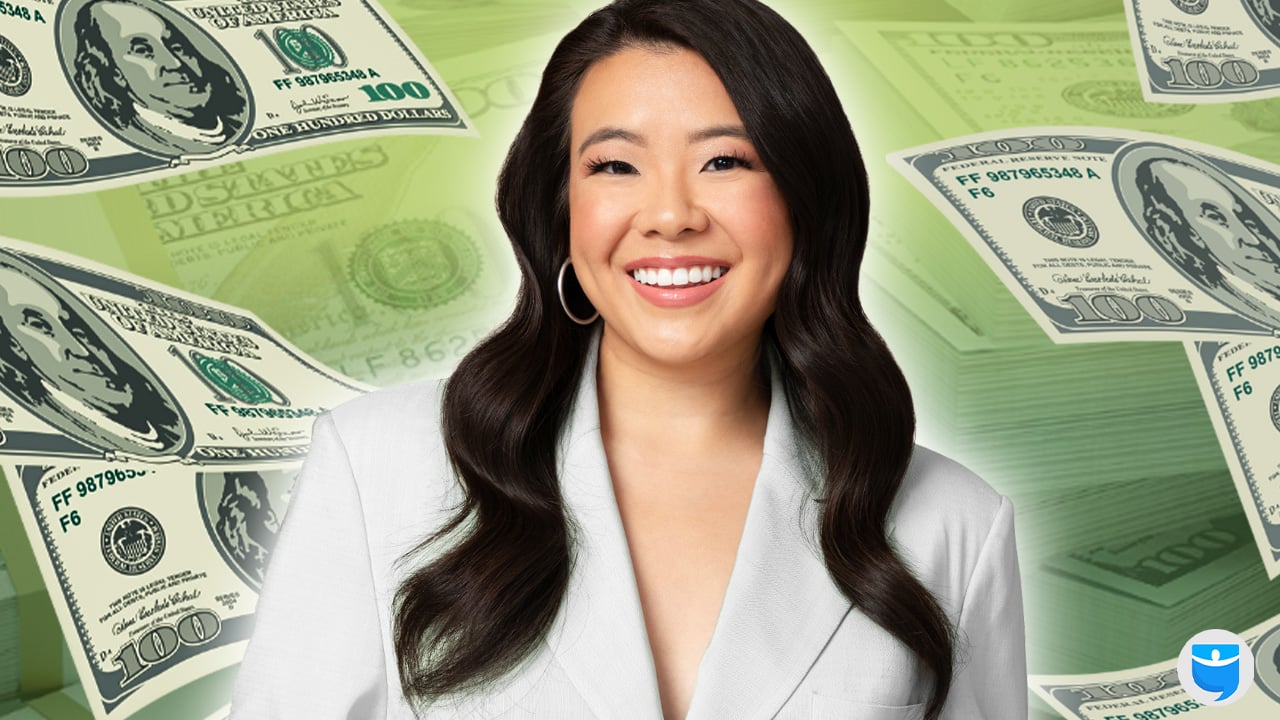
How to Start Thinking, Acting, and Investing Like the Rich
Everyone wants to know how to get rich. And here’s the truth: getting rich might be much easier than you think. While most people would assume the wealthy grind their way to success, this isn’t always the case. In fact, rich people are FAR lazier than you think, and we’re not saying that in a bad way. Rich people make money while they sleep, so they don’t HAVE to work harder every day. Want to know how you can do the same? Vivian Tu, AKA “Your Rich BFF,” will show you how!
Vivian grew up with super-saver immigrant parents who taught her the value of money. When she went off to college, she realized a whole new world of wealth existed—this was only multiplied when she became a Wall Street trader. Vivian saw the fancy suits, the designer bags, and the jewel-studded bracelets and realized that these “rich” people were doing something most people didn’t know about. After her friends and coworkers wouldn’t stop asking her for financial advice, she decided to take her knowledge to the masses.
In her new book, “Rich AF: The Winning Money Mindset That Will Change Your Life,” Vivian details what the rich do that you (probably) don’t. These habits of the wealthy can change your life and upgrade you from the position you’re in now. In today’s episode, we talk about the tools you can use to get rich, why you’re playing real-life Monopoly all wrong, and how rich people think to build wealth even when they’re not working.
Mindy:
Hello, listeners, and welcome to the BiggerPockets Money podcast where we interview Vivian Tu from Networth and Chill and talk about her new book, Rich AF. Hello, hello, hello. My name is Mindy Jensen, and with me today is the Shewolfeofwallstreet, Amanda Wolfe.
Amanda, I’m so glad you could join me today. Thanks for
Amanda:
Having me. I’m excited to be here.
Mindy:
I always love talking to you, Amanda.
Amanda:
Yeah.
Mindy:
Amanda and I are here to make financial independence less scary, less just for somebody else, to introduce you to every money story because we truly believe financial freedom is attainable for everyone, no matter when or where you starting.
Amanda:
Whether you want to retire early and travel the world, go on to make big time investments in assets like real estate or start your own business, we’ll help you reach your financial goals and get money out of the way so you can launch yourself towards your dreams.
Mindy:
Okay, Amanda, I am so excited to talk to Vivian today because she has a great framework for not only becoming rich, but also a great way to think about being rich and growing your wealth and ways to invest so that you can join the rich people club too.
Amanda:
Yeah. And I loved her book so much and I’m so excited to talk to her because I think that she had a really refreshing, unique spin on money mentality stuff and thinking rich. I’m a total self-development money junkie. I read all the books and I really liked the way that she broke things down. She broke things down in a lot of analogies and storytelling, which I find really helpful for me to retain information. So I’m super excited to talk to her today. I thought her book was awesome.
Mindy:
Exactly. Yeah, this is a really engaging book and I’m excited to talk to her. But before we bring in Vivian, let’s take a quick break.
And we’re back. Vivian is an ex Wall Street trader and is now the founder and CEO of Your Rich BFF Media and the host of the podcast, Networth and Chill. Vivian produces educational financial content on TikTok, Instagram and YouTube with over 5 million followers across those platforms.
Vivian, welcome to the BiggerPockets Money podcast. I’m so excited to talk to you today.
Vivian:
Thank you so much for having me. I’m so excited to be here.
Mindy:
Vivian, for those who don’t follow you yet on social media, can you tell us a little bit about yourself?
Vivian:
Yeah. I am the daughter of two immigrant Chinese parents. I grew up in the suburbs of DC, went to school in Chicago, and when I graduated, I started my career on Wall Street. That is my big tagline, your favorite Wall Street girly. I started as a trader. I traded equities. And I did that for a while until I realized that that job wasn’t the best fit. I wasn’t making the kind of money that I had seen in the movies and I wanted to do something that was a little bit more creative, but also where I could just get paid more.
I ended up moving into the tech and media space. And there, all of my new friends wanted to hear more about what I was investing in, should they put money into our company 401k, what kind of health insurance to buy. And I ended up creating educational content to put on the internet because they wouldn’t stop harassing me about it. And as it turns out, a lot more people needed that information than I had anticipated. And very much, the first video I put up went viral, like that, and overnight I became your rich BFF.
Mindy:
Well, I love that. So growing up, what was your relationship with money and how did you start to educate yourself?
Vivian:
I would say my parents were really good at saving. That’s the story of so many immigrant parents. My mom was a coupon clipper. I would sit there and cut them with her and we would wash Ziploc bags. And in our kitchen there’s a drawer with one big trash bag with a bunch of smaller grocery bags in it, and we save all the bags. We’re bag people. But what that ended up teaching me was to really, really value a dollar and how hard somebody has to work to have that dollar. So I’ve always been really good at budgeting and saving, and I’m certainly not someone who’s been a frivolous spender in the past.
But going to school in Chicago, I went to the University of Chicago, I grew up in what I would consider a upper middle class neighborhood. I would say, in that neighborhood, my family was probably slightly below average in terms of wealth. I got to college and I saw a level of wealth that I had just never seen before. It really, really led me to feel like I had to do certain things to keep up appearances, which frankly, if you don’t got it like that, you’re just never going to be able to keep it up. So I would say I probably made some money mistakes in college, spent some money that I certainly shouldn’t have on things that I didn’t need to impress people that I didn’t even like.
And it wasn’t until I graduated and got my first big girl job full-time, I was working on Wall Street, that my mentor, my very first manager took me under her wing and she was so cool and everything I wanted to be, new Chanel bag, new pair of Gucci stilettos every single day to work, would clickity clack in on the way. And I was like, wow, I want to have that. But she was also the first person who explained investing in a way that I understood. And she was like, “Listen, I grew up, my family ran a Chinese restaurant. I didn’t come from money.” She had a very similar background. She went to Stanford on scholarship, did not have money like that, got this kind of job and she had to learn things the hard way. She was like, “I did not contribute to my 401k for the first five years of my career because I couldn’t afford to. I literally was hand to mouth.” And she’s like, “I know that’s not the case for you, so you need to be doing this.”
And so she was really the first person who encouraged me to use investing as a tool to grow my wealth versus just scrimping and saving and cutting out every single purchase that brought me a tiny ounce of joy in my life.
Amanda:
So it sounds like she was really a pivotal moment in your life as it relates to finance. So you did the couponing and the reusing of the paper bags and probably the containers for your Tupperware type life and then know what we know. So then you’re exposed to all of this great wealth. You’re working on Wall Street. So what made you decide that you wanted to get into the personal finance education space and start your platform, Your Rich BFF and Networth and Chill?
Vivian:
Yeah. I was working on Wall Street and I was working for my manager who I loved so much, but I ended up getting switched over to work for somebody else. And this new guy was just awful. He treated me badly. I was not given the respect that I deserved. And frankly, he was a chauvinistic pig who would say racist things. Like when I would wear a long cardigan to work, he would ask, “Is that a kimono?” and touch his hands and bow at me. And it was just really, really inappropriate. And I knew that he wasn’t ever going to be my advocate, but more importantly, he was never going to pay me. I was never going to get the money that I had been promised for sitting 14 hours next to an insufferable man to then have to go to a client event after work. All of the things that I was promised I wasn’t getting, and I was like, well, I’m going to get them one way or another, whether or not it’s through this traditional corporate financey route.
So I told my mentor, I was like, “Hey, I am not cool with this. I’m about to leave.” And she was like, “No, no, no, do some interviews.” I ended up interviewing with her best friend who ended up becoming my first manager, and I moved into the tech media space in strategy sales at Buzzfeed. And there, I made a lot of new friends who wanted my advice, who wanted a recommendation on what they should do, should they buy the company stock options, should they select this fund over another in their 401k portal. And because it was so crazy to me that so many people had the same questions, I just started making videos so I could refer back and be like, “Hey, guys, if you have this question, just go watch video seven at the lunch table.” I didn’t mean for it to become a whole business and take my job into the entrepreneurship realm like it did.
Mindy:
So You wrote a book called Rich AF, that’s what we’re going to call it today. Rich, can you tell us about this book and why you chose to write this at this time and who did you write it for?
Vivian:
Yeah. I felt like there had been a slew of really, really classic OG finance books that had served my parents’ generation really well. But knock, knock, welcome. It’s 2023. It does not look the same anymore. The landscape is not the same wages of stagnated. The price of housing has tripled. The price of an education has 10x. We do not live in the same reality that our parents live in. And on top of that, I think it’s been easy for some people for a while. They’ve been playing on tutorial mode. If you are a old rich white guy, you can get into your little time teleportation machine and go back to any time in the timeline. As a young Asian woman, there are some time periods that I cannot go to. If you are a Black person, there are some real time periods you cannot go back to. If you are a gay person, there are many times that you cannot go back to.
And I think that speaks volumes to the access we’ve all had with financial information for some time as well, because for so long, financial services has only catered to people who are already rich, likely white and likely men, and that’s not fair. I wrote this book to teach personal finance to people who I like to call my audience. I’ve lovingly dubbed them the leftovers. They are the people that the financial services industry has left over. These are women. These are people of color. These are the LGBTQ community. These are people who grew up low income. These are people who may not have gotten that education because they grew up with money trauma. And it’s so important in particular for those communities to learn about this because that is how you build up overall in those demographics because when you put money in those pockets, that money gets reinvested. And so it’s important to not concentrate wealth just with people who already have it.
Amanda:
Right. And that’s definitely what continues to happen within generations. And I think that we can probably all agree that financial literacy is quite often missing in most households and schools in the US. So can you talk to why financial literacy is so important, why it’s never too late? Because I think that’s another one too, right? Well, it’s too late for me, so I’m just going to set my kids up. Or does it even make sense to start now? Can you talk a little bit about that?
Vivian:
Yeah, absolutely. It is a damn shame that you are legally obligated to go through 12 years of education, so first through 12th grade. I don’t know kindergarten’s mandatory, but you have to go through school. If you don’t take your kid to school or if you don’t homeschool them or they’re not in some sort of education, you as a parent can get in a lot of trouble. You then expect them to get the education they deserve in those schools. And I’m not putting this on teachers, certainly not because they are bound by what is federally and state mandated. And financial literacy is not a federally mandated subject.
So I’m out here in my biology class learning that the mitochondria is the powerhouse of the cell sick. You know what? I didn’t become a scientist. I’m out here learning that the Pythagorean theorem exists. I’m learning sign, co-sign, drawing triangles. You know what I don’t do? Draw triangles for a living. You know what both a scientist and a mathematician and literally anybody who makes money needs to do? Pay taxes, legally speaking. That would’ve been nice to know how to file a tax return because the first year I did it, I thought I was going to jail. And it would’ve been nice to know how to make a budget because the first year that I moved to New York City, was working on a Wall Street salary, I was living paycheck to paycheck. That’s bad. And I think about all of the people who didn’t make as much money as I was making living in New York City, which is many people. How are they doing it? Because we’re not taught how to do these things in school.
So of course, the people who know the secrets, the rich people who’ve already got this game figured out, they’re going to pass those secrets down one rich person to the next down their generational line and that same family, just because great-great-great-great-great-grandpa owned a railroad, now the entire family’s just set forever. I don’t necessarily think that makes sense. I think there needs to be class mobility in a place like America, but also just across the world because, what is the point of working hard or dreaming of a better future if there is no class mobility? If the ability to work harder to make more, to have a better life does not exist, what’s the point? So I think that’s really, really important.
And then, in terms of people fearing that it’s too late and like, “Oh, I’ll never be good at this. I’m going to just set my kid up,” I think wanting to set your kid up for success speaks to you being a great parent. Of course you should want that, but it is never, ever, ever too late for anybody to finally figure out their finances, to get good with their money because you owe it as a service to your children as well as yourself to get yourself in the best financial position possible.
Because you know what happens when you are like, “Oh, I’ll start helping to save and invest for my kids, but I’m not going to do anything for myself”? When you become too old to work, that burden will fall on someone else, and likely it’ll fall on your loved ones. And I would hate to be a burden, and I hope people don’t think of it that way. I hope people are like, “Well, I’ve done a good job raising my kid. They love me. They’re going to take care of me.” But you should want to be able to take care of yourself. The hope is then, even if you can take care of yourself, your loved ones love you enough to want to take care of you, but it’s important to want to set yourself up for success as well as your kids.
So I really don’t think it is ever too late to learn about finances, to learn about money. The best day to get started was yesterday, but today is the second-best day. So the sooner you can do it, the better.
Mindy:
I love that. My daughter is a junior now in high school, and her freshman class was the first class in Colorado that was required to take 0.5 credits of personal financial literacy classes to graduate. But I am very excited not only for this class, but going forward, I’d like to see it be more than just 0.5 credit hours to graduate.
And reading your book, you had a really great analogy about playing Monopoly, and I totally identified with your stance on playing Monopoly because I never read the rules. Somebody taught me how they played Monopoly. “Oh, you just go around the board and you collect $200 every time you pass go.” So that’s what I did, and I have never put a house. Can you explain this analogy for audience?
Vivian:
Yeah, absolutely. The way I like to think about it is that life, very literally, is a board game. And most of us learn how to play the board game of life, in this case, Monopoly, the same way that we learn how to tie our shoelaces or learn how to hold a pencil or what kind of foods we like. We learn from our loved ones, our guardians, our parents, and you’re not reading the rule book of life. You are not looking up every single law that you could potentially break on the police department’s website. You’re just doing what the people around you are doing because you’ve learned, okay, if I can have a nice life, I can do this, dah, dah, dah, dah. But the thing is is that some people are taught every single rule and then taught when to use those rules and when to build a house and then to turn that house into a hotel, and should you buy the railroads, and what happens when you get sent to jail, and when you pass go, what are some secret things you can do to make sure that you’re collecting your $200 but still getting to roll again.
There are so many intricacies when it comes to our personal finances that the vast majority of us don’t know about. And even if we do know about, we don’t know how to effectively use. And that’s the difference between knowing the rules and having a strategy.
So it’s not just about understanding, oh, the max contribution of a Roth IRA for the 2023 tax year is X, Y, Z. Frankly, I’m someone who can hardly remember those figures. Every single time I talk about a certain type of account in my content, I got to Google, what’s the contribution limit again? And that’s okay because it’s not the number that matters. It’s not those figures that matter. It’s about teaching somebody how to fish versus just giving them the fish. You want to be able to be financially literate. And I say that not like knowing every fact about finance in the world, but being able to do the research and get to an answer for every question you have.
So you need to understand what something like a Roth IRA does. You don’t need to remember all the facts and figures of, what’s the income limit? How much money can I put into it? What happens this? You can look all of that information up. You don’t need to memorize it. And every year, likely it’s going to change. So what’s the point? But you have to understand that having one can help you save and invest for your retirement, you acquire some tax benefits, and there are some other cool things that you can spend that money on along the way that you can take that money out for penalty free. And you got to know that. And so I think it’s very much about learning how to strategize your life versus memorizing every single rule.
Amanda:
I love that. It’s the teaching you to fish, but it’s also knowing what to look up, right?
Vivian:
Yeah.
Amanda:
So it’s, what is a Roth IRA? Maybe I have to start there. I love that. And then you have another point in the book that I really love that says that rich people think differently. And I love that. Think it’s so true. So can you tell us about how rich people think differently?
Vivian:
Oh, there’s so many different types of ways that rich people think differently, and I outline a lot of them in my book. So please, please go pre-order, go buy. You can find the book at richaf.me. Yes, I made the URL a manifestation. But what I think is really, really key is a sense of entitlement. I always talk about this. My parents came to this country and they were focused on survival because they were immigrants. But I was born here, baby. I got a blue passport. What are you going to do? Where are you going to send me? I am entitled to be an American and live my best life. And I know that. I trust that.
And I don’t mean be entitled by harassing the poor person working at the the cash register at the Burger King. That’s not what I mean. Don’t be a Karen. But what I am saying is rich people understand the value of what they have. No matter how much money, no matter what, they understand the value. They know what they can ask for. They know that they can negotiate. They know that if they get hit with a late fee, all you got to do is call and ask for it to get taken off, and they’ll probably take it off. And I think having a little bit of an entitlement, understanding that your business is worth something, your patronage is worth something, your review on Yelp is worth something, is really important because those moments will help you get the most out of what you have.
And that’s why rich people aggressively negotiate when they’re buying a home, aggressively negotiate at the car dealership. They will go back and forth and back and forth for three hours and then walk away until the guy from the dealership is literally sprinting to chase after them to give them an extra $2,000 off of the MSRP, whatever. It’s important to remember that. You have value as a person and you need to take advantage of that because businesses know it. And when you realize it, you’re going to be able to really, really maximize what you get out of those businesses.
Mindy:
I love that. Another point in your book that I found fascinating and a little surprising was you said that rich people are lazy, which on the surface doesn’t make sense because, how can they be rich and lazy?
Vivian:
Rich people are the laziest. Oh my God, are you joking? Fun fact, I just went on vacation and stayed at this very ritzy resort. And my fiance and I, we are like, “Oh, it’s great. We’ll walk the half mile down to the beach,” whatever. Everyone was taking golf carts all around this property. They did not want to walk. So yes, anecdotally, rich people, very lazy. But even more so, what I mean by that is rich people love to talk about working hard, hustle hard, always grinding, money never sleeps. It’s so gross and cliche, those sayings. But in reality, they want you to work hard. They want you to pump their gas hard. They want you to DoorDash their food hard. They don’t want to work hard. They know that their human bodies can only work a certain number of hours a day.
Typically, you see people working nine to fives. Even if a very ambitious “rich person” is working a 14-hour day like I did when I started on Wall Street, you can only work so many hours before your body just gives out, before your brain is not functioning the way that it probably would at its best. And they know that. So they recognize that it’s better to have your money make you money than to have your brain or your body make you money. They don’t want to be thinking. They do not want to be lifting things. They do not want to be walking. They want to be chilling. They want to chill by their pool. They want to go play a round of golf. They want to go get a massage, as does everybody, because all of us want the best life that money can buy.
And when you come to the realization that at the beginning of your life, you will work hard for money, but if you can get investing sooner rather than later, your money can work hard for you and you can put your feet up, that’s the key lesson that everybody should realize.
Amanda:
I love that because it’s not the hardest worker who becomes richest, right? Otherwise, every janitor, every teacher. I think that’s such a good point. I love that. You also say that rich people don’t care about impressing you, which I thought was really interesting and made me sit and think for a minute because a lot of rich people, they’re the first ones to go grab all the name brand everything. So how is this true and what are they spending their money on?
Vivian:
They don’t care about impressing you because you know they can afford it. I was talking about buying designer goods and what kind of mental math that I’m doing to decide whether or not a piece is worth buying or not. And someone was like, “This girl’s a hypocrite. She’s wearing an Hermes necklace, dah, dah, dah, dah, dah.” And I’m like, “Babes, I hate to break it to you. This was $18 and you can find it on my Amazon storefront.” It was a literal joke. It wrote itself because you know that I’ve got the net worth to buy the real thing. When I buy something that looks similar, you just assume I got the real thing because you know I can afford it. I don’t care about impressing people with goods anymore.
I’ve noticed that a lot of people are leaning into the quiet luxury trend, which I’m just like, ugh, gross. But I think it’s true in that rich people still like to flaunt their wealth, but they only flaunt it in a way that is like you can clock it if you are rich yourself. It’s not necessarily even about impressing people. It’s about spending money on things that you personally appreciate. And I noticed that about myself. When I first got to New York, I was spending more money on designer and luxury goods, so much more money than I do now on them because now I can really actually afford them and I don’t need them. What’s the point? That holds my stuff just as well as that tote bag I got for free at that one fair that I went to. They were handing them out. It holds stuff, great. For me, it was almost like a armor, showing people that I belong, I have money, I can do those things, but rich people know they belong.
Amanda:
Yeah, because you had been trying to belong for so long, right? Say that five times fast. You get to college, you’re exposed to all these different things, and now I’ve reached it. I’ve achieved it kind of, right?
Vivian:
Yeah.
Amanda:
Yeah. I love that. And you say something else in your book that I think is really interesting that I also totally agree with is that you can’t save your way to rich. You can’t save your way to rich. So apart from not buying things to impress people and buying things really intentionally and on things that matter to you, what do you mean by you can’t save your way to rich? Is it that they’re out there spending everything or can you unpack that a little bit? .
Vivian:
Yeah. Back in our parents’ day, it was an honor to be a blue collar worker. If you were a trades person, you could work. You could be a plumber, an electrician, whatever. You would be able to do that and your partner likely could stay at home and you would be able to eventually afford a home, your two and a half kids, golden retriever, white picket fence house with the tire swing in the front. You were able to have that. Nowadays though, you can’t just save your way to that dream anymore because the cost of living, the cost of housing, the cost of an education has so grossly outpaced wages.
And it’s important to note that now, even if you are a single person, if you want to get to retirement, if you want to live here happily ever after, you need to be in a two income house. And you’re like, “Bro, I’m not picking up a second job. I don’t want to do that. That sounds so horrible.” No, no, no, no, no. Hear me out. You can have one income from your job or your side hustles, whatever, but your second income needs to come from investing because you can only save as much as you earn, but you can always earn more money. And when you are doing two pieces of the pie being one, maximizing your income from labor, so asking for a raise every year, picking up a side hustle, just increasing the amount of cash coming in the door, you are then able to put more of that cash towards investing. And again, it’s basically giving your money to your secret best friend who can work 24/7, does not need a coffee break, does not need to get medical dental benefits. Your money is 24/7 that can work for you. Is like having a little employee, and your little employee makes money and you make money. And the more money you make, the more money your little employee can make. And eventually, you have two streams of income being one person.
Mindy:
Okay, so let’s talk about some of these tools that we can use to become rich, to create additional streams of income, to help us generate this wealth and generate more income to invest in.
Vivian:
Yeah, I think, number one, first and foremost is I’m very much of the camp that everybody needs to be asking for a raise every single year. And I don’t mean some rinky dink inflation raise, you’re getting two, 3%. That does not count. No, sorry. That just makes sure that you can still afford eggs. You need to ask for 10 to 15% every single year. And people always bulk at that number. I’m not saying you’re getting 15% every year, but you need to be asking for it. And if you end up getting 8, 9, 10, 12%, great, you’ve still beat inflation and you’re making more money now. That’s awesome.
But if you are in any job for two years and you haven’t been promoted, you haven’t been given a raise, it’s probably time to start looking elsewhere because it has been proven through a long tail research study that if you do not get a raise every two years, over the course of your lifetime, you’ll make 50% less. And that is insane to me because that’s half, half. You want to make half as much money? Imagine having what you currently make. Would you be cool accepting that? I would not. I would not be cool with that. And I don’t think a lot of the listeners would be either. So if you don’t want to make half as much as you deserve in your lifetime, you need to make sure you are getting paid more, a meaningful amount, 10 to 15%, every two years. And if you’re not, you need to look elsewhere because every two years, you got to go up or you got to go out.
Mindy:
Wow.
Amanda:
Yeah, 50%. I didn’t realize that was half. And think of how many people stay in their jobs for 10, 15, 20 years. And it’s more than just getting out of your comfort zone. It’s your entire livelihood and your entire retirement and so many things.
Vivian:
And I will say, back in our parents’ generation, people stayed at companies, they were company man, company women, because they had a reason to be. You would stay at a company for 30 plus years because you had a pension.
Amanda:
Exactly.
Vivian:
The longer you stayed somewhere, the more money your employer was legally obligated to set aside for you in retirement, not your money, their money. They would then invest that money. And regardless of how those investment returns did, you would be owed a dollar amount already calculated for you in retirement so you could bank on that money. The problem became when 401ks were invented, I want to say in the ’70s, late ’70s. I don’t know the exact year off the top of my head, but when they were invented, companies instantaneously started adopting them because they were like, “Suddenly, this is not our problem. It’s your problem. Amazing.” And so they’ve now passed that burden of retirement onto the workers.
And so not only is the 401k worse in every single way, your employer is maybe matching your contribution, but you have to be the one to put your money away for retirement. And what does that mean? That means you have to be paid more. It means you have to have more of a reason to stay somewhere. There’s no incentive keeping you around. So now, people in our generation can’t afford to be loyal, whereas it paid to be loyal back in our parents’ generation. So things have changed, and we have to address that because the way you make strategic decisions in your life is going to differ based on how the rules of the game change.
Amanda:
I love that. And I think that a lot of that old advice is still being trickled down to people because you meet people and you’re like, “Two years? No, that’s too soon. Five years? You’re barely learning the role still.” And I think it’s really interesting because it’s the parents and the grandparents, they’ve grown up with pensions, to your point, and they were taken care of in retirement, and that’s not the truth anymore.
Mindy:
Yeah, I remember my dad impressing upon me, “Don’t job hop. Your resume looks terrible because you quit a job every year, year and a half since you started and you don’t need a three-page resume.” Well, yeah, I do. I don’t actually need a three-page resume. One page is fine. You just highlight the highlights. But yeah, you have to job hop in order to make any money. The new hire budget is much bigger than the retention budget.
Vivian:
Isn’t that crazy too? Because it’ll be so much cheaper to just be like, “Hey, we’ll pay this person marginally more and they already know how to do the job,” versus like, “Oh no, we lost our star talent again. Why does this keep happening to us?” It’s like, you know why this keeps happening to you. You know exactly why.
Mindy:
I know why it keeps happening to you.
Vivian:
Yeah. It’s like literally just pay your employees what they’re asking for. Is that confusing? I don’t get it.
Mindy:
Yeah, no, it shouldn’t be confusing, but it is. All right. Vivian, if someone wanted to get started today on their journey to becoming rich AF, what advice would you give to them?
Vivian:
I think one of the easiest things that you can do in 15 minutes is just signing up for a high yield savings account. So I think a lot of us think of bank accounts as the traditional brick and mortar. There’s a bank on the corner, they’ve got an ATM and maybe they gave you a baseball cap in college. You’re sick. Okay. They’re my bank forever. No, that’s not a good idea. You want to go with a high-yield savings account or a high yield checking and savings account, if you can find access to one, because you literally just get paid more interest to park your money with a bank.
How this works is when you give your money to a bank to put into a checking or savings account, that money doesn’t just sit there. It may sit there in the app, you show the number. Sure. But that money then gets lent out to people, whether that be through mortgages or personal loans or small business loans, what have you. That money gets lent out. And you know for a fact the bank’s making a killing lending that money out. What are you getting? A couple cents every year. Gross. But if you have a high-yield savings account, you can get a lot more in interest.
Is it the amazing solution you can just put your money into a high yield savings account and retire? No, but it is going to help preserve your wealth better than putting it in a regular savings account. And once you have an emergency fund set up in your high-yield savings account, you can really start focusing on high interest rate debt pay down, you can focus on investing. There’s so many other steps, but I would say the very first one is putting your money and keeping it safe somewhere that you’re able to get paid a good interest rate.
Amanda:
Yeah. When I first learned about high yield savings accounts, I thought it sounded like a scam. I’m like, wait, why are they going to pay me interest and this other big bank isn’t? I don’t get it. And right now, some of them are paying like three, four, 5%, which is insane. So what is your favorite high-yield savings account? Because I’m sure some people are sitting there like, “All right, that seems like an easy first step. Let’s do it.”
Vivian:
Yeah. My favorite high-yield checking and savings account is through SoFi. The reason why they’re my favorite is because it’s not just high yield savings. They actually do high-yield checking as well. So even money that’s just sitting around for one week waiting to be paid to your landlord or cover your wifi bill or buy your groceries, you can earn interest on. And I just think you should always be earning interest because your money has value, you have value as a customer and you should be entitled to that interest.
Mindy:
I love that. I didn’t even know they had a checking account. All right, Vivian, thank you so much for your time today. I loved your book Rich AF. And if somebody were looking for you online, where would they find you?
Vivian:
You can find me all across social media as Your Rich BFF. And if you are interested in checking out the book and ordering your own copy, you can head to richaf.me.
Mindy:
Awesome. Thank you so much today, Vivian, and we will talk to you soon.
Vivian:
Thank you so much for having me.
Mindy:
Okay, that was Vivian TU, founder and CEO of Your Rich BF Media and the host of Networth and Chill. And that was a super fun interview. Amanda, what did you think of the show?
Amanda:
I loved it. Vivian’s funny. She is funny. I feel like her personality just radiated through the microphone.
Mindy:
Yes, I love her. Take no prisoner’s attitude. Take no guff from anybody. She’s just going to tell you like it is. And you know what? That’s I love most about the book and her podcast and just her social media presence. She’s not fake. She’s just, here’s the reality of the facts of money. Here you go. Here’s information for you and you can take that and apply it to your life. I really, really like her no-nonsense approach.
Amanda:
Yeah. And I think that her name really encapsulates her way of educating too, right? Your BFF. You feel like you’re FaceTiming with your BFF when you talk to her, when you read her book. It’s so digestible, you feel like you’re talking with a friend. And I think that makes the money lessons and the framework throughout the book that much more digestible.
Mindy:
Yeah. And she’s not lecturing you. She’s just giving you information. Yep, absolutely love it. So you can find Vivian all over social media at Your Rich BFF, and don’t forget to go pick up a copy of her book that just came out called Rich Af.
All right, that wraps up this episode of the BiggerPockets Money Podcast. Amanda, if people were looking for you online, where would they find you?
Amanda:
You can find me shewolfeofwallstreet.com, my website, or any social media platform, Shewolfeofwallstreet, and that’s Wolfe with an E.
Mindy:
All right, that wraps up this episode of the BiggerPockets Money Podcast. She is the Shewolfeofwallstreet, Amanda Wolfe. And I am Mindy Jensen saying, take care, teddy bear.
Speaker 4:
If you enjoyed today’s episode, please give us a five star review on Spotify or Apple. And if you’re looking for even more money content, feel free to visit our YouTube channel at youtube.com/biggerpocketsmoney.
Mindy:
BiggerPockets money was created by Mindy Jensen and Scott Trench, produced by Kaylin Bennett, editing by Exodus Media, copywriting by Nate Weintraub. Lastly, a big thank you to the BiggerPockets team for making this show possible.
Help us reach new listeners on iTunes by leaving us a rating and review! It takes just 30 seconds. Thanks! We really appreciate it!
Interested in learning more about today’s sponsors or becoming a BiggerPockets partner yourself? Check out our sponsor page!
Note By BiggerPockets: These are opinions written by the author and do not necessarily represent the opinions of BiggerPockets.
How to Start Thinking, Acting, and Investing Like the Rich Read More »