Richard

Inflation breakdown for April 2023 in one chart

Inflation breakdown for April 2023 in one chart


A shopper in Greenville, New York, April 30, 2023.

Robert Nickelsberg | Getty Images News | Getty Images

Inflation in April notched its lowest reading in two years, as price pressures for consumers continue to moderate from multidecade highs and costs for household staples appear to be in retreat.

The consumer price index, a key barometer of inflation, increased 4.9% in April versus a year ago. That is the smallest annual reading since April 2021, the U.S. Bureau of Labor Statistics, or BLS, said Wednesday.

The index also fell from 5% in March, marking the 10th consecutive month of declines.

More from Personal Finance:
What debt ceiling standoff means for money market funds
Why missing one $2 expense could derail a national park trip
MIT economist helps decide when recessions begin and end

“Increasingly, we can be confident that inflation is coming back in” to target, said Mark Zandi, chief economist of Moody’s Analytics.

Inflation measures how quickly prices are changing across the U.S. economy. The CPI measures anything from fruit and vegetable prices to those for a haircut or concert ticket.

Since the CPI reading was a positive number in April, it means consumers didn’t see prices falling, in a broad sense. But it shows the rate at which they’re rising has slowed significantly from the 9.1% peak in June 2022.

Policymakers aim to keep inflation at about 2% a year. It may take another year or so to reach that target, but “we’re definitively headed in that direction,” Zandi said.

Where consumers saw prices fall in April

Where consumers saw prices rise in April

Ramit Sethi: How renting could make you richer than buying

“It looks like inflation in the [shelter] category has peaked,” Andrew Hunter, senior U.S. economist at Capital Economics, said.

Overall, households are faring much better than they were months ago relative to inflation in staples such as food, energy and housing, according to Zandi.

“Gas prices are way down from where they were a year ago,” he said. “Food prices are no longer rising quickly.”

“And rents are now flat to down,” Zandi added. “Those are the key items in people’s budget and all of them feel pretty good at this point in time.”

Why inflation surged to multidecade highs

Consumer prices began rising rapidly in early 2021 as the U.S. economy started to reopen after the pandemic-related shutdown. Americans unleashed a flurry of pent-up demand for dining out, entertainment and vacations, aided by savings amassed from government relief.

Meanwhile, the rapid economic restart snarled global supply chains, a dynamic exacerbated by Russia’s invasion of Ukraine. In other words, supply couldn’t keep up with consumers’ willingness to spend.

Inflation, which increased in economies around the world during the Covid-19 pandemic era, was initially siloed in categories of physical goods such as used cars and trucks. But the dynamic has morphed.

Now, it’s largely being driven by the labor market, not a shortage of physical goods, economists said.

Increasingly, we can be confident that inflation is coming back in.

Mark Zandi

chief economist of Moody’s Analytics

As the economy reopened after the pandemic, businesses rushed to hire workers and job openings surged to record highs. That demand tilted the job market in favor of workers, who had ample opportunities. They saw wages grow at their fastest pace in decades as employers competed to hire them.

That strong wage growth has nudged employers, especially labor-intensive service businesses, to raise their prices, economists said.

But now, “the earlier extreme levels of excess demand for workers are easing,” Hunter said.

Those labor-market dynamics should continue to put downward pressure on overall inflation.

“The trend from here is definitely looking a lot better,” Hunter said. “I think we’re finally seeing clear signs of progress.”


Source link

Inflation breakdown for April 2023 in one chart Read More »

11 Tips To Ensure Clear Written Communication

11 Tips To Ensure Clear Written Communication


As much of customer service is now conducted through live chat or social media, ensuring your teams are properly trained on best practices for written communication is paramount to your success. When your staff can not only educate and serve your customers but also connect with them in a meaningful way, you’re much more likely to build a loyal following that will want to recommend you to their family and friends.

According to the members of Young Entrepreneur Council, keeping these 11 tips in mind when engaging with customers in a written format can help ensure your communication is clear, helpful and likely to earn you the trust and loyalty of your customers.

1. Keep Responses Short And Direct

Customer service professionals must fight the urge to respond in a way that sounds like their spoken voice, as it can lead to long sentences, over-politeness and tons of run-on sentences. In a world of hashtags and snappy slogans, it’s best to keep your message short and direct to avoid misunderstandings. Text that takes longer than 20 seconds to read may be overlooked and the main point may get lost. – Heather Francis, Elevate Funding

2. Repeat Customer Requests Back To Them

You should always repeat the customer’s request back to them. Adding a layer of clarity will allow the customer to make corrections if needed. If they have no corrections, you may proceed with understanding their concern correctly. Summarizing the conversation is also helpful. Multiple single sentences are sent in a row with chat messages, so say something like “To summarize your concern…” and then repeat it to the customer. – Mary Harcourt, CosmoGlo

3. Use Tools To Review Your Message

Don’t send anything without reading it and checking for ways it could be reasonably (or frankly, unreasonably) misunderstood. Support yourself with a spelling checker and editor tools. Writing was never a solo venture. It was always done in dialogue with editors. Use tools that help you be your own editor. If something is high stakes—an email to a shareholder, for example—send it to someone you trust. – Tyler Bray, TK Trailer Parts

4. Learn From Past Interactions

Learn from the best practices of past interactions. These real-life examples of effective communication serve as a foundation for crafting clear messages and setting the right tone for various issues in future engagements. I highly recommend reviewing these examples with your team, as doing so will encourage collaborative learning and the development of improved communication strategies. – Alfredo Atanacio, Uassist.ME

5. Send Customers Detailed Guides And Articles

Putting together detailed help articles that you can send to customers to support more technical customer service requests can be useful for maintaining clear communication. Guides can help you provide faster responses (because you won’t need to type out a 10-step process every time) and give customers something to refer back to if the issue happens again. – Diana Goodwin, MarketBox

6. Use Plain Language

Avoid jargon and technical terms when communicating with your customers. Not everyone has the depth of knowledge to understand these words, and the last thing you want to do is make your customers feel dumb for asking something. Use plain language to explain concepts and ideas. – Samuel Thimothy, OneIMS

7. Add Bullet Points To Break Up The Text

Long-form comments are hard to read and easy to misinterpret. Instead, make it simple for customers by spoon-feeding them the main points as bullets. This is also more likely to be a helpful resource for other fans and followers who need information that provides succinct answers and is easy to identify. – Firas Kittaneh, Amerisleep Mattress

8. Leverage The ‘BLUF’ Approach

To ensure clear and helpful written communication in customer service, you should use the “BLUF” (Bottom Line Up Front) approach. In this approach, you present the most important information or solution first, followed by any necessary details. This technique improves the clarity, efficiency and readability of your texts, making it easier for customers to take action based on your response. – Vikas Agrawal, Infobrandz

9. Standardize Your Processes

It’s essential that you come up with standard operating procedures and train your teams on those to streamline your communication. The problems may vary for different companies, and so do the solutions. So, identify the issues, brainstorm to find the best possible solutions and standardize your processes. This keeps loopholes at a bare minimum and helps ensure great customer service. – Stephanie Wells, Formidable Forms

10. Ensure You Have Real Humans On Standby

Make sure to have a live human available if you are using any chatbots. While chatbots can answer basic questions and address concerns rapidly, sometimes a customer has a specific question and would like to talk to a representative. Make sure to establish regular hours when representatives are available and respond to any weekend or holiday messages. – Duran Inci, Optimum7

11. Send A Record Of The Conversation Afterward

One way to ensure you’re effectively communicating with customers is to send a record of the conversation to their email addresses. Many consumers can feel like a representative wasn’t clear when they just don’t fully remember the conversation. An automated log of the interaction can clear up confusion and make it easier for customers to find value in your advice. – John Turner, SeedProd LLC


Source link

11 Tips To Ensure Clear Written Communication Read More »

3 Rentals (While in College!) and Turning a Horrific House into a Cash Cow

3 Rentals (While in College!) and Turning a Horrific House into a Cash Cow


Buying your first long-term rental property sight unseen? What could go wrong? While alarms might be going off in your head right now, they weren’t for today’s guest. What seemed like the “perfect” rental property turned into a major headache once he arrived to check it out four months after closing.

Welcome back to another episode of the Real Estate Rookie podcast! After completing multiple wholesale deals, Hudson Jump’s real estate investing journey was off to a blazing start. He figured it was time to try his hand at long-term rentals next, and it wasn’t long before he came across a potential cash cow! Unfortunately, when Hudson was finally able to check out the property he had bought, the door had been kicked in, there was trash up to the ceiling, the toilet and shower were missing, and there were squatters on the property!

While this nightmare scenario would have been enough to make any real estate rookie throw in the towel, Hudson instead found a partner who was able to help him salvage the property and transform it into a rental that generates $1,400 monthly cash flow! If a bad deal has ever caused you to question your future in real estate, tune in to hear Hudson speak on the advantages of partnerships. As always, our hosts Ashley and Tony are here to help as well—offering invaluable advice on buying properties sight unseen, leveraging direct mail, and the value of building lists!

Ashley:
This is Real Estate Rookie episode 285.

Hudson:
I swear to God, I was just so brutally honest. I was like, “I am screwed. I need your help. You can have the property if you want. I’ll just eat the holding costs. I’ll lose whatever.” She was like, “Settle down. We just met. What are you talking about?” I met her there the next day and she was like, “Yeah, man, you messed up.” I was like, “Yeah.” Now we actually own that unit as a rental property. We have an operating agreement. We split it 50-50. So everything’s good now.

Ashley:
My name is Ashley Kehr, and I am here with my co-host Tony Robinson.

Tony:
Welcome to the Real Estate Rookie Podcast, where every week, twice a week, we’ll bring you the inspiration, motivation, and stories you need to hear to kickstart your investing journey. We’ve got a heck of an episode for you guys today. We’ve got Hudson Jump, J-U-M-P, first. He’s got a pretty cool name. I don’t think I’ve ever met anyone with the last name Jump. But he’s also a senior in college and he’s about to graduate right now. I think he’s got a few exams left after this podcast episode. He’s just got a really cool story about grading it out as a young person in real estate. But a lot of what he talks about is applicable to all of our rookies that are looking to get started.

Ashley:
Yeah. Listen for the number 10,000 throughout this episode. So listen to what he does and just how monumental that number is for what he’s doing. We’ll wrap it up at the end, too. So make sure you listen all the way through the end, and Tony and I give our thoughts onto what we think was really impactful through this episode. Tony, what are some other little hints that you have or teasers about your favorite things about this episode?

Tony:
What I loved was how when Hudson found himself in a difficult situation with a deal that he thought was going to pretty much go sideways, he was able to partner up with a super experienced real estate investor who had done hundreds of flips and have that person come in and partner with him on that deal and turn it into something more profitable. I think it’s a lesson that so many folks listening can take about how to align yourself with people who are more successful than you.

Ashley:
Yeah, it’s just, once again, we’re hearing about a successful partnership. That’s not always the case, but Hudson really gives some ideas as to what made his partnership successful. A big takeaway from that was honesty up front. That was really a big thing, so it makes you listen to that part of it.

Tony:
So before we jump in, I just want to give a quick shout at someone that left us a five-star review on Apple Podcasts. Rob T. from California says, “Love this podcast!!!! Truly exceptional. Ashley and Tony have phenomenal on-air chemistry. Well, thank you, Rob. Both informative and entertaining, just what a rookie like myself needs to find the tools and inspiration to get started.”
So for all of our rookies that are listening, if you have not yet left us a review on Apple Podcasts, Spotify, wherever it is you listen, please take a few minutes out of your day and do that. The more reviews we get, more folks we can reach, more folks we can reach, more folks we can help. That’s our goal here at the Real Estate Rookie Podcast.

Ashley:
He’s really spot on about that on-air chemistry. In person, we have no idea what to say to each other.

Tony:
Yeah. It’s just awkward silence the whole time.

Ashley:
[inaudible 00:03:16]. But thank you guys so much for leaving these great reviews. It really has made it very enjoyable for us to read them on air. So if you haven’t already, please leave a review for us, and we’d love to read it on air.

Tony:
Also, just a quick heads up, right now we’re at 1,496 reviews. So we’re four reviews away from hitting 1500, which is pretty cool. So that’s 1500 rookies that have shared how much the show has impacted them. So it’s pretty cool.

Ashley:
Yeah. Yeah, that’s awesome. We especially love it when you share how the show has impacted you in some way.

Hudson:
My name is Hudson Jump. I’m actually a senior at the Ohio State University majoring in finance and I have a minor in psychology. I actually had a presentation this morning. I have a few more exams before I’m done for good.
But, yeah, I came to Ohio State actually to wrestle. I quit after a year and then just focused on work and school and just hanging out with my friends and having fun. Now I’m feeling good.

Tony:
Dude, you’re a senior in college. It always not amazes me, but I’m just always so inspired when I see younger people who are already going on this journey of financial freedom and making things happen. So I know for a lot of my friends, when we were seniors in high school, we were more so focused on … I mean a lot of people were focused on partying and all the stuff that comes along with going to a big school like that. But for you, Hudson, you’re focused already on building your path for the future. So just quickly walk us through what triggered this desire to start building your financial, I don’t know, foundation for yourself.

Hudson:
Yeah. So, at first, I actually wanted to be a psychiatrist. I was a full-time psychology major. Then my brother-in-law, he’s a big realtor here in Columbus and he is a landlord as well, he started having me do some of the grunt work, cleanouts and demolition work and whatnot. I just saw how many opportunities there were. I started listening to BiggerPockets and seeing everything that was really out there. There’s so much opportunity to explore and there’s not really one thing you need to do. There’s so many different things you can do to make money, and I just thought that was really amazing.

Tony:
Yeah. Apologies, Hudson, because I said you were a senior in high school. But you were not a senior in high school, you were a senior in college. So just a little bit of a time difference there. So it was this relationship with your brother-in-law that introduced you. But I think there’s a lot of people, Hudson, that are exposed to real estate investing. Maybe they know someone in their personal lives that’s doing it, but exposure by itself isn’t enough to really kick them into gear to want to go down that path themselves. So what was that moment for you that said, “Hey, maybe this is a path that I actually want to go down?”

Hudson:
For sure. At first, when I was working for my brother-in-law, I was just trying to make money. I wasn’t necessarily focused on learning specifics about being a landlord or owning rental properties, or even wholesaling. I was just a college student trying to make money, and that’s what I did.
I started to build up my wealth, nothing amazing, just a few thousand dollars, which is pretty amazing for a college student. But I just kept working, and then I learned about wholesaling, and then I learned about flipping, I learned about rental properties.
So, yeah, like you said, at first it was a good workout. I got some money in my pocket. It’s not very stressful. So, yeah, that’s just where I started with that.

Ashley:
Hudson, in your college group of friends, in your circle, are other people entrepreneurs or going after things, or is it more of just like, “Oh, I work at the restaurant a couple of days a week,” or things like that? Give me a little background as to the people you hang out with in college and maybe what sets you apart from other college students maybe?

Hudson:
Yeah. So this is actually interesting. Most of my friends don’t even know this is what I do or that I have properties, which I actually really enjoy. I like having one foot in both worlds where I can still hang out with my friends on the weekend and go out, but there comes a time where it’s time to work and get stuff done.
I actually really like that split. I have some friends who … They’re just all over the place. I have friends who are finance majors like me. I have friends who are biomedical engineering. I have friends who are in architecture. That’s the cool thing. They don’t necessarily know that this is what I’m doing, but we can all still connect and relate and have fun together.

Tony:
I just want to point out, I think one of the most difficult parts of the early journey of becoming a real estate investor is the lack of community, because a lot of times when you’re just getting started, you can’t talk to your friends, you can’t talk to your family, you can’t talk to your spouse, your boyfriend, girlfriend, whoever it is, because no one else is drinking the Kool-Aid in the same way that you are.
So for you, Hudson, was it difficult … Because you said you liked it, which is the opposite of what most people say. Did you find it difficult at all that no one else around you was doing it for you to stay motivated?

Hudson:
For sure. I felt like I was in limbo, and still, to an extent, I do because I’m living in this eight-person house with all my friends in college. But then I have my brother-in-law and other partners and whatnot who own hundreds of units, which is insane. So I see this split. Yeah, I definitely do feel like I’m in no man’s land at times, but that’s where connections and everything else, being with partners, has really benefited me.

Ashley:
Hudson, before we move any further, can you just give us an overview of your portfolio and how many deals you have done?

Hudson:
Yup. So I currently own three long-term rentals. I’ve wholesaled seven properties and I’ve wholetailed one. So I have two flips on the market as well. Right now they’re both contingent with my current partner.

Ashley:
That is awesome. Congratulations.

Hudson:
Thank you so much.

Ashley:
Can you break down the difference between a wholesale deal and a wholesale deal? Because we really don’t talk about a wholetail deal that often on here.

Hudson:
Yeah. So wholesale is essentially you reach out to a seller and usually you know they’re motivated in one way or another to sell their property quickly. Then you turn it around and you don’t do anything to the property. You sell it most likely to another investor for them to do the work and renovate it and keep it as a long-term rental or flip it and put it back on the market.
A wholetail would be you’re buying a property that doesn’t necessarily need major repairs. You’re doing minor things, maybe you’re painting, you’re adding new flooring, stuff like that, just basic simple stuff, and then throwing it on the market quickly. It’s a quick turnaround. You’re not necessarily trying to get the most bang for your buck, but you’re making a decent profit, more than you would if you were just wholesaling your property.

Ashley:
So let’s talk about that first deal that you actually did. Was that a wholesale then, or was that one of the buy-in holds?

Hudson:
My first deal that I actually went into contract in was a wholesale. So when I first started wholesaling, I was just looking up online like how do you wholesale? How do you find potential sellers? I started … I made phone calls. I was just on the local auditor’s website looking to see if people had enough equity in their property that it made sense for them to sell. But I really had no idea what I was doing. I just needed to take a leap and start getting into something bigger.

Tony:
Hudson, I just wanted to ask, why wholesaling? Because there are so many other ways of getting started in real estate investing. What was it about wholesaling that made you say, “Okay, this is the next step from here. This is how I want to get started”?

Hudson:
Yeah. I feel like wholesaling is a common first step or a common starting ground for investors. It’s pretty simple. Not that much goes into the process. It’s not like you’re doing all the renovations and whatnot. It’s really being a people person and going out of your way to find potential sellers. But you quickly learn, you see everyone online, like, “Oh, I’ve wholesaled 100 properties this year,” and it’s not that easy.

Ashley:
Can you walk us through the steps that you took in that very beginning as you were trying to get your first deal? So you mentioned you went online to the website, looked for certain properties. Can you just walk us through that whole thing? You made the phone calls, you went to appointments. What was that whole process like for you in the very beginning?

Hudson:
Yeah. So my process at first was, again, I wasn’t really sure what to do. I was literally … I would look up online what does a wholesaler do? I wasn’t even sure really what that entails. My methods and ways of finding leads, it ramps up as you quickly gain knowledge of what you should and shouldn’t be doing. So at first I was writing handwritten letters nonstop. Literally, in my lifetime, I’ve written over 10,000 letters. I’m not exaggerating.

Tony:
You personally with your hand have written 10,000 letters.

Hudson:
Yeah, and-

Tony:
Wow. Wait, I just want to pause for a second, Hudson, because you’re saying that very casually, but that is an incredible achievement. Most people who go into the role of wholesaling, they’re either doing just printed letters or maybe they’re just writing a signature at the bottom, or they’re hiring a company that does the … They’ve got the machines to make it look like writing. What you’re saying is that you hand-wrote 10,000 letters.
I think it’s so important to call that out because that cost you $0. It costs $0 to write those letters. All you have to do is invest your energy and your time. So for someone that’s listening to this podcast that maybe doesn’t have an excessive amount of discretionary spending, what you just said of handwriting 10,000 letters, it’s a step that any person can take to get started. So I just want to commend you on that.

Hudson:
Yeah. Thank you.

Ashley:
Hudson, I have to ask too, did you work in a nursing home and pull a Happy Gilmore here where there’s old ladies like, “My fingers are tired,” from having them write all those letters for you? So you personally wrote them all yourself?

Hudson:
Literally, yes. I used to also pay my roommates to write letters with me as well.

Tony:
Wow.

Hudson:
We would all be sitting around writing letters.

Ashley:
So how much would you pay them? Let’s get into that process, too. How much did you pay them? Did they just have to copy a script you gave them? So if somebody else wants to hire people, what should they do to do that?

Hudson:
So, like I mentioned earlier, you quickly learn so much. You learn what works and what doesn’t. At first, when we started, we were writing long letters. Literally, it would take up a whole legal pad, like a one-page legal pad. Then as time went on, I found that’s not really the most productive way to do things.
So I’ve tried so many different methods. I would say literally one sentence, “Hey, I’m interested in making an offer on your home.” I would put bullet points on some, say, “No cleaning required. No repairs needed.”
[Inaudible 00:15:32] went on, the letters got shorter and shorter, because, personally, I’ve found that short and sweet seems to work better for me. That’s just what I found. So I stuck with that.

Tony:
So you start this journey, Hudson, by first leveraging direct mail. I guess let me just ask. There are so many other ways that wholesalers can reach out to prospective buyers. There’s direct mail, there’s texts, there’s cold calling, there’s maybe using realtors who have dead listings. There are so many different ways to get in contact with sellers. Why specifically did you choose direct mail as your platform and why specifically did you choose to hand-write those as opposed to getting a postcard or something?

Hudson:
So for one reason, as you guys were mentioning, that it’s pretty cost-effective. I had time on my hands, but I didn’t necessarily have the capital to work other methods. Then, two, so Columbus, Ohio, that’s where I’m located, is a hot market. So you have wholesalers and investors really everywhere. So I wanted to look for a method where I could reach out to potential sellers that other wholesalers or investors weren’t willing to do, because I’m sure you guys probably wouldn’t be willing to write thousands of handwritten letters. It’s not really worth your time. But, in a way, that helped me reach out to a crowd that other people might not be able to reach.

Ashley:
I think this is a great example of something different. Usually it’s somebody talking about how they did a DIY rehab, because they were able to save money. It was cost-effective for them at that time, and maybe not everyone would do that. But here you are, instead of going out and doing a rehab or other things where you’re hands on, you decided to save the money this way. I think that’s a great example if someone’s like, “Well, I don’t know how to do a rehab, so I can’t save money that way.” Well, maybe you can in sourcing deals or other things.

Tony:
That’s a great point. I’m glad you brought it up, Ashley, because there’s this common misconception that as a real estate investor, time is money and you should delegate everything that you can. But when you’re first starting, maybe your business can’t afford for you to delegate everything, and you have to start doing a lot of those things yourselves.
Like you said, Hudson, there are things in my business that I did when we first started that I no longer do today. Ash, I’m sure the same is true for you, where there were things that you did in your first deal that you probably never do on a deal today.
So I just want to offer rookies to understand that when you hear me or Ashley or some of our more experienced guests talking about their team and how they delegate, we all didn’t start that way. We all started in the grind doing it ourselves. I appreciate you bringing that up.

Ashley:
Tony, real quick. There’s still things that we should delegate out that we are still doing, too.

Tony:
Absolutely. I keep a list. I have a board and I keep a list of this board of things I don’t want to do anymore. Every time I find myself doing something, I just ask that list. It makes it harder to delegate when you find that person.

Hudson:
So literally on my phone, in my notes, I have the same exact thing, a list of things I should be doing, but I just really don’t want to do. Those are honestly usually the things I’ll ask my roommates to do. I’ll try to get them to do them.

Tony:
Let me just add to that, I know this isn’t really the premise of this episode, but I think it’s an important thing to call us since we’re on the topic, is that every person in their business should be doing that. Whatever it is that you don’t want to continue to do, keep track of that somewhere.
Then to take it one step further, when you actually have to do that task yourself, document and record the steps that are necessary to do that. Then you either have a written or video SOP, so that way when you do hire someone to take on that task, you can hand them those instructions and then they can go ahead and execute themselves. So that’s something we’ve been really trying to focus on in our business, is building up this library of video SOPs that we can hand off to our team members.
So, Hudson, you land on direct mail. Obviously you get started with that. So what happens from that point on?

Hudson:
Yeah. So I just quickly started to ramp up my CRM and lists and whatnot. I got into PromptStream and a few other softwares to really weed out not bad leads, but leads that don’t necessarily make sense. So at first when I was on the auditor’s site, I was specifically looking to see if people had high equity in their property, which is a great place to start. But then I got PromptStream and I started stacking lists and working into probate and distressed owners, things like that. This all was happening over a few-month period.

Ashley:
I want to define some of those things, because when I first started out, I … What’s a list? Everyone keeps talking about a list. Where does this list come from? So can you maybe break that down a little bit more? Then also you talked about a distressed owner. Maybe just explain this is how I found a distressed owner in PromptStream, changing the filters on there. Just talk about that a little bit for us, please.

Hudson:
Yeah, PromptStream is great. I still use it to this day. I’ve used it since I started, now for about the past nine months or so. And so, when you start investing, you want to build a list. You want to have a list of potential properties that you know could turn into deals.
So you start with maybe something basic like … You could even go as basic as a specific zip code. That’s pretty broad. Then you work it down into properties that have above 55% equity, because then these people are more likely to sell their homes. You wouldn’t sell your home if you’re not going to make money on the transaction.
So then you would work down from there and you just keep getting more and more specific. So you have these high-equity properties in the specific zip code, and then you can go a step farther. Maybe there’s an out-of-town owner, which would be great. Just keep narrowing down your list. Maybe they’re on the probate list somewhere, someone passed away. So they’re more likely to sell their home. There are so many options, and you keep narrowing it down until you get to a select few properties that you really need to target hard.

Tony:
So, Hudson, did your letters lead to your first deal?

Hudson:
Yup. So actually my letters were … They led to all my wholesale deals.

Tony:
Okay. So talk us through that first one. So you sent out these letters. I think, if we can, before we actually get into the details of the numbers, just when … Because here’s the thing. I think a lot of us can wrap our heads around the idea of sending out the letters. That part is relatively easy. It’s relatively straightforward.
I think it’s what happens when the letters go out and the next steps where people start to get a little nervous or confused around what to do. So when a seller actually returns your call, or gives you a call based on your letter, and you pick up that phone and they say, “Hey, Hudson. I got your letter,” what does that dialogue look like? What are you saying to those folks to actually get them to the point where they’re saying yes about selling to you?

Hudson:
So, to be honest, at first it was probably really bad when I was answering the phone. It can be scary and challenging. You don’t necessarily know what to say. But just with repetition, that becomes so much easier. I have no problem talking to potential sellers at this point.
But, yeah, first I was frightened. Now I say basic things such as, “When was the last time you renovated the roof?” or, “How long have you lived there?” Just really simple things. Really, the thing I was trying to get to is I want to see the property in person myself. That’s the big thing.
So if you can schedule that on first contact when they reach out and call you, that’s great. But of course that’s not usually how it works. You need to keep following up to get the deals.

Ashley:
So you did your first wholesale deal. What about your first long-term rental? Was that from the letters, too? What made you decide to keep that property as a rental instead of wholesaling it?

Hudson:
Again, just taking it one step farther. I just thought that was the right thing to do. Looking back, it was definitely the right thing to do. I wanted to keep going and start getting properties to hold onto, except that deal was a complete disaster. I’m still processing it to this day. It’s given me a lot of hard times, but it’s getting better.

Ashley:
Okay, but you still continued to invest. So talk about the mindset of that, as your first buy and hold property didn’t really work out the way that you had hoped it would. So why did you continue on?

Hudson:
For sure. That really was the result of a partnership I formed as a result from that first property and how my partner really taught me that things just keep moving forward, things will work out. There’s always an answer. I couldn’t see that by myself, but it took a partner who knew what they were doing to really show me that. I don’t know where I would be, honestly, without meeting that partner.

Ashley:
Ashley, it reminds me of a JP Desmet who we had on a recent episode as well, where he lost $250,000 over the course of his first few deals. It wasn’t until he found the right partner, the right mentor to coach him through that, he finally found success on that fourth deal I think it was. So, Hudson, if you can, give us the details of what exactly went wrong with that first deal.

Hudson:
Geez, where do I even start? So, seriously-

Tony:
That’s how you know it’s a good story, when you don’t even know where to begin.

Hudson:
Yeah, you guys might shun me a little after this one. So I reached out … I sent them a letter this out-of-town owner. They reached out to me. We went back and forth for a little bit. They wanted … I can give you the numbers right now as we go as well. So they wanted $75,000 for the property.
Working with my brother-in-law and some other local investors, they helped me figure out an ARV that made sense. So we had a projected ARV of around $160,000.
The property was very unique. It was a residential, three bed, one bath in the front. Then there was a commercial unit attached to the back. So the property was huge. The numbers seemed to make sense from the outside, but this was just me not knowing what I’m doing, just like la, la, la. I offered them $60,000 and they were like, “No way. I’m not doing that.” I was just like, “Okay.”
I followed up again a few weeks later and offered them $65,000 site unseen. I had never been in the property. I actually didn’t step foot in the property until four months after purchasing the property, the closing.

Ashley:
Real quick, Hudson. Was this a vacant property? Was there someone living in there?

Hudson:
There was a tenant in there.

Ashley:
Okay. So you have to assume it’s at least habitable, I guess, when you were purchasing it.

Hudson:
Yes.

Ashley:
Okay.

Hudson:
You’d assume, right? So, again, now, even though this was only seven months ago or so, I would never buy a property that’s tenant-occupied. I just wouldn’t. It’s just extra hassle. Of course, I would never … I don’t know anyone who would buy properties that are sight unseen, at least for their first deal.

Tony:
Hudson, can I ask, what made you confident to purchase that property sight unseen, given that it was your first? Just walk through what your thought process was and maybe what some of the lessons were you learned coming out of that?

Hudson:
Yeah. Just, again, I just mentally felt like I needed to take a jump. I needed to make the next step, whatever it may be. Looking back, that was a horrible choice. It really was. But things happened to work out for the best. That is something I would never do again. I would never buy a property site unseen.

Tony:
Yeah. But I guess just for clarifying purposes, did you buy it site unseen because the tenants that were inside wouldn’t allow you to enter, or did you feel that it would strengthen your deal? Just what was the reason behind not trying to get inside before you closed?

Hudson:
Yeah. The tenants would not let me enter the property. They wouldn’t even let the landlord enter the property, which is a red flag again.

Tony:
A telltale sign by itself, right?

Hudson:
Yes.

Tony:
Now I appreciate you sharing that. It’s just something I want to … I was talking with someone. We had our event last week and someone was in a similar situation where they took a leap of faith and it didn’t quite work out for them. I shared this thing, it’s this framework that I’ve learned in the person development space.
But when you think about taking action, you have these three different phases or three different areas. You have your comfort zone, and that’s the zone that most of us operate in for the majority of our life, where we’re doing things that we know how to do, we can do with our eyes closed, hands tied behind our back.
Then outside of the comfort zone, there’s a growth zone. That’s where you push yourself beyond your existing limits and how you start to get better and develop new skills.
But then outside of the growth zone, there’s the danger zone. The danger zone is where you almost bite off more that you can chew and you end up in a situation where it’s no longer productive, but it’s counterproductive because you’ve taken on too much.
It’s a fine balance to keep because you always want to make sure that you’re in that growth zone pushing yourself, but you also want to make sure that you don’t go too far to the point that you’re in the danger zone and just totally out of your element.
So I appreciate you, Hudson, for taking that big step. But it seems like maybe weren’t one step too far.

Hudson:
Yeah, for sure. The thing is when I first started, I was scared. I didn’t necessarily know what to do. Then it’s easy to overlook things. You don’t analyze deals, property, or work the numbers correctly. You take a big risk and sometimes it goes too far. Sometimes it just happens to work out.

Ashley:
So, Hudson, after this deal, you’ve had one more property, or two more?

Hudson:
So I have two flips on the market right now after this deal. Then we currently, me and my partner, hold two properties we’re renovating as we speak.

Ashley:
Okay. Then the house that you’re living in now for college, are you renting or-

Hudson:
Yup.

Ashley:
Okay. So you’re renting and then you have purchased your rental properties. Okay, cool. I was just wondering if you were house hacking. Did you ever think about buying a house there and then renting to all your friends?

Hudson:
So that’s actually the plan next year. Our lease is up in July. We’re planning on moving just in downtown Columbus. I’m going to buy a property, hopefully, if the numbers make sense, and then rent it out to my friends. That’s the plan.

Ashley:
Okay. I have one more college-related question, then I want to get into the actual funding of your deals. But knowing what you know now, have you regretted going to college?

Hudson:
So I should say yes, honestly, but I would say no because college … It’s so fun. I would say I’m here … Literally. I’m here having fun. I’m hanging out with my friends all weekend. I have two steps, where Monday through Thursday up until about 5:00 PM, I’m grinding, I’m working, I’m working. Then I love it. I love being with my friends and just going out, hanging out, having fun.

Tony:
I love the transparency.

Ashley:
Yeah. Last night someone told me this quote, I don’t remember it exactly, but it was from Angel Garcia, that he told me that this was one of his favorite quotes. It was something about you don’t regret things that you did, you regret things you didn’t do. I just thought of that with if you didn’t go to college, you may regret not going to college.
Yeah. I always think that’s so interesting, because I think that’s a very common question for somebody that’s in high school that’s interested in real estate investing. Should you even go to college or just jump full board? It’s, I think, a very personal question, and I think there’s pros and cons to both definitely. But I was just interested in hearing that.

Tony:
Ashley, I just want to ask you, you’ve got three young boys. As they get closer to college age … And I ask because we have the conversation with Sean, my son, because he’s only three years out from college right now. But as your boys get older, what’s your thoughts on them going to college versus not going to college?

Ashley:
Honestly, I don’t care. I’m pretty sure my oldest is just going to take over the farm and run the farm. I don’t see, as of right now, him doing anything else. You don’t need to go to college for that, and that’s fine. I mean he’s nine and he can rebuild a motor. That’s good for me.

Tony:
That’s amazing.

Ashley:
He has some skill. But also we have the college 529 plans for each of the kids. Recently, they announced that they can be now turned into a retirement account and be retirement. So if they don’t use them for college, it will now be retirement for them. So I mean that makes me feel even better about them not going to college, because now we won’t pay penalties for taking that money out for them to do something else with.

Tony:
Totally. Yeah. My son’s a freshman in high school, so he’s got three years of high school left. I’ve told him multiple times, I was like, “I don’t care if you go to college or not. But all I require is that you have a plan.” I was like, “If you don’t want to go to college, then show me a clear plan of what you are going to do to be a productive self … You can take care of yourself as an adult. What you’re not going to do is you graduate from high school and seat on my couch and play video games all day.” So it’s like you’ve got to have a plan.

Hudson:
Well, I think that … So, for sure, I would be farther ahead in my career work-wise if I did not go to college. But the friendships and memories I’ve had in college, seriously, I wouldn’t trade them for anything.

Ashley:
I think having a degree in psychology has probably helped with your wholesaling, creating relationships and communicating with people and reading people. Then also with a finance degree. I graduated with an accounting and finance degree, and I think it’s helped me tremendously with analyzing deals, understanding financial statements, and just business in general. So I’m thinking that’s probably the same in your case too, that you can actually use your degrees to help your real estate investing.

Hudson:
Yeah, for sure. I specifically chose finance. Psychology just worked out for the better. But I specifically switched over to be a finance major because of real estate. That’s something I’ve always struggled with is in the numbers aspect of things and analyzing deals and whatnot. I’m the guy who’s just jumping in and trying to make things work.

Tony:
So, Hudson, I want to go back to that first deal, because you alluded to the issues that you ran into. But just give us a breakdown of what the challenges were, what went wrong, and how you eventually course-corrected to make it a better deal, or just how you saved yourself from everything going the wrong way.

Hudson:
Okay. So I’m going to fast forward four months from closing date, the first day I stepped inside the property. So I drove over there. It’s actually in Newark, Ohio, just about 45 minutes east of Columbus. I walked in the front door and it was kicked in. There was trash just piled to the ceiling. You couldn’t see anything. I’ve done a lot of cleanouts, and I might say it was the worst property I’ve ever been in.
So I can still vividly remember it. I walked back into the dining room, I took a left into the bathroom, except there was no toilet or shower. It wasn’t really a bathroom, I guess, even.
So I mentioned that the back half was a commercial unit. It was just a big warehouse off the back of the house, and it was just piled with trash just everywhere, just everything. I felt like I had a rock in my stomach. I just couldn’t even comprehend what was going on. I felt horrible.

Tony:
So once you get inside, Hudson, obviously the condition of the property is far worse than you imagined. Does this mean that the numbers don’t work for you? Are you now over budget? What were the ramifications or the implications of the conditions of the property?

Hudson:
Nope. Yeah. So I estimated the rehab to be $35K, and I knew immediately that wasn’t going to work. So that was another factor where I didn’t know what to do. It sucks when you have no idea what to do and you just feel lost. That’s really what happened. There were squatters in the back of the property. It was just a mess all around. This was after already holding it for four months. So I had already spent over $3,000 in holding costs.

Ashley:
How were you funding this deal with the purchase, the rehab? Was this from wholesale money, or did you get some kind of funding?

Hudson:
Yup. So I provided the downpayment. So, yeah, I didn’t have very much money at the time after doing that. Then I had a hard money lender. I used a bridge loan for the other funds.

Ashley:
So now all of a sudden you’re getting more expenses that are coming up. How did you start chipping away at that problem?

Hudson:
Yeah. So for a few days, I was just trying to recuperate, just figure out what I need to do. I reached out to my brother-in-law who had helped me the most this far in my journey. He knew of an investor in the area who was just killing it. She had flips left and right. She owns a lot of rentals and is just like go, go, go.
So he gave me her number and then I called her. I swear to God, I was just so brutally honest. I was like, “I am screwed. I need your help. You can have the property if you want. I’ll just eat the holding costs. I’ll lose whatever happened.” She was like, “Okay, settle down. We just met. What are you talking about?”
So then I met her there the next day and she was like, “Yeah, man, you messed up.” I was like, “Yeah.” But she said we’ll work through it. She’ll walk me through the renovations. She’ll help me with everything. I was like, “Yup, that sounds as good as it could be.” I couldn’t ask for anything more, honestly.

Ashley:
So with that partnership, how did that conversation turn … Did you end up giving her the property, or how did that partnership evolve? Was it her saying, “Okay, this is what I want out of it and I’m going to help you,” or what did that piece look like?

Hudson:
Yeah. So I’ve provided the financing on that property and I handled … I’ve worked with the hard money lender and whatnot and she’s handled the rehab, and we just went from there. Now we actually own that unit as a rental property. We have an operating agreement. We split it 50-50. It’s been rented for a few months now. So everything’s good now.

Tony:
Hudson, can I ask? So what support or guidance did this new partner bring to you? How were they able to make this now a profitable deal as a long-term rental?

Hudson:
For sure. She has so many connections in the area, where she can have contractors and whatnot do the work for much cheaper and effectively and get things done so quickly. I never really thought about that as a beginning to start my investing career, but it really is beneficial. She’s just on top of things immediately.
When we walked that property, she was getting … We walked that contractor and she was like, “Get on that right now. Start cleaning over there,” like, wow, she knows what she’s doing. I was just a scared little puppy in the back, but …

Ashley:
Yeah. But that is a great point, that experienced investors sometimes do have that network where they’re getting discounts or they know the right people to call. So you watch social media and be like, “Oh my God, they did this rehab for this,” and it’s like, well, that’s because they have that contractor doing three different rehabs for them at once. They keep them busy, things like that, where they’re getting that preferred pricing. So I think that’s a really great point to touch on.

Tony:
I think the lesson to take away, Hudson, is that if you’re able to do the hard work of finding the deal for an experienced investor, that is one of the best ways to build a relationship, because good deals open so many doors. Even though you overpaid for this property, given the condition of it, that experienced investor was still able to turn to a good deal for his or herself.
I think the lesson for all of our rookies listening is if you can find a way to bring value to another investor or someone that has more experience, that’s the best way to find a mentor, to find a potential partner, to find someone to guide you along is doing the hard work of finding a good deal. I think you’re a great example of that, Hudson.

Hudson:
Yup, for sure. Maybe I can’t analyze deals the best, maybe I don’t know how to do all the rehab, but my partner texted me an hour ago and said, “Hey, can you pick up these cabinets? We need to get them installed ASAP,” and immediately I was like, “Yup, I’m on it. I’m going there after this.” It’s just the small things that you’re willing to do that other people might not be willing to do.

Ashley:
Yeah, or they can do, they just don’t want to do it. Just have somebody do those things where, okay, if they have a partner that can go and do it, just doing those little tiny … Which may seem tiny tasks, sometimes it’s so hard to hire someone to do that because it’s such a simple thing where your contractor’s, “No, I’m not going to run to Lowe’s right now and pick up cabinets,” or, “I’m going to charge you a ridiculous amount of money to do that and take the time out of my day.” So, yeah, that’s a huge benefit.
Hudson, can you go over the numbers real quick for us on this deal? Just tell us the purchase price, the rehab, what you’re renting it out for, and what you ended up cash flowing.

Hudson:
Yeah. So I purchased it at the time for $65K. The rehab was around $50K, which it should have even been much more than that, but my partner saved me there.
Then we actually got it reappraised yesterday. So we don’t have it refinanced yet even. I’m still holding it. I’m still paying holding costs and whatnot. But it is currently renting for $1400 a month. I’m excited. I’m crossing my fingers for the refi.

Ashley:
What do you think that it’s going to appraise at? What do you think the ARV is?

Hudson:
So things got a little splotchy with the commercial aspect of the unit. I don’t know, I’m hoping $150,000, but we’ll see.

Ashley:
Yeah. Well, awesome. Excited for you. Thank you so much for being open and honest about the struggles of what you went through, because if just one person is maybe going through the same thing that you did and hearing your story, hopefully that gives at least somebody some kind of motivation and inspiration, like, “Hey, here’s what I did. I went and found a partner and it worked for me.” There are options out there. So if anybody else is having that happen, don’t give up. Do what Hudson did. Go out, find a partner, solve the problem, make yourself solutions.

Tony:
I guess we’re going to jump into the rookie exam, Hudson, if you’re ready for that, brother.

Hudson:
Okay. Yeah.

Tony:
All right, man. These are the three most important questions you’ll ever be asked in your life. But actually I don’t know if that’s true for you because you said I think you have an exam right before this, or right after this. So you might be the one caveat to this. So question number one, Hudson, what’s one actionable thing rookies should do after listening to this episode?

Hudson:
So when I started, it was write letters, do things that other people aren’t willing to do to connect with potential sellers. But my advice would be find someone who knows what they’re doing, who wants to help you. It’s so easy. There are so many people who know what they’re doing, but you’ve got to find the right people who really want to help you and want to grow with you.
That’s where I’ve taken off to the moon with my investing career. I don’t know where I would be without the connections I’ve made. Maybe I wouldn’t even be in real estate anymore.

Ashley:
What is one tool, software, app, or system in your business that you use today? Besides PromptStream, because you already said that.

Hudson:
Can I say making connections with local realtors?

Ashley:
Yeah, sure.

Hudson:
So, yeah, really my partner and I have connections with some great realtors around the area who focus on distressed properties and selling properties that aren’t up to market standards. So we have so many connections now that the deals are flowing to us, instead of us spending our time and effort trying to find deals.

Tony:
Love that. That’s a great position to be in. It snowballs, right? Once you get that first one, you start building relationships, and before you know it, you’ve got more deals coming in than you can use. So last question here, where do you plan on being in five years?

Hudson:
I love that question because I seriously have no idea. I was wholesaling six months ago, and then now I’m working with my partner. We’re working on a few higher end flips. I don’t know. I would like to keep working up and see where it takes me, hopefully get into apartment complexes one day, something of that sort. Just keep going and seeing what presents me.

Tony:
Yeah. Well, Hudson, if where you’re at today is any indication, brother, I’m sure you’re going to crush whatever goals you set aside, man. So we’re excited to be experiencing that journey with you.
So before we wrap things up, I just want to give a shout out to this week’s rookie rockstar. Today’s rookie rockstar is Andrew Snyder. Andrew says that, “Just closed on my first deal and made $5,000.” He’s been wholesaling off and on, but decided to take it seriously this past year.
The owner actually left him a Canada gold ring today at closing as a gift for helping him and following up. What a crazy thing to happened that he bought a deal from someone else and that person thanked him for buying the property. So it just goes show what happens when you wholesale, you do it the right way, it’s a win-win situation.
So if you guys want to get a shout out as a rockstar in the Real Estate Rookie Podcast, I’ll just post in Real Estate Rookie Facebook group or in the forums and we would love to share your success with all the rookies that are listening.

Ashley:
What is a Canada gold ring? Like a ring on your finger?

Tony:
I have no idea, but I’ll take it.

Ashley:
I’ll have to ask some of my Canadian friends. Okay. Well, Hudson, thank you so much for joining us. Can you tell everyone where they can reach out to you and find out some more information about you?

Hudson:
So, yeah, I mean I’m not very active on social media or anything, honestly. If you just reach out on Instagram or anything, my Instagram’s just @hudsonjump, J-U-M-P. You’re not going to find much about real estate, to be honest, but I would be willing to connect with some people, reach out, I would love to help, and we can go from there. But, yeah, I’m not very active on social media, to be honest.

Ashley:
Because you’re too busy partying in college, huh?

Hudson:
You would just assume. Yeah, I’m just hanging out.

Ashley:
Well, Hudson, thank you so much. We really appreciated the value you have brought to today’s show. We can’t wait to have you back on in a couple of years to see where you went with your continued success.
Tony, do you think that everyone is having the same kind of emotions, response to this episode, like pure excitement and joy for Hudson but also a pain inside as to why wasn’t I doing this at college?

Tony:
Yeah. It’s always this weird dynamic where I think we love hearing stories of people that are relatively young, who are taking these massive steps towards building their real estate business. But it also, like I said, hits you right in the heart. It’s just like, “Man, why wasn’t I doing this at that age?” But I mean it was a really cool episode. Just his whole demeanor and his approach and his mindset is super inspiring.
But I also want to call out, because he faltered at the beginning with that deal where he underestimated the rehab cost and didn’t get inside for four months. JP Desmet, who was on episode 279, he was a guy that lost $250,000 on his first few deals. The common theme between JP and Hudson was that both of them found their way out by partnering with someone else that had more experience.
So for all of our rookies that are listening, I think that’s one thing to take away is that if you find yourself from a position where you’re just in over your head, the fastest path to success or getting back on the right path is finding a partner that can potentially help you out.

Ashley:
Yeah. If you guys didn’t know this, Tony and I actually have a book launching this summer called Powered by Partnerships, which goes in depth about this as to why you should consider having a partner. So I think this episode in general was a great case study for that.
Another thing I really enjoyed about this episode are the list that you and Hudson talked about, the list that you make as to … And it’s something I’m definitely going to start doing, is making a list of things you don’t want to do, and then building off the SOPs for that, the standard operating procedure. So I challenge you to also do that, to go ahead right now and start making a list as you go through your day of things you don’t want to do that you can eventually start to outsource.

Tony:
We need to get these people on as a sponsor for the podcast, because I feel like we talked about them quite a few times. But I use Loom, L-O-O-M, to record all of our video SOPs. It’s a super easy way, just like whenever I’m about to do something that I know I eventually want to delegate, there’s like a little button on my web browser, I hit the button, I record it, I save it, file it, and then when that team member comes on, I just send them a link to that video and say, “Hey, here’s how to do it,” and they don’t have any questions because it’s such a detailed explanation through video.

Ashley:
Yeah. I use Loom, too. I really like it. Then I tie that into monday.com, which has almost like the written part out of the checklist element to add to that, or the template piece, I guess.

Tony:
Yeah, and last thing that really jumped out at me about Hudson as well was the 10,000 letters. That is just a monumental number of letters. I don’t think people can wrap their minds around how much work goes into 10,000 letters. I tried to write, I think, like 200 letters when I first got started, and that took me so long. So I couldn’t imagine doing 10,000. So just major kudos to him.
But that’s the hard work that goes into being successful. That’s the stuff that nobody sees behind closed doors, but then they want to celebrate someone’s success. So if you’re hyping Hudson up for being successful, also hype him up for doing that hard work of writing 10,000 letters by hand.

Ashley:
Yeah, and also the fact that he started to realize maybe I should hire my roommates, where it probably is relatively inexpensive to pay someone to write letters. You’re sitting there watching TV, doing whatever, and you guys are just writing letters. So maybe some quality bonding time with your friends.

Tony:
Yeah. He also didn’t clearly state that he did not go to the old folks’ home when you asked him that question. He neither confirmed nor denied. So maybe there’s a little bit of that in there as well.

Ashley:
We do also have an Instagram shout out for you guys today. So today’s shout out is Alex Camacho. His Instagram account is @realestatedealmaker. So what caught my eye today was a post he did. It was an Instagram reel about seven departments that he has created to build a seven-figure real estate investing company.
So Alex does all kinds of real estate investing strategies. I suggest you guys give him a follow, because he shares a ton of knowledge about how he has built his business and systems and processes, team members he has in place, things like that.
Thank you guys so much for joining us. I’m Ashley, @wealthfromrentals, and he’s Tony, @tonyjrobinson. We will be back on Saturday with the Rookie Reply.

Speaker 4:
(singing)


????????????????????????????????????????????????????????????????????????????????????????????????????

Interested in learning more about today’s sponsors or becoming a BiggerPockets partner yourself? Email: 

Note By BiggerPockets: These are opinions written by the author and do not necessarily represent the opinions of BiggerPockets.


Source link

3 Rentals (While in College!) and Turning a Horrific House into a Cash Cow Read More »

Mortgage demand surged after Fed signaled potential pause in rate hikes

Mortgage demand surged after Fed signaled potential pause in rate hikes


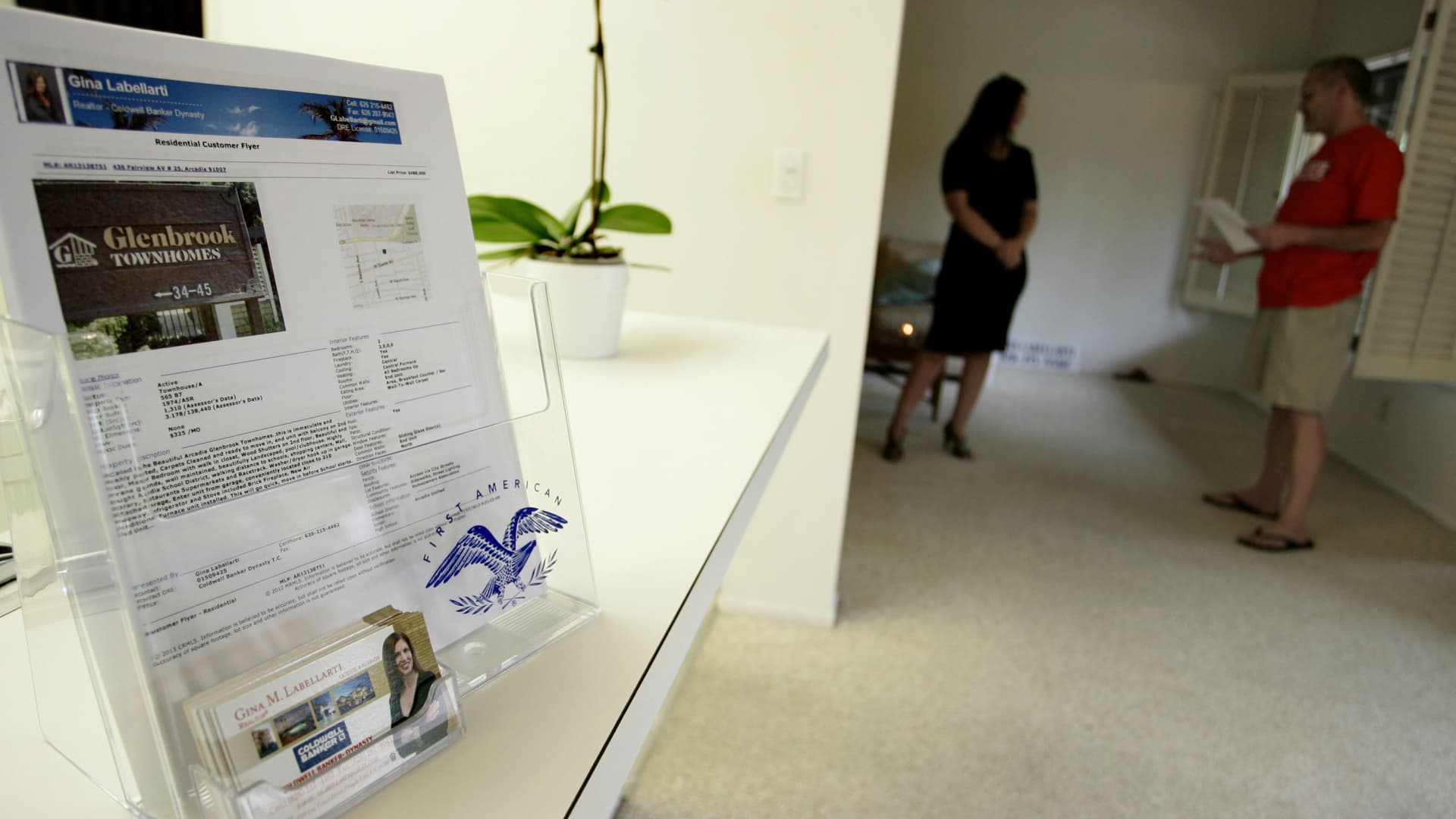
A display for a realtor with Coldwell Banker Dynasty TC, left, is displayed as she speaks with a potential homebuyer during an open house in Arcadia, California.

Jonathan Alcorn | Bloomberg | Getty Images

Mortgage rates fell slightly last week after the Federal Reserve chairman suggested a potential end to a historic string of interest rate hikes. The drop wasn’t substantial, but it was enough to boost demand from current homeowners hoping to refinance their mortgages to lower rates.

The average contract interest rate for 30-year fixed-rate mortgages with conforming loan balances ($726,200 or less) decreased last week to 6.48% from 6.50% in the previous week, with points declining to 0.61 from 0.63 (including the origination fee) for loans with a 20% down payment, according to the Mortgage Bankers Association’s weekly survey. The rate was 5.53% for the same week one year ago. Mortgage rates for all surveyed loan types decreased over the week.

related investing news

The latest inflation readings are expected to show that prices are still rising

CNBC Pro

As a result, applications to refinance a home loan jumped 10% last week, compared with the previous week, seasonally adjusted. Refinance demand, however, was still 44% lower year-over-year.

“Mortgage applications responded positively to a drop in rates last week, as the Fed signaled a potential pause at the current level for the federal funds rate in anticipation of inflation slowing and tightening financial conditions that will slow economic and job growth,” wrote Joel Kan MBA’s deputy chief economist in a release.

Applications for a mortgage to purchase a home increased 5% for the week but were 32% lower than the same week a year ago. Rates haven’t really dropped enough to offset high home prices. Prices have been cooling since last summer, but are already re-heating this spring due to strong demand and very low supply.

Mortgage rates rose sharply to start this week, according to a separate survey from Mortgage News Daily. The increase was due to investor sentiment that the regional banking crisis may be easing. All bets are off Wednesday, however, when the government releases the Consumer Price Index, a monthly report on inflation. Any large divergence from expectations, in either direction, could move bond yields, and consequently mortgage rates, decisively.


Source link

Mortgage demand surged after Fed signaled potential pause in rate hikes Read More »

Seven Questions To Ask Yourself When Trying To Hire A Diverse Team

Seven Questions To Ask Yourself When Trying To Hire A Diverse Team


When trying to hire a team with diverse backgrounds and skills, business leaders can be left wondering how to find candidates who are different enough from each other to ensure varied points of view and experience levels but also similar enough to each other to work well together and create a cohesive team culture.

Luckily, there are some questions leaders can ask themselves to help make the hiring process a little more straightforward. Below, the members of Young Entrepreneur Council discuss seven of those questions and why they are so effective at helping you determine whether or not someone would be a good fit for your team.

1. Is this candidate a self-starter?

The first question you must ask is, “Does this candidate exhibit the traits of a self-starter?” This is because self-starters typically bring a strong sense of ownership, adaptability and proactivity to the table. They are eager to learn, lead and take on new challenges, which can be invaluable in a diverse team setting. – Kelly Richardson, Infobrandz

2. How will they fit into the company culture?

When weighing whether or not to hire someone, business leaders should ask themselves, “How will they fit into the company culture?” They may not adapt well to a people-first business if they don’t seem outgoing or willing to work with others. I suggest preparing some questions so you can gauge how potential hires feel about this subject before you make a final decision. – Daman Jeet Singh, FunnelKit

3. Are their skills transferable?

If you want to hire a team with diverse backgrounds and skills, ask yourself if their skills are transferable. In other words, can their skills be used in a way that’s different from the primary job offer? If so, they are a safe bet for your team. Hiring people with diverse skills is important because you can shift them around as needed. – Chris Christoff, MonsterInsights

4. Will this candidate bring a unique perspective?

When you are considering hiring someone for your team, ask yourself, “Will this candidate bring a unique perspective, enhancing our team’s problem-solving abilities?” Diverse backgrounds foster innovation and resilience, leading to a stronger, more competitive company. Embrace diversity to unlock your team’s full potential. – Michelle Aran, Velvet Caviar

5. Will this person be able to grow and adapt?

It is important to ask yourself, “Does this person have the potential to grow and adapt?” I value having a team of people who are willing and able to learn new things quickly and who are also comfortable with change and adapting to new circumstances. This is especially important in today’s dynamic business environment since people who are willing to grow will be more innovative and, in turn, help you grow. – Blair Williams, MemberPress

6. Is this candidate aligned with the company’s mission and values?

Ask yourself if the candidate is genuinely aligned with the company’s mission and values, regardless of their background or skill set. Shared values and a passion for the company’s mission can help create a strong team culture, regardless of individual differences. This can help ensure that the new hire is aligned with the company’s goals and is motivated to contribute towards its success. – Adam Preiser, WPCrafter

7. Am I considering all the ways they could contribute?

An advantage of a diverse team is that they can bring new perspectives and skill sets to the table. One of the first things to ask yourself is whether you’re considering all the possible ways someone might contribute to the team. Make sure you’re not limited by preconceptions. For example, someone might have life skills or soft skills that would be a valuable addition to the team. – Kalin Kassabov, ProTexting


Source link

Seven Questions To Ask Yourself When Trying To Hire A Diverse Team Read More »

Barbara’s Wild Real Estate Tactics You’ll Want to Repeat

Barbara’s Wild Real Estate Tactics You’ll Want to Repeat


Barbara Corcoran understands real estate arguably better than anyone else. And while most of us know her from Shark Tank, Barbara swims in a league of her own as one of the most successful real estate investors and brokers in New York City. She knows the up-and-coming areas, the overpriced hipster neighborhoods, the streets to stray away from, and which will make you rich when owning real estate. And while Barbara has made a killing, she’s done it in a way foreign to almost any other real estate investor.

If you want to know the “formula” for making a fortune, this is the episode to tune into. In it, Barbara uncovers the exact way she finds the hottest rental markets before anyone else, why she consistently overpays for properties, the reason you should partner on almost EVERY deal you do, and why small-time investors are MUCH more likely to succeed than the big players.

Not only that, but Barbara also shares her past failures and why falling flat on her face was what she needed to see great success. She talks about her infamous word-of-mouth campaign that sold out an eighty-unit apartment complex in hours, the “Corcoran Report” that landed her on the front page of The New York Times, and why you MUST talk to waiters whenever investing in a new area.

David:
This is the BiggerPockets Podcast show 763. What’s going on everyone? It’s David Greene, your host of the BiggerPockets Real Estate podcast. Here today with Rob Abasolo. Not only are we the biggest, the baddest, and the best real estate podcast in the world, we also have another bee Barbara Corcoran.

Barbara:
I try to be honest when I’m not [inaudible 00:00:19] but a lot of people like to be right. They like to be accurate, does it make sense? They ask opinions. They really sharpen their sword and they never get out there.

David:
For those that are listening too and they feel the call in their soul, “I need to be more like Barbara,” but they’re just risk-averse. What advice do you have for those poor, timid souls?

Barbara:
Get out of the game, you’ll never going to do well. I hate to be that coarse, but get out of the game. If you’re afraid of risk, you have no business being in real estate.

David:
Today’s guest is none other than Barbara Corcoran. She is a straight D student, held 20 jobs before the age of 23, is an avid TikTok user. Hosts her own podcast Business Unusual. She’s as resilient as she is brilliant. Please, help me welcome Barbara Corcoran. Barbara, good morning to you.

Barbara:
Thank you, David. Nice to see you, Rob.

Rob:
Nice to see you.

David:
In case you’ve been living under a rock, Barbara is a host of Shark Tank and the Queen of New York City real estate. We are thrilled to have you on today. I know that there’s a lot of information that our listeners are going to love. Barbara, we are going to start with a game, we call this game two truths and a lie, and it should be fun. In this case, I am going to read a statement.
Rob and I are both going to try to guess if it is honest or not, and then you are going to tell us after we guess. Statement number one: Barbara’s landlord once tried to evict her because he thought she was running a prostitution ring. Rob?

Rob:
Okay, that is very specific and I don’t think that that’s a scenario that our producers would’ve just written to be read on this show, so I’m going to go that is true.

Barbara:
True, wow.

David:
I’m going to say that it is exactly what someone would come up trying to not look like they were throwing the wool over their eyes. I think this is a double agent of a question and I’m going to go with lie.

Barbara:
Of course, it was true. I came home one night, eviction notice on my door from being a prostitute. The reason for that, he had a reason to do it. I guess my landlord, John [inaudible 00:02:17] was his name. He saw men in and out of my apartment all day long, but what he didn’t know was that I had started their business in the apartment with my two roommates and I met all my customers there.
They would come in, we’d spend an hour and then I’d go out with them. We come in again, we go out with new guys. He thought I was a prostitute, but what was great was when I confronted him, I went to his office and told him he got it all wrong, I was just a working girl. He gave me an exclusive on his entire building of 14 units. I came out smelling like roses.

David:
I think I missed what the business was. What were you guys doing when you would go out with the gentleman?

Barbara:
We were renting apartments. I started my first brokerage firm and we were renting apartments up and down the streets of the city.

David:
You were going to show apartments to these people. They would just meet you at your place.

Rob:
Now, technically, could he have evicted you for creating an unwarranted business like a commercial business in the apartment? Was that against the lease or anything?

Barbara:
I’m sure it was against the lease, but most importantly if his sentiment was that he’d wanted me out of the building for whatever reason he could have certainly asked me to move out because I had too much traffic.

David:
You turned that into a business opportunity in the sense that you were able to lease his units, right?

Barbara:
Yes, but you have to realize one of his arch competitors was three blocks south on 83rd Street, and I was renting his apartments for 10% more than the building I lived in because I was building part walls and making one bedrooms into one bedrooms and a half. I got more rent for him and he got jealous that’s really why I got his listings.

David:
Next question, Barbara once invested over $100,000 in videotapes for property walkthroughs. Rob?

Rob:
Here’s why I think this is true, I think it’s true because Barbara foresaw that comfy would sell $85 million when other people didn’t see it coming. I imagine that at this time, videotapes for property walkthroughs is probably kind of like a new revolutionary thing. Barbara’s revolutionary, so this is true.

Barbara:
Well, Rob, you’re obviously smarter than David is. What are you going to say?

David:
You threw me off a little bit with that comment there. I’m trying to wrap my head around how these videotapes would be used to generate business. You can’t put them on the internet. There wouldn’t be any reason to mail them, so you’re a smart marketer. I feel like they might have been trying to throw us off by using a marketing tool, but I’m going to go with lie just because I can’t see the benefit of this. Who’s right?

Barbara:
You’re going to get jealous of David once again. It’s true, except the number was wrong. I don’t know how you read that one, but it was $77,000 my first profit I blew on homes on tape. Put all my apartments on tape and asked my salespeople, please give them out to your customers. It’s going to make the shopping easier. Remember, this was before the internet. It was a disaster.
However, I heard that my husband was a Navy captain, had played war games in Korea on this new thing called the internet. When he told me how it worked, I slammed my apartments on there and had two sales with him the week. I was the first firm on the internet with elite time of two years because I just happened to listen to my husband and moved on it quickly.

Rob:
Wow, I would liken this to maybe back in the day in Walmart, you would walk in and they were giving out thousands of AOL CDs and you’re like, “I guess I’ll take it.” This is what you were telling your agents. You’re like, “I’ve got these VHS copies of the third floor walkup here on 8th Street. Give those out to your friends and family, see who wants to buy it. Then, it didn’t actually pan out at that time.

Barbara:
Do you know what’s wrong with that? I had my agent’s name face professional makeup and phone number with every apartment and they refused to give them out because they didn’t want to lose their customer to the next agent. I never thought of that one, that’s why I wasted the $77,000.

Rob:
Had you not done that, do you think that that business strategy would’ve taken off?

Barbara:
Probably not, but what I do know by doing it and failing so miserably I had to save face and come up with a cover, I came up with the internet, and it wasn’t a cover. It was the best thing for me to step in.

Rob:
Very, very cool. Last one, Dave, cue it up.

David:
Last statement, Barbara was asked to speak to Citigroup but then choked on stage.

Barbara:
Easy one, come on guys.

Rob:
I’m going to assume choked like, “I blew it.” Not choked like she eating a piece of steak and you’re like choking. I’m going to go no, impossible.

David:
I think this is choked like Eminem, 8 Mile mama’s spaghetti on the sweater style.

Rob:
Then, I’m going to go not true, I can’t see it. Obviously a very charismatic speaker, so false on this.

David:
I’m going to go much more logically because we already found the lie since this is two truths on the lion, I’m pretty sure this has to be a truth. We probably shouldn’t have named it that, so I’m going to go with truth.

Barbara:
Looks to me, David that you just had a IQ implant somewhere because [inaudible 00:07:21]

David:
Well, I think I still won.

Barbara:
With that deal, it wound up as a good thing because they asked me to sit down. I was mortified. I actually got paranoid and thought everybody had passed on the street had been in the audience that night for a week. Then, I realized I had to get over myself. I was going to have to public speak sometime in my life so I volunteered to teach at NYU at night and I found my star salesperson the first night I was teaching, Carrie Chiang.
She made for me in that year $400,000 when my best agent was making $42,000. For me, I learned the great lesson much more important than speaking. I learned the great lesson, get back up. Get back up, you never know what’s around the corner.

Rob:
Well, this is your opportunity Barbara, if you’d like to redo the speech little redemption, what we’ve blocked off in an hour. You can go ahead and start from the top.

Barbara:
I’m not going to do that to you guys. It wasn’t a very good speech anyway.

David:
Thank you for playing that game with us. It’s always fun to get to learn these little tidbits and personal stories of what someone’s been through.

Barbara:
David, you don’t look like having fun. You don’t look like you’re having fun at all.

David:
I have what’s called resting cop face. They called RCF.

Barbara:
Oh my god.

David:
Don’t let that fool you, Barbara. This is what I look like when I’m-

Barbara:
It’s intimidating.

David:
Yes, as a cop, that wasn’t the worst thing in the world, but I suppose as a podcast host that’s not the same thing. Would you say that most of your successes in real estate investing have been built off of failures?

Barbara:
Yeah, because I don’t know, there’s something about the universe when you fall on your face, it’s like bouncing a ball, the harder you hit, the more you could bounce up. There’s always another flip side to it, always another flip side. I learned that building my business very much so. In terms of investing in real estate outside of my firm where I bought properties and nurtured the properties and tried to increase the rent roles, I don’t think that really holds true that I learned from failure I just became very careful.
I did have a wacky formula for buying real estate and I always did well by repeating the same little dance step again and again. Do you want to know what that is?

David:
Please.

Barbara:
I shortened your question as you know. Number one, I always bought an up and coming areas. I was in Brooklyn long before anybody was buying Brooklyn from Manhattan. I was in there early and I always looked for a 10% partner. I found a local person who knew their neighborhood, loved their neighborhood, wasn’t in the business, I made them the 10% partner, I put in the cash, and they found me the best property, the absolute best property. I hedged my bet right away.
I paid them the 10% and I told them they could overpay for the property, I didn’t care. Almost every property I overpaid for, I overpaid again and again and again. I’ve just repeated that again. I also located the up-and-coming areas by talking to waiters, creative people and said, “Where are you living now?” They were poor. They couldn’t pay their rent. They had five guys living together or four girls living together. I would say, “Where are you living?”
They’d tell me where they were living. I would go at that, we can look at the area and that’s always where I bought my real estate. That’s where the biggest gain is in up-and-coming areas. They’re risky, don’t know what you’re doing and I had a partner who knew what they were doing.

Rob:
You said that you found a 10% partner. Can you explain this construct a little bit? When you say 10% partner, did you say, “Hey, go find me a cool building. If you find me a lead, I’ll give you 10% of the purchase price?” Were they actually equity partners in that property?

Barbara:
They were equity partners and they stayed with me until I sold. I hold onto properties a long time because I say you make a lot of money slowly in real estate, but when I sell, they get their 10% share and it’s substantial. Sometimes I paid off my partners with 10% that represented 50% of what we paid for the building 10 years ago because they really appreciated. Their interest was there. Their heart and soul wasn’t like a broker want to sell me something.
Their interest was I’m going to buy you the best place, the right side of the street away from that problem because they were changing areas, choppy areas. You can always make a lot of mistakes there. I never made a mistake. They always found me the best stuff.

Rob:
That’s really cool. If you’re giving someone 10% stake in the property, were they like property managers? Did you actually empower them to actually run and maintain the property as well? Was that a separate job function?

Barbara:
No, I really didn’t because I knew how to run property. I had the organization set up and that’s not really what turned them on. They didn’t want to collect rent and stuff, but why it worked so well is I had the money, I didn’t have the time. They had the time, they didn’t have the money. We were perfect partners together.

Rob:
Did you ever make any millionaires out of these partners?

Barbara:
Well, I had a different one in every locale I went into. No, probably not millionaires but close to millionaires.

Rob:
Probably pretty close if it’s 50% what you paid for the property. I’ve always said this, sorry, if you can’t afford it’s probably too late for you to buy it. You never really can afford the thing that you want. You should be buying things that scare you a little bit, things that are a little bit more up-and-coming. You said that you would go into these neighborhoods and overpay, why overpay for a property at this time?

Barbara:
There’s something weird that happens when you’re a dealer in properties. The minute I was interested in something, gosh, somebody else was interested. I would just say right away, “I’ll pay 10% more than the next guy.” Close the deal, get your hands on it, take it off the table. It shouldn’t be that way, but for me, maybe I had bad luck it always was that way. I just decided I didn’t care about overpaying.
You go into a new up-and-coming area it appreciates so quickly that 10% is absorbed less than a year later. You’ve already made up that loss and it’s not even a loss, it’s a perceived loss, but you more than make it up so why worry about it? It’s history.

David:
It’s a very narrow perspective when the only way that you look at making money in real estate is from one element, such as you only look at the cash flow. You only look at the price you paid versus what they’re asking for. I’ve broken down to 10 different ways that you make money in real estate. You mentioned one of them is what I call a market appreciation, which is this area will appreciate faster than the market as a whole like you referred to as up-and-coming area.
Well, if you have a really big chunk on that end, you can afford to buy less equity, which is what I call when you pay less than a property’s worth. You don’t have to win as much on that side if you’re getting a huge win on another side. You’re a great example because so many people in our community would say, “You should never overpay. Just go write another 7,500 offers instead and eventually, you’ll strike gold.” You may end up buying a property that nobody else wants and there’s a reason why that would be.

Barbara:
I share a story I heard as a very young broker that never left me. I was going to listen to Harry Helmsley, of course that name. The biggest commercial owner in New York at the time. I heard him lecture and I raised my hand. I said, “Listen, how do you get a great deal on a property?” He said, “I always overpay.” What? You overpaid?

Rob:
You get a good deal by getting a bad deal?

Barbara:
Right, because it makes up for it in the long run or even in the short run, it makes up for it.

Rob:
I would say, and David, I don’t know if this is true for you too, but on my end of things, when I calculate all of the cash flow that I’ve ever made from real estate, it really pales in comparison to the appreciation I’ve had on the portfolio itself.

David:
Barbara, that’s one of the things about your story that I wanted to ask you is it seems like when you got your start, you’ve talked about the snowball that first property went up in value, created the next, created the next. Now, equity from previous properties is paying for future properties. You never have to put your own money into real estate again theoretically. This is in direct opposition to the cash flow gurus that tell everybody only look at properties for the ROI, the cash flows are going to provide. Nothing else matters.
As someone who’s been very successful with real estate, who has admitted that you’re playing an appreciation game, you’re thinking at it like an entrepreneur, “If I buy this company, how much can I increase the value of the company?” Not just what are the cash flows of this company right now? What can you share about that perspective?

Barbara:
I probably shouldn’t admit this, but I don’t pay attention to it. How I look at it is I look at the property and think, “How much of a mortgage could I slam on this property with the tenants, pay the rent, and I have a little extra to pay the expenses that always come up?” A new roof or what have you. I just see how highly leverage I can get. Then, the minute the property becomes worth more and the rents go up, I go back and slam a new mortgage on it and take the money out.
Remember tax-free, take the money out, I buy another property. I believe in a high leverage, I’m not afraid of that at all. As long as I could pay my expenses, I never leveraged beyond the point where I’m not going to sleep at night that’s how I multiplied my portfolio again and again. Do you know, and this is a true story, I bought a studio apartment in Greenwich Village when I was 29. I scraped together 10%, I think it was $88,000 of thereabouts as my recollection.
I scraped together, I chickened out, and I didn’t close. They kept my deposit. I didn’t sue for it because I just purposely failed the board. It was the board. It took me three years before I could get my hands on another property because Manhattan ran away from me. There was no way I could buy something. When I finally bought a studio, I traded for a one bedroom, then I traded here for a two bedroom and I could always afford it because I appreciate a lot, then a three bedroom.
I can’t say I bought the penthouse I live in today, which is worth so much money from that property. I would’ve never been in the game if I hadn’t gotten in the game. It was such a shame I didn’t get into it three years earlier. I could’ve done so much, not that I regret that because I guess you get cold feet once in a while, but I got cold feet again very often at a closing table I’ll start second guessing myself like, “Well, how good is that area?” I just look at my partner and I think, “What do you think?” They’re such a believer in the neighborhood. I go, “No problem, let’s close.”

David:
It’s so interesting, it sounds like you’re investing in an area not as much in a specific unit.

Barbara:
I don’t care so much about the unit. I care about the area, but realize too I care about the partner. If I’ve got the wrong partner, I’ve got the wrong building. If I got the wrong building, I’ve got the wrong numbers. Another [inaudible 00:17:37] here with you, which illustrates this beautifully, is I bought a townhouse on 10th Street in Greenwich Village and I still own West 10th Street. I bought that building for $120,000, which sounds ridiculous, a five-story, eight unit building.
I remortgaged that building to date probably 9 times, maybe 10, I don’t know if I’m exaggerating. Every time I took a chunk load of hundreds of thousands of dollars out of it and I had a great standard of living. I always took that money out for one purpose to buy myself a more beautiful home or a second home. It’s been a cash cow, I would never sell that business. I said business, it’s really like a business, a separate business. I would never sell that building.

Rob:
This reminded me of a story that I’ve heard, something that I heard on your social channels actually, I think on TikTok. A story about the penthouse that I believe you own now and the origin story of how back in the day you willed it in, you manifested it, “This is going to be my property one day.” Do you think you could share that story for the listeners at home?

Barbara:
Of course, I could. I was in a bad stretch of real estate and I took a job as a messenger because I could work different hours. I had the Corcoran Group at the time, as shocking as I might sound, I probably had about maybe 85 agents, 90 agents working for me, but I couldn’t meet my overhead so I decided I needed another job. I went out and worked as a messenger. They paid very well for messenger that you delivered. I delivered some package to a lady up on 97th and 5th.
I walked into a house, an older lady, and I looked and she had a stunning terrace view of Central Park. I was blown away, I didn’t know people lived like that even though I was in the real estate because I had never seen a place like that. I said to her as she signed for the message, I said, “Do me a favor, ma’am. Call me if you ever decide to sell.” Did I believe myself? Probably not but I thought, “What the heck? I’ll put in my hat.”
What did she say? I think she said something like they’ll take me out in a box or I’ll die at this place something like that. I left, do you know she called me like 14 years later and I bought her apartment for $10 million. How do you like that? I don’t say I manifested it. I don’t think I’m manifest, I had a lot of good luck making money after that and I came out of whatever trough I was in. I was able to quit that job and concentrate on my business again. I couldn’t believe it when she called me, I remembered the view and it was no different when I went back to see it.

Rob:
When she called you, by the way, this is one of the most amazing stories I’ve ever heard, but when she called you, did she happen to remember Barbara Corcoran the messenger, or at this point had your business exploded and maybe she remembers your face and she saw you on billboards? How did she get in contact with you?

Barbara:
When she saw me as a messenger, I wasn’t doing billboard advertising. I didn’t do full pages in the New York Times and the Wall Street Journal. I became prominent in my field after that. I don’t think she even registered my face, but she must have. Then, she saw that I might have the money for that thing because I looked like a big cheese even though most times I didn’t have the money. She called me on the basis of what she was seeing in the public eye.
I’m just the messenger, she remembered me. Funny enough, two days ago I got a handwritten note from her. I can’t even remember her first name. Anyway, she said, “Thank you for answering my call. I’m so happy I called you to sell you my apartment.” I kept it as proof because a lot of people say that can’t possibly happen. I have it.

Rob:
That’s amazing. Well, I’m going to put it out there right now for all of the hundreds of thousands of listeners at home. Barbara, when you want to sell your penthouse, please call me. I’m going to give myself a 14-year clock to be able to afford a penthouse at New York City. Deal?

Barbara:
It’s a deal, but you better shorten your clock to maybe 10 years. I’m not sure I have that much time left.

Rob:
I’ll start putting the feelers out around nine, nine and a half.

Barbara:
Good enough, I won’t answer your call. I’m sure Mike wants my house.

Rob:
That house at the time that you bought it obviously is very expensive $10 million. Was that also in appreciation play? Did you know, “If I buy this, it’s going to be worth more one day? Or was it just more of, “I want this because I wanted it.” I want to realize this goal of owning this home and the financials are the afterthought?

Barbara:
Nothing’s more luscious and having a dream come true. That’s what drove me, I wanted my dream to come true. I dreamt about that place over and over again, that was the driver. I also knew as a real estate person, you buy on Fifth Avenue with the full park view, nobody’s going to build in front of it, what’s going to go wrong with that investment? Nothing, it’s golden. I had no hesitation to get a good investment as well.

David:
You’ve said before, Barbara, that one of your greatest assets as a business leader is your imagination. Coming up with ideas and being willing to test them. What are some of the ideas that have worked for you with real estate investing?

Barbara:
Well, let me tell you, always my imagination, because you know what? The little guy, when you scrap it and trying to come up from the bottom really has the corner on imagination new ideas and getting ideas into the street fast. My big competitors, I noticed they moved slow, they had committees, attorneys, accountants, they have an idea that Monday, it might come out six months later. I had an idea, Monday was on the street by Wednesday.
I very much relied on my imagination. Probably my biggest idea that made the biggest change in my business for the very first time I did it was writing the Corcoran Report. I had 11 sales for the year, it was terrible time. Something wrong with the market, I don’t know what it was. I had a complaining salesperson accusing me of not supporting them not advertising. Well, of course I had no money, I didn’t want to tell them that.
I said, “I have a great idea.” Then, after they left I thought, “Now, what kind of big idea do I have?” I thought of the Corcoran for it. I took the 11 sales average amount and it came out to $58,400 some odd change for an average apartment that I sold, my firm sold. I published a report with one line, the Corcoran Report, sorry, conditions and trends in the greater New York City marketplace is sent to the New York Times every writer wrote that day. Two Sundays later, I was on the front page of the real estate section.
According to Barbara Corcoran, prices have reached all time while using my figure, my figure based on 11 sales. That day was a bellwether change for me in my career because people would call and I could hear my agents on the phone saying, “You’ve heard of us?” Usually, they were on the phone saying, COR, COR, that kind of a thing. We were found. Suddenly, people thought I was smart. Was I smart? No, I was clever.
A lot of people like to be right. They like to be accurate, does it make sense? They ask opinions, they really sharpen their sword and they never get out there. I got the idea, slammed it, whatever it was, and threw it out to the marketplace and only a percentage worked. Believe me, the things that worked for me and my company worked at least five times more than anybody else because I was always out there trying stuff and I ran lean, mean, and fast.

David:
That is such a good point. I can’t let us pass this over. I’ve noticed this as a real estate broker, real estate investor, real estate, everything, people that come into our business from other professions, architects, engineers, anyone that was somewhat analytical.

Barbara:
[inaudible 00:24:48]

David:
Yes, you’re making the same face that we all make when we get those people, they want to make a spreadsheet of the 18 properties that they don’t want to buy and go over all the reasons they don’t want to buy it with you.

Barbara:
Isn’t that true? Yes, the spreadsheet bankers, finance guy, oh my God.

David:
Anyone that has an analytical mind is also trained to not make mistakes. They’ve got this emotional relationship with numbers where they believe making a mistake will lose you money or cause you pain in some way. The way you win at life is to never make a mistake. It is a very difficult gateway that you’ve got to go through to make money in real estate where you learn making mistakes does not lose you money.
Like you just said, throw as much out there as you can, the more things that stick are what are going to make you money. You can do nothing wrong in a day, make zero mistakes and make no money. You can do 20 things in a day, 17 of them were wrong, but your three wins we’re still more than the zero wins that the analytical mind had. I know people that are listening to this are having a hard time gaining traction, they’re having a hard time getting going.
Listen to what Barbara’s saying here, stop thinking that avoiding mistakes is the way that you win in the space with real estate. Any advice on that topic, Barbara?

Barbara:
I would say that I tried, you have some very brilliant people in the game, people well-educated. I always lose my money with Harvard MBAs. I’m sorry, I shouldn’t say that, but I always do. If they’re in the game, I’m like, “I’m not going in there anymore.” You get a left brain type of person, terrible for investing in real estate because they lack one thing in their DNA, they’re risk-aversive. If you are risk-aversive, you can’t win at real estate.
You got to have blind faith a lot of the time. I think, “What am I crazy? I’ll do it anyway because I’ve come this far, I’ll do it anyway.” It’s different. Maybe they run funds and then punch numbers, but they never make a lot of money. I’m telling you, the scrappy first generation immigrant that doesn’t know any better is much more apt to make money than the Harvard educated kid that just came out of schools we’re working for 10 years.

David:
It’s not to say that numbers don’t matter, it’s that being in love with the numbers is the problem, it’s having the vision, it’s seeing the opportunities. That’s such a good point. It made me think about when someone wants to date someone, nobody wants to be courted by a guy who just overanalyzes everything and never makes a mistake. They want a person who’s going to put themselves out there, be passionate about what they’re doing.
Try different things, show the love that they have for someone that matters so much more than the person who’s like, “I made sure we had reservations at every single restaurant at the exact same time. I scanned the menu before we even went, so I knew what I was going to order.” That is what makes anyone fall in love and real estate won’t fall in love with you if that’s the approach you’re taking.

Barbara:
It’s so true what you just said.

Rob:
Barbara, out of curiosity on this, the Barbara Corcoran Report that you mathed out, “The real estate is at an all time low in New York City.” I know that you mathed it out based on yours, but was there actually any truth to that number on a broader scale? Was that pretty close to what was actually happening? Did anybody ever call you and say, “That’s not true. How did you know?” I was kind of curious how that your data actually ended up comparing to the actual data of New York. Did you ever look into that?

Barbara:
No, I didn’t. It was already out, it was printed, I was getting the notoriety. Who knows if it was accurate? Who cares if it was accurate? The main thing was nobody else had a number out there. Nobody was producing numbers. After that, over the next 10, 20 years, people started mimicking my competitors because they realized all the reporters called me. Why? Not that I had better opinions than them or was more experienced, I was certainly less experienced but I had a number to give them.
What do reporters need more than anything else? They don’t need your opinion. They already have an opinion when they call, they want a good sound bite. More importantly, they want numbers to back up their own opinion and I gave it to them. If I had a reporter call me and say, “I’m working on a Russian oil well story and I wonder if you have any rich Russians that I could talk to?” I found them a Russian to talk to, or two or three. They came to me like a source.
I feel like a media joint. “What do you need? Got it. What do you need? Got it.” It’s not important whether your number is right or not, you do the best you can, was that an accurate number? Based on my sales, was it in line with the field? Probably but I didn’t care. I already had the number, it got the notoriety, it was onto the next [inaudible 00:29:13] report? The next [inaudible 00:29:16] report. I just kept churning the things out.
The Richard Gere report, the Madonna report, the Hillary Clinton report, the Guggenheim Museum report. I would grab any number average out, pop it out there. I didn’t have the decency enough to wonder if my numbers were right.

Rob:
I love it. You said you were clever, obviously what was happening here is you’re a genius marketer and that comes into play with something that I heard about, a word of mouth campaign that you had when you were trying to sell out a unit or sell out a building. Could you tell us that story too?

Barbara:
You’re probably referencing the one-day one price sale. By the way, exaggerated, I’m not marketing genius I just take risk. I’m good at that. I swear to God, that’s the baseline of the whole thing. No, I had 88 apartments that an insurance company and developer came to me for, two. Came to every bill, every broker in town, we need to sell these interest rates, we’re 18%. Can you imagine that? That’s why when everybody’s excited about the high interest rates now, I’m like, “What are you talking about?”
Interest rates are 18%, no one was buying anything. They said, “We have to sell these 88 units that we don’t want to auction. We don’t want a public sale because we don’t want to be embarrassed.” I looked at the units, they didn’t have kitchens, they high floors, low floors back, apartments, creepy lobbies, they had everything wrong. I went back and said, “No, there’s no way to sell it. I’d like to tell you differently, no way to sell it. I met with the developer in the insurance company.
Interesting about motivation. The developer, Bernie Mendik, who has since deceased, he said to me, “You’re a smart girl, you’ll figure it out.” I had arise to his occasion. I went home that night and thought of a puppy sale my mother brought me to where all the puppies were given away and there were too many buyers for the puppies, so I did an exact knockoff on that. I went back and I said, “We’re pricing all the units alike, back apartments, high floors, low floors, all alike.”
You give them the mortgage so they don’t have to worry about the mortgage at 2% down from the 18%. We’ll have a one-day sale first come, first serve. I opened that office on the Upper East Side in the morning around, it was due to open at I think eight o’clock, but I was there at 6:30. I had over 150 people in line waiting for those 88 unit apartments. I said go, I gave them the sheets, the addresses. They ran, husbands, wives, single people ran to see the apartments they wanted the best one. It was sold out. I would say with less than two hours I made $1 million.
Who would ever see that thing coming? You know what the key to it was? It wasn’t enough to go around. Even the guy who got the loser, the really disgusting apartment with the same price as everybody else, he was happy because he saw how many people were waiting behind him and couldn’t get anything. That was just a marketing way, a secret sale with no advertising to support it but it worked like a dream.

Rob:
Many units did you say that you sold?

Barbara:
88 Units. And the average sale price, well right now won’t sound like anything, the average sales price I think was $64,000.

Rob:
Wow, that’s 88 units. I’m sure that’s got to be a record in New York for the fastest building ever sold out. If listeners want to hear more about this story, you tell this a little bit more as well on TikTok in your Get Ready With Me video, right?

Barbara:
Yes.

Rob:
Looking at that one, I believe it had over a million views.

Barbara:
Yes, I think it may have. I think it’s because I look so good without makeup.

Rob:
It’s a very fun series. I think your social platform and in all of the stories that you tell really, really are a very fun thing to watch. I find myself on your reels all the time. Something that you mentioned a little bit earlier about the 18% interest rates. I say this all the time, I say that interest rates used to be 16% to 18% back in the ’80s, ’90s. Then, a lot of people say, “Yeah, well the cost of living back then wasn’t all that high, so it’s not the same.”
Well, and that’s what I was going to ask, it’s all relative. When you sort of look at it, having seen your career play out, do you feel that like a 7.50%, 8% interest rate is really detrimental to the success of people in today’s market?

Barbara:
Well, it is in this one regard. It keeps people out of the market because of their expectations. Remember we got until last year, we were accustomed to 3%. I think that’s what the mortgage rate [inaudible 00:33:32] We got accustomed to that. Everything is relative like, “I wish I had gotten it then I missed the boat.” No, it’s not that way at all. It was just as expensive to live in New York, I’m telling you but people still borrowed at all along the way 14, 15, 16, once it got beyond 16, people started pulling back.
Today people are pulling back at what, 5%? Where is it now? I don’t even keep track of it, honestly. It seems so cheap to me. I don’t think that’s true the premise that people are giving you at all. No, I still feel like there’s deals to be done because of the low interest rates. I’m going to labeled it as high. All of my buildings in the last year at a higher rate, I probably should have done it a year early, but it’s still a cheap rate, my god.

Rob:
Well, you did mention, you know, would buy this property and then you would slam a new mortgage on it once the rents went up. That concept I believe you’re talking about is a cash-out refi. Basically, the value of the building would go up and if the rents went up and you could do a cash-out refi, you’d have a little bit of a higher mortgage, as long as you could cover your bills, you would take that money out and reinvest it somewhere else, right?

Barbara:
I’m talking about a lot of money back out. I’m not saying I had a mortgage of $200,000, I put 250 on it. I would wait five years. For the $200,000 I would then put an $850,000 mortgage on put in my pocket. Listen, refinancing is the way you really get rich in holding real estate that’s what I never like to sell. It’s just a bank that’s going to keep on giving. That’s how I look, I feel like I’m in the banking business, but I have real estate to back it up.

David:
On that topic, you, you’ve mentioned several strategies that are somewhat, what’s the word I’m looking for here? They’re not common, when you hear this overpaying and when you say overpaying, what I’m assuming you mean it’s just paying more than the list price. It doesn’t necessarily mean you overpaid because real estate is worth whatever someone’s willing to pay for it.
Focusing on the location over the actual unit, putting an emphasis on solid fundamentals of an area and an asset class over over-reliance on the analytics of a specific unit and getting, not looking at the numbers with a microscope looking at them with a big picture plan, picking the right partner to invest in. This is very different than the gurus that sell real estate investing courses that say, “I will teach you how to analyze a property and you can just look at every single property individually.”
The question I wanted to ask you is, do you believe this works primarily in markets where you’re likely to see appreciation where money is flowing? Something like New York City, Manhattan, maybe South Florida right now, some of the California markets. Do you think that’s part of where your strategy came from, was the area that you were in and the business that you were involved in?

Barbara:
Not really. I think it would apply anywhere. There’s always primary estate that’s golden that everybody’s clamoring for that you don’t have enough to go around. Then, there’s always the next area, next store. The people say, “I don’t really like it so much, I don’t want to have my kids go to school there.” All the reasons why, those are the areas that are the sweet spot, and that’s everywhere not just New York.
It happened to me because I was in New York doing Brooklyn. I thank God picked Brooklyn versus New Jersey. I don’t know why, I really didn’t know New Jersey, but you could always find an area. It works. I just don’t think it’s about a particular area. There’s always something up and coming. Do you know what is a great way to find out if you’re right in your premise? You travel there at night. I never went into any area of Brooklyn and even found a partner or starting investing, I used to get a car at night, rent a big driver because I didn’t know what I was headed for.
I would cruise the streets. What do you think I would find at night? A lively evening community of creative, generally gay communities, having a ball. The gays always moving first is how I found. Then, after that I would go and I would see the baby carriages and hallways stuffed in collapsible cheap carriage. The yuppies are starting to come in. You see a lot at night when people aren’t at work. You see what’s happening, who’s living there.
I remember I bought one building on the very Upper West Side because I saw old ladies all sitting on the bench with pigeons and they weren’t getting mugged. I thought I would never sit on that bench, but it was safe enough for the old ladies, so I realized something’s changing here. I think you have to just be personally involved and have your mind open. I have even chosen particular blocks based on the trees.
I know it sounds weird, but it’s so darn pretty. I’m thinking everybody’s going to love this block, look at flowering trees. More important to me than the numbers, because when I look at the numbers, I’m just seeing today’s numbers, but I’m projecting what tomorrow’s numbers might be and I’m buying on that basis.

David:
That is such a good point. Not getting wrapped up in, I call it the year one result. When we analyze the property we’re looking at right now in this snapshot of time, what can I expect it to do? You’re not buying it for a year, you’re buying it forever if you’re Barbara and you keep refinancing them. You can’t analyze for what it’s going to be like in 30 years. There’s some intangibles that go into this and you’re sharing a lot of that.
I have one last question, but before I ask it. I know you have a technique involving waiters in restaurants and getting valuable information from them. Can you share that with our audience?

Barbara:
The best, you go to a restaurant there’s always good-looking young waiters. They want to be dancers, they want to be writers, they came to New York. New York is such a wonderful place to draw people in. They all come to New York, but they’re making their rent. They’re working at night. I always make a habit saying, “Where are you living? Where are you living?” Then, I make a mental note. Now, on my phone, I used to have a little pad with me make a mental note.
Then I’m out there within a week looking at it. That’s what I do, it’s a little routine. A lot doesn’t pan out, some areas are too darn early for me. They scare me because I’m like, “I’m so happy I had that big driver with me. That’s not a good area.” Most of them pan out, so I always think you have to tap into youthfulness and people who are short on cash to identify up and coming. I think it’s your best guide.

Rob:
It’s effectively asking locals what the secret spots are. “Hey, where are you at? What’s the cool bar? What’s the cool club in town?” Basically, just following the scent to finding these little pockets that no one really knows about.

Barbara:
Yes, and they’re choosing the right property within that pocket and that’s where the partner comes in.

David:
Last question from me, Barbara. For those that are listening to you and they feel the call in their soul, I need to be more like Barbara, but they’re just risk-averse. They don’t have experience accepting that risk is a part of life. What advice do you have for those poor, timid souls?

Barbara:
Get out of the game, you’ll never going to do well. I hate to be that coarse, but get out of the game. If you’re afraid of risk, you have no business being a real estate. If you want to make money, you have to take a risk, it’s just that way. If you’re measuring what you’re about to go into based on what you could have bought it for last year, your memory is your greatest deficit. We’ll hold you back, if your mind is wired that way, get out of the game.

David:
Well, that is fantastic, Barbara. Thank you very much for sharing that advice.

Rob:
Perhaps the most honest advice and honest answer we’ve ever gotten on the show, by the way. I love it.

Barbara:
Thank you so much. I try to be honest when I’m not bullsh*tting.

David:
As you know from two truths and a lie, there’s often a lie mixed in with truths and sometimes you have to be able to figure it out, but it can still be fun when you do so. Barbara, for people that want to find out more about you, where’s the best place for them to go?

Barbara:
It’s @BarbaraCorcoran on all the social media platforms. If you just have want to have fun just follow me on Instagram at TikTok. I have a blast, but I also give great advice. I try to do both.

David:
Rob, how about you?

Rob:
You can find me @Robuilt on YouTube. You can find me @Robuilt on Instagram. Be sure to follow the raw belt with the newly added blue check mark, which is a beautiful day for me. You no longer have to get asked if I’m going to invest in Forex or anything like that. Make sure it’s the blue check mark. Be sure to also find me on the Apple podcast platform where you can leave the BiggerPockets Podcast, a five star review because this is one of the best episodes we have ever done. David, what about you?

David:
Yes, thank you for that mention about the blue check mark. This is my cup that I keep full of the tears of internet scammers as they are crying themselves to sleep every night, unable to scam people pretending to be us. You can find me at my website, davidgreene24.com or any social media that you like. DavidGreene24. Please do go give me a follow. Barbara, you’re such a pleasure to talk to you. Thank you so much for being here and for calling me out.

Barbara:
[inaudible 00:42:12] I don’t call you yet, I’m doing it today. Thank you so much, really. Thanks for the platform.

Rob:
I want to say Barbara such a big fan. You are a hero of mine and I think honestly, I held it together pretty good on this podcast considering how dang excited I was to interview you. Thank you so much for joining today.

Barbara:
Let me remind you that you were the winner of the contest, you got two out of three, your partner and only got one out of three.

Rob:
I’m going to be the winner in nine years when I buy the penthouse. That’s really what I’m holding out for.

Barbara:
I’m waiting for you call. Is this you?

David:
It is. This is David Greene for Rob [inaudible 00:42:46] Abasolo, signing out.


Help us reach new listeners on iTunes by leaving us a rating and review! It takes just 30 seconds and instructions can be found here. Thanks! We really appreciate it!

Interested in learning more about today’s sponsors or becoming a BiggerPockets partner yourself? Email [email protected].

Note By BiggerPockets: These are opinions written by the author and do not necessarily represent the opinions of BiggerPockets.


Source link

Barbara’s Wild Real Estate Tactics You’ll Want to Repeat Read More »

Brits are being offered no-deposit 100% mortgage loans

Brits are being offered no-deposit 100% mortgage loans


Renters in the U.K. will be able to borrow up to 100% of the value of a property in a new mortgage scheme introduced by Skipton Building Society.

Mike Kemp | In Pictures | Getty Images

LONDON Renters in the U.K. will be able to borrow up to 100% of the value of a property without a guarantor or deposit in a new mortgage plan introduced by Skipton Building Society.

A building society is a British financial institution that provides banking services for, and is owned by, its members. The new mortgage product, aimed at first-time buyers who are currently renting, has a fixed rate of 5.49% for five years, over a maximum term of 35 years.

The average five-year rate was 5% in March, according to the Moneyfacts UK Mortgage Trends Treasury Report, across all loan-to-value ratios. Buyers typically get a 5.33% mortgage rate on 95% LTVs, according to the report, but the majority of buyers opt for a lower rate.

A number of banks, including NatWest, Santander and Nationwide, introduced 95% mortgages in April and May 2021 after the British government announced a new mortgage guarantee program encouraging high loan-to-value lending to enable more first-time buyers to get onto the property ladder post-pandemic.

The new Skipton deal is widely reported to be the first time a mortgage lender has offered 100% mortgage products since 2008, when some building societies offered rates of up to 125%. Many of the products were then pulled from the market as the country fell into financial crisis.

In a press release, Skipton said it would ensure monthly mortgage payments for each applicant are not more than the average of their last six months’ worth of rental costs.

The offer is only available to first-time buyers, and is subject to affordability and applicants’ credit scores, as well as a good track record of rental payments over at least 12 months.

Skipton has described the move as “a lifeline to tenants … to help them break out of their trapped rental cycles and onto the property ladder for the first time.”

Charlotte Harrison, CEO of home financing at Skipton, said people being unable to get onto the property ladder is “having a massive impact on the fabric of our society.”

“We recognise there’s a clear gap in the market for people who have a strong history of making rental payments over a period of time so can evidence affordability of a mortgage,” Harrison said in a press release.

According to research carried out by Skipton, 35% of renters are struggling to save due to increased rental costs.

The slightest fall in house prices … will leave homeowners in negative equity, with the property worth less than the mortgage balance.

Graham Cox

Self Employed Mortgage Hub founder

The move could be “just what is needed” for some borrowers, according to Rita Kohli, managing director at mortgage advice service The Mortgage Shop, but there are concerns about launching this kind of product in an environment where house prices could continue to fall.

“[This] means that, as advisers, we will need to make sure clients understand the risk of negative equity very clearly,” Kohli said in a research note.

There is “grave danger” that borrowers will “overextend themselves” with this kind of product, Graham Cox, founder at mortgage advice service Self Employed Mortgage Hub said in a note.

The UK may be the fastest-growing investor in China in terms of major markets, says British minister

“The slightest fall in house prices … will leave homeowners in negative equity, with the property worth less than the mortgage balance,” Cox said. “Not a great place to be if your income drops and you need to sell,” he added.

To prevent customers falling into negative equity, stress tests will need to be particularly rigorous, Senior Economist at Capital Economics Andrew Wishart told CNBC.

“That will mean that the maximum people can borrow could be less than with other mortgages, meaning that the gap between the house price the buyer aspires to purchase and the amount they can borrow is particularly large,” Wishart said.

There is also the question of whether there is a larger structural problem in the British housing market, with there being a “severe shortage” of properties available for first-time buyers, Jonathan Long, head of corporate real estate at wealth management firm Investec, told CNBC.


Source link

Brits are being offered no-deposit 100% mortgage loans Read More »

How To Choose The Right Legal Structure For Your Franchise

How To Choose The Right Legal Structure For Your Franchise


By Nellie Akalp

The franchise model of doing business streamlines the entrepreneurial process. By operating as a franchisee, you can become a business owner without much of the preliminary groundwork involved in building a company’s infrastructure and systems from scratch.

But even though a franchise location is associated with a larger brand, its owners hold responsibility for forming a business entity and managing all of the operations and administration at their site.

In this article, I’ll discuss some of the nuances of starting and operating a franchise entity.

Franchisee vs. franchisor: What’s the difference?

First, let’s clarify some of the terminology I’ll refer to throughout this post:

  • What’s a franchisor? A franchisor is a business that sells the right to others to open stores or sell products or services using its brand, expertise, and intellectual property.
  • What’s a franchisee? A franchisee is an individual or business entity licensed to operate their privately owned business (a franchise) under an agreement with a franchisor.

For example, McDonald’s is a franchisor; the owner of the McDonald’s location in your town is a franchisee.

Franchising and forming a business entity

Forming a legal business entity supplies liability protection to business owners and may provide some tax advantages. The underlying purpose for setting up a franchisor’s entity is slightly different from why it’s important to set up an entity for a franchise location.

Franchisor entity

A franchisor forms an entity to sell rights to franchisees to open and operate a franchise location using the franchisor’s brand, intellectual property, and expertise. An independent legal and accounting entity, the franchisor entity protects its owners and the main business from the debts and legal liabilities of franchisees.

Consider this hypothetical example: Subway is a franchisor. Suppose someone wants to sue the business after slipping and falling on a wet floor at a franchisee’s location. The individual would sue the local franchise business, and the main franchising entity would be protected.

Often, franchisors choose the Limited Liability Company structure for their entity. Technically, a franchisor entity can be formed in any state. However, it’s wise for franchisors to discuss their options with an attorney and tax professional before deciding.

Franchisee entity

A franchisee entity is one set up by a franchisee when purchasing the rights to operate a local franchise. Many franchisors will require the franchisee to set up their entity before drafting contracts or a Franchise Disclosure Document (FDD), so the paperwork can be put in the entity’s name. Franchisee entities are usually LLCs. Many franchisors will not allow a corporation to purchase a franchise because the issuance of stock would have significant legal and tax implications.

A franchisee should almost always register its entity in the state where it has its physical presence, regardless of whe re the owner’s residence is. The physical location of the franchise will require permits, licenses, lease agreements, etc., and therefore the business must be registered in that jurisdiction to obtain them.

Naming a franchise entity

Many franchisors create an entity under a name that implies its purpose of selling franchises—for example, Your Company Franchising Inc. or Your Company Franchise Sales, Inc. This makes it easy to differentiate entities.

As for franchisees, they may use the franchise’s brand name for marketing purposes by establishing a DBA (a fictitious name). However, their legal entity’s name must not include the name of the franchise being purchased (because the franchisor has trademark rights to that entity name).

For example, franchisees would avoid registering their legal entities as Smith Subway, LLC or Smith’s Burger King, but might instead set up DBAs like “Subway Store #1234” or “Burger King Woodland Hills.” Franchisors usually have a specific way franchisees should format their DBAs.

More from AllBusiness.com:

What about multi-unit franchises?

A multi-unit franchise is when one franchisee purchases multiple locations. Typically, the franchisor will want each unit set up as its own separate legal entity with separate DBAs and permits.

In some cases, franchisees can start a parent company that holds all their entities beneath it to keep things simple. However, this only works if the franchises are all owned by the same people.

Entity requirements for franchised businesses

In addition to the contractual obligations to franchisors, franchisees must comply with federal, state, and local requirements when setting up their business entity:

  • File formation paperwork with the state to establish the LLC or corporation.
  • Obtain an EIN (employer identification number).
  • File a DBA (doing business as) to establish a fictitious name for the franchise location.
  • Create an LLC operating agreement (or corporate bylaws).
  • Register for payroll tax and other employment-related taxes.
  • Complete sales tax registration (usually does not apply to service-based franchises).
  • Filing for any required business licenses and permits to operate legally at their location.

Becoming a franchisee

Are you curious about what it takes to start and operate a franchise? Here are resources to help as you assess the feasibility and explore the possibilities:

Starting a franchise business lets you enter the world of entrepreneurship with built-in brand awareness and established systems and processes. That doesn’t mean it’s entirely “plug and play,” though! Make sure you get the legal and accounting guidance you need to ensure it’s the right fit for you.

About the Author

Nellie Akalp is a passionate entrepreneur, business expert, professional speaker, author, and mother of four. She is the founder and CEO of CorpNet.com, a trusted resource and service provider for business incorporation, LLC filings, and corporate compliance services in all 50 states.


Source link

How To Choose The Right Legal Structure For Your Franchise Read More »

What An Analysis Of 295 Housing Markets Told Me About The National Market

What An Analysis Of 295 Housing Markets Told Me About The National Market


How would you describe the housing market right now? Is it up? Flat? Down? Crashing? Each option is a little bit correct and a little bit wrong. That’s because these days, there is almost no way to describe the housing situation in the United States on a national level. To understand what is happening and to make solid investing decisions in 2023, you need to be looking at regional trends and individual market metrics. 

To shed some light on the differences in market behavior, I dug into the 295 largest housing markets in the country and wrote up the most interesting trends and findings from my research. 

Sales Price

Of the 295 markets studied, 200 of them are up or flat year-over-year. This is true, even though on a national level, housing prices are down about 3%. Meaning although about two-thirds of markets are still up YoY, the depth of declines and size of the markets seeing negative price growth is dragging down the national average. 

For the most part, the pandemic-era craziness is over, but there are actually still 37 markets with double-digit growth. Macon, Georgia, is up 28%, with many of the other red-hot markets coming in the Midwest. Springfield, Ohio; Saginaw, Michigan; and a few places in Wisconsin still have growth of over 20%. 

Of course, there are markets that are seeing big declines as well. Austin leads the way with -14% growth, followed by Sacramento and Boise at -12%, and other major markets like Seattle, Phoenix, Los Angeles, and Denver are all seeing some of the worst corrections. 

What stood out to me when looking at sales prices is how pronounced regional differences are. For the most part, western states are seeing big declines, while markets in the Midwest and Northeast are doing fine. The South is mostly growing still, but there are some markets in decline there too. To help visualize some of these regional differences, I selected markets (somewhat at random) from each region.

Median Sales Price of Boise, Madison, Orlando, and Rochester (2018 - 2023)
Median Sales Price in Boise, Madison, Orlando, and Rochester (2018 – 2023)

As you can clearly see, Boise has seen steep declines but has started to level off. Madison and Orlando are relatively flat, and Rochester is still on an upward trend (even though seasonality makes it look like it’s declined for a few months, it’s up YoY).

Median Sales Price Percent Change YoY of Boise, Madison, Orlando, and Rochester (2018 - 2023)
Median Sales Price Percent Change YoY in Boise, Madison, Orlando, and Rochester (2018 – 2023)

Inventory

The prevailing logic over the last year is that inventory was going to rise considerably with higher interest rates, and in some ways, this is true. Of the 295 markets studied, 183 had inventory up YoY. Some markets have truly skyrocketed, with markets like The Villages, Florida; Austin, Texas; and Spokane, Washington, all seeing inventory more than double. 

This seems like an alarming statistic because rising inventory can precede steep price declines, but year-over-year data might be misleading us. Inventory was extremely low during the pandemic, so I looked at current-day inventory and compared it to the same months in 2019. What I found was that only 20 markets have inventory higher than pre-pandemic levels. This is extremely low! Even with higher interest rates, there are only a handful of markets in the entire country with inventory levels that have fully rebounded. 

What’s even more remarkable to me is how low inventory has stayed in other markets. In Muncie, Indiana, for example, inventory is only 21% of what it was in 2019. Meaning for every five houses for sale in 2019, there is now just one. When you look regionally, low inventory levels are primarily concentrated in New England. Massachusetts, New Hampshire, Vermont, and Connecticut all have several markets with desperately low inventory. 

Inventory of Boise, Madison, Orlando, and Rochester (2018 - 2023)
Inventory in Boise, Madison, Orlando, and Rochester (2018 – 2023)

Even in Boise, which has seen a steep correction, inventory fell in line with seasonal patterns this Winter and is not accelerating out of control. 

New Listings 

One of the main reasons inventory remains so low is the lack of new listings. Of the 295 markets, only 16 have seen growth in the number of new listings in the last year. This is as close to a national trend as it gets in the housing market right now. Surprisingly, those 16 markets are primarily concentrated in Florida and Texas. 

In certain markets, sellers are in revolt. Burlington, Vermont, has seen a 68% decline in new listings this year, as has Truckee, California. Other areas with ultra-low new listings are in New England. That makes sense—declining new listings and low inventory tend to be closely correlated.

Percent Change YoY of New Lisings in Boise, Madison, Orlando, and Rochester (2020 - 2023)
Percent Change YoY of New Lisings in Boise, Madison, Orlando, and Rochester (2020 – 2023)

If you want to know why the housing market isn’t crashing on a national level, this is one of the main reasons. There is very little to buy, which is offsetting the decline in demand that has come with rising interest rates. 

Days on Market

Days on market (DOM) is an excellent indicator because it helps us understand the balance of supply and demand in a market. In markets where there is excessive supply, DOM goes up. In markets where there is excessive demand, DOM goes down. Balanced markets stay flat. 

What we see right now is that 246 markets have rising DOM. Even though inventory has remained low—properties are sitting on the market longer in most parts of the country. But how much longer varies dramatically. 

Percent Change YoY of Days on Market in Boise, Madison, Orlando, and Rochester (2020 - 2023)
Percent Change YoY of Days on Market in Boise, Madison, Orlando, and Rochester (2020 – 2023)

In Boise, the average days on the market went from 13 one year ago to 88 today. That is an increase of nearly 600%! No wonder prices are falling in Boise. The chart above does a great job of showing what’s happening right now. Markets that boomed, like Boise and Orlando, are reverting. Meanwhile, the more “boring” markets like Rochester and Madison are holding almost perfectly steady, as they have for years. This is generally true for many major metros in the Midwest and Northeast. 

Sale-to-List Ratio

The last metric I looked at is the Sale-to-List ratio, which measures, on average, how much below or above the asking price properties are selling for. Despite dropping demand, there are still 49 markets in the U.S. that are averaging above-list sales. Of all markets, Rochester, New York, leads the way with the average home selling for about 107% of the list price. Madison is also above 100%, which again is no shock given the supply and demand dynamics. 

For the other 246 markets, however, buyers are getting discounts on the sale price. I’ve been talking about the concept of “buying deep” for months (buying under the asking price), and it seems that in 84% of markets, this is happening. In Key West, Florida, buyers are buying at 95% of the list price, Austin is 96%, and in New Orleans, it’s about 97%. 

Sale-to-List Ratio in Boise, Madison, Orlando, and Rochester (2020 - 2023)
Sale-to-List Ratio in Boise, Madison, Orlando, and Rochester (2020 – 2023)

To me, this is a perfect example of why it’s so important to understand local market dynamics. If you see that inventory is rising and you’re in a buyer’s market, you can offer less than the asking price—and as the data shows, you’ll probably get it! However, if you’re in a strong seller’s market, you may still have to write competitive offers and won’t have the luxury of being as patient as you might like. 

Conclusion

Hopefully, this analysis has shown you that trying to describe “the housing market” is not possible right now. Every region and every individual market is behaving differently. There are markets still in the grips of the pandemic boom with massive growth and low inventory. And there are markets seeing steep corrections. 

How you invest in 2023 should largely depend on the dynamics of your local market. Some markets will support flipping right now, while others are better for rentals, and some maybe shouldn’t be touched altogether. As an investor, I encourage you to stay on top of the metrics I outlined in the post above and use them to help you make investing decisions. 

What are you seeing in your local market, and how are you adjusting your investing tactics accordingly? Let me know in the comments below!

Find an Agent in Minutes

Match with an investor-friendly agent who can help you find, analyze, and close your next deal.

Note By BiggerPockets: These are opinions written by the author and do not necessarily represent the opinions of BiggerPockets.


Source link

What An Analysis Of 295 Housing Markets Told Me About The National Market Read More »

Threats to the billion dollar parking industry

Threats to the billion dollar parking industry


Share

While historically family-owned, the parking industry is today largely dominated by two players: SP Plus (SP+) and ABM. But the industry is facing some challenges. Aside from the rise of e-commerce and ride-hailing, a post pandemic world where workers are rarely driving into urban areas is forcing the industry to pivot and expand its services, as well as heavily invest in technology. It remains to be seen if those strategic decisions will pay off.

13:20

Sat, May 6 20238:00 AM EDT


Source link

Threats to the billion dollar parking industry Read More »