Richard

Co-Living Units Are Helping Investors Generate Higher Returns—Here’s What You Need To Know

Co-Living Units Are Helping Investors Generate Higher Returns—Here’s What You Need To Know


Before the pandemic, co-living as a housing solution was already gaining popularity as urbanization caused rents to rise in major cities. Now, the concept of living in accommodations with communal spaces is making a comeback after the pandemic left a rental affordability crisis and loneliness epidemic in its wake.  

Early this year, the largest co-living operator in North America, Common, announced a merger with Habyt, the largest co-living operator for Europe and Asia. The result is a global leader in co-living that will operate 30,000 units worldwide, many of them co-living spaces. It is estimated that there were 74,000 total co-living bedrooms either for-rent or in development in the U.S. in 2022. At the end of 2019, real estate investment firm CBRE found that there were about 5,000 beds in only about 150 co-living communities around the country. It’s a rapidly accelerating trend, and research shows it may have staying power.

What Is Co-Living? 

Co-living has always been a way to save money on rent—groups of friends, especially young single people, often rent shared spaces to save money on their monthly housing costs. But modern co-living spaces are different. Buildings constructed or renovated with the intent of unrelated individuals sharing the same living space often come with top-of-the-line amenities. Think of higher-end decor and furnishings, fitness and yoga studios, expansive co-working areas, and perks like cleaning services and high-speed WiFi. People typically live in individual, furnished bedrooms but share common areas like kitchens, bathrooms, laundry facilities, and living areas. 

There are variations in how these spaces are operated. Some companies, like Outsite, use a membership model, where digital nomads can book spaces for as few as three nights. Others, like Bungalow, work as a tech platform that connects roommates seeking housing in major cities and subleases homes to them. Companies like Common offers a combination of private units with co-working spaces and shared units with private bedrooms. 

The rising popularity of co-living spaces has also created a market for co-owned units. For example, the Co-Own Co. in Denver allows homebuyers to purchase a share of a unit with a private bedroom and bathroom. It’s a way for individuals to start building equity for a fraction of the typical cost of buying a home in the city. Some developers are also applying the co-living concept to single-family homeownership by building communities with a common house and other amenities and providing programming designed to foster community. 

A Solution to Two Distinct Problems

Skyrocketing rents 

The rent-to-income ratio in the U.S. is now 30%, an increase from 27.2% in 2019. In some cities, the problem is far worse—in New York, the ratio is 68.5%, and in Miami, it’s 41.6%. High rents are making it difficult for residents to afford elevated prices on gas and groceries and to stash away enough savings to hope for homeownership. 

The surge in rental prices, which hit 17.1% year-over-year growth at its peak in February of 2022, was mostly due to limited inventory and high demand for more space during the pandemic. In some pandemic boomtowns, such as Austin, Texas, rents more than doubled within a year. 

The rental market is starting to cool—national average asking rents are declining, according to Zillow. Multifamily inventory is forecasted to increase in 2023 as well. But rents remain elevated at 8.4% higher when compared to the same time last year, and apartment homes are still out of reach for many residents of urban areas. In 2022, there were 16% more chronically homeless individuals than there were in 2020. Since limited space relative to the number of residents seeking apartments is a significant part of the problem, co-living is a natural solution. 

Even before the pandemic, local governments were examining the prospect of shared living spaces as a potential fix for unaffordable rents. Through SharedNYC, New York City’s Department of Housing Preservation and Development selected three proposals for shared housing developments with various models designed to provide housing to low-income residents. And in San Jose, California, lawmakers adjusted the local zoning code to include co-living, allowing a new development with 800 units to begin construction. 

For decades in the U.S., boarding houses prevented homelessness for low-income urban workers. In the 1960s, it’s estimated that there were about 2 million “single room occupancy” units, similar in concept to modern co-living units. The National Alliance to End Homelessness sees the return of shared housing as a solution that would end homelessness for most people. Most modern co-living spaces rent for just slightly below market rate, but there’s an opportunity for multifamily developments that use a co-living model to bring even more affordable units to market. 

The epidemic of loneliness

Renters who choose co-living may get more bang for their buck—luxury apartment amenities at below-market rental prices—but that’s not the primary reason most people rent a modern co-living unit, according to a survey co-organized by IKEA’s research and design lab. Respondents said the best benefit of co-living was the opportunity for social interaction. 

Co-living spaces offer numerous opportunities for community building through both incidental interactions and intentional programming. Digital nomads can take a moment to socialize at the “water cooler,” just like employees who work in offices. Families can get support with child-rearing. Solo seniors can gather for meals. And everyone can have someone to call if they’re injured or need help. There are additional benefits for transplants who may need to move quickly without support—not only does co-living offer easier access to furnished spaces, but it also delivers an instant social circle. Some co-living companies even work to place roommates with common interests. 

That’s kind of a breath of fresh air for the astounding percentage of Americans experiencing “serious loneliness.” A report from the Harvard Graduate School of Education puts the figure at 36% of all Americans, including 51% of mothers with young children and 61% of young adults. Social isolation can increase your risk of several serious health issues and is a risk factor that rivals even smoking when it comes to premature death. Loneliness is correlated with higher rates of anxiety, depression, and even suicide. 

Issues with the Co-Living Model

Some co-living companies have yet to work out the operational kinks. For example, residents of Common’s co-living spaces complained of unsanitary conditions, poor security, hostility among roommates, and poor communication from the support team. Residents of Bungalow properties in New York reported finding strangers in their bedrooms, which were kept unlocked due to local law. They also complained of poor communication and sudden lease terminations, calling the operation a “scam.”

The complaints are drawing the attention from local lawmakers, who could respond by cracking down on this form of rental housing rather than relaxing regulations to make it more viable. For example, allowing locks on individually-rented bedrooms in New York might solve the problem in part, but if tenant complaints point to other unfair practices, the co-living model might be banned in the city altogether. 

But in some cities, like Philadelphia and Minneapolis, lawmakers are embracing the idea of “single room occupancy” rentals, bringing legislation to allow the units in multifamily and commercial zones. 

A New Asset Class for Investors

Co-living isn’t just a solution for loneliness and unaffordable rents. It’s also an emerging asset class for real estate investors. Despite some problems with the co-living business model, co-living companies generally report the higher rental income per square foot than traditional rental models. For example, in New York, earnings for co-living units are reported to be 40% to 50% higher than traditional apartment rents. 

report from students at MIT also suggests that co-living buildings should be more resilient during an economic downturn than traditional multifamily housing. Indeed, during the COVID-19 pandemic, co-living spaces continued to earn a 23.2% premium per square foot over rents per square foot for traditional studio apartments in comparable markets, according to research from real estate services firm Cushman & Wakefield. 

The MIT report also indicates that co-living is on the verge of becoming more widely accepted, both among lawmakers and the general public. Early signs show that co-living will become a “fundamental asset class within residential real estate,” the report states. While the model is still in its infancy and comes with some potential headaches, it may become a welcome alternative to traditional long-term multifamily rentals for some investors, especially in urban areas where housing prices are making it more difficult to yield positive cash flow.

New! The State of Real Estate Investing 2023

After years of unprecedented growth, the housing market has shifted course and has entered a correction. Now is your time to take advantage. Download the 2023 State of Real Estate Investing report written by Dave Meyer, to find out which strategies and tactics will profit in 2023. 

Note By BiggerPockets: These are opinions written by the author and do not necessarily represent the opinions of BiggerPockets.



Source link

Co-Living Units Are Helping Investors Generate Higher Returns—Here’s What You Need To Know Read More »

Seven Ways Entrepreneurs Can Leverage Virtual Reality To Better Their Businesses

Seven Ways Entrepreneurs Can Leverage Virtual Reality To Better Their Businesses


With advanced technology like virtual reality (VR), it can sometimes be difficult to fathom all the potential applications it can have in the business world. However, nearly every day there seems to be new and exciting innovations in the VR space that can impact both businesses and their customers.

Below, several members of Young Entrepreneur Council discuss some of the cool, unique ways they’ve seen virtual reality being used recently—from immersive training experiences to global collaboration—and how these use cases might inspire any entrepreneur to leverage virtual reality for their own business.

1. For Mental Health And Wellness

Virtual reality has been slowly making its way into the mental health and wellness sector. Recently, employers investing in the mental health of their employees have been in the spotlight as well. There are businesses today using VR to help people with anxiety, PTSD, depression and other mental health ailments. Through this type of therapy, people can work through trauma and train their minds by utilizing guided VR meditation. Businesses often offer benefits to aid in their employees’ physical health; however, I’m sure all places of work would be able to utilize these kinds of mental health benefits. – John Hall, Calendar

2. For Immersive, Interactive Training Experiences

Using virtual reality to train first responders is one of the most interesting use cases I’ve seen for virtual reality. It’s hard to mimic a situation where you’re being put in harm’s way. Virtual reality allows you to adjust a simulation in ways that you may not be able to in real life. Plus, it is less dangerous than other methods of training. Organizations issuing the training are then able to capture relevant data about the progress of their candidates and make more informed training decisions. – Michael Fellows, Solidity Beginner

3. For Collaboration On A Global Scale

The pandemic has ushered in a new era of digital events, conferences, training and meetings. With innovative VR platforms and applications such as meetingRoom, it is now possible to bridge time zones and collaborate with global clients or teams just like you were all together in the same room. Presenters can give presentations in a simulated environment, which can be helpful in training or coaching sessions with clients. The capacity to hop on a call with someone in London and collaborate as though I am in the same room opens doors for better training with my coaching and digital marketing clients, not to mention better workflow with our global team. VR could also be used for team-building exercises, market research, sales presentations and product demonstrations. – Tonika Bruce, Lead Nicely, Inc.

4. For An Enhanced E-Commerce Experience

Virtual reality is transforming the way customers explore and compare products. Some e-commerce shops today are utilizing this technology to allow their shoppers to get a better sense of what the product will be like in person by exploring it virtually first. This technology presents a valuable opportunity for brands to create an even more rewarding, one-of-a-kind experience for their customers. In addition to enhancing their experience, it also has the potential to significantly reduce the costs of more traditional methods. For example, the more shoppers can take a look and explore a product before purchasing it, the less likely they will be dissatisfied, need customer service and initiate a return. – Blair Thomas, eMerchantBroker

5. For More Enticing Marketing Efforts

The most popular way to market tourist sites is through videos showcasing the beauty of the areas. Companies that use VR take the experience to the next level by giving potential visitors the chance to visit a place virtually. The excitement of the people treading on white-sand beaches or walking around magnificent structures is incredible. It’s astonishing that not all travel and tour companies are doing this now. Lowe’s too is utilizing VR well with the Holoroom How To experience. More people prefer DIY home improvement projects to save money and personalize designs. The AR/VR experience at Lowe’s gives DIY homeowners the confidence to start a project. There is so much potential in VR in marketing that it’s surprising it isn’t mainstream yet. – Bryce Welker, Big 4 Accounting Firms

6. For Bringing Fantastic Experiences To Life

The Franklin Institute and other Philadelphia museums allow visitors to immerse themselves in historical settings using virtual reality. A child can explore a shipwreck underwater without ever getting wet, or walk around Impressionist art exhibits. They will engage their senses and remember the experience. Entrepreneurs, especially those working with children, could use VR to bring fantastic experiences to life. When you create such an experience, you also build positive associations within the brain and customers will remember your personal branding. For example, if you are selling a B2B service about team building, you can use VR with remote team members so they can engage better than they would on a video call. You have multiple possibilities for engagement. – Duran Inci, Optimum7

7. For Speeding Up The Sales Process

One of the coolest and most unique ways I have seen virtual reality used recently is by a company that makes manufacturing and material processing equipment. A significant challenge this company faced was the extremely long lead times their clients encountered during the sales process. This was due to the complex nature of the quotation process, not to mention the inability to accurately demonstrate the end product to the decision makers. To overcome these challenges and drastically reduce the length of their sales cycles, the company chose to leverage virtual reality software displayed on tablets. With this software, they could demonstrate their products to clients remotely and quickly create configurations for quotes, cutting sales cycle times dramatically. – Richard Fong, Trustable Tech


Source link

Seven Ways Entrepreneurs Can Leverage Virtual Reality To Better Their Businesses Read More »

70% Of Economists Say We’re Heading For A Recession—Are They Right?

70% Of Economists Say We’re Heading For A Recession—Are They Right?


Another day, another contradictory economic data point. For the last several months, the U.S. economy has been throwing off confusing and often conflicting signals about what is to come. Some indicators show that the U.S. economy is performing relatively well, while others are flashing ominous signs of a recession. So which is it? Is the U.S. heading towards a recession in 2023, or can the Federal Reserve actually pull off the “soft landing” it has been aiming for?

For most of the last year, I have been firmly in the “there will be a recession” camp, and I haven’t necessarily changed my mind, but it’s impossible to ignore some of the better-than-expected economic data that has been released recently. I am not saying a soft landing will happen, but I do think it’s more likely now than it was just a few months ago. Below, I will provide evidence for and against a recession, and you can decide for yourself what you think will happen.

The Case for a Recession

Rising interest rates

Any conversation about a recession has to start with the Fed’s actions to raise interest rates. Since March, the federal funds rate has risen from near zero, to about 4.5%, in an effort to combat rampant inflation. Rising interest rates make it more expensive to borrow, which can reduce borrowing, spending, and investment. It can take months, or even years, for the economic cooling effects of rising rates to take effect, and it’s very likely we have not fully felt the impact of rate hikes that happened months ago—let alone the fact that they are still going on.

That said, there are already signs that economic activity is slowing down. Notably, consumer spending has been down for the last two months.

personal consumption expenditures
Personal Consumption Expenditures (Dec. 2021 – Dec. 2022) – St. Louis Federal Reserve

Declining consumer spending and sentiment

Consumer spending is the engine of the U.S. economy, as it makes up roughly 70% of the gross domestic product (GDP). After years of high inflation, a bad year for the stock market in 2022, and a lot of economic pessimism, it seems like Americans are cutting back on spending and bracing for difficult times ahead. 

It’s worth mentioning that although consumer sentiment has rebounded slightly from summer 2022 lows, it is still extremely low. Meaning it’s not looking likely consumer spending will pick up anytime soon.

Consumer sentiment
Consumer Sentiment Index by the University of Michigan (Dec. 2017 – Dec. 2022) – St. Louis Federal Reserve

A puzzling labor market

The labor market is a puzzle right now, but there have been some major high-profile layoffs over the last several months. The tech sector has been hit particularly hard with companies like Amazon, Microsoft, Google, Netflix, Spotify, and many more laying off large swaths of highly paid employees. We’re also seeing layoffs in some financial and professional service sectors. 

While these layoffs haven’t impacted the unemployment rate just yet, there is a general sense that this is just the tip of the iceberg, and more layoffs are forthcoming. Additionally, continuing unemployment claims (those who have been looking for work for a while) have ticked up modestly of late, indicating that it’s taking laid-off workers longer to find a new job. Of course, any significant increases in the unemployment rate would greatly increase the chances of a recession. 

An inverted yield curve

Lastly, there is the yield curve, one of the most reliable predictors of a recession over the last 40 years. It predicted all but one recession accurately over that time. An inverted yield curve happens when long-dated U.S. Treasury bonds yield higher than short-dated bonds. 

10-Year Treasury Constant Maturity Minus 2-Year Treasury Constant Maturity (2018 - 2023) - St. Louis Federal Reserve
10-Year Treasury Constant Maturity Minus 2-Year Treasury Constant Maturity (2018 – 2023) – St. Louis Federal Reserve

This is unusual because long-dated bonds usually offer higher yields due to the higher risk of inflation and default over a long period. The yield curve only inverts when investors are betting on a decline in long-term interest rates (due to an economic slowdown). We all know the Fed is currently raising interest rates, but the yield curve tells us that investors are betting that there will be a recession and the Fed will ultimately have to cut rates. 

There are plenty of other economic signals that indicate a recession, but these are some of the clearest and most reliable datasets we have. 

The Case for a Soft Landing

For months now, the Federal Reserve has been telling us that they are aiming for and believe a “soft landing” is possible. A soft landing basically means that the economy would cool off sufficiently to reduce inflation but not enough to cause a recession. As I wrote above, I thought this was pretty far-fetched a few months ago, but some data suggests a soft landing is still feasible. 

Declining inflation

First and foremost, inflation is declining, as I’ve written about extensively. It’s still very high (last reading at 6.4% year over year), but the downward trend is clear, and the monthly readings have been very encouraging of late. 

cpi 2018-2022
Consumer Price Index (2018 – 2022) – St. Louis Federal Reserve

Since the primary recessionary pressures on the economy are inflation and the Fed’s actions to tame inflation, any reduction in the inflation rate is positive news for the economy. If the Fed stops raising rates, it will remove a lot of uncertainty from the economy, which could help it stabilize. 

A confusing but resilient labor market

The second encouraging factor is the labor market. Yes, I know I wrote that the labor market is showing signs of recession, but it’s all showing signs of resilience. It’s very confusing. Despite the high-profile layoffs that are making headlines, there are signs the labor market is doing quite well. After rising over the summer, the number of initial jobless claims (people who claim unemployment benefits for the first time) has been ticking down over the last couple of weeks. 

initial unemployment claims
Initial Claims (Jan. 2022 – Jan. 2023) – St. Louis Federal Reserve

There are still over 10.5 million job openings in the U.S., which far outnumbers job seekers. As a result, the unemployment rate remains extremely low, at 3.5% (as of December 2022). Of course, there is a big question of whether the open jobs line up with the job seekers, and as I mentioned above, more layoffs could be around the corner. But whichever way you look at it, the labor market has shown tremendous resilience up to this point. 

GDP growth

Lastly, GDP is growing, even in inflation-adjusted terms. Real GDP grew at a 2.9% annualized rate in Q4, which is basically the antithesis of a recession. The most commonly accepted definition of a recession is two consecutive quarters of GDP decline (even though that’s not technically how recessions are determined). By that measure, the U.S. is definitely not in a recession. 

real GDP 2012-2022
Real GDP (2012 – 2022) – St. Louis Federal Reserve

It’s worth noting that most economists calling for a recession in 2023 are saying it will come in the second half of the year, so GDP growth in Q4 of 2022 is not exactly surprising. That said, GDP growth is a good sign for the economy, in my opinion.

What Do The Experts Say? 

Despite some relatively good economic news of late, over 70% of surveyed economists still believe a recession will occur, according to a Bloomberg poll. Every economist does have a different opinion. Still, the general consensus of those who believe there will be a recession is that we haven’t yet felt the full impact of high interest rates. We’ll see further declines in consumer spending and higher unemployment throughout 2023. 

That said, even some detractors admit that a soft landing is feasible. Jason Draho, an economist and Head of Asset Allocation Americas for UBS Global Wealth Management, recently said, “The possibility of getting a soft landing is greater than the market believes. Inflation has now come down faster than some recently expected, and the labor market has held up better than expected.”

Mark Zandi of Moody’s Analytics recently coined the term “slowcession” to describe what he thinks will happen: a slowing of the economy to a near halt, but without actually going backward. 

What Does This All Mean? 

Of course, no one knows for sure what will happen over the coming year, but I think it’s increasingly likely that we will see a relatively modest outcome—either a soft landing with very minimal growth or a recession that isn’t too deep. We often like to look at things in black and white and say that it’s “recession or not,” when in reality, there are many shades of gray. 

It’s likely we will land in a shade of gray. 

Of course, things could change. There are many geopolitical risks, and if the labor market truly breaks or the stock market dives even further from here, there could be a deep recession. 

For real estate investors, it’s important to know that economic slowdowns tend to come with lower mortgage rates. So while no one should be rooting for a recession, there is an interesting dynamic at play for real estate investors. 

It’s often said that housing is “first in and first out” in a recession. Because real estate is a highly leveraged asset, during a rising interest rate environment, housing activity tends to slow down first. Housing makes up about 16% of GDP, so when housing slows, it can pull the rest of the economy into a recession. Once the economy is in a recession, interest rates tend to fall, making mortgages cheaper, and houses more affordable. This can lead to an uptick in buying among homeowners and real estate investors, and that uptick in housing activity can help pull the rest of the economy out of a recession. First one in, first one out. 

We’re already starting to see this in some ways. Housing has slowed down over the last couple of months. Mortgage rates are down from where they were in November, but if we see a recession, they could come down even more. Combined with falling housing prices, this could create great buying opportunities that could pull the economy out of the recession. 

Of course, this is just one scenario, but it’s the one I see as the most likely at this point.

More from BiggerPockets: 2023 State of Real Estate Investing Report

After years of unprecedented growth, the housing market has shifted course and has entered a correction. Now is your time to take advantage. Download the 2023 State of Real Estate Investing report written by Dave Meyer, to find out which strategies and tactics will profit in 2023. 

The State of Real Estate Investing 2023 By Dave Meyer

What do you think will happen in 2023? Do you think we’ll see a soft landing? A recession? Or something in the middle. Let me know in the comments below. 

Note By BiggerPockets: These are opinions written by the author and do not necessarily represent the opinions of BiggerPockets.


Source link

70% Of Economists Say We’re Heading For A Recession—Are They Right? Read More »

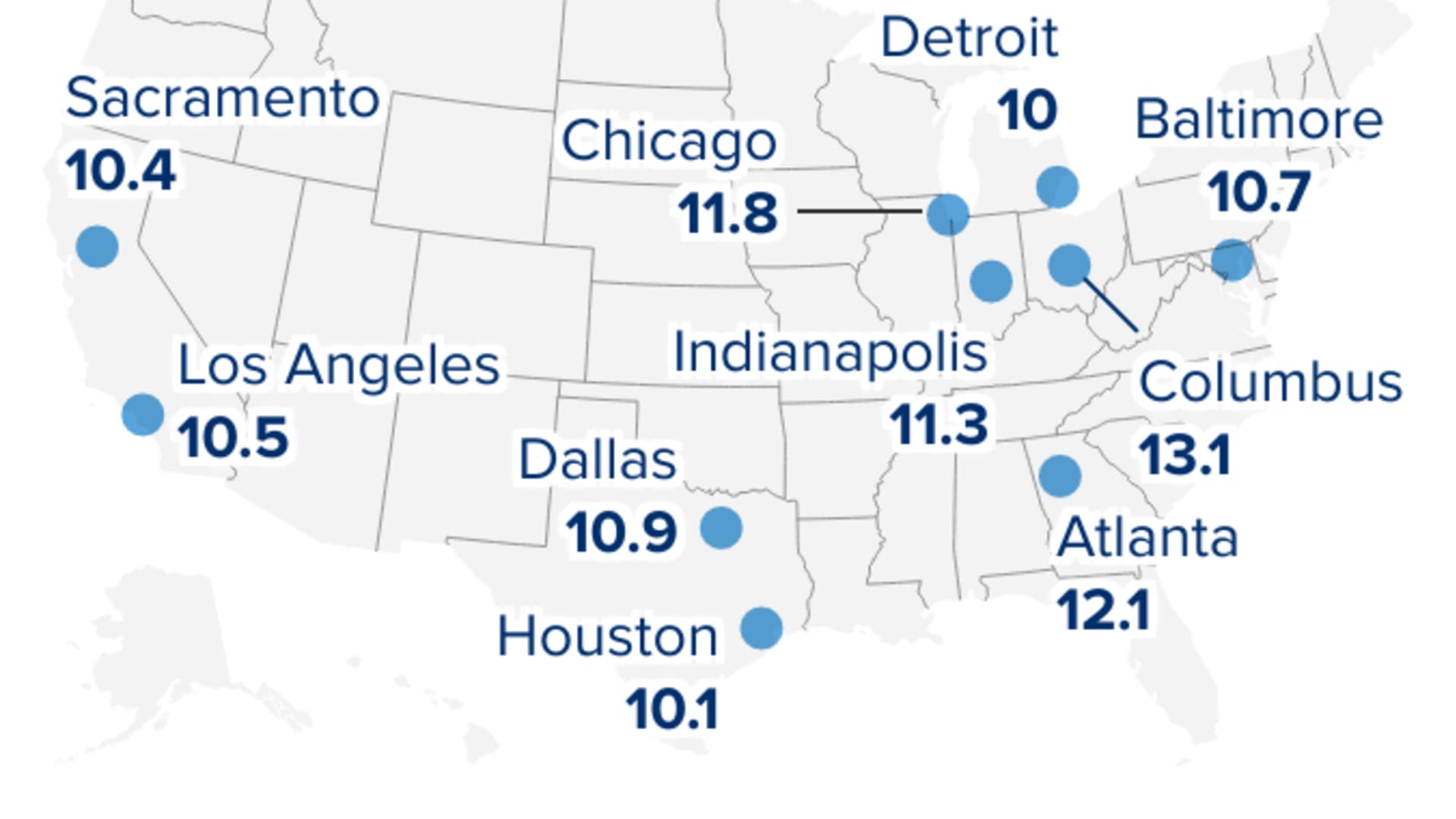
These are the 10 most rent-burdened metro areas in the U.S.

These are the 10 most rent-burdened metro areas in the U.S.


Spencer Platt | Getty Images News | Getty Images

New York is the most rent-burdened metro area in the U.S., according to a new report from Moody’s Analytics.

A household with the median income in the Big Apple would need to pay nearly 69% of earnings to rent the averaged-priced apartment there, the research division of the rating agency found.

Families who direct 30% or more of their income to housing typically are considered “rent burdened” by the U.S. Department of Housing and Urban Development, and “may have difficulty affording necessities such as food, clothing, transportation and medical care.”

More from Personal Finance:
Biden to revisit ‘billionaire minimum tax’ in State of the Union
Amid inflation, shoppers turn to dollar stores for groceries
Savers poised for big win in 2023 as inflation falls

To not be considered rent burdened in New York in the average apartment, a household would need to earn $177,000 or more a year, said Lu Chen and Mary Le, economists at Moody’s Analytics.

Rents can be disproportionately higher than incomes when “the location is highly desirable from a lifestyle or future income perspective,” Chen and Le wrote in an email. “Both of these are true for a place like New York City.”

Keeping rent under 30% is ‘increasingly unattainable’

For decades, people have been advised not to spend more than 30% of their gross income on housing, said Allia Mohamed, co-founder and CEO of Openigloo, which allows renters to review buildings and landlords across the U.S.

However, Mohamed said, “in high-rent cities, in particular, this parameter has become increasingly unattainable.”

Recognizing that problem, the Biden administration last month rolled out a blueprint for a renters’ bill of rights, which aims to add new tenant protections and curtail exorbitant rent increases in certain properties.

Rent taking up close to half of peoples' incomes, says Bilt Rewards CEO Ankur Jain

More than 44 million households, or roughly 35% of the U.S. population, live in rental housing, according to the White House.

“Renters should have access to housing that is safe, decent and affordable and should pay no more than 30% of household income on housing costs,” the blueprint reads.


Source link

These are the 10 most rent-burdened metro areas in the U.S. Read More »

How To Develop A Personalized Learning Strategy For Your Workforce

How To Develop A Personalized Learning Strategy For Your Workforce


By Subbu Viswanathan, CEO of Disprz, an enterprise skills acceleration platform, 3-time tech entrepreneur, former McKinsey consultant, ITT and ISB alumni.

Conducting corporate learning with a generic approach often fails to capture the learner’s interest. One of the best ways to motivate employee learning is by embracing personalization. A personalized learning approach gives dedicated attention to employees’ personal growth to ensure development and career advancement.

Recent research found that “93% of high-performing organizations agreed personalized learning supports an employee in reaching professional goals more efficiently.” Before we see how to develop a personalized learning strategy, let’s get to the basics and understand what this learning and development (L&D) technique really is.

What Is Personalized Learning?

Personalized learning is an employee-centric L&D approach that tailors training to an individual’s job role, needs and interests. This smart L&D strategy aligns skilling with a learner’s skill gaps and career path.

In a world where everything from e-commerce platforms to movie streaming apps is personalized, providing the same “just for me” experience is pivotal to grabbing employees’ attention. Making personalized learning a part of your L&D strategy can be very beneficial for your organization. Those potential benefits include:

1. Boosting employee engagement

2. Improving knowledge retention

3. Maintaining a competitive edge

4. Boosting career development

5. Increasing employee retention

5 Steps To Develop A Personalized Learning Experience

Many companies, like Netflix and Amazon, have tapped into personalization to enhance user experience. But how can L&D leaders like you implement personalization for employee learning? Here are five steps to develop a personalized learning strategy for your organization.

1. Set Learning And Business Goals

Before you commence your personalized learning journey, it is crucial to set learning and business goals that act as a benchmark to measure progress. You must be clear about what you want to achieve for a department/role before investing time and effort in creating their personalized learning journey.

To effectively set goals, work with the business heads to understand the objectives for each department and coordinate with the team leads to establish goals for each individual. For instance, a business aims to achieve a 30% increase in revenue in the next year. To link this goal with the teams, you want to set business goals for each department and learning goals for each individual within that department. This can ensure personalized learning efforts are aligned with business outcomes.

2. Create A Skill Inventory

One of the most crucial steps of personalization in learning and development is to bridge the individual skill gaps and improve employee performance. That’s why it is imperative to have a skill inventory that defines the skills needed for each role in your organization. This can give you a bird’s eye view into what skills matter for different roles in your organization.

Here are a few steps to building a skill inventory.

• Based on industry standards, list the skills for every role.

• While creating the list, consider your business objectives, variety of projects and key areas of the specific role.

• Categorize them into technical, functional and leadership skills.

• Use a number scale to grade every skill level. For example:

1. Novice

2. Advanced Beginner

3. Competent

4. Proficient

5. Expert

• Manually perform the skill research, or leverage advanced learning technology, like a Learning Experience Platform (disclosure: my company offers this product), that can assist you in identifying and benchmarking skills for each role.

3. Assess Employee Skill Gaps

Assess each employee’s skill level using your previously created skill inventory to detect gaps that are affecting performance. Through self or manager assessment, find out the grade for every skill. This can help you determine which skills are missing and which need to be strengthened. For instance, a bank associate could be graded three on a one-to-five scale for account management skills.

Once you have a grade for every role, connect with the team lead and guide them to have a one-to-one conversation with the employees to give them a visual representation of both the existing capabilities with the skill score and the details of the required skills.

Encourage the team lead to collect information about the employee’s needs, aspirations and goals they want to achieve. This data can help you in mapping out a personalized learning journey that can be embedded into the employee’s flow of work.

4. Tap Managers In The Learning Process

Managers have a wealth of information about their teams. This makes them an often-untapped resource for developing personalized learning journeys. It is important to gain the cooperation and participation of the manager to be successful.

As per LinkedIn’s Report, 49% of talent developers globally reported that “getting managers to make learning a priority for their teams” is one of the top challenges they encounter.

Coordinate with managers and bring them into the flow of learning. Take their input on employees’ strengths and weaknesses. With their help, identify the right courses for creating impactful learning programs that employees would willingly complete to enhance their skills. Unlocking employees’ potential and designing personalized journeys that facilitate career progression can be much easier with their help.

5. Identify The Right Technology To Personalize The Learning Experience

To simplify the learning process and make it more accessible and engaging, you can leverage personalized learning technology, like a Learning Experience Platform (LXP). An LXP links skilling and business impact by benchmarking where individuals stand and tracking their skilling progress—allowing you to make real-time amendments to the learning approach.

The market is flooded with many learning technologies. So how do you determine the right tool for your business? Below are the top three features I recommend keeping an eye out for when choosing learning tech:

1. Capable of identifying and benchmarking role-based skills

2. Includes abundant assessments to evaluate current employee readiness

3. Able to auto-generate a personalized pathway

Personalized learning is an engaging experience that allows employees with a growth mindset to enhance their skills. To fulfill this expectation, L&D professionals should develop and implement a personalized learning strategy by setting the right goals, assessing the company skill gaps, creating a skill inventory, incorporating the right technology and ensuring the manager’s buy-in to drive maximum impact. By following these steps, your employees can receive a personalized learning experience that captures their interest and bridges their skill gaps.


Source link

How To Develop A Personalized Learning Strategy For Your Workforce Read More »

The 3-Step System to Scale ANY Real Estate Portfolio

The 3-Step System to Scale ANY Real Estate Portfolio


You need to know how to scale your real estate portfolio. You’ve been stuck at the same number of units, dealing with the same problems for far too long. But what can you do? At what point do you reach a limit to the number of rentals you can take on? Is there even a limit at all? For most investors, hitting a wall in your real estate portfolio can feel like the beginning of the end. For David Greene, this just shows that you need to scale a little smarter. And today, he’ll show you exactly how to do it.

David, at one point, had a portfolio of over fifty single-family homes. As a result, he was constantly getting calls about evictions, maintenance issues, late payments, and the everyday landlord headaches. He realized that he was spending all his extra cash flow fixing the regularly sprouting problems, so he decided to pivot. Now, he has a cash-flowing, profitable, passive real estate portfolio with multiple types of rentals nationwide and far fewer headaches. Not only that, he’s leading a top real estate agent team, teaching his top agents the same skills in his newest book, SCALE: A Successful Agent’s Guide to Leveling Up Their Real Estate Business.

In it, David teaches top agents how to leave the mundane headaches behind and start building a business. But this book isn’t just for agents. If you’re an investor, the same rules apply to you, and learning these skills can help you leverage time, money, and other workers to help you grow an even bigger business.

David:
This is the BiggerPockets Podcast show 724.
If you don’t learn lead, you never get to scale. You will always be managing the people that you have leveraged. You will have a high paying enterprise that is probably doing very well financially, but you are still very much involved in. When you get to leadership, you actually are able to influence large amounts of people over shorter amounts of time. You can scale to something like what Chick-fil-A has or you can scale to something like what Ken McElroy has with his real estate portfolio. You can get really good at whatever it is you’re doing and do it and mass if you can learn the skill of leadership.
What’s going on everyone? This is David Greene, your host of the BiggerPockets Real Estate Podcast here with a special episode for you today where I get to talk more. In today’s episode, Rob is actually interviewing me about scaling a business. Rob, I’m going to hand it over to you.

Rob:
That’s right. We interview you, thy David Greene, the titular host of the BiggerPockets podcast. Man, I’m excited. Like I said, the roles are reverse. I got this pseudo power, I had all this pressure to succeed. But I’m excited, dude. This was a really good episode where I feel this is a masterclass on scaling. We talk about so many good things for people that are really at that level where I guess they can’t get to that next level, they can’t expand their portfolio and we really dig through a lot of the concepts that might help people do that, right? We talk about your three dimensions of success, which break down to learning how to do your job, leveraging other people and leading. This is really, to me, the golden nugget of the day. So I’m excited for people’s mind to be unlocked on air today. What was some of your favorite parts?

David:
Well, everyone listening to a podcast like this, you and I, because we listen to our own shows, the goal is to make more money, have more success, have a better life than what we have right now. It’s very simple. A lot of us have that drive to get there, but we don’t have a direction of understanding how to do it. Or what’s even worse, we don’t understand the factors that are working against us in trying to accomplish it, which just leads to frustration and shame and guilt and this feeling like you could be doing more. So in today’s show, we’re really trying to get deeper into what stops people from having more success as well as layout a clearer path of step one, step two, step three, what it takes to start learning something and then what the next step is and then the next step is. Some of my favorite parts was your commentary. I thought you were very funny today and you did a very good job getting stuff out of me that other people don’t.

Rob:
That’s right, man. Well, it’s always really fun to get into your mind because I’m always exposing how unorganized and not where I want to be. So this is a very inspirational episode. So we’ll get into it here, but before we do, today’s quick, quick, quick tip is brought to you by David Greene.

David:
Today’s quick tip is, if you’re having a hard time figuring out why you’re not making more progress in real estate investing, in business, in anything, it might be because you’re taking the wrong path. Start asking yourself the question of what feels heavy and what feels light. Typically the things in life that we are good at, that we have skills, that fate has blessed us with doing feel light, we don’t mind doing them. And the stuff that we are not good at that we should be leveraging out to other people feels heavy and we can’t stand it. I noticed this is often the case with very seemingly insignificant tasks that I just put off forever because I hate them. Those are the first things that should be leveraged out. Rob, what do you think?

Rob:
I got a bonus quick, quick, quick tip, and that is to pre-order your newest book, David, SCALE. If you pre-order it before February 16th, you’ll actually be entered to win one of 10 seats on a coaching call with you, David Greene, right?

David:
That is right. And a little bonus there, if you order all three of your books and the Top-Producing Agent’s series SOLD, SKILL, and SCALE on the BiggerPockets bookstore, you’ll also get a free month of your exclusive Wealth building Mastermind, which is just like the craziest deal of all times. So if you guys want to be entered in to get all those good bonuses, head over to biggerpockets.com/scale right now and use code SCALE724 for 10% off of checkout. Remember, that’s SCALE724. And if you stick it around until the very end of the episode, you’ll understand why we chose that promo code.
Very good. Rob, you’re getting much better at these intros.

Rob:
It’s called a callback. I read it on Wikipedia. I think it’s supposed to be important.

David:
All right, well let’s get into it.

Rob:
David Greene, you have written five books with nearly 500,000 copies sold. That’s a lot of investors and agents here helping. You’re also the titular host of the BiggerPockets podcast, the biggest real estate podcast in the world. We know you, but David, who are you and why are you here today?

David:
Well, that’s the first time I’ve ever been called titular, I can say that. Well done.

Rob:
I’m pretty sure I used that correctly. I honestly don’t know.

David:
I mean it sounded intriguing at least. People are Googling right now, like how do you spell that and what does that mean. We should let you host more often. You’re going to come out big words like this.

Rob:
That’s my SAT word of the day right there.

David:
Who am I? I am much more like our average listener than I am like your average influencer. So I was a blue collar guy. I started working in restaurants when I was young. I went to college, didn’t know what I wanted to do, got a psychology degree. My very last year in college, I switched to a criminal justice minor, ended up getting into law enforcement. Did that for a while. Kind of saw how negative the relationship between law enforcement and the public was going. Realized I didn’t want to do that until I was 50. Started investing in real estate.
I had just been really good at saving money for a long time and then I started learning how to invest that money. Caught a wave of inflation that really helped with rising rents and increasing property values. Learned strategies like the BRRRR method and long distance real estate investing. Built myself some wealth, became a millionaire through real estate and didn’t even know it until I was around like 30 years old when I actually started to track my net worth and then said, “Okay, this was really hard to figure all this out. Let me start writing books for other people to teach them how to do it.” So I got out of law enforcement, became a real estate agent, learned the hard way how to just make money being an agent at all. Then I became a top producing agent. So I was the top in the office and I was one of the top in the country. And then I built a team to take over the agent business I had called the David Greene team and I wrote three books for BiggerPockets on those.
So I’ve written SOLD, SKILL, and now this newest book, SCALE, which is teaching real estate agents how to be good at their job. And then we mentioned the BRRRR book and Long-Distance Real Estate Investing.

Rob:
I’m glad you clarified that because initially we were talking about I thought this book SCALE was about how to scale a fish and turns out not that I was like, “Wow, that’s a big pivot, David.”

David:
You know what’s funny, a big part of the SCALE format is comparing fish, catching the fish, cleaning actually within business. That is an analogy I rely on heavily in the book. So it’s funny that you came up with that.

Rob:
So I’m not completely off. We’ll, we’ll get to that analogy a little bit later because I’ve heard you talk about it. That’s always a really good one. But tell us, how does it fit in with your other two books? Because you have written a couple of books here. Is this sort of the final one? Is there more in the series? Is this the culmination of your grand catalog of books?

David:
Not of books, but for the top producer series with BiggerPockets that was written for real estate agents it is. So the dirty secret in my opinion, subjectively speaking in real estate sales, is that most agents are terrible. I don’t think it’s that big of a secret because you hardly ever find a person who says, “My agent crushed it.” Even the best agents, you’re frustrated the whole time. Just it’s hard to be good at it. People don’t understand what the industry is like as a real estate agent. It’s not really architected or engineered to be beneficial for both parties. So it turns into a much more adversarial relationship with the investors or the clients and the real estate agents that it should be.
So the book SOLD was written just to teach agents what I wish that when I had had a broker that would’ve told me. No one tells you how to start a business, how to work a database, what scripts to use, what your job is. They don’t tell you how to use the MLS, they don’t explain anything. Let me tell you how to open a lockbox, you got to figure it all out. So SOLD is written just for the new agents who aren’t making money and don’t know why. That’s just to get you profitable.
SKILL was written for the agent who knows how to be an agent but wants to become elite. They want to be a top producer, they want to make good money. No one becomes an agent to just make average money. You just keep your W2 job if that was the case. So SKILL is all about excelling at your job, delivering a really good listing presentation, having a buyer’s presentation, how to talk to clients, understanding what I call the sales funnel, which is the five steps of taking a person and leading them down a process of becoming a lead and then a client, and then an escrow and then a closing, and the actual work you’re doing in between every step to just give some direction and doing really well.
And then SCALE was written for the person who wants to take a job they’ve become very good at and turn it into a business. And at that point, you can either turn it into semi passive income, much like owning investment property. You own a business and other people are doing the work and you are managing that business. Or, scale it huge. Now that I’m not having to actually write the contracts and talk on the phone to the buyers, I can open up expansion teams in different parts of the country. That was probably the most fun book to write because the principles in this apply to not just real estate agents, but to business owners everywhere including real estate investors.

Rob:
Yeah, I’m excited. We’re going to dive into your writing process a little bit and actually ask you a little bit of the nuts and bolts of what it’s like to be such a prolific writer. But before we get into all that, I do want to ask, I know that you are a man of many businesses. You’re a renaissance man of real estate, you got a brokerage, you’ve got an agent team. The book may seem like it’s framed for agents, but knowing you and how you are so prolific with your metaphors, I just wanted to ask, how are we going to tie this to investors who don’t care about scaling their agent business? There are other people that this applies to, I’d imagine, right?

David:
Yes, it’s absolutely true. The reality here is I only learned how to create a real estate agent team out of a job using the principles that I had done with my portfolio. So long before I had ever created a real estate agent business, I had created an investment portfolio that is a form of owning a business. Being a real estate investor is being a business person. You are gaining assets that produce income. You’re trying to control expenses. Instead of looking for clients, you’re looking for properties. You’re constantly leveraging the workout and trying to find a better team. You’re looking for better property managers. You’re looking for better lenders, you’re looking for better loan opportunities. You’re looking for better locations to invest in, for better agents to help you, for better handymen.
So much of our lives, like for you, focusing in short term rentals is controlling expenses and controlling the customer experience and trying to systemize the things that come up a lot without handing complete control over to another human being that can run it into the ground without you seeing it. You could call it a game, you could call it a challenge. There’s different words to use there, but it’s a pattern that pops up in any form of business. If you’re Alex Hormozi and you’re starting gyms, if you’re Rob Abasolo and you’re buying short-term rental properties or running courses to teach people how to do it, or you’re David Greene starting a mortgage company or buying my own rental properties, these patterns reappear over and over and over, and the books are written to help the people who are just starting to get into this to recognize the pattern when it first comes and get a head start on creating a process to systemize these challenges that come up so that you can run a profitable business.

Rob:
Business. Yeah, I think one of the things I’ve learned over the past couple years is that without systems, scaling is effectively impossible. Or I guess, scaling efficiently cannot be done without systems, right?

David:
That’s absolutely true. If you don’t understand how to implement systems, and then the next step is actually make the step forward to fail at it. No one starts a system and immediately has the perfect system on the first try. Nothing in life works that way, but yet that stops a lot of people from doing it because they know they can do it better themselves and if they do it with someone else. If you don’t do that, you never get to the point where you can own more than a handful of rental properties.
So take you as a short-term rental investor, I’m a short-term rental investor. Actually, this is a really good analogy. If you’re someone who starts off like you did Rob and you’re managing them yourself, full-time, you quit your job, you don’t have a family, the ideal situation, how many of those suckers can you effectively manage at one time in a portfolio?

Rob:
Five to 15.

David:
Right? There you go. Depending on the area.

Rob:
How good you are.

David:
Depending the guest is and how good you are, right?

Rob:
Yeah.

David:
But even then, if it’s just you, even 15, if you have no help, no admin help, you just have software and you, it’d be very difficult to manage 15 short-term rentals, coordinating all the cleaners yourself, not having any form of administrative support. To do a good job, you’ll probably capped somewhere at that, like five. A stud could maybe do 15, right? So you cannot scale if you do things yourself.
When I bought mine, I had watched the process that you were going through and that other people had went through, and I just said, “I’m never going to manage these. I’m going to hire a property manager right off the bat to deal with this type of stuff.” And I put a strategy together to accumulate them in a way that I could rely on property management to run it effectively. You can’t just leverage any property to a property manager and trust they’re going to do a good job. The location, the asset type, the type of tenant that’s going to be visiting the property manager themselves, they all go into this.
So I was able to buy about… I have 12 functioning short-term rentals right now that I forget exists most of the time unless I’m talking to the bookkeeper and looking at the numbers right out the gate versus the process that someone else who doesn’t understand business scaling would have to go through. It would maybe take years of managing it themselves, trying to get someone else involved, failing, trying again, buying too many, selling a couple off. It’s this very slow process to get to the point where what they want is financial freedom in a big portfolio.

Rob:
Yeah. Yeah. Well, let’s just dive into a system really fast because I think we say this word a lot. We say systems, processes, and automations quite a bit on the podcast. I think a lot of people probably just who… There’s like two types of people, right? The really organized type A person and then there’s like the creative, everything floats in the ether kind of thing. So for me, when I hear system I freeze up because I’m like, “Ugh.” But it’s really not that complicated of a concept, right? So what exactly is a system as you define it?

David:
A system is made up of two pieces, and I talk about this in SCALE. Everyone gets the first one and then they mess up on the second piece. This is why people have a hard time with systems. The first thing that makes up a system is an order of tasks or a checklist of things that need to be done. It’s that simple. So if I’m selling a house, a system would be a list of all the tasks involved in getting a listing. First I guess it would start with getting the listing presentation ready for the client. And then once the listing agreement is signed, there’s a process of getting the house ready for the market. And then once it’s on the market, there’s a series of tasks for keeping the seller updated and marketing the property to buyers. And then when it goes into escrow, there is a series of tasks involved with completing all the paperwork, negotiating and bringing it to close.
Okay. So there’s like four steps to the system of selling a house. Every single thing in business has a series of repeatable steps. If you owned a restaurant, I could outline for you the system involved with what the cooks are doing to cook the food, who’s ordering the food, the waiters have a process of how they’re supposed to put the order in and make sure it goes to the table and bring the customer their check. It’s a series of tasks that are repeated all the time.
The second piece to a system is what everyone gets wrong. Most of us understand we need to write out all the tasks that are involved in the job. The second part is having a person that can execute it with skill. What I see is people make the task and they hand it to an admin who doesn’t have skill in that area and it all falls apart and they say, “Yeah, systems don’t work.” When you’re the person doing it, you’re usually doing it well, which is why if you have a series of tasks and you then follow them, you’re your own system. In order to scale, you have to take those two pieces and you have to bring other people in to do the job. And that’s what I found the challenge in business has been.
I’m very good at outlying a series of operations that need to be done. I’m very good at anticipating where things will go wrong and even putting training in place to prepare, but it doesn’t matter if I don’t find a person who’s good at accomplishing those tasks. You actually still have to be good at things in life if you want to be successful. And that’s the second part of a system.

Rob:
Yeah, man, you really nailed that on the head. I mean, it’s two things, right? It’s delegation of this kind of written out system you talked about, but it’s also some level of management is still needed to that person because a lot of the times people tend to empower employees too much at the very beginning and they sort of leave. They come back and then they get mad that the employee failed, but there was no oversight to make sure that the system was perfected.

David:
Yeah, and that the person who was working through the system understood the importance of it. So let’s say for you, you own an Airbnb, you’re managing it yourself and you get a customer who’s unhappy because the hot water isn’t coming out of the shower, okay? You are not just thinking your job is to get the hot water turned on. That’s how a person who’s not taking responsibility thinks.
A person who is taking responsibility thinks, “My job is to make the client happy so they leave a good review when they come back. And a part of that is getting the hot water turned on, but that my responsibility is to not just solve a problem or check a box, it is to achieve a result.” And that’s the best way I can describe what responsibility within business looks like. If you take the approach of, “My job is to accomplish a result, to find a cash flowing property, to add equity to a property, to keep a guest happy, to increase rents,” you take a much different approach than when you’re just working off a series of checklists where the client calls and says the hot water’s not working.
Well, you call the handyman, they go out there, they fix a thing, you check the box, you pat yourself on the back and you say, “Hey, I did my job.” But you don’t ever talk to the client, you don’t apologize, you don’t see how they’re feeling, you don’t dig in. And then they leave a one-star review and the employee says, “Well, not my fault. Not my problem. It’s not my house. I did my job.” That is what’s hard about scaling, is you have to have, it’s funny, a system in place to check the people that are working your system, and you have to make sure that their heart is in the right place so that they are perceiving their responsibilities with the same level of responsibility that you as the owner would have.

Rob:
Yeah, so effectively you’re basically saying you want your employees to not look at things so binary, so black and white. There has to be a little bit of, I guess compassion or empathy for the employer or for the owner of that business to make sure, I don’t know, that your vision is being executed correctly, right?

David:
Yeah, they have to care. They have to give a crap would be another way to put it, because the person visiting your Airbnb isn’t going to think, “Well, this was an amazing experience except for the hot water. That’s only chalked up due to one employee that works at the company. I’m not going to punish the owner by leaving a one-star review because of one bad apple.” All they know is they’re not happy and they want to let everybody else know, “Don’t stay in this place because you might have a similar experience.”
A lot of the advice I’m writing about in books like SCALE is for the person working in a company that wants to get ahead, that wants to own their own business someday, or wants to make more money within that business and they don’t understand the power of responsibility. Every business owner out there has given us a hallelujah amen as they’re listening to this, right? Every person who’s an employee might be baffled or confused. So many human beings have come under this delusion that avoiding responsibility is winning. I don’t know that our industry as real estate investors has done much to help. There might have even been… It might hurt it because a lot of the time real estate investing gets sold as the alternative to hard work, the alternative to working for the man and being a slave for someone else. It paints this picture that if you get out of that world and you come into this one, you just buy a couple houses and you’re done, you can do whatever you want. It’s actually the opposite.
Responsibility increases when you take over the asset that you’ve invested your money into. It is more pressure that is on you to perform better at this job. And the best way that people can prepare for making more wealth themselves is to take on additional responsibility where they’re at. It’s kind of like adding more weight to the bar when you’re working out. Building up your strength, learning how the systems work, not just what your job is to do, but why your boss put that system in place, what problem they’re trying to solve. Understanding that will equip you way better when you start building your own portfolio, you start buying your own houses, you got to take the call from the unhappy guest and you realize, “Oh, there’s more to this than just getting that water turned back on.”

Rob:
Sure. Yeah. Well, I think that begs a really important question, right? Obviously knowing your strengths are important, but knowing your weaknesses is probably even more important. So how do you evaluate that as someone that’s looking to scale in the real estate business?

David:
Understanding your weaknesses is the biggest thing. So your weaknesses not only will… We tend to look at that and think, “Well, that’s where I’m going to make mistakes.” That is true, but that’s not the most dangerous thing in a weakness. Your subconscious is very aware of your weaknesses even if your conscious isn’t. And so what happens is we will avoid putting ourselves in situations that we know will expose a weakness even if putting ourself in that situation might be very profitable.
So if you’re a human being who knows I haven’t really done enough research on this topic like I should have and you’re invited to speak at a meetup, that might be very beneficial to your business, you’re going to get all the eyeballs on you. You’re going to opportunity to teach the people what you do. Let’s say that you’re a loan officer, that’s a chance you could pick up some clients that you could close loans for and make money. But you’re not paying attention to what’s going on in the market. You’re just checking boxes for someone else working a system they made and you’re not actually making an effort to learn how the whole process works. You will have an insecurity that comes from your weakness of not having enough knowledge. And what will happen is you’ll decline the invitations to speak at the meetup and you won’t ever realize how much money you lost by not taking action.
We always notice the money that we lose that was already ours. Something goes wrong, you got to fork over a guest another five grand. It sucks. You hate that. But you never realize the money that you could have made had you taken more action or been more decisive or had more confidence. That’s where your weaknesses are really hurting you. So understanding what they are, being honest with yourself, and then finding other people or other software or other systems to accommodate those will sort of allow you to take the steps that you need to take to scale and make more money.

Rob:
Yeah, that makes sense. So one of the big, I guess, pillars or one of the big topics and fundamental philosophies of SCALE is the purpose of leverage. I know that that’s obviously important, right? If you want to scale, if you want to get to millions of dollars in real estate in your portfolio, leverage is going to be a very necessary thing. So talk about a little bit. What does that mean? What is leverage? And how does leverage fit into the grand scheme of real estate?

David:
Well, if you think about just using a lever to pry something open, it’s really a… What’s the word I’m looking for? Like a physics type of a concept. You take a really long bar and that can be used to generate more energy than if you just try to use your hand to pry it open. If you think about the Pirates of the Caribbean quote with Johnny Depp, that, “Leverage! Leverage!” And they use it to do things that normally one person couldn’t do. There’s different ways that you can utilize that same concept in your business. The one we talk about all the time kind of become synonymous with the word leverage is money. I’m going to buy a $500,000 property, but I’m only going to use $100,000 of my money or my strength. I’m going to use $400,000 of the bank’s money or the bank’s strength. And there the leverage of the bank allows me to buy a property five times bigger than what I could have bought on my own.
The same thing is true of human capital. You get administrative assistance, you get property managers, you get real estate agents that are working with you and growing your business. You get handyman, you do contractors. If you had to do every single thing involved in buying real estate just on its own, no one would ever buy a house. We’d have to learn how to read title reports. We’d have to learn how to secure financing on our own. We’d have to know all the rules and regulations and paperwork involved in a transaction. We would have to be able to inspect a house on our own. You see where I’m going? No one could ever buy a property if you had to do everything yourself. So you’re already using leverage when you buy. When you become a business owner and when you’re scaling, you are getting intentional about learning how to be better at using other people, other software, or other money to do things you could not have done on your own.

Rob:
Okay, so it sounds like the way you’re breaking it down is leverage is two things effectively, right? There’s leveraging money, which is like you said, taking $100,000 and using that to get a $500,000 loan with the bank. You’re using other people’s money to help you scale your portfolio that way. And on the second part, what it sounds like is you’re really leveraging time, right? That’s what it comes down to. You as a single operator cannot physically do everything that it takes to run a 5, 10 unit portfolio, but you can leverage other people’s time to help you leverage sort of an infinite amount, right?

David:
You can use other people’s competence to help you do things. So if I use a home inspector, I’m not just getting the time back of inspecting a home. I’m saving years and years and years of experience that I would need to be able to do what that person does. You can leverage other people’s skillset, right? I might have you have a phone call for me instead of me because you can get to the end result faster. You can leverage other people’s knowledge. That’s what we’re doing on this podcast. People are listening to us and learning things that they would normally have had to lose money to learn. But by listening to us, they’re saving themselves the money, the pay and the time, the heartache of having to do it themselves. So we are all leveraging all the time. It’s nonstop, right? I’m leveraging the convenience that Google creates and allowing me to search for things quicker or store things in the Google Drive. Scaling is just about recognizing we’re already doing it and becoming better and more purposeful about ways you can do it more efficiently.

Rob:
So it kind of goes back to the strengths and weakness thing, right? Because you understand what you’re good at, so what you’re good at is going to give you the most leverage whenever you’re using your strengths to, I guess, run towards your goal. And if you’re really weak at something, if your weaknesses are, let’s say like you said, your skillset may not be needed on the phone call but you bring someone else’s skillset on there to get you to that end goal, then you know that it’s important to leverage someone’s competence. So really it seems like strengths and weakness identification is a pretty pivotal moment for you, right?

David:
Yes, that’s a great point. Some of the tools I use for that that I talk about in the book and in other places are the DiSC profile. So that’s a personality assessment trait that will help you identify what people tend to value in communication. Because what I found is what you communicate is what you value, and it’s almost always your strength. We don’t communicate in areas of our weakness, we communicate in areas of strength. So when I can identify somebody else’s mental makeup via the use of a tool like DiSC, I give myself a huge advantage in knowing what area of my business they would be better in. There’s certain profiles that work better for sales or for management or for analysis or for driving a project forward. That’s just a tool that can be used as you’re trying to understand what strengths and weaknesses are with different people. And the wise investors out there that are trying to grow a big portfolio, they’re already doing this even if they don’t recognize it.

Rob:
Yeah, definitely. So it sounds effectively like systems, identifying weaknesses and strengths, leverage, they all sort of tie into the end result that we’re all trying to get to, which is success. I know that one of the big things you talk about in the book is that there’s three dimensions of success, right? So walk us through that concept and what does that mean for the everyday investor?

David:
So this was something I had to learn the hard way. I became a real estate agent and my immediate frustration was there’s no one to teach me how to do this job. I actually had my license, went to the office, met with people, came in and had a question on how do you run a, we call it a comparative market analysis, just like how do you look at what the act of pending and sold properties are, nobody would help me. And I was so disenfranchised I spent six to eight months after that never going in the office again. I was just pissed. Like, “This is no point. My broker sucks. Nobody’s supporting me here.”
I finally had a cop friend who came to me and said, “Hey, do you want to sell my house?” And I had told him I would. I almost felt obligated to go take this listing, which as an agent is the best thing ever. We fight mad to get listings. That’s, “Anyone listening, please come to me if you want to sell your house.” So I had to call a friend and have him show me how to use the MLS to even run a CMA to figure out what I should sell his house for. It was not a good experience for me. And then once I learned that, now I had to learn how to negotiate.
I remember on that first deal I made this really big mistake where I got the buyers to waive their appraisal contingency, but they still had an inspection contingency. And then the appraisal came in low. I was really new, and so I just thought like, “Well, they have to pay what they said they were going to pay for. They don’t have an appraisal contingency.” But the agent made something up about poop in the backyard from the dog as the reason they were backing out of the deal, but then told me, “Hey buddy, you don’t know what you’re doing. We have an inspection contingency, we’re going to use that to back out.” And I was like, “Oh, that’s evil. You’re lying,” right? But I just was naive. I didn’t understand how the game got played. So I went through this process of having to learn a lot of things the hard way.
I first started reaching out to my database of people in my life that I hadn’t talked to for six or seven years and my first conversation was, “Hey, I’m a real estate agent now.” Bad mistake That’s like when your friend that you haven’t seen since high school wants to talk with you about a multi-level marketing opportunity, you’re immediately just like, “Ugh, I don’t want to talk to you. I don’t like you anymore.”
So I went through this process of learning. This is the first dimension of success. If you just consider a spectrum with zero on one end and 100 on the other with 100 symbolizing perfection, all of us are in some capacity learning how to be good at our job. It’s knowledge and the execution of that knowledge. So learning how to be a good basketball player, learning how to be a good snowboarder, learning jiu-jitsu, learning how to be a good barista, whatever it is you’re doing, there’s people that go to work every day and give a half-hearted effort and don’t really move along that spectrum very far so they don’t make more money. And there’s people that go to work every single day and push it as far as they can trying to get to 100.
So for you, Rob, I don’t know because we’ve never talked about it, but I would be willing to bet when you were a copywriter or you were in advertising, you showed up every day trying to learn from the people that were good at it, trying to gain as much knowledge as you could from the mentors that crushed it there, really giving your best effort. If you’re in the gym, you’re working out to failure every single day because you want to get stronger and you got better and better and better and better at the job and gain more skills. The first dimension of success is just committing to the process of being good at what you do.

Rob:
Yeah, it seems like there’s also a little bit of… It’s sort of like this funny juxtaposition of success is learning how to do your job. But a really big part of learning how to do your job is failure, right? It is the failures that make us successful. So that was a big part of my advertising career where I would always see the rock stars at the agency and I would go and sit next to them and, “Hey, what’s up? What are you guys talking about? You guys got any ideas? Can I share my ideas?” And they always say in advertising to fail big, right? So it is a very awkward and very uncomfortable thing to walk into a room and present a really crazy idea that you know will never get accepted, but you still do it anyways just to gain a little respect with the peers in the room that you put it out there. And it’s through that that you kind of get better.

David:
Yeah, through failing you get feedback, which is something in the next book I’m writing about, I talk about the feedback learning cycle, where the quicker that you put something into process or you start something, there’s a process, then you get feedback on how it went. The quicker you can get to feedback, the quicker you can adjust the first two steps. And you actually improve how quickly you can learn by proactively putting yourself in a position like you just mentioned, right? So these are all stuff I read about in books that are about, “Hey, you want to be better and get more money? It starts by getting better at your job.”
Money doesn’t just come to you, you’re not owed it. No one’s going to go find a great deal and hand it to you because they feel bad for you. That’s not the way the world works. You want to get better at learning. Well, what I realized as an agent was I got to a point where I was selling probably 40 houses a year and I could not do anymore. It was barely hanging on to be able to sell 40 houses a year. And I realized I had to get other people to help me, but I didn’t realize that that was a completely new process where I would be starting over at zero.
So I talk about the second dimension of success is leverage. Leverage is all about developing the skill of creating systems and managing other people to get them accomplished. I knew I needed to use people. What I didn’t understand is I had hit the hypothetical 100 on the learned dimension, so now I have to go in a new dimension. I’m going up. If you imagine Mario running across the screen left to right, that’s the first dimension. Now he can jump, that’s the second one. But no one told me I’d be starting at zero, that I would hire people and fail, and hire people and fail, and hire people and pour and pour and pour into them and continue to fail.
It’d be similar to if you were running a rental property and you were managing it yourself and you got to the five short-term rentals and you couldn’t do anymore. And so you just hired someone and said, “Hey, here’s what you do,” and they ran it into the ground and you just thought, “Oh, leverage doesn’t work.” It’s because you don’t understand that there is a skill to leverage also. You start at zero and you have to build up to 100 on this new dimension. Nobody tells you that. So a lot of people get to that point and they quit. They’re like, “Well, I tried it. It didn’t work. Not for me. I’m just going to quit.” But you didn’t quit when you were learning. You made tons of mistakes when you were learning. You just expected that that was part of the process of moving along that dimension. You have to go and humble yourself from being at 100 to starting over at zero and making a lot of mistakes as you learn the skills of leverage, the second dimension.

Rob:
Now you mentioned that you capped out at 40 properties as an agent, right? Understandable, right? We only have a finite amount of time. But as an investor, is there a cap there as well on how many properties you could buy? Is there any kind of bottleneck on that end as well?

David:
There is, and that’s why the government created the 1031 kind exchange because I had a similar thing happen to me in my investing portfolio. I was using the BRRRR method in northern Florida and I was acquiring properties sometimes at the point of four to five a month. I was able to get that done with the construction crew I had and the agent that was finding me the deals. I had a bank in place that I had a line of credit where I could fund these and I knew how to analyze the deal to make and buy them so that I was pulling 100% of my equity pretty much out of these deals. I had a property management company to manage them, but when I hit about 50 single family rentals, there came a point of diminishing returns. Every day it was some email of something that went wrong with one of these 50 properties or several of them.
The cash flow on single family houses is not what you hear people talk about. It’s maybe 300 a month, 350 a month on most of these, but then it just takes one bad tenant having to be evicted, that two years of cash flow can immediately be gone. So you’re not making nearly as every time you think you’re getting ahead, something goes wrong and breaks and it comes back and I realize, “I’m not getting the cash flow that I want out of this.” The properties are not appreciating as much as they would be in other parts of the country. It’s not fun because every day I’m coming in, I got to solve some new problem. Property managers can take some of the sting out of maybe 10 or 15, but when you get to 50, you’re still making decisions and following up and all of a sudden now I didn’t want to own the portfolio.
So I sold those homes and I reinvested. I probably sold half of my portfolio, reinvested it into half as much real estate that costs four times as much. That’s a great example of using leverage and capital as well as leverage in business to get out of a situation that was not able to scale any further and into a new one, these short-term rentals that I mentioned earlier, that are much easier to manage.

Rob:
Yeah, well it is kind of funny you’re talking about leverage or I guess your bottleneck here on the real estate side. Capital is a part of it, but there’s also just the actual organization and operations that can really cap you out too.

David:
Yeah. And so at a certain point, I’ll probably keep scaling up on short term rentals. Maybe when I get 50 of those, then I’m going to sell on 1031 into some mega properties or an apartment complex. But yes, you hit this ceiling. Whether you’re investing, whether you’re a real estate agent, whether you have a pool cleaning business or an auto repair shop, there is a limit to every single person where you hit a ceiling and you can’t go any further. The principle that repeats over and over and over is you now need to learn a new skill. You cannot keep doing the same thing you’ve been doing and keep getting good at fixing cars or repairing them or cleaning pools. You have to learn a new skill in leverage to get into the second dimension. The people that do that get ridiculously, exponentially better returns. You make a lot more money when you can have six or seven people out there doing the work that you were only able to do yourself as you manage them, but there is a ceiling that you hit and leverage as well.

Rob:
Yeah, leverage is hard. This is a tough one. I finally unlocked it for myself. But I think where the trap that people tend to get into is with leverage, you’re talking about leveraging other people a lot of the time, right? And so what it means to have other people on your team is one really big thing. You got to pay for them. You got to pay for their time. You got to employ them. And that means when you’re first getting ready to scale and you’re turning that corner like I am right now, you are going to make less money by hiring those people. But as soon as those systems are in place and everything starts churning, you’ll actually make a lot more money in the long run because they will be able to effectively do everything that you could never do by yourself, right?

David:
Yeah. But the point I just want to highlight, that’s how we tell people, that is how it works when it works. The process of getting there is not as simple as we made it sound describing it. And it never is. We tell people, “Here’s how you analyze a property” and they’re like, “Cool, I got the calculator. I got the information. Let me just go out there and analyze properties.” And they do it for three months and they can’t find a cash flow property. Well, that’s the reality, is it’s hard to execute on the information that’s being given unless you figure out a skill. You learn an area where properties are more likely to work. You figure out how to add value to a property, add rental units to it that will make a duplex into maybe three or four units instead of two.
Now, that’s a skill that you figure out that now opens up doors and allows you to scale faster. So leverage is the key, but you’re going to start over at zero. It’s okay. You just have to have humility and know just like I sucked when I was learning how to do it, I’m going to suck at leveraging how to do it as well, but if I stick with it, I will learn this just like I learned how to do it myself.

Rob:
Yeah, yeah. Okay. That’s a very beautiful way to put it. I think it is important to say easier said than done. You got to sort of fail at this, right? You got to learn the job of leveraging to do that well as well, right? So it all kind of ties together. So we’ve got learn how to do your job, leverage, which is maxing out and sort of using other people to help you scale your operations, and then we’ve got the last one here, which is lead. Tell us about that.

David:
Lead is the third dimension that you have to learn if you want to scale a business. So if you look at learn is running left to right on a spectrum on a plane, and then leverage is going up and down, lead would be going further out. It’s literally the third dimension of a cube. Leading is probably even harder than leverage. It’s the hardest of all of them because leaders have to anticipate things where other people can just respond or react to something going wrong. Leaders have to literally influence the emotions and the psychological state of the people that are working for them. That becomes their job.
So you know what this is like Rob. You’ll have a person who’s very good, they’re trained in what you need them to do. You’ve learned leverage, you’ve executed it. You have a person on your team that’s handling let’s say all the customer complaints or they’re analyzing the deals that you might want to buy. You’ve gone through all the growing pains of teaching them how to do it. You finally hit a rhythm and now they say, “Hey, I think I want to go start my own business. Hey, I think that I want to start a family. Hey, I just don’t feel like my heart’s not in this. I was listening to Simon Sinek and he was telling me that there’s more to life than just a job, and now I want to know what are you offering me to give me purpose in life.”
That’s the type of thing leaders have to now deal with. Or when I’ve got several different people that are all doing the same thing, but this one’s doing it better and making more money and this one isn’t making as much money but they don’t think that they’re not as good, how do I keep everyone happy and working on what they’re doing? It’s very difficult. You need to learn psychological skills. You’re going to be taking on problems that no one in the company wants. So the only problems that make it to the leader are the ones that every single other person has looked at and said, “Nope, I don’t want any part of that. I’m passing that one along, okay?”
If you’re a UFC fighter, you are only fighting the toughest people in the world. You don’t get easy ones anymore. And leadership is a dimension a lot of people never get into because they’ve already started over after learn, they’ve gotten leverage down and now they got to do it again. That third dimension is huge, and so they just don’t want to. The problem is if you don’t learn lead, you never get to scale. You will always be managing the people that you have leveraged. You will have a high paying enterprise that is probably doing very well financially, but you are still very much involved in. When you get to leadership, you actually are able to influence large amounts of people over shorter amounts of time. You can scale to something like what Chick-fil-A has, or you can scale to something like what Ken McElroy has with his real estate portfolio. You can get really good at whatever it is you’re doing and do it and mass if you can learn the skill of leadership.

Rob:
David, you make me a better man, my friend. I love this. I really, really, really do because it’s three things, the three dimensions of success. Learn how to do your job, leverage, lead. It’s so simple, but as you explain it, it’s so funny how I can see all the fundamental cracks of my business. I’m like, “Oh, that.” It’s because I’m trying to do it all at once, but it really is starting over from the top. And I think the reason it’s hard to ascend to that next dimension or getting to lead is exactly what you said, which is humility, which is like, “Why do I need to start over? I’ve already cut my teeth on this. I’ve already perfected my skills. Why do I have to go back to the very beginning and sort of suck again?” right? So I really appreciate that. This makes a lot of sense. So help us contextualize this because I can see how this makes sense from a practical business standpoint, but what would it look like for a wholesaler to implement the three dimensions of success?

David:
So the first thing they have to do is learn, “How do I find motivated sellers?” Because you’re not going to get a wholesale deal in a contract if you don’t have a seller that needs a quick sale or they’re willing to sell for less than market value because there’s so many people involved in needing a profit that the margin has to be really big for there to be enough to go around. Once you finally find out how to get the sellers, now you got to learn a new skill. You got to learn how to talk to them. You got to have a really good mouthpiece. Pace Morby well-known for this. We just interviewed Brent Daniels, Jamil Damji. You’ll notice all three of those guys got a silver tongue. They know how to make you feel good. They are very, very, very skilled communicators, okay? The typical wholesaler that’s like, “I have no money, so this is the strategy I’m going to use,” doesn’t have communication skills, they’re not going to do well in the business. So that’s a thing that has to be learned.
Once you’ve got those two things, now you have to learn how to create a funnel where deals keep coming in and you keep putting them in contract and you find an end buyer to give them to. So you have to have the skill of building up a buyer’s list. You’re probably going to need to be able to explain to your buyers what the ARV is and you’re probably going to have to solve some of their problems. You’re going to need construction, handyman crews, different referrals, lenders that will work on properties that don’t qualify for conventional financing. You probably have to accumulate all these pieces to hand to your end buyers so that they’re going to be willing to work with you to close the deal.
Then you got to learn how much money to spend on whatever your marketing efforts are and how to read a P&L to make sure that you are selling for more than you’re spending, okay? That’s a lot of crap that a person has to get good at to just be a good wholesaler. The leverage side would come in where now you are teaching other people how to have the conversation with the sellers at close to 80% of as good as you did, which is hard. It was hard to learn how to talk to sellers. Now you got to convince an employee who doesn’t have an ownership in the business and maybe just wants a job, they don’t want a business like you, how to be good at doing that to effective.
Now you got to teach other people the marketing techniques that you’ve used and hold them accountable to making sure they’re getting the phone ringing as much, okay? You have to leverage off the pieces of that business that you got good at. You got to train a bunch of other people to be as close to as good of it as you were. But if you can do that, you can probably be wholesaling a couple hundred deals a year instead of 10 to 12.
And then the last piece would be leadership. For a wholesaler that wants to get into leadership, they now can franchise their model and say, “I’m going to teach…” Like this is a… What was that? We Buy Ugly Homes. I think that’s one of those, right? They turned their model of marketing and getting properties under contract that were ugly into something that you could now pay them to be a part of this group and they get a chunk of your profits, but they can do this across the country. Or you can take your whole selling technique that works in Houston, Texas where you’ve crushed it, and you can go to Miami, Florida or New York or Southern California and you can use the same systems but adapt them to another market so you can have five wholesaling enterprises all with a bunch of leverage in each one. That’s like a practical application of how these three dimensions would work in a normal business.

Rob:
Love it, dude. I want to ask you how it applies to a flipper because it’s really cool to just hear you break it down so quickly like that. But I know we’re getting to the end of time. Not the end of all time, the end of the time on the podcast. Anyways, before we end here, I actually did want to ask you about your fish cleaning versus fish catching analogy, because I remember when you told me this, you kind of melted my mind a little bit about it because it’s just kind of a really cool way to sum up what business is and basically how one scales, right? So walk us through that and how it applies to scaling your business.

David:
So this is a mystery to people that just have had jobs, they’ve never owned a business, because to them all tasks are the same, okay? Like getting a sale, completing the sale, administrative work, sweeping the floor. It’s all just stuff that has to get done and they go through it with varying degrees of enthusiasm. But when you own a business, you start to see very clearly, “Oh, there’s actually two completely different parts here.” There is a component of catching a fish, getting it out of the water and into the boat that involves a set of skills, knowing what lures to use. This is sales and this is marketing, okay? The skill of setting the hook, that’s sales, like being able to close. Then once it’s closed, the ability to reel it in and get it in the boat without the hook coming out or the line breaking. That’s like your follow up once you’ve got a verbal commitment. And then getting it out of the boat and into the live well. Okay, now like the money’s in the bank.
Once you’ve done that… Or maybe not the money’s in the bank, but the contract has been signed, right? Now, you have to go clean this fish and turn it into a filet that can be sold on the open market because nobody wants to just go buy raw fish, okay? They want a dinner, they don’t want to buy a fish. So when you own the business and it’s just you doing the job, you’re doing all of that. You’re gassing up the boat, you’re spending your capital to buy the boat, you’re launching it, you’re trying to figure out where the fish are. You’re figuring out your own bait. You’re trying to get the fish to bite. You’re setting the hook, you’re getting it in the boat. You catch a couple of them. Now you stop fishing. You got to go all the way back to the dock, launch your boat, get out, clean these four fish, figure out some way to get them to market, get your money for the fish, and then go all the way back and start catching fish again.
The key to business is understanding there are certain tasks that you do that are inherently more valuable than others. So if you look at this fishing example, catching a fish is by far the most lucrative thing you can do. Cleaning the fish, gassing up the boat, sending the fish off to the market, that is something that is easier to leverage because it’s less valuable. So if you had a fish cleaning business, the goal would be to learn how to be as good of a fisherman as you could to where you’re catching so many fish that you couldn’t keep up with it.
The first position you hire for is fish cleaning, which is what I call operations. You split it into sales and operations. Sales is getting a fish in the boat. Operations is getting that fish cleaned and turned into revenue. Your first hires are on the administrative side, they’re on operations for any business. It doesn’t matter what it is, you hire people to do the easier task and they get paid less money because those tasks are less challenging and don’t require as much skill. As your fish cleaner has so many fish to clean, they can’t keep up, maybe you hire a second one and you give them two different tasks. “Okay. Your job is to cut off the head and the tail, your job is to filet.” And you sort of create this assembly line, which is what Henry Ford figured out on the operation side to be efficient.
And then you also simultaneously want to scale out your sales side. So there’s you fishing, but what if you brought another fisherman with you and they fished on the back of the boat and you fished on the front of the boat and you could theoretically catch twice as much fish and you gave them maybe 25% of the total catch or something, right? So they have some incentive here to try to be good at catching fish also, but that person’s going to make more than the fish cleaner.
There’s a couple lessons there. If you’re trying to get really good at operations and fish cleaning, don’t expect to be really wealthy. It doesn’t mean that it’s bad. Not everybody in the world cares about wealth. We need fish cleaners in the world. But if you’re listening to this podcast, you’re trying to figure out, “How do I get out of the place I’m at? How do I get more money?” It’s learning how to catch the fish. It’s learning how to find the deal. It’s learning how to put it in contract and own it. It’s not learning how to be a good manager or a good bookkeeper or a really good… I don’t know. I can’t think of another example of what happens in real estate, but not all jobs are the same. But you do create an org chart as you get better and better at catching fish. And then the more people that come in, the more specific those jobs actually become.

Rob:
Yeah, there’s a reason that sales and the people that bring in the money to the organization tend to make really the most, right? They tend to be the most compensated, right? Because they’re the ones catching the big fish. So thanks for breaking that down. And that ultimately brings us back to the very reason that you titled the book SCALE for fish scales.

David:
That’s it.

Rob:
I knew. I knew. I knew there was a reason, man. Well, before we go, I want to do a very fast author deep dive. I’m going to ask you three questions, fire round style, and I just want you to answer them very quickly for everybody at home. Is that cool?

David:
Yes.

Rob:
Okay. Starting with question number one, who are your book heroes?

David:
Jay Papasan, Gary Keller, Cal Newport, and John Eldredge. They all write so succinct and so solid that every time I read my old books I’m like, “You suck because you’re not nearly as good as them.” With each book I write, I become a little better at being succinct and clear. I think my writing style now is remarkably better than when I wrote long distance investing in BRRRR. But I compare myself to the best of the best of the best that I can find to always be trying to grow in my… On the learn scale, I’m still learning how to be a better author.

Rob:
Well, if it helps, when I read your books, I actually do feel like it’s you narrating the words. So you’ve got that down. I think that’s the most important trait right there.

David:
So you’re saying I’m just as long-winded when I talk as I am when I write?

Rob:
That’s what you said. You’re extrapolating that from what I said.

David:
I appreciate that.

Rob:
Go clean a fish. What is your favorite writing food or beverage?

David:
All right, so writing is actually incredibly difficult. It’s easy to write a book, it’s very hard to write a good book. And so it is very important to be caffeinated for me when I’m writing if I want to maintain the levels of focus that you have to continue to try to articulate points in a clean way that is persuasive and actually conveys nutrients or knowledge. So I started drinking, these are much better than just a normal energy drink, they’re these Sparkling Ice+Caffeine. Of course, the people that are health nuts out there are going to be screaming, “That’s still not healthy!” I know. It’s not, but I can’t stop and go to Starbucks in the middle of writing. That’s like an hour of time wasted. I have to have something in the fridge here in my office.
So I’ll drink those to stay. I’ll just kind of sip on them all throughout the day. I don’t hammer it all at one time. I will often eat corn nuts. I’ve got these right here because there’s not too much sugar and not too many calories in those things. But if I have to stop writing to go get food, it is very hard to get back into it. It’s kind of like when you stop running to tie your shoe and the last thing you want to do is start running again.

Rob:
All right. Or whenever there’s like a stop light and you have to stop, and so you just jog in place just waiting for it to turn green.

David:
Yes, it’s the work, right?

Rob:
And everyone’s just like, “We get it, bro. You run. Just chill.” All right. Lastly, what is your process? Run? Write? Cry? Repeat?

David:
Yeah, something similar to that, man. My writing process, I’ve done this enough times now that I’ve created a system for it, right? And now I am much faster at writing most books. This one I’m working on after SCALE has just been a humdinger. It’s a very difficult book to write, but I think it’s going to be the best book I’ve ever. It’s going to help more people than anything. I’m really excited about it.
But the process is basically I brain dump every single thing that I think should be in the book onto a Google document. So for SCALE, I’m thinking about everything that a person would need to turn a job into a business, and then everything that a realtor estate agent would need to know to do that well. And a lot of it is not just the information what they should do. It’s actually highlighting the enemies that are going to make it hard to do it. Because telling people what to do is not hard. You could tell someone how to go get a short-term rental. It’s very simple. The execution of getting it is completely different because there’s things that pop up over and over and over that prevent us from succeeding. It’s not hard to know how to have a six pack, it’s hard to eat the right food. That stuff is what you’re really trying to master when you’re trying to get good. So I will dump all of it out.
I will then go through this big old list of stuff and I will group it into categories like, “Okay, all these concepts are kind of the same. Let’s create that.” And I create these buckets or categories that are all somewhat related. I then take those and I turn them into chapters. I then look at all the chapters I have and say, “Is anything missing?” Once I decide there’s nothing missing, I put them in the order that I think will have the strongest emotional impact. So you don’t want to start the book off right away telling people how to set the hook on a fish. You got to have them understand the idea is that there’s fish catching and that there’s fish cleaning is the difference.
Once I’ve got the chapters in place, I then break it into all the subpoints that I want to make in that chapter. I’m actually pretty, pretty thorough with my outline. And by the time I have an outline, I basically have a book. It’s then very easy to just go through my outline. I don’t hit writer’s block if I’ve done it well and I just turn every little subpoint into a paragraph or two.

Rob:
Wow. Well, a peek behind the green curtain. As a reminder everybody, if you go to biggerpockets.com/scale, you can pre-order the book right now and use promo code SCALE724 for 10% off at checkout. Remember, that’s SCALE724. And that is the amount of scales that are on a fish. That’s how we got to that promo, SCALE724.

David:
That’s pretty funny. And if you have a real estate agent in your life that you want to help, these books can be a lifesaver for them because they’re struggling and they just don’t know it. It’s very frustrating turning the job. There’s a lack of mentors. There’s a lack of direction. These books are written to be the mentor I didn’t have, as well as all the information I’ve used teaching David Greene team agents how to do their jobs accumulated for other agents. If you buy all three of the books in this series, we’re also offering a one month free membership into my Wealth Building Mastermind. So that is worth way more than the cost of the three books.

Rob:
That’s a crazy deal. That’s a crazy good deal. So go over to biggerpockets.com/scale and use promo code SCALE724. David, before we get you out of here, where can people find out about you on the internet? Where can people connect and do all that good stuff?

David:
They can find me @davidgreene24. Also, if you’re kind of on the fence about the book, I would recommend that you just go to Amazon and read some of the reviews of my other book, see what people think about other things. Or they can follow me on YouTube, also at youtube.com/davidgreene24. You’ve got me much deeper into the YouTube world, Rob, and I appreciate you for that.

Rob:
Hey. Hey, happy to be here.

David:
Where can people find out about you?

Rob:
Oh, you can find me @robuilt on YouTube or on Instagram. But honestly, I think if you heard this podcast today and you were like me where you were sort of your mind was melting and you’re like, have a more clear understanding of how to scale, do me a big favor. Go leave us a five-star review on Apple Podcasts or wherever you download your podcasts so that our podcast can be served up to millions more people to help them scale their real estate businesses. Do that for me and it would mean the world to me and Dave.

David:
Amen.

Rob:
Well, awesome. Well, I’m not even going to try the call sign. So do you have a call sign? Can you close this out? I know I’ll fail miserably.

David:
All right. This is David Greene for Rob, my favorite fish, Abasolo, I’m glad I caught you brother, signing off.


Help us reach new listeners on iTunes by leaving us a rating and review! It takes just 30 seconds and instructions can be found here. Thanks! We really appreciate it!

Interested in learning more about today’s sponsors or becoming a BiggerPockets partner yourself? Check out our sponsor page!

Note By BiggerPockets: These are opinions written by the author and do not necessarily represent the opinions of BiggerPockets.



Source link

The 3-Step System to Scale ANY Real Estate Portfolio Read More »

We expect the residential development market to be slow: Skanska CEO

We expect the residential development market to be slow: Skanska CEO


Share

Anders Danielsson, CEO of the construction and development company, says that also applies to the commercial development market, but infrastructure is expected to be stable for most of Europe.

03:01

Fri, Feb 3 20233:53 AM EST


Source link

We expect the residential development market to be slow: Skanska CEO Read More »

Five Customer Success Metrics That Reveal The True Health Of A Business

Five Customer Success Metrics That Reveal The True Health Of A Business


By Tonika Bruce, CEO of Lead Nicely, who helps startups, nonprofits and leaders WIN with unique & innovative marketing and business strategies!

The success of any business venture depends on two factors: the goals and metrics for defining that success. One of the goals is customer success, which starts with understanding why and how customer success is critical for growth.

Customer success goals might be straightforward, but the real deal lies in metrics. For entrepreneurs already on top of one or more of these CS metrics, monitoring business success will be easy.

Here are five customer-focused metrics that reflect the performance and true health of a business:

Customer Loyalty

Once the business gets off the ground and starts attracting clients, loyalty is arguably one of the most important objectives to focus on. Customer loyalty is reflected in the retention rate. Tracking retention rate will indicate the number of customers that consistently use a company’s product or service over a specified period and—in the case of merchandise—repeat purchases.

The actual number of loyal customers can be calculated with this formula: Retention Rate = [Number of customers at the end of a specified period] – [Number of new customers in the period] ÷ [Number of customers at the start of the period] x 100.

In other words, the retention Rate is the number of retained customers divided by the number of customers at the start of the period x 100. The last step will give you the percentage, which you can use to easily track improvement.

Net Retention Rate And Average Rate Per Customer

Closely related to customer loyalty is the net retention rate. While customer loyalty measures the number of clients that stay with the company, the net retention rate tells of their purchasing power.

Customer loyalty is an excellent foundational customer success metric for a new business to track. However, net retention must be considered down the line as it is more comprehensive. For instance, net retention will tell you how many customers have upgraded or downgraded their product use. These factors can indicate when a customer is about to stop using a product.

In addition to the net retention rate, the average rate per customer speaks of the company’s customer value. While the number of customers matter, one business may have high-value customers while another has low-value customers. You want to be in the former category. To gauge the average customer value of the business, divide the total revenue collected from customers by the total number of customers.

Churn Rate

The churn rate is another success indicator when it comes to customers. Simply put, churn rate is the flip side of customer loyalty, showing the number of clients a business has lost over time.

In SaaS, the churn rate is the number of people unsubscribing from the product, considering product or service satisfaction generally drives the churn rate.

Notably, a high churn rate is a critical telltale sign that the business may not be providing value or the retention strategies are not working. Further, these retention strategies may include activities along the customer journey, such as onboarding, customer support and promotions.

As with average rate per customer, churn rate is another excellent way to determine the value each customer brings, helping you to assess the difference between losing a client paying $200 and one paying $1,000.

To get the churn rate, use this formula: Churn Rate = [Number of lost customers] ÷ [Total number of customers at the start of the period] x 100.

Is there an acceptable churn rate? All businesses lose customers at some point, even the most popular and robust ones. The big question is how many losses can you incur before you enter the red zone. According to Hubspot, an acceptable churn rate is below 8%.

User Statistics

User statistics or analytics indicate customer success in using the product or service. A business can determine its user cohorts (i.e., groups of users with shared traits) by analyzing the user data inside the website or product.

Analytics show the company’s health at a finer scale by revealing how customers adopt, interact and engage with the key product features or, in the case of goods, the types and categories of goods. Entrepreneurs using tools like customer relationship management technology understand how vital this metric is to the growth of the business and customer success in the long term.

Customer 360: Tying It All Together

At the core of customer success is the customer. That’s why gauging the health of a business takes interacting with metrics around the customers. With that said, a Customer 360 touches on all of these metrics and more trackable data and solutions that give businesses information about the customer’s interaction with the business at any point—past, present and even future.

While it takes sophisticated tools to gather consistent, accurate data, a Customer 360 is the single source of comprehensive insight into all the relevant information, which includes but is not limited to:

Product usage history

Purchasing history

Transaction history

Length of time as a customer

Survey history

Inquiry history

Next purchase or renewal

Contract value

The goal of customer success is revenue growth, but it is also worth noting that customer success is customer-focused. From these metrics, the business owner can tell whether that’s the case for their business.


Source link

Five Customer Success Metrics That Reveal The True Health Of A Business Read More »

Why NFL Players Are Buying Real Estate During the Recession

Why NFL Players Are Buying Real Estate During the Recession


Who’s buying real estate? Maybe you are, maybe your friend is, but what about NFL players? Most casual fans would assume that getting paid millions of dollars a year would ensure a long-lasting retirement, but this isn’t always true. For many professional athletes, you’re constantly living one injury away from having no income. If, like many newly-signed pros, you splurge your first few years of checks, you could enter into retirement flat broke without any of the millions you earned.

This is the exact opposite of what Cliff Avril and Devon Kennard did. They knew that their career earnings started ticking away the second they stepped onto the field, so they made moves to protect their wealth in other ways. Although numerous financial advisors told them to play it safe with index funds, REITs (real estate investment trusts), or other more “passive” investments, they decided to multiply their active income by investing heavily in real estate.

And, even during an economic downturn, these two financial powerhouses are still investing, trying to maximize their dollar as much as possible. In this episode, we chat with Cliff and Devon about syndications they’ve invested in, how they’re staying up-to-date in today’s wild housing market, where they’re investing, and why they picked real estate over all the other assets. You don’t need to be a pro football player to take these lessons to heart, so stick around because this episode is bound to make you wealthier!

Dave:
Hey everyone. Welcome to On The Market. I’m your host, Dave Meyer, joined by Seahawks super fan James Dainard. What’s going on James?

James:
I’m just, I woke up so early and I was excited for the day. This is a good day.

Dave:
You’re just a kid in the candy store today. Could you tell everyone why you’re so excited?

James:
Well, we have two awesome people coming on. We got Devon Kennard, and then we have Cliff Avril, which I’m a huge fan of. I actually think Cliff’s one of the most underrated pass rushers that played during that era. He was dominating before he went out of the league, and I’m just a massive Seahawk fan. The only thing we got to get on, we have to get Kam Chancellor on. That’s, I did reach out, so you never know.

Dave:
Maybe now, at once we’ve done this, we can send him a link to the episode and be like, “This could be you.” I don’t know if that would inspire him, but maybe we can show him that other people and his former teammates are doing it too.

James:
Yeah. Big hits, that Kam is known for big hits, but yeah, I’m stoked. This is it. It was a fun, great show and I’m just, anytime we bring on athletes, I sign up, put me in. Put me in coach.

Dave:
Yeah. It’s awesome. I mean, the conversation is so good. They really have some applicable lessons and they’re obviously athletes that come from the world of professional sports, but everything they say really applies to general investing and people, a lot about being a member of a team that I really thought was really interesting about how knowing your role on the team and building a team around, what you’re good at and augmenting and supplementing your skills.
So I think it’s super interesting. They’re really great investors and it seems like they’re doing some incredible stuff right now. So we talk about all sorts of stuff, everything, how to get started, how to vet syndicators, what they’re doing in today’s current market. So I think you’re going to really enjoy the show. Was there anything in particular you think people should listen out for?

James:
No, I agree. Just building that team and then sticking to what you know, and I did also like how they’re going over their performance and how they know that they’re responsible to evaluate that asset and to punch as many holes in as possible in it. So just saying it doesn’t matter who you are, we’re all following the same rules and the same basics.

Dave:
Absolutely. All right, well let’s get into it. But first we’re going to take a quick break.
Cliff Avril and Devon Kennard, welcome to On The Market. Thank you both so much for being here.

Cliff:
Thanks for having us. Thanks for having us, and I’m looking forward to this conversation.

Devon:
Absolutely. It’s a pleasure man. Thank you for having us.

Dave:
All right, well for those of our listeners who don’t know you, could each just introduce yourself and give us a little background with both with football and with real estate. Cliff, let’s start with you.

Cliff:
Oh wow. 10 year NFL vet, pro bowler, Super Bowl champ, beat some of the y’all Broncos and I’ve been retired for five years now and I’m living the dream through real estate and some of the things that I’ve learned through the NFL and in applying it to the real estate game.

Dave:
Awesome. Well thanks for being here. What about you, Devon?

Devon:
My name is Devon Kennard. This is my 9th year in the NFL going into 10 next year. I’ve been investing in real estate since my first year in the NFL. I own 22 properties and I’m also a limited partner in a number of syndications. So I love real estate, I love playing football and I’ve had my fair share of dubs in the 12 land too. So I see James with Kam Chancellor jersey. I remember those days. I got some dubs that way.

James:
Well, you going to get dubs on us there, did you?

Devon:
No. When I was in New York they got us there, but-

James:
Oh, I was there for that game.

Devon:
Yeah. It was one of my first years in the league. Actually, a funny story, I remember Marshawn Lynch ran over our bit of linebackers and I was right outside with my fam running smooth over.

Cliff:
Welcome to the NFL.

Devon:
[inaudible 00:04:16] over my first, it was my rookie season and I’m like, “Oh my goodness. Yeah, I’m here now.”

Cliff:
Was that Super Bowl year? Was that Super Bowl year? I think that was Super Bowl year. Huh?

Devon:
I think it was, bro. I’m turning the playback with my right shoulder in the middle linebacker having clean in the hole, Marshawn runs them smooth over. I just remember Quinn did, that was one of my first big memories. I was like, “Yeah, you got to lower your pants on Marshawn.

Dave:
All right. So I’d love to just start with learning about how you both got started in real estate. It sounds like you both have built impressive portfolios. Cliff, I’m curious, were you investing while you were still in the NFL or has this sort of been since you retired?

Cliff:
No. Yeah, so I was an investor in real estate throughout my career while I was in the league through different syndications and funds and different things like that. And that was my first taste of getting into the real estate game from an investor standpoint.
I had purchased some homes, actually one of my best investments was my very first home that I purchased from my mom. That’s pretty much doubled in price that we still own. But yeah, I was an investor while I played and then I decided once I retired, to dive deeper into it and start building my own portfolio, because once you read in between the lines of those syndications and docs, you start seeing all the fees that are associated with it and kind of change your mind a little bit and say, “Hey, let me see what I can do myself and see how I can keep some of those returns for myself.”

Dave:
And what about you, Devon? You’re still in the NFL. What inspired you to get started when you obviously have a full-time job?

Devon:
Yeah. I think for me, it started actually when I was in college, coming into college I was a top five-star recruit, top defensive end, outside linebacker in the country, and I had a lot of injuries while I was in college and it made reality set in. So where I was like, “What am I going to do if football didn’t work out for me?” So I started to have mentors and connect with different people and real estate stood out for me.
So after my rookie season in the NFL, I started to get into syndications. I got into my first syndication, but I always wanted to balance the two. I thought syndications were a good way to build passive income, but I also wanted to build my own personal portfolio.
So I started going to different meet ups in the off-season after my first year and I bought a single family property in Indianapolis from a turnkey provider. And that was kind of the first property that got me rolling and I’ve just kind of kept stacking from there.

James:
How did you, because real estates, I mean it is definitely what I invest only in, I’m kind of a one-dimensional investor. But as where a lot of athletes go to the NFL, they get these bigger contracts or contracts and then they sit down with these financial planners and there’s so many different investment platforms out there.
I mean, we’ve seen just investing across with a financial planner or crypto’s been really big the last two years. We’ve seen a lot of in athletes kind of endorse that.
How did you guys select? Why real estate with all the different platforms out there? What made you zone in on real estate? I know for me, it was about why I wanted to own, what I was investing in and that’s what got me into my first deal at 19. But why did you guys zone in on it?

Cliff:
For me, being out here in Seattle, I’ve been fortunate and blessed to meet quite a few individuals that are very successful. Whether you’re talking about the CEO of obviously, CEO of Zillow and all these different individuals and you meet them all. And one thing was common, they all own real estate. They might have not been in the business of real estate, but they all owned a lot of real estate.
And I would always ask questions and obviously the tax benefits, the cash flow, all these different things. I’m like, “Man, if the wealthy people are doing that…” Because out here I joke around all the time and say, “It’s athletes, if you’re in some of these smaller markets, you might be the top earner in those cities, but here in Seattle you might not come top 3000, 4000.” You know what I mean?
So being around all those folks that are doing better than you, it exposed me to the real estate game and just understanding that how valuable it can be. As you know, taxes are always going to be probably some of our biggest expense. So if you can mitigate them through different ways of investing and making money, why not? So that was my approach and how I got into it.

Devon:
Yeah. I would say I definitely agree with that for myself as well. But when I first got into the league, I had a financial advisor and it was mostly a traditional guide who was trying to get me into stocks and all that and do what everybody else was doing. And I was looking at it and I came into the NFL with a vision of like, “I wanted to create enough income to where when I’m done playing, I can sustain my life off of the income that I have generated.”
And all the investments I was recommended and getting me into the stock market seemed was speculative. It was going up, it was going down. I wasn’t pocketing anything. And I was like, “This isn’t helping solve the problem.” That I feel like we have as professional athletes, you played for a certain amount of time, you get out of the NFL, what income do you have coming in? And the stock market didn’t seem to solve that problem for me.
So that’s where I started to look outside of my financial advisor, listen to other mentors, listen to BiggerPockets and read books and I’m like, “Real estate was kind of the solution.” And I kind of had to teach myself because I didn’t know a lot of people in my position who was really building out primarily real estate portfolios to build their portfolio and create their wealth. So it was kind of trial and error to be honest.

Cliff:
Trial and error works in this business as long as you take steps. That’s huge though, I would agree. Trial and error, it just taking the steps, going back to what Devon was just saying, as far as for all of us athletes when we first get into the NFL, NBA, everyone’s pushing the financial advisors, and I have one and I’ve been with him for 15 years now.
And what I appreciate about my financial advisor, which I’ve come to realize is very different from a lot of other ones, are one, he teaches you what you’re investing in. Two, he’s not like… Most financial advisors don’t want you investing outside of them because obviously they don’t get paid with the capital that you deploy in other assets, but my guy is very much behind that.
He’s very much behind helping me understand from a tax perspective being a CPA as well, helping me understand the value of investing in real estate, how to capitalize and making sure that you’re being efficient in how your business is running. So for me, my experience has been a little bit different from a financial advisor standpoint, but I do hear a lot of stories of financial advisors kind of pushing you away from real estate and diversifying your portfolio.

Dave:
It’s so funny you say that. I have been looking for a financial advisor myself and spent honestly months just looking for anyone who could have this kind of conversation with me about real estate. Just like a casual, you know what I’m talking about, the difference between a syndication and a house flip. And I found five of them in the entire country, they just don’t exist.

Cliff:
It’s hard man.

Dave:
And it’s so weird, right? Because honestly stocks and bonds, it doesn’t vary that much and there’s this whole industry that help you customize your portfolio, and what are you really customizing? You’re buying index funds, whereas real estate is actually hard and you need to customize it a lot, but there’s not a lot of people out there to teach you how to do it. But I guess that keeps James and I on a job, so that’s pretty good.

Cliff:
But it goes back to what I was saying though, right? They’re not compensated for things outside of what they present to you. So most won’t do that. That’s not a great business plan for them if you think about it. You know what I mean? Most of them won’t even try to learn that aspect of it because it’s kind of taking money out of their pockets.

Devon:
I think that’s very key because as I had gone through different financial advisors earlier in my career trying to find a good fit. That became a rule of thumb for me, is if I bring some of the deals that I’m doing and I’ve evaluated them and I know they’re pretty sound deals and all of this and I’ve presented to them and they’re telling me I shouldn’t do that or I should only do what they have, that is automatic red flag because you’re not giving me unbiased advice anymore.
You’re slowing me towards everything that you have, and if it’s not from you and your group and your fund, whatever, then you’re kind of telling me it’s no good. And that’s just not the case many, many other times. So finding somebody who’s going to be open and transparent, and I think that’s the long game.
So my financial advisor now, his mind says more so like, “I’ll help you evaluate things you’re doing outside of me because if it’s successful, it’s going to increase your revenue, increase your net worth, which is then going to have more money to that I can potentially invest for you down the line.”
So having someone who has that long horizon in mind and isn’t just trying to get the immediate win with just do what I tell you type of deal, I think that’s really important.

James:
Yeah. The overall big picture of the client, right? Because we work in the client side of the business for real estate. It’s, well I mean what people should be doing is diversifying and investing in all different asset classes. That’s the safest way to do it. I don’t do that because I seem to lose money every time I put it in anything but real estate. But I think that’s called the sell away, right? In a lot of these big firms, when you sign up as a broker, you’re not allowed, you’ve signed a sell away agreement, you’re not allowed to offer other investments from what I understand, maybe I’m wrong there.
And so as you guys started getting into real estate and you’re talking to financial planners and then you chose real estate, it sounded like both of you invested in a syndication deal first or so you’re investing in someone else’s processes, which is kind of a scary thing for a lot of investors when they’re making that first step. I know even for me, I did some passive investing the last couple years, where I invested in other operators, which I’ve never done before and it was kind of nervous.
So as with you guys getting new into real estate and you were just learning, how did you make that first selection of which operator you were going to put the money into? How did you vet that person? Because there is a lot of, you hear stories, I think there was one out a couple months ago where it was an athlete suing an operator, an investment advisor because they gave him bad advice and there’s a lot of bad advice and there can be bad deals out there and you got to be kind of cautious. How did you guys take those steps and vet through that?

Cliff:
For me, I’ve kind of just over time created criterias of why or who I’m going to invest with, because at the end of the day you’re investing in the jockey. I do some private equity investing as well and different things like that. You’re investing in the jockey, you’re investing in the operator, but in knowing that, now you got to do your due diligence of what their resume is. And I’m going to always be able to go back to football as analogy and it’s no different.
You get this first round draft pick that you just, you’re going to look at his film from previous years to see why you’re going to draft this guy. So it’s no different with individuals that I work with. I need to see your resume just like I assume and I hope that you’re going to do the same with me as far as for what I know in the real estate game if you’re going to invest with me.
And so for me as I was going it was referrals, it was references from different individuals. Okay. Do you work with solely athletes or do you work with other individuals? That plays a big role for me too. If you only work with athletes, I don’t want to work with you. You know what I mean? Because there must be a niche there and there must be some kind of ignorance or something. I don’t know what it might be. So I need to know all the different individuals that you’re working with as well.
So for me, it’s just I have a criteria of different things that I look for. Also, again, my financial advisor are very involved with that as well. They’ll go to meetings with me and poke holes through some of the pitch decks and different things that people might have for us and we kind of come collectively as a team and figure out if this makes sense to invest or not.

Devon:
Very similar for me as well. I always say all stars hanging around all stars and it’s relevant in football and I think it’s relevant in business. So when I meet someone and I have a mentor or someone that I have some type of business relationship, “Who are you dealing or doing deals with?” They usually have the best recommendations.
The guys who they’ve made the most money with, the guys, they’ve had the track record. So I typically start there and then I start to evaluate and ask questions, “What are you looking for in this deal? Why is this a good deal?” And then I start to get various deals with myself and I bring it to one of my mentors, my financial advisor, and I usually have two or three people, especially early on when I didn’t know what I was doing and I send them the decks and I’m like, “What do you see? Is this a deal that’s similar to the deals that you’re doing? What’s different?”
So when it comes to syndications, I started to get an understanding of what… People always talking about high fees, what’s a high fee? What’s a fair fee? What’s over speculative? Are they factoring in repairing maintenance? Are they hiking up REITs way higher than is realistic?
I start to gauge these things based on conversations you have and what other people are looking at. And then you build that and it’s like, “Okay, now you kind of have an idea of what to look for and you have people who can come to help you vet it.” And that doing that meticulously over and over again, you start to get in a good rhythm and can really see there’s trends on good deals and there’s trends on bad deals and you can decide pretty quickly the good from the bad.

Dave:
That’s super good advice. I think that a lot of people when they start investing in syndications, I was like this, “Err.” A little, I was overwhelmed and I sort of just took people at their word at first because I was like, “Man, they know so much more than me.” And I was a little bit afraid to ask questions or to try and poke holes in their business plan, but you should do that.
And James, you’re an operator. I assume as an operator you want investors who understand what they’re getting into and want to ask those types of questions and make sure that they’re a hundred percent on board with your business plan and know what they’re getting themselves into.

James:
Oh yeah. That’s a big red flag for me. If someone just comes and says, “Hey, I want to give you money.” Because they have heard stories about us or seen us grow. We slow everyone down, because not only do you have to punch holes, I mean every investment has holes in it, no matter what it is. It could be the greatest deal in the world, but there’s holes there and you have to look for those, and then not only that, when I’m talking to operators or when we’re as operators, we know what those holes are already and we try to address those immediately.
Because as operators it’s really important to explain the risk, because you know what? How it’s put to me is you want people when… Everyone’s happy when things are going great, right? When 2020 to 2022 is going on, everybody’s happy. The problem is with investing their cycles, they lay go up and down and when you have to get in a foxhole because you’re in a bad cycle, you want those like-minded people in that foxhole with you, because the worst thing you can do is jump out of that foxhole and then the whole thing collapses, and the whole ship goes down. And so you want to make sure that you have like-minded people in these investments.
So as operators, we’re also interviewing our investors. If all of a sudden they freak out, then that’s not good for the whole ship and we can’t have that thing sink. So you have to be like-minded because also other operators offer different things. Some are short-term high yield investment guys and that’s great for what maybe an investor’s trying to do because they don’t want to be in a deal for five to 10 years.
There’s guys that are only in deals for five and 10 years. The syndication deal I invested in, they said they plan on never selling it. It’s like, “Hey, just be under the pretense. We’re never selling this one.” And I was okay with that because we’re still going to be able to get our money back out after we refi. So just making sure everyone’s on a like-mind is really important.

Dave:
So one question I get a lot about syndications and then we’ll move on to some other stuff, but it’s how to get deal flow? Especially when you first started, how do you find syndications? So I know you both are probably higher profile than the average On The Market listener, but I’m just curious, how did you start getting deal flow in syndicators and finding people that you ultimately did trust and decide to invest with?

Devon:
Well, I’ll start. I mean I’ll say on that you would think, guys are getting tons of syndication opportunities, but there’s not too many guys I know who invest in a ton of real estate syndications to be honest. They get a lot of exposure to REITs and different things like that from their financial advisors, but pride meets syndication, they’re not a ton of guys in the locker room that I’ve been who are in the kind of deals that I am in. So that’s one to start.
So for me, when I first started getting into them, I was looking around like am I doing something wrong because I’m asking people and talking to guys in the locker room and not a lot of people are in these kind of deals. So that that’s my experience. And how I started to finally deal was again, goes to all stars, no, all stars.
Who’s investing in these kind of deals? And who are the syndicators that you’re working with? What kind of deals? And then you start to create trees of different people you’re networking with, that are investing in syndications. What deals are they getting into? Who are the main people running these deals? And you build relationships with these different syndicators and it grows from there.
So I feel like there’s a really organic way that you should go about it and asking people who are doing it, what deals are you doing, what syndicators are you working with, how successful have they been for you? And then going from there.

Cliff:
I would agree as far as for the locker room most times and not guys aren’t thinking about investing or guys aren’t thinking about real estate syndications and different things like that. One, guys are young, they’re not processing it like that. But I was fortunate enough to, when I got to Seattle in particular, I was fortunate enough to be around guys like Marshawn, Michael Bennett, Richard Sherman, all these different guys that were like-minded when it came to investing in what we’re going to do with our money.
Marshawn say, “Man, you got to count your chickens.” That was a thing in the NFL. In our locker room as the veteran player, for me, when I used to walk into the locker room, we had 6:00 AM workouts and stuff. Myself and Michael Bennett, we controlled the speakers in the locker room and the first thing we’re doing, we’re playing Rich Dad, Poor Dad. We’re playing different books and audio books or whatever, making sure that guys understand, like “This is extremely important too because this ride can end immediately.”
So as far as for being exposed to different syndications, it’s all about just having the conversations with one another. “Oh man, Marshawn, you’re in real estate man. Who’s, how are you doing it? What are you doing? Who’s bringing you these deals?” “Oh man, I’ll put you in contact with such and such.” “Oh man, Richard, what you got going on?” “Cliff, man, I know you’re into real estate. What you got going on?” And then, “Okay, you meet this individual.” Next thing you know, you’re meeting other people that are doing it and then you start hearing more and more deals start coming your way.
Now, it’s on you to vet through those deals to make sure that you’re not getting guy or it’s the right situation for you. So it just boils down to having a conversation. But networking, money and investing is like religion and everything else at the dinner table. No one really wants to talk about it in the locker room, you know what I mean? And for us, it was completely different.
We wanted to talk about it because we wanted all of us to be a part of being able to obviously capitalize off the money we’ve been able to earn on the field. And honestly, I think that’s why we were so good, is because we were truly a brotherhood. We were truly friends that wanted to talk about all the different things that we had going on and no envy or anything like that came about. And so that allowed us to grow in whatever avenue we decided we want to go in.

James:
Yeah. And I think that’s a good, do you think you guys were so passionate about that? Because that’s what it’s about, right? That networking and vetting people through referrals and those, I mean that the best deals I’ve ever done or best people I’ve ever met is usually through a personal referral.
Do you think that your locker room was so into investing? Because of how many players when they leave the NFL or leave any kind of professional sport, there was some stat that came out or it was that Sports Illustrated said 78% of NFL players go broke after the first two years of their retirement. And that’s it, that’s a scary stat. That’s not a high test rate.

Cliff:
No doubt. But now, I also want to talk about that stat too, just in general, right? Because you got to think about it, the average is less than three years in the NFL, right? So in that three-year span, have you accumulated enough money to actually be good for the rest of your life? 99% of the time, no you haven’t.
Now, have you made some decent money? Yes. But you’re also 22, 23, 24 years old, haven’t bought a house. You know what I mean? You’re still training and different things like that. So I can understand how some guys may be broke, but also guys haven’t really earned that much money to be financially set for the rest of their lives. Usually that’s your second contract, usually that’s when you’re 27, 28 years old.
But knowing that stat, for me in particular, I started thinking about that. I started thinking about, “Okay, well if the average is less than this, all right, I need to start putting money away, I need to start putting money away in the 401(k) plan that they have in the NFL.” Which is pretty solid. I know some people don’t necessarily believe in it, but again, I’m all about diversifying and putting money in different places.
But the conversations of just talking about what we’re investing in, you’re starting to see athletes are thinking more about investing in where to put their money, because you see Kevin Durant, Steph Curry, all these guys are making big boy moves. And if you’re not where they’re at financially, but you’re thinking that way, you’re getting that right mindset and it’s all about just not wanting to be part of the statistics as well. So you start to have these conversations with one another and guys tend to be on the same page.

Dave:
Cliff, that’s an awesome statistical analysis. I love that being a data nerd. But it’s also true if you compare that to how many 24-year-olds just go broke, just in general probably, I think most of us were there at some point being broke. But I love what you’re saying about just normalizing the conversation about money and investing.
I feel like that’s just so important and people don’t want to talk about it. It doesn’t make any sense. It’s exciting. And personally I think it’s kind of fun. I guess itself and I have a podcast about it, but I mean I think it’s just so important if you’re of that mindset to try and teach other people that it’s okay to talk about it and it’s fun to talk about and it’s actually going to really benefit you.

Devon:
One thing I’m passionate about within that is I’ve been in a lot of locker rooms and guys have the assumption that it has to be the star player. And it’s that guy who’s doing, who’s making all the moves, who’s doing all of that, and then all the other guys, it’s this kind of unsaid thing where you got to football, better be your life, you got to be locked in if you want to keep making it, if you want to do this, and being a person who, I feel like I’ve been kind of in the middle, I’m never been a pro bowler. I’m not going to be a Hall of Famer one day, I haven’t won a Super Bowl, but I’ve been blessed enough to have a very long and successful career.
So I can relate to some of these guys who’ve in the years, 3, 4, 5, 6 years, but maybe didn’t sign a mega deal. No, it’s even, it’s just as important if not more for you to start to build out in investments to look at things differently. But a lot of those guys, which is majority of the locker room, are so locked in on just trying to survive as long as they can in the NFL, that they don’t revert any of their attention to what they need to be doing outside of football.
So in the locker rooms I’m in, I have a lot of conversations with those guys because, I was just with Arizona and it’s like, it is not just Kyler Murray and J.J Watt and AJ Green and those guys who need to be making moves in our locker room. It’s the guy who’s in year three who is hoping to get another deal.
Like, “What are you doing with the money you’ve accumulated? And even if you don’t have enough to sustain you the rest of your life, how can you use the money you’ve made to propel you into the next thing?” And helping guys think that way I think is really important and the difference in the locker room.

Cliff:
But the goal also, to add onto that as well, I think it’s a confidence thing. And I’m not just even talking about athletes, we’re talking about money in general. It’s not something that’s taught in school. Financial literacy is not something that’s taught across America. So people aren’t confident talking about something they don’t really know much about.
Now, when you bring the athlete’s perspective into it as well, it’s the same thing. “Now, I got a couple of dollars, I still don’t know what to do with it.” “TV tells me I should go buy this Rolls-Royce.” And that’s probably the dumbest thing to go do. So it’s the confidence thing in understanding financial literacy.
So as we know better, as athlete people, as we understand money and we got to give the game back to the youth so they can do a little bit better as they come through the ranks as well. But I think it’s more of a confidence thing and just know you’re not confident because you don’t know understand it or you don’t know it.

Dave:
That’s such a good point. I mean, you wouldn’t want to go talk to someone about something you don’t feel comfortable with. It always feels like you kind of want to go home and learn a little bit by yourself so that you’re at least literate enough in financial terms to be able to have those conversations, but which is great. Why I guess, why you’re putting Robert Kiyosaki and Rich Dad, Poor Dad on the workout playlist.
I mean, I thought I learned, listened to some pretty nerdy things while I work out, but that’s another level right there. But it’s helpful, I think to just give people that background knowledge so that you can start having those conversations.

James:
And Devon’s going to have to start bumping the OTM. On The Market. Devon, I want everybody here [inaudible 00:31:18].

Devon:
Everyone here On The Market.

James:
Every what podcast. So you guys have both been actually fairly active investors, passively actively for the last five to eight years and it’s been a little bit of a different market. We’ve seen the ramp up, 2012 it’s kind of when the market started really turning a corner again, at least in the Seattle market it did, I’d say 11, 12. And then we saw the craziest market I’ve ever seen in 2020, 2022 where there were some really massive gains going on.
And how was you guys, in going through… Because this is going to be your guys’ kind of first SAR cycle. I know when I was really young, I was in real estate and how I got started was in door knocking and wholesaling. And then 2008 happened and I learned a lot of major lessons at that point.
And we’re not going into the same thing as that, but we’re going through a different dip in the cycle and I know, what have you guys been doing to change with the market or as passive investors, what are you guys looking for or as projects that you’re getting involved in, have you guys gotten more cautious, go on the deals you’re looking at, or are you guys in the middle of deals right now that you’re having some issues in? Because that’s always that learning curve.
The markets are good and then they’re not good and then they can level back out and it’s just those constant waves that you got to ride as an investor. What kind of lessons have you guys learned, or what has been happening with your projects in the last nine months?

Cliff:
For me, I think it’s all about being creative. Getting creative. I just closed on apartment building about two months ago and we did seller financing. The terms made sense, the interest rates and everything else made sense so we pulled the trigger on it. So I think it’s just all about being creative and how you’re financing because money’s getting more expensive.
The rents have been at was crazy for the longest. Now they’re kind of starting to soften up a little bit. So you just adjust and your performance. For me in particular, I’m very, very conservative in my approach with performance and different things like that. So I never want to be in a situation where I’m upside down because I was thinking REITs were going to be $2,400 and right now they’re freaking 1500 bucks. Let’s just put it at 16 or 1700 bucks or whatever the case may be. So I’m extremely conservative when it comes down to that type of stuff, but I’m still looking for deals.
The one quote that sticks with me is Warren Buffett’s quote, “Be fearful when everybody’s greedy and be greedy when everybody’s fearful.” I feel like we’re about to be in that process right now. We’re about to be in a space where everybody’s kind of being fearful. So I think opportunities will present themselves and now it’s all about just getting creative on how to acquire these assets. And I’ve been fortunate enough to find different ways of doing so.

James:
The apartments have gotten better in Seattle, the deals are there, that I mean, because it was hard to lock down anything decent sized the last 24 months. Now it’s, they’re actually, there’s really good opportunities out there right now.

Cliff:
No. Seattle’s a different beast, man. I don’t buy any of my multi-family stuff in Seattle just because it’s, one, too expensive, a lot of money chasing a lot of the same deals and so I kind of stay away from that.
But in Seattle in particular, we build spec homes and I’m on the east side in Bellevue, so you being from this area, you understand it’s a different ballgame as far as for what homes are going for and it has softened up a little bit. But we built some spec homes here and then I take those proceeds and I go buy stuff in the Midwest. I go buy stuff in the southeast region for cash flow and some appreciation as well.

James:
Yeah. Good news is this, actually Bellevue’s picking up. The last two weeks right out the gate, the transactions are moving again. It was in stall mode for three to four months and I think it might have just been a lot of seasonal change too. It’s the momentums picking back up. We sold seven, eight homes in the first two weeks of the year.

Cliff:
Yeah. I just closed on a property. We pre-sold it. And it’s funny because we pre-sold it early part of, or the end of 2021 and everyone’s like, “What are you doing? You’re crazy. Why would you pre-sell that? You’re leaving so much money on the table.” And just like my football days, I’m all about guaranteed money. I don’t care how big your contract is, how much money’s guaranteed because if I blow my knee out, I know that’s all I’m leaving with.
So it’s the same exact thing. The same exact approach with some of our spec homes is, if somebody brings us something that makes sense, we sold it, we pre-sold it and then at the end of the day, we just closed on it about a week and a half ago and people were like, “Oh my gosh, you’re a genius for pre-selling stuff.” You know what I mean? I’m like, “Yeah, because I’m going with that for sure thing.” You know what I mean? I’m not chasing the extra couple hundred thousand just to lose a few hundred on the back, dude.

Devon:
I would say on my end a big shift I’ve made is because I’ve been playing in the NFL when I first started investing, I was doing a lot of turnkey properties or close to because I didn’t have the time and I didn’t feel comfortable enough overseeing rehab jobs, big projects essentially. And now, I’m kind of to the point where I transitioned and I’ve identified certain markets where I can get things off market for way below market value and add more value to them through renovation and then refinanced the whole birth strategy essentially.
And I’ve had a lot of success in the last couple of months and even right now I’m, going to be closing on a 6 plex in Tampa, Florida and I’m essentially borrowed off market from a wholesaling team that I’ve built a good relationship with and I’m buying it cash. So been able to get a really great deal on it, going to put a little more cash in it to do it up, do it really nice.
And once again like Avril said, my assumptions are very conservative. I think I’m going to be able to get 2K plus in rents. I’m assuming I’m going to be able to get 1600 and I feel like I’m leaving a lot of room to be successful in planning for worst case or rents not to go up.
I’ve also started to say, in a lot of markets I’ve seen rents either stay the same or go down. So I’m keeping my projections as the same for the next couple of years where it’s, I don’t think that’s actually going to happen, but I don’t want to be like, “Oh, in two years I’m going to be able to get 2200 on this.” I don’t want to make those assumptions right now. I’m keeping it conservative and if that happens I’m going to be even happier.
So those are the kind of things and how I’ve transitioned because of my understanding of real estate, the relationships I have and the deals that I’m able to get by using capital and getting it back out once I refinance as opposed to what I did when I first started getting into real estate and buying turnkey or closer to turnkey style properties.

Dave:
I love that advice about being really conservative, especially right now given the economic climate with rent increases. The last couple years, it was safe to assume that rent was going to go up and now it’s really flat and you’re seeing a decline.
And when people ask me about how to underwrite deals, like you said Devon, I love putting myself in a position where it’s great if I’m wrong, I like to believe that I’m right and like, “Yeah, it’ll be flat, but if I’m wrong, that’s even better.” So it’s just a win-win situation. So I think that’s great advice for this type of market.
If you’re going to underwrite a deal, assume the worst because it is really uncertain right now, and if it still works and things aren’t as bad as they could be, then you’ll probably benefit.
One thing you both seem to do is invest in multiple locations and markets across the country. So I’m just curious, Cliff, we’ll start with you. How did you pick those markets? What type of analysis and research do you do?

Cliff:
Oh man. So in the Midwest in particular, I went to Purdue. So I invest in Chicago in particular because one, my best friend, he was in my wedding and everything I met at Purdue, he’s a GC. So as you all know, real estate is the ultimate team sport and football is the ultimate team sport. So I understand that you have to have the right pieces in place to be able to have some success. So I picked Chicago because I had a GC, I had a property manager that I’ve known for years that is crushing it out there. So that’s why I picked the Chicago market.
Now, obviously there’s tenant laws and different things that you have to deal with a little bit out there, but that was okay because of the cash flow that I knew I was going to be able to get. And come to find out, the Midwest actually has been one of the more stable markets in the country during this little downturn.
But a couple, about a year and a half ago, people would’ve been saying, “Why would you even invest in the Midwest?” And then I’m in the southeast region as well. I’m in Huntsville, Alabama, growing market, great market, a lot going on out there. And my business partner actually put me into that market.
She owned a lot of real estate out there. There was a property that presented itself that was actually right next door to her property and they couldn’t take the deal down by themselves. And she brought it to me and she already had the infrastructure, she had a property managed, she had the GC, she had contractors and different things like that already in place. So it was really just buying into her infrastructure and we were able to stabilize and we actually just cash-out refinance a few months ago on that deal in particular, but I’m a big team player.
I understand that you need teammates and how I judge all these things is, “Hey, I’m the general manager, my asset managers, the doggone quarterback and our contractors and everybody else is the old line.” That’s how we move. That’s how we’re going to make this thing happen. And again, there’s a lot of football analogies, but that’s definitely how I’m moving and things have been working out so far.

James:
So as a GM, have you made any bad picks? Is there any of that?

Cliff:
There’s always bad picks. There’s always bad picks, right? There’s always going to be a few bad picks, but I’ve been, knock on a wood, I’ve been fortunate enough that it hasn’t been any bad picks to the point where we’ve lost money.
The deal might not have worked. I might had to sell it early and get out of it, but we didn’t necessarily lose any money. We lost a little bit of time on that property, but we didn’t lose anything. So I’m very appreciative of that so far and hopefully we keep that trend going.

James:
Definitely the trend you want to stay on.

Devon:
For sure. And to answer your question for me, I would agree, I just say it a little differently. I look at the markets where I can find my core four. Here, people talk about the core four a lot, and where can I find a real estate agent? Where can I find the proper lending contracting team and property management? And then what I look at outside of that, is it a growing, is in an area that’s growing? It just scale there.
I don’t want to go somewhere where I’m only going to buy one property because a lot of the stuff I look at is single family and smaller multi right now. So where’s a market that I have the core four and there’s opportunity to scale and when I identify those markets, then I’m willing to invest there. So those are the main things that I kind of consider. And it’s usually through referrals.
Maybe someone knows great real estate agent or broker in, that’s how it happened for me in Tampa, actually through Kathy. Met a great real estate agent and team Kathy, Peggy, shout out. That’s my girl. But I met through her and then I built a team out in Tampa through networking and that’s why I’m investing in Tampa right now. So if you can get your core four and you believe you can scale, then I invest in that market.

Cliff:
And I agree exactly. I mean you have to have those that core four for sure, and any and every market that you go into and of course you got your market analysis. You got to see population growth, you got to see job growth, you got to see all these different things as well in these markets.
And these are all things that I know I’m privy to and that I look at before I go into any market, but having some individuals that you can trust, I think goes a little bit further than just even some of the market analysis. Just having teammates that you can trust that they’re not going to screw you over as well, right?

Devon:
Absolutely.

Dave:
It’s such good advice. And so many people I think obsessed, especially if you’re investing passively or out of state, they obsessed about what market to invest in. And I recognize that some of that is my fault because I regularly published lists of best markets to invest in.
But so much of it is about just developing the right team and like you said, it’s a team sport. The difference between investing in Tampa and Jacksonville, just picking two random cities, it’s probably not that much on average. And if you have a good team, I think you could either one could be better depending on how good your team is, it’s not really about the city. There’s so much more to it. So I think that’s really good advice

Devon:
Yeah. To add to that for instance, in Ohio, I love the Midwest too and I know Cliff was mentioning the Midwest, but I don’t really like my team in Ohio right now. So I’m probably getting out of some of the stuff I have in Ohio.
It’s cash flow great for me but my property management, I add a lot of issues. The city of Cleveland’s giving me a lot of issues. I’m just kind of over it. As opposed to another market, I’m doing a lot of stuff in Tampa right now. My team seems to be clicking and it’s great.
So it’s like I know people making a ton of money in Cleveland and in Ohio in general, but it’s been a bad experience. I don’t really like the team I have and I’ve been trying to fix it and it’s just, I’m kind of over it at this point. So I think that’s a good testament right there.

Cliff:
Well sometimes you got to fire the coach. You got to fire the coach.

Devon:
That just happen in Denver, is it Dave?

Dave:
I’m not really a Broncos fan. Actually, Devon I’m a Giants fan, so I remember when you went in Seattle. I just lived in Denver so I sort of like the Broncos.

Devon:
Don’t be surprised when the Giants beat Philly, I’m calling it right now. Ain’t got nothing to lose. And Philly ain’t hot right now.

Dave:
Dude, this is what the Giants do. They sneak into the playoffs and every five to seven years they somehow take that miraculous run through the playoffs and win despite all odds and other teams being better than them. So we have a track record of being successful like this. I think it’s our year.

Cliff:
But y’all have Manning back there.

Dave:
I know, I know.

Cliff:
They got some Hart.

Dave:
Anyway, well the last question I wanted to ask you guys before we get out of here is Cliff, you made a comment about this at the beginning that you’ve, there’s some things you’ve learned in the NFL and as an athlete that you applied to your real estate investing career and I was curious what those lessons are.

Cliff:
Yeah. No, I mean I feel like this is any space as far as for any profession, I feel like there’s just a few different things that honestly separates people from having, quote, unquote, “success” in their profession, and it honestly, it’s going to be the hard work, it’s going to be consistency and you got to be all in, right? You got to be all in with the NFL in particular.
Part of the problem we talked about guys going broke and not investing and different things like that is because they’re all in, they’re not even worried about their money right now. They’re all into this particular space right now because they just want to get playing time. They want to get to the new deal, but they’re not thinking about, “Okay, what’s going on with their money?” Now, I’m not giving them an excuse or anything, I just know firsthand, you know what I mean? And so it’s no different with the real estate game. I truly like this.
Before I got on call with you guys, I’m running through Buildium and I’m looking through making the who’s delinquent? Who hasn’t paid? Man, we got three vacancies. Every single day that’s my life right now and I really like it, so applying those things.
And then I talked about earlier being the GM, having the quarterback as the property manager, having your contractors as the old line, really putting that, those analogies but that’s really how I construct my business and how I’m moving in this space. So that’s kind of how and what I’ve learned and I’m trying to apply those same things in the real estate game and also my business.

Dave:
What about you Devon? Is there anything you’ve learned that from being an athlete that translates to your investing career?

Devon:
I would kind of relate in, it’s about building the team around me that fits what I need. Being on a football team my whole life, I play a certain role on my team. I have a certain skillset and making sure I surround myself with the individuals I need that’s going to get the best out of me and it’s going to allow me to focus on what I’m best at. And I think that’s no different in real estate.
So on football I’m an edge setter. I’ve always played the run really well. I’m going to make sure that I’m in a position where that’s, I’m able to always do my strong, what I’m best at. What helps me do that, film study, recognizing formations, all of these different things. What’s something that I’ve never been known for necessarily? I haven’t had a double digit sack season in my career. So I need to work on pass rushing. What do I do in the off-season? How dare a pass rush coach? I really put emphasis on my pass rushing. So I approach real estate the same way.
What I’m naturally good at? I think one of my strong suits is networking, building relationships, kind of big picture seeing it. But I need people to help me with the specifics. I’ve never put hammer to nail. I need a good contractor and good property management so I can understand it, but also who’s going to be overseeing those kind of things. And that’s really pivotal.
So understanding my strong suits and knowing where I need really strong teammates and players, that’s going to help me get to where I’m trying to go. So I think we can relate football to real estate in those ways, it’s allowed me to scale faster and build the people around me that I really need.

James:
Devon, I really like that. It’s sticking to what you know and you do. We do really well as investors in Seattle because we stick to what we know. We’re not like we go after heavy value add where we can structure the deal. We have that construction background and it’s the best way as you’re going through a transition in market to mitigate risks too.
If you know what you’re like right now, my buy-backs is sticking to what I’m really good at. Whatever my teams are ready to go with, that’s what I’m buying. It’s not, has nothing to do with liquidity. It’s how well can we execute that plan. And I think that’s really important for today’s market.
And then as you’re learning things, like he was saying, he’s on the off-season, he’s working on his pass rush and he’s working on his edge setting. Those are things that you can take the step into but as we’re in that transitionary market right now, stick to what you’re really good at.
And if you’re really good at it, there’s less people competing with you too. So that buy opportunities are better in addition to how to maximize that deal, and that’s where the spreads are. When people are a little bit freaked out right now, if you stick to what you’re good at, you’re going to get the best possible deal at what you’re really good at.

Cliff:
To elaborate on that too, I also think with real estate in particular, there’s so many different ways of making money in real estate. You can be a wholesaler, you can buy a whole development, all these different things. So the hard part about real estate is the shiny object syndrome and trying to spread yourself thin, but correlating that with sports in general, it’s only been a few players that can play two sports and be a pro at them. There’s not that many guys that can do that.
So, know what you’re good at, stick to it, focus, be all in on that and be great at that. Be great at pass rushing. That was my thing. I was a pass rusher. I set the edge with nothing I need to, but I’m getting after your quarterback. That was my, so I know who I am and that’s the lane I’m going to stay in.
And it is the same thing with real estate. I want to buy multi-family properties. I want to buy value add multi-family properties, and I’m going to hold onto them. I’m going to cash flow the mess out of them. And then, like I said, I do spec homes here on the east side of Seattle and that’s what I know what goes into that and I use those funds to go buy those assets that I’m talking about. But that’s my niche, that’s my lane and I want to grow in that space and get better at it and hopefully become a pro bowler and a Super Bowl champion.

Dave:
That was a great way to exit. That was a quick walk off line. So now we got to end the podcast.
Well, we are out of time, so I just wanted, thank you both for being here, but just wanted to ask you, Devon, where can people connect with you if they want to learn more about what you’re doing or follow your progress?

Devon:
You can find me on all social media @devonkennard, and then also my website www.devonkennard. I also have a book coming out in April, so it’s all about financial literacy in real estate investing. So check that out. You’re going to be able to pre-order here soon, so make sure you follow me on social media and stay tune in there.

Dave:
Awesome. That’s great. Well, congratulations on the book.

Devon:
Thank you.

Dave:
What about you, Cliff? Where can people connect with you?

Cliff:
Yes, all my real estate stuff is on TikTok @cliffavril, A-V-R-I-L. All my real estate stuff is on TikTok, but I’m also on Instagram as well. So you can follow me there and get snippets of some of the stuff that I post on TikTok.
And before we leave as well, I want to let you guys know I’m a big fan of the show On The Market. I kid you not, I listen to every single episode whenever they drop. Like this morning, I kid you not like, all I listen to is real estate podcast in general, but On The Market with you guys when you guys do the panel and everything else. I love it, man. Keep up the good work.

Dave:
That’s awesome. Thank you so much. We appreciate that.
All right, well, Devon Kennard and Cliff Avril, thank you guys so much for joining us. We really appreciate your time.

James:
Thanks guys.

Devon:
Thanks for having us, Meyer.

Cliff:
Thanks for having us. Appreciate you guys.

Dave:
Was that just a dream come true for you?

James:
It really was. Just anytime that we can bring on a Seahawk player or any athletes, I’m all in on that show. I’m just permanently requesting a panel spot for those shows.

Dave:
Oh yeah. Well, so after we finished recording the interview, we were just saying goodbye to Devon and Cliff and before, right before we were recording this and Cliff revealed that he is actually a fan of On The Market and listens to this show. And wait, was that actually, was that when we were recording?

James:
I don’t know if it was when we were recording, but I just had an idea we should get him a Seahawk jersey that says On The Market on the back. I’m totally getting this.

Dave:
For either way, we should do that, but either way, I just wanted to know what it felt like for you as a diehard Seahawk fan to have a Seahawk legend tell you that he was a fan of what you’re doing.

James:
I’m not going to lie, I was having flashbacks of when they won the Super Bowl against the Broncos, it was like I felt almost that good.

Dave:
Oh my God. Yeah. I can imagine that. That’s pretty cool experience. Well, that was super fun. Fanboying and all, that was really insightful. I think that they both have really good perspectives and it’s really just interesting to hear a little bit about how different people get involved in real estate even while they’re in their career.
Because obviously being a real estate, excuse me, being an NFL player, this high profile thing, but I think what they were saying really applies to anyone, regardless of what career you have, it’s about talking to your friends and your colleagues, normalizing discussions about money and investment and trying to help each other, building out your team. These aren’t things that are necessarily just restricted to NFL athletes. It’s for anyone who’s trying to build a portfolio while they’re in a full-time job.

James:
Yeah. It’s all the basics, and their stories matched up with how we all got started. Cliff was saying he bought properties because he had a general contractor in that market that he knew really well and trusted. I mean, I did the same thing when I first bought my first big project, I hired a friend of mine because I trusted them and it says the same beginning steps and it was really cool to see that, because a lot of times too, sometimes it’s like, “Oh, these athletes, they have a lot of money. They just put the money to work with these managers.”
But they’re doing the day-to-day stuff that we all do, making sure rents are collected. Going through the, they’re going through their own performance and maybe checking them out. They’re not just going off of people’s words, but it’s that same day repetitive stuff that we do as investors and they’re doing it and doing well.

Dave:
Yeah, absolutely. I thought it was great and learned a lot. We were joking about making a show where James goes knocks on doors with NFL players and maybe we’ll, that will be our OTM spinoff sometimes too.

James:
You know, I’ll feel pretty safe if I’m at a bad house with a big 300 pound lineman behind me.

Dave:
Yeah. Yeah, absolutely. Oh dude, the other thing I forgot about that I thought was so funny was Cliff said something. He was like, “Yeah, all those financial advisors tell you to buy a Rolls-Royce. That’s the stupidest thing you could do.” Jamil just bought a Rolls-Royce.

James:
Oh my God. I was dying. Whatever it was, the coconut or whatever. I was absolutely dying.

Dave:
It’s so funny. I don’t think Jamil would argue that it’s a good financial decision though, but it’s probably fun.

James:
No. I don’t understand that. Yeah, you can buy a truck too. That’s also a write off and cost a third as much.

Dave:
Yeah. Yeah, for sure. All right, well that was a lot of fun. Appreciate you being here, James. Just know everyone who knows who you are, but if they haven’t connected with you in a while, where should they reach out to you?

James:
Good place to find us is on Instagram’s an easy place, jdainflips or at jamesdainard.com. You can get more information from us and more tips on investing.

Dave:
Awesome. Great. And I am @thedatadeli on Instagram where you can find me. If you have any feedback about these shows, have any questions, hit up either James or I.
And if you like this show, please make sure to give us a five-star review on either Apple or Spotify. We really appreciate those reviews. If you’ve been listening to the show, haven’t done it yet, please go do it now. It will be a great help to us. Thanks again for everyone who’s listening out there. We’ll see you next time for On The Market.

James:
On The Market is created by me, Dave Meyer and Kailyn Bennett. Produced by Kailyn Bennett, editing by Joel Esparza and Onyx Media, researched by Puja Gendal and a big thanks to the entire BiggerPockets team.

Dave:
The content on the show On The Market are opinions only. All listeners should independently verify data points, opinions, and investment strategies.


Interested in learning more about today’s sponsors or becoming a BiggerPockets partner yourself? Check out our sponsor page!

Note By BiggerPockets: These are opinions written by the author and do not necessarily represent the opinions of BiggerPockets.



Source link

Why NFL Players Are Buying Real Estate During the Recession Read More »