Richard

How homeowners can make sense of the climate finance

How homeowners can make sense of the climate finance


Solar panels create electricity on the roof of a house in Rockport, Massachusetts, U.S., June 6, 2022. Picture taken with a drone. 

Brian Snyder | Reuters

When Josh Hurwitz decided to put solar power on his Connecticut house, he had three big reasons: To cut his carbon footprint, to eventually store electricity in a solar-powered battery in case of blackouts, and – crucially – to save money.

Now he’s on track to pay for his system in six years, then save tens of thousands of dollars in the 15 years after that, while giving himself a hedge against utility-rate inflation. It’s working so well, he’s preparing to add a Tesla-made battery to let him store the power he makes. Central to the deal: Tax credits and other benefits from both the state of Connecticut and from Washington, D.C., he says.

“You have to make the money work,” Hurwitz said. “You can have the best of intentions, but if the numbers don’t work it doesn’t make sense to do it.” 

Hurwitz’s experience points up one benefit of the Inflation Reduction Act that passed in August: Its extension and expansion of tax credits to promote the spread of home-based solar power systems. Adoption is expected to grow 26 percent faster because of the law, which extends tax credits that had been set to expire by 2024 through 2035, says a report by Wood Mackenzie and the Solar Energy Industry Association. 

Those credits will cover 30 percent of the cost of the system – and, for the first time, there’s a 30 percent credit for batteries that can store newly-produced power for use when it’s needed.

“The main thing the law does is give the industry, and consumers, assurance that the tax credits will be there today, tomorrow and for the next 10 years,” said Warren Leon, executive director of the Clean Energy States Alliance, a bipartisan coalition of state government energy agencies. “Rooftop solar is still expensive enough to require some subsidies.”

California’s solar energy net metering decision

Certainty has been the thing that’s hard to come by in solar, where frequent policy changes make the market a “solar coaster,” as one industry executive put it. Just as the expanded federal tax credits were taking effect, California on Dec. 15 slashed another big incentive allowing homeowners to sell excess solar energy generated by their systems back to the grid at attractive rates, scrambling the math anew in the largest U.S. state and its biggest solar-power market — though the changes do not take effect until next April.

Put the state and federal changes together, and Wood Mackenzie thinks the California solar market will actually shrink sharply in 2024, down by as much as 39%. Before the Inflation Reduction Act incentives were factored in, the consulting firm forecast a 50% drop with the California policy shift. Residential solar is coming off a historic quarter, with 1.57 GW installed, a 43% increase year over year, and California a little over one-third of the total, according to Wood Mackenzie.

This roofing company says it's figured out how to make solar shingles affordable

For potential switchers, tax credits can quickly recover part of the up-front cost of going green. Hurwitz took the federal tax credit for his system when he installed it in 2020, and is preparing to add a battery now that it, too, comes with tax credits. Some contractors offer deals where they absorb the upfront cost – and claim the credit – in exchange for agreements to lease back the system. 

Combined with savings on power homeowners don’t  buy from utilities, the tax credits can make rooftop solar systems pay for themselves within as little as five years – and save $25,000 or more, after recovering the initial investment, within two decades.  

“Will this growth have legs? Absolutely,” said Veronica Zhang, portfolio manager of the Van Eck Environmental Sustainability Fund, a green fund not exclusively focused on solar. “With utility rates going up, it’s a good time to move if you were thinking about it in the first place.”

How to calculate installation costs and benefits

Here is how the numbers work.

Nationally, the cost for solar in 2022 ranges from $16,870 to $23,170, after the tax credit, for a 10-kilowatt system, the size for which quotes are sought most often on EnergySage, a Boston-based quote-comparison site for solar panels and batteries. Most households can use a system of six or seven kilowatts, EnergySage spokesman Nick Liberati said. A 10-12 kilowatt battery costs about $13,000 more, he added.

There’s a significant variation in those numbers by region, and by the size and other factors specific to the house, EnergySage CEO Vikram Aggarwal said. In New Jersey, for example, a 7-kilowatt system costs on average $20,510 before the credit and $15,177 after it. In Houston, it’s about $1,000 less. In Chicago, that system is close to $2,000 more than in New Jersey. A more robust 10-kilowatt system costs more than $31,000 before the credit around Chicago, but $26,500 in Tampa, Fla. All of these average prices are as quoted by EnergySage. 

The effectiveness of the system may also vary because of things specific to the house, including the placement of trees on or near the property, as we found out when we asked EnergySage’s online bid-solicitation system to look at specific homes.

The bids for one suburban Chicago house ranged as low as $19,096 after the federal credit and as high as $30,676.

Offsetting those costs are electricity savings and state tax breaks that recover the cost of the system in as little as 4.5 years, according to the bids. Contractors claimed that power savings and state incentives could save as much as another $27,625 over 20 years, on top of the capital cost.

Alternatively, consumers can finance the system but still own it themselves – we were quoted interest rates of 2.99 to 8.99 percent. That eliminates consumers’ up-front cost, but cuts into the savings as some of the avoided utility costs go to pay off interest, Aggarwal said. 

The key to maximizing savings is to know the specific regulations in your state – and get help understanding often-complex contracts, said Hurwitz, who is a physician.

Energy storage and excess power

Some states have more generous subsidies than others, and more pro-consumer rules mandating that utilities pay higher prices for excess power that home solar systems create during peak production hours, or even extract from homeowners’ batteries.

California had among the most generous rules of all until this week. But state utility regulators agreed to let utilities pay much less for excess power they are required to buy, after power companies argued that the rates were too high, and raised power prices for other customers.

Wood Mackenzie said the details of California’s decision made it look less onerous than the firm had expected. EnergySage says the payback period for California systems without a battery will be 10 years instead of six after the new rules take effect in April. Savings in the years afterward will be about 60 percent less, the company estimates. Systems with a battery, which pay for themselves after 10 years, will be little affected because their owners keep most of their excess power instead of selling it to the utility, according to EnergySage. 

“The new [California rules] certainly elongate current payback periods for solar and solar-plus-storage, but not by as much as the previous proposal,” Wood Mackenzie said in the Dec. 16 report. “By 2024, the real impacts of the IRA will begin to come to fruition.”

The more expensive power is from a local utility, the more sense home solar will make. And some contractors will back claims about power savings with agreements to pay part of your utility bill if the systems don’t produce as much energy as promised. 

“You have to do your homework before you sign,” Hurwitz said. “But energy costs always go up. That’s another hidden incentive.”


Source link

How homeowners can make sense of the climate finance Read More »

How to Estimate Rehab Costs and Where to Find the Right CPA

How to Estimate Rehab Costs and Where to Find the Right CPA


Need to know how to estimate rehab costs, even if you’re investing out of state? For most investors, it seems almost impossible to do a full-scale renovation while living hundreds, or thousands, of miles away. But, many time-tested investors have done it (including Tony), and you can too, but you’ll need to know who to go to and what to ask before you start. Or, you could bite off way more than you can chew, and risk losing your rental as a result.

Happy Saturday, rookies! We’re back with another Rookie Reply, where your snowed-in on her birthday host, Ashley Kehr, and Tony J. Robinson are here to answer questions directly from the Real Estate Rookie Facebook Group and the Rookie Request Line. In this episode, Ashley and Tony share their best tips on estimating rehab costs, how to structure a partnership when someone brings money and the other brings effort, separating your rental property finances, and how to find a rock-solid CPA before tax time!

If you want Ashley and Tony to answer a real estate question, you can post in the Real Estate Rookie Facebook Group! Or, call us at the Rookie Request Line (1-888-5-ROOKIE).

Ashley:
This is Real Estate Rookie episode 244.

Tony:
If your partner is just bringing the capital, if all they’re doing is bringing the capital and you are doing literally everything else, you’re sourcing the deal, you’re managing the rehab, or doing the work yourself, managing the tenants long-term, finding those tenants, maybe you deserve more than 50%, but it’s all going to depend on how much work is moving into that deal.

Ashley:
My name is Ashley Kehr, and I’m here with my co-host, Tony Robinson.

Tony:
And welcome to the Real Estate Rookie Podcast where twice a week we bring you the inspiration, motivation, and stories you need to hear to kickstart your investing journey. And I want to start today’s episode by shouting out someone who’d love to see five star review on Apple Podcast. They go by the username Real-A States. So I like the name, but they say, “Thank you guys so much for the info and for the inspiration. This is definitely the best and most engaging/addictive podcast that has helped change my mindset and my path towards financial freedom.” We appreciate you username Real-A States, and if you haven’t yet left us an honest rating review on Apple Podcast or Spotify, please do. The more reviews we get, the more folks are able to help and helping people is our goal.
So Ashley Kehr, I got to start by saying a very happy belated birthday to you. You turned another year older and wiser this past week and I hope you enjoyed yourself. I know you were a little under the weather, but hopefully you still got to enjoy yourself a little bit.

Ashley:
Yeah, I was. So I didn’t really do much. So I stayed in my celebration for the weekend. We had a huge snowstorm hit Buffalo, where 10 minutes from me, they got 80 inches. We were lucky we didn’t get quite that much, but there was the Bills game this weekend, which was supposed to be a home game and it got pounded the snow and there’s just nowhere to put any of the snow to clear it out of the stadium or the parking lots for all the tailgaters. So I ended up packing up my Wagoneer with seven people and we drove out to Detroit Saturday, spent the night and then Sunday went to the Bills game in Detroit where it was moved and that was a lot of fun. The best part about it, I think is we got club seats for $30 each. When is that ever going to happen again?
So that was considered my birthday celebration I guess. So that was fun. Something spontaneous and if you guys follow me on Instagram and listen to the podcast for a while that my why is so that I can be spontaneous and I got to take my middle child to his first Bills game. So he loved it and it was just a great experience overall.

Tony:
That’s awesome. Well, I’m glad you enjoyed yourself and I’m glad you’re feeling better.

Ashley:
Thank you. And to Tony, happy anniversary, your wedding anniversary, it was yesterday.

Tony:
Thank you. Yeah, it’s been crazy. Sarah and I have been dating for 14 years. We’ve been married for two and it’s crazy to think now literally almost half of my life we’ve been together. So it’s been a great journey together. So we’re grateful and we’re excited for what’s coming next.

Ashley:
I saw on her Instagram story, so for those of you that don’t know that want to do some digging one night when you can’t sleep. Tony has a music video out on YouTube and so Sarah had told us before how she had gone and she would stand with Tony and pass out CDs. So this already shows you how much of a hustler Tony was, even at a young age when he was a teenager passing out his mixtapes. And Sarah would go with him and she showed a story and saying that all those years of passing out mixtapes paid off because she finally has a sugar daddy and showed the video of the store of Tony taking her out shopping. So I just thought that was so awesome and true.

Tony:
Yeah, she deserved every minute of it. Hang up with me on my crazy ideas.

Ashley:
Yeah. Well, today we are going to be going over four rookie reply questions. The first one is going to talk about your reserves and how you actually track your reserves. Should you just keep them in one bank account? Should you have separate bank accounts? The next question is about investing in a burr and estimating the rehab cost. So how, especially if you’re investing out of state, you can’t even be physically in the property. How are people figuring out how much a rehab will cost before they put in their offer? Our next question is talking about structuring a deal with partners. Tony and I always love the partnership questions, so we’ll go into what our thoughts are on partnership and putting 50% of the money from each partner into the deal.
And then lastly, it’s about that time everybody should be meeting with their CPAs to do their tax planning if you haven’t already, and how to screen a CPA. So we go through some tactics and questions that you can actually ask somebody when you’re trying to find a real estate specific tax advisor.
Okay. Tony, our first question today comes from Cameron Burnett in regards to organizing and separating finances from rental units i.e. vacancy expenses, capital X savings and the money received from rent. Do you guys recommend setting up a separate checking saving account for those things, or what is the best method you have found? Also in regards to repairs, do you use a separate credit card? Is that what you use for day-to-day? Thanks.
Okay, so the first thing I think of is it’s going to be on what is going to work best for you. And I put this in a personal finance perspective. If you have always been somebody that can easily save money, you’re not racking up credit cards, you could have a lot of money in your bank account and you are not just going and spending it because you have it, keep that money just in one checking account. There’s no need to actually separate it. But if you are someone that has money in account and you have a very hard time not spending that money or thinking it’s available and you need that out of sight, out of mind money, then go ahead and put that into a separate savings account.
I have seen where people even put it into a separate account for vacancy, a separate checking account for capital expenditures, maybe another one for repairs of maintenance, all these different savings account that they have. And you also see this very common in the personal finance community when people are budgeting where maybe they’ll have their Dave Ramsey envelopes where, okay, this month these are how much money I have to spend for each of these things. You could also do that for your properties if you think that will give you a better overall picture of what your finances look for the property and help you save and figure out what you can take as cash flow for yourself by separating those things out.
Or you can just simply create an Excel spreadsheet and say, “Okay. I have $5,000 in this bank account, 2000 of that is something I’m saving for capital expenditures. A thousand of that is, I’m saving in case there is a vacancy. And the rest of that maybe is cash flow or your three to six month savings for your mortgage in case it does become vacant.” So I think it really depends on what will help you the best and which will help you stay more diligent in not spending that money.

Tony:
Yeah. I think that last statement Ashley is perfect. It’s about what is the system that works best for you? And in my personal finance life, I don’t do this as much anymore. When I was working my W2 job, I had 24 separate checking accounts. So when I got paid, my direct deposit would get dispersed between all these different accounts. It was like my car payments, my mortgage, my insurance costs, my groceries, my clothing expense. I had a different checking account for every major spinning category. And for me that was an easy way for me to budget my money without having to put too much thought into it.
And even in our real estate business, we have not to that extent, but we have a separate account for taxes. Every property has its own reserves account. And then we use our operating expense accounts to cover things like vacancy and the short-term rental space need to repairs and maintenance. So I do like to separate it out just so that there is some not to touch that money. If you want to go buy a new bed frame or you want to buy a new appliance or whatever it is that you’re not dipping into the money that needs to be set aside for something else. So I do like the idea of separating those things out.

Ashley:
In regards to that, don’t be super strict on, “You know what? I need money to buy a new HVAC, but I don’t have enough in my capital expenditures account.” Sometimes you will have to take money that you’re saving for your rainy day fund or that you are saving for to cover vacancies, things like that, you will have to pull money. So if you do have the money all in one account might have to use a large chunk of that for one thing and then rebuild it with cashflow over the next couple months. So even if it is separated, there may become a time where you have an expense or you need to cover a mortgage payment where you’ll need to draw from several of those accounts.
So it’s not what each individual thing is you’re saving for. What matters is the amount or the total dollar amount that you have, saving that percentage that you’re saving for in. We like to recommend three to six months, definitely more towards the six month side, especially as you’re first getting started. And then as you’re building your portfolio, you can decrease that because you have built up this large chunk of money as your reserves that the chances of every single property needing a new roof most likely is not going to happen. So just think about that too when you’re making your decision. And also, who’s keeping track of all this, do you have time to actually track all these different individual accounts too?

Tony:
So the second part of that question is do you use a separate credit card for your day-to-day expenses? So we do have one general business credit card that we use for a lot of things, but then we use the property specific account to pay off that credit card. So I’ll usually go in a couple times a week and say, “Okay. I’ll order new charges we built against the credit card,” and then I’ll say, “Okay. For this property, this is for that property,” and then I’ll make a payment to the credit card from each property specific account. So that’s how we do it and honestly we don’t have to do it that way. I just like to get the points and we spend so much with our business that it will be crazy for us not to do that. But that’s what worked for us. What about you Ash?

Ashley:
Yeah, I think the biggest thing is if you have the properties in an LLC or not, you want to make sure that your credit card is in the LLC and that you’re making payments from the LLC account to pay off the credit card. But yeah, I agree with Tony with taking those points, those sign up bonuses have gotten me lots of vacations for sure. So anything and everything I can pay with a credit card, I do and I do keep it separate. And then I have it linked to my QuickBooks. So my QuickBooks is pulling information from… So right now I’m using Chase in Wells Fargo, it’s pulling the statements in the charges from those accounts directly. And then also I can use ScanSnap right in my QuickBooks app and I can take a picture of the receipt and we’ll link to that transaction. You can use this with Tessa too, that we always recommend.
So I think having that separate credit card is great just for bookkeeping purposes too. And then you’re not having to go through and actually like separate, okay, this was for a personal expense, this was for the business, this was for this property. And I also have different credit cards for different LLCs too, which make it easier so that this charge I know is for a property in this LLC.

Tony:
I love that last point. Literally, I was telling Sarah, my wife this the other day that we need to probably add a couple more credit cards because we have our flips, we have our short-term rentals, we have our events. There’s so many different things we’re spending on, it becomes a bit of a pain trying to pay everything off at the end of the month, which is why I usually go in there honestly, once is a week at least. But the idea of having a different credit card for different parts of your business makes a ton of sense too.

Ashley:
And there’s certain times where it comes up like, “I need to buy something at Lowe’s for three different properties that are in different LLCs.” So what we try to do then too is even just do check out three different times so it has those three different receipts instead of like, “We need to go through this receipt and break it down line-by-line.” So that has helped too. And the rare circumstances that happens. So Tony, with the business credit cards and the personal credit cards, there is a difference with them too. So when you get a personal credit card, it’s going to show up on your personal credit report.
So for example, I got a 0% interest credit card a couple years ago. Actually opened it in my husband’s name and my debt’s income because he had nothing on his credit at that time. So I did it in his name. So it ended up like we did 0% so that we could do our rehab and put our things on that. Well, it reported that balance to the credit reporting agency. So it showed on his credit report that he had this balance on a credit card, even though it was 0% interest, he still owes that money. So it shows up on that.
I think the minimum payment on that was $35. So it’s not really killing his debt of income because of that low monthly payment. But still that’s something to be very cautious of that if you are using a personal credit card, you’re not paying it off if you’re getting that 0% and hopefully if you have anything over a 0% credit card, you are paying it off every single month and so it’s not accruing and putting a balance on your debts income.
So there are credit card companies that have a limit, and this is why at the time I have been huge into travel hacking. So it’s called the Chase five where you can only open five Chase credit cards within 24 months, I think it is. So I had already reached that Max getting these signup bonuses to get us this great free vacation in Hawaii. So I opened the other one in his name. So be cautious of those things too, that doing in your personal name, there do become limits as to how many credit cards you can open into your name with certain companies.
If you go on the business side and opening your LLC… I have a lot of people ask, should I open a business credit card just to establish credit for my LLC? First of all, I’ve never had anyone ask what my credit is for my LLC. I’ve never run into a situation where that’s been an issue. So I don’t even know a circumstance where somebody would look up my LLC credit. I’ve been able to get a business credit card anytime I’ve opened a new LLC without even showing any income or anything yet. They’ll ask what the annual income is and I’ll put in projected based off of what the rent is coming in currently.
So with that, it usually does not report to your personal credit report. There is one company, I can’t think of it offhand if it’s Chase or Capital One, but one of them, if you have a business credit card, it will actually still report to your personal credit showing that you have those accounts too. So that’s just something to play the game with is if you want to go the business route or go the personal route.

Tony:
Yeah. We do have a business credit card actually through Capital One, but we very rarely use it just because the limit is so low and honestly the points aren’t as good. We have a Chase Sapphire reserve or preserve, one of the Chase Sapphire cards and I love that one and it’s a personal card, but we only use it for business expenses. So we still get the benefit of it being a business credit card even though it’s not. And then just like you said, Ashley, we pay it off. It never carries a balance from one month to the next. I’m literally going in once a week probably and paying the balance down to zero. So yeah. Anything else on that one?

Ashley:
No, I don’t think so. Let’s go on to our next question. So the next question is from John Mazzella. Hey everyone. I am planning on doing a bird from a distance. I’m going to use a realtor chart to find the property and provide the ARV with comps. Remember the ARV is the after repair value. My concern is how can I estimate rehab costs to know how much to offer on a house? I don’t think it makes sense to drag the contractor around with me all day while I look at properties I might not buy. I’m very comfortable running the numbers but missing the piece of estimating the rehabs. Any and all suggestions welcome. Thank you. So Tony, when you’re looking at flips, how are you estimating the rehab?

Tony:
Yeah. So John, I mean I can sympathize with your situation. So when I first started investing, I live in Southern California and I started investing in long-term rentals in Louisiana. And just like I was targeting properties that needed rehab and I was struggling with that same thing like, “Oh my God, how do I get to these rehab estimates without me being there? Without me knowing really what things cost?” So there was a few things that I did. Okay. First, I found properties that represented what I wanted that property to look like after the rehab. So I found my own comp. Say, “Hey, once this rehab is complete, here’s what I want it to look like.” And I found a few contractor contacts, mostly through my agent and through my bank. And I said, “Hey, I’m looking at purchasing this property, here are some photos of what I want it to look like post rehab, can you give me a ballpark of what this might cost?”
So that was one way of showing them, hey, here are the before photos, here are the after photos. I just need a ballpark on what that might cost me. The second thing I did was I asked them to give me… I said, “Hey, for properties that are similar to this, for projects you’ve recently completed, what was the cost per square foot on those rehabs?” So now I have a ballpark number for this property, but that cost per square foot. Now I have something that I can apply to future projects as well. So if I find another property and I know that it was whatever, how much per square foot, now I can go and apply that to this next property I’m looking at without needing to reach back out to that general contractor.
And the third thing I did was I offered to pay them. I said, “Hey, here’s one that I’m serious about. I’ll pay you for your time if you just go and walk this and give me a bid.” Now, honestly, I think I only ended up paying one of those contractors, but the majority of the properties I looked at, the contractor was willing to walk for free just because they wanted to work. They were willing to walk it just as part of their bidding process. So those are three steps that I took. So showing the photos of what I want the ARV to look like and ask them for a ballpark, asking them for price per square foot on their previous jobs that were similar to mine. And then the third was offering to pay them for their time to actually go out there and walk it for me. Give me a rehab estimate.

Ashley:
Yeah. I think seeing this is you haven’t even put in an offer yet. So when you put in your offer, even if you don’t have somebody come in and estimate the rehab for you yet and you are not sure, you can build in that inspection period, that due diligence period where you can go ahead and put it under contract and then you have the contractor walk through it. You can let them know, I have this property under contract, my intent is to purchase it and go through with it. I just wanted to know that it makes sense. And then if the numbers don’t make sense, you go back and renegotiate with the seller showing them that you had somebody bid out the property and Tony made a great point about paying somebody, offer them to pay them for their time to go and walk through the property.
And this also gives you more of a time period. The market is definitely shifting where the minute they become listed, you’re not having to make an offer. There more of a cushion period now so that you could have somebody walk through the property. But also if you build that in that inspection, that due diligence period into your contract, you’ll have more time to coordinate with the contractor to get them into the property. So you’re planning to in invest long distance, you’re not going to be at the property to really look at it. And I think finding somebody local to go through the property is going to even just be an advantage of itself to even if you’re having to pay them, just so that you get an idea yourself of what the property is looking like, instead of just relying on photos off of the MLS or maybe you even do have a great real estate agent who’s taking video for you, FaceTiming you through the property.
The last thing that I would do is, this will be time consuming but if you want to keep investing in this market, and if you want to get a safe and sound investment, you want to do your research and do your homework. So you can also reach out to contractors and ask them, “What do you charge to install a toilet? What is your price per square foot to paint a property? What is your price per square foot to install flooring?” And you can build yourself out a template. And this is what James Denyer does. He gets prices from his contractors and he uses his template to do his estimate. And then that’s how he creates his offer based on these estimates of what his contractors have been charging him.
And since this is your first property, or even if it’s only maybe your second or third property, you still may not have a great idea of what rehab cost, but you can go through and you can look up, go to lowes.com, homedepot.com, get an idea of, okay, this is the size of the kitchen, this is how much cabinets would cost for this. This is how much the price per square foot is for a decent luxury vinyl plank flooring. And then you can find out what it costs to install. I mean even Lowes and Home Depot, they do a ton of installation services where they’re actually contracting with a lot of the local vendors to do their installs for them.
So you can get an idea of how much that is just by going on their website or calling the pro service desk too at your local hardware store and asking them, “What is your current price right now to have carpet installed, have flooring installed, have cabinets installed, anything like that too? And you can get an idea. I mean, you can get real nitty gritty, watch a YouTube video of how to install a toilet and you can see, okay, you need a wax ring, you need the toilet, you need the hose, all these things that you need. And then you can say, “Okay. I’m going to go on Lowes and I’m going to link each of these items into an Excel spreadsheet and build out your material list.” Okay. You’re going to do tile, you need the tile, you need the grout, you need the mortar, you need the tile spacers, all these different things.
And then you have this going forward. So there’s multiple ways of estimating the rehab, but give yourself that buffer, so James Nana. Experienced flipper, I mean I’ve done over 500, maybe even be a thousand homes. He still adds in, I think it’s a 20% rehab buffer for his estimates, for things that maybe change orders, things that you couldn’t see until you ripped open the walls or for changing in material costs, things like that. So always add in that buffer, that percentage too.
Before we move on to the next question, Tony, I want to hit on when we head on Celine too, on episode 241, he talked about mistakes he made with contractors too, because it’s not only estimating the rehab, but you’re learning how to deal and manage contractors and sometimes the lowest price isn’t always the best price, or the best quality and the best thing for your…

Tony:
Best value.

Ashley:
Yeah, the best value. So if you go and listen to his episode, he’ll tell you about a couple mistakes he made and that was episode 241. Okay, our next question is from Jesse Uniraff, how does everyone go about structuring a deal with a partner? Do you both put 50% of the money in for the down payment, even when one is doing the bookwork, brought the deal, et cetera?

Tony:
It’s a loaded question. It’s something that I feel like comes up all the time. It’s a great question, Jesse, and I think Ash and I both are super passionate about partnerships because we both use them quite a bit and scaling our current portfolios. First, I’ll say is there’s two types of partnerships. You have debt partnerships, you have equity partnerships. A debt partnership would be more so like a private money lender type situation where that person isn’t retaining any equity in the deal, but they do have a guaranteed repayment of their money at some predetermined period of time. But I think what most people think about when they think about partnerships and probably what you’re leaning towards is an equity partnership, Jesse. And the first thing that we’ll say, and Ashley and I have said this a million times over, is that there is no right or wrong way to structure a partnership on the equity side.
Some things to consider though are who is doing the hard work, who’s bringing the labor? If you guys are buying a real estate deal, someone has to source the deals. Someone maybe has to set up transaction coordinating the closing process. Someone once you actually close probably needs to manage that property on a long term basis. Maybe if there’s a rehab, someone needs to manage a rehab or actually do the rehab work. Think about all the different things that need to be done to get this deal completed. And ask yourself, is one person doing this? Are you guys sharing those responsibilities equally? Or is one person doing 75%, the other person doing 25%? So I think the first thing to look at is the sweat equity component, the labor component.
And the second piece, and this is what I think most people think about is the capital side. Who’s bringing the money for the down payments and the closing costs? If there are any rehab costs, who’s covering the rehab? I will say that I think most people overvalue the capital, especially newer investors, they overvalue the capital, meaning that just because someone’s bringing the capital doesn’t mean that they deserve 80% of the deal or maybe even 50% depending on what that deal looks like.
So I think ultimately, Jesse, you and your partner have to sit down and think about what is the structure that you guys are most happy with? But what I can say is that if your partner is just bringing the capital, if all they’re doing is bringing the capital and you are doing literally everything else. You’re sourcing the deal, you’re managing the rehab, or doing the work yourself, managing the tenants long term, finding those tenants, maybe you deserve more than 50%. But it’s all going to depend on how much work is going into that deal.

Ashley:
And I think an important part too is if this is your first deal partnering together, make sure that you are not in a situation where it’s going to be every deal going forward. So date this person, first try out this deal, try out this deal structure. Just because you set in stone this one deal structure for this one property doesn’t mean going forward for the rest of your guys’s life, every deal you do together needs to be that same structure. So think about that too. I love putting a cost or a dollar amount per the activities or the job responsibilities that you’re doing for the business too.
So making out a list. You said one of them is going to be doing the bookwork. Okay, put a dollar amount to that and maybe they get paid $100 per month or $25 per month, whatever that is to do the bookwork so that when you do eventually decide, you know what, I don’t want to do the bookwork anymore, I want to outsource this. Well, that’s not fair because we’re both 50/50 owners and I’m still doing all the maintenance, but now you’re not doing the bookwork or the leasing and you’re still getting half the cash flow. So putting that dollar amount to the jobs and responsibilities and getting paid for those. So taking in owner’s off for those things that you’re doing, then splinting the cash flow after that.
So in your question, do you both put 50% of the money in for the down payment? That also will depend on how you are purchasing the deal. If you are doing it in your personal names or one personal name, or if you’re doing it with an LLC because if you’re putting it into your personal name, the bank is going to require you to show that you have brought all the funds yourself or they were gifted from a family member. So think about that too, is how were you actually purchasing the property too. And then if you’re doing it into an LLC, it’s a lot easier to gather money from wherever to put it into the actual property into the deal.

Tony:
And just the last thing I’ll say on that point too is even if one person brings all the capital, there are different ways to repay that person as well. You could set it up so that person maybe gets a certain percentage of the cash flow every month before you guys split it. Somebody’s like, “Hey, the first 10% of all the cash flow goes to partner A for bringing all the capital, then the remaining 90% we split down the middle.” Or it could be a fixed dollar amount every month to say, “Hey, partner A gets back $100 per month every single month until they’re repaid what they brought to the table, regardless of how much profit is generated.” Or maybe there’s no profit that gets paid out and it’s just when you guys sell the property. So that’s called a capital recapture.
So you say, “Hey, when you guys go to sell the property, you guys agree to split everything 50/50, but partner A gets paid back first.” So say you go to sell the house and there’s $100 in equity, but partner A put up $25,000 to purchase that property, that means partner A gets their 25K back first and then the remaining $75,000 could split 50/50 between the two of you guys. So there are different ways to even structure paying that capital partner back outside of just like, “Hey, you get all of the equity in this property.”

Ashley:
Okay. So our last question today is from Derek Moore. And remember you guys, if you want to ask question, you can leave a question in the Real Estate Rookie Facebook group and we may pull it to be played onto the show where we answer it for you. So make sure you are a member of the Real Estate Rookie Facebook group.
Okay. So Derek’s question is how do you all screen a CPA and determine whether or not they’re familiar with real estate investment taxes? Every CPA I’ve spoken with says, “Yes, I know tax strategies for real estate.” Any good screening questions, you all can recommend anything? I should be on the lookout as a red flag. Lastly, anyone in the Tampa, Florida area know of a good CPA? So love for you guys to, if you’re watching this on YouTube, to comment into the YouTube video in the comments below and let us know if you have a good recommendation of a CPA in Tampa. But I think what the cool thing is that it’s very easy to find a great CPA that can be virtual. They don’t have to be in your location. There’s really no need to have a CPA that is located in your market or near you. You just have to make sure they have that knowledge of your state tax prep. So that’s the only thing.
As far as screening a CPA, and actually I was on the Real Estate Ricky Bootcamp call last night and we were talking about this too with Tyler Madame. And our recommendation that we gave when you’re trying to find a good CPA is reading the two textbooks that BiggerPockets has by Amanda Han. So it’s Tax Strategies for the Savvy Real Estate Investor is one, and then the other one is more advanced strategies. Reading those books and taking some notes of those tax strategies. And then using your knowledge, your basic knowledge, no reason to go in depth to ask your CPA about those tax strategies.
So I think a very common one is obtaining real estate professional status, even if that’s something you don’t need or you don’t even want, asking if your CPA knows what that is. And you can even put in a question about it, given my situation, what would I have to do to be a real estate tax professional? Wait, is that right? Tax professional? Did I say it right?

Tony:
I think it’s just-

Ashley:
Yeah. It’s just professional as I said that, yeah. So a real estate to qualify as a real estate professional. And then there’s other things in there can ask them a question about 1031 exchange, things like that. So I think giving yourself basic knowledge by reading one of those books can give you enough to build a questionnaire and make sure the question is tailored. So it’s not a yes or no question. So here’s an example, and this is actually a question I feel like Tony and I have gotten a couple times recently is I own a property with another investor and we want to do a 1031 exchange. Can we keep the property in, or can I just buy the new property and my partner just cash out and not have to be a part of the 1031 exchange? So asking different questions like that and seeing how knowledgeable they actually are.

Tony:
Those are great qu questions to ask Ashley. I think the only other thing I would ask too is don’t just ask them like, “Hey, are you familiar with real estate investments, the tax strategy?? Say, “How many real estate investments do you own?” And if they’ve only got one or two, maybe not the best person, or maybe ask them how many of your current X number of clients, what percentage are full-time real estate investors? And if it’s a really low percentage, if maybe like 1%, the other 90% are doctors and lawyers and cops or whatever it is, then maybe that’s not the right person for you.
But I want to see from my tax strategists, from CPA as someone who has a heavy concentration in real estate investments. Either because they own a lot themselves or because the majority of their clients are real estate investors also. So I really do think that spending time and places like the BiggerPockets forums or the Real Estate Rookie Facebook group and asking for recommendations from other investors is probably, Derek your best bet of finding a good solid CPA that understands real estate investing and its tax implications.

Ashley:
Well you guys, thank you so much for joining us for this week’s Rookie Reply. Keep the awesome questions coming. You can leave your questions on the Real Estate Rookie YouTube channel. You can also leave them in the Real Estate Rookie Facebook group or send a DM to Tony or I, and we may choose them to be played onto the show. You can also always leave us a voicemail at 18885 Rookie. Thank you guys so much for joining us and we’ll be back on Wednesday with a guest.


??????????????????????????????????????????????????????????????????????????????????

Interested in learning more about today’s sponsors or becoming a BiggerPockets partner yourself? Check out our sponsor page!

Note By BiggerPockets: These are opinions written by the author and do not necessarily represent the opinions of BiggerPockets.


Source link

How to Estimate Rehab Costs and Where to Find the Right CPA Read More »

Home flipping profits drop at fastest pace in over a decade

Home flipping profits drop at fastest pace in over a decade


Investor home flipping profits hit 3-year low as profit margins drop significantly

As the housing market cools quickly, house flippers are finding it harder to make fast profits.

In the third quarter, gross flipping profit, which is the difference between the median purchase price paid by investors and the median resale price, dropped to $62,000, according to ATTOM, a real estate data provider. That’s down 18.4% from the second quarter and down 11.4% year-over-year. It represents the smallest profit since the end of 2019 and the fastest quarterly drop since 2009.

With that drop in gross profits, the return on investment fell to 25% from 30% in the previous quarter. Not bad, but not as good. Still ATTOM notes it’s not the size of the profits, but how quickly they’re falling. 

With profits shrinking and higher mortgage rates hurting affordability for potential buyers, the share of home sales that were flips fell as well. Roughly 7.5% were flips in the third quarter, still historically high, but down from 8.2% in the second quarter. Flips, defined as homes bought and sold in a 12-month period, made up a 5.9% share of all home sales in the third quarter of 2021.

Home prices are weakening quickly, while renovation costs remain high.

“It’s apparent that fix-and-flip investors aren’t immune to the shifting conditions in the housing market,” said Rick Sharga, executive vice president of market intelligence at ATTOM, in a release. “With demand from buyers weakening, prices trending down over the past few months, and financing rates significantly higher than they were at the beginning of the year, flippers face a much more difficult environment today, and probably will in 2023 as well.”

Home prices are still higher today than they were a year ago, but each month the gains are shrinking dramatically. Mortgage rates have come off their recent highs, but they are still more than twice what they were at the start of this year. The combination has caused home sales overall to drop for nine straight months.

While mortgage rates have dropped slightly over the past two months, that may not matter too much to flippers since about 64% of them use all cash. That is unchanged from previous quarters.

Another factor weighing on investors is the cost to flip. Prices for labor and materials remain high, and supply-chain delays are still factoring into renovation costs. The average time it took to flip a home in the third quarter did drop slightly to 163 days, after rising for three consecutive quarters. That is still, however, longer than the 149 days it took to flip a home in the third quarter of last year.

Markets that showed the highest flip rates were Phoenix; Spartanburg, South Carolina; Atlanta and Gainesville in Georgia; and Winston-Salem, North Carolina. The markets offering the best returns were Buffalo, New York; Pittsburgh and Scranton in Pennsylvania; and Salisbury, Maryland. 


Source link

Home flipping profits drop at fastest pace in over a decade Read More »

The “Sellers Strike” Has Begun—Why The Housing Market Is Going Dark

The “Sellers Strike” Has Begun—Why The Housing Market Is Going Dark


Back in March and again in August, I noted that “We are undoubtedly reaching the limits of affordability for Americans,” which should “cool the real estate market” and likely “cause a correction” but without the unpleasantness of a crash. 

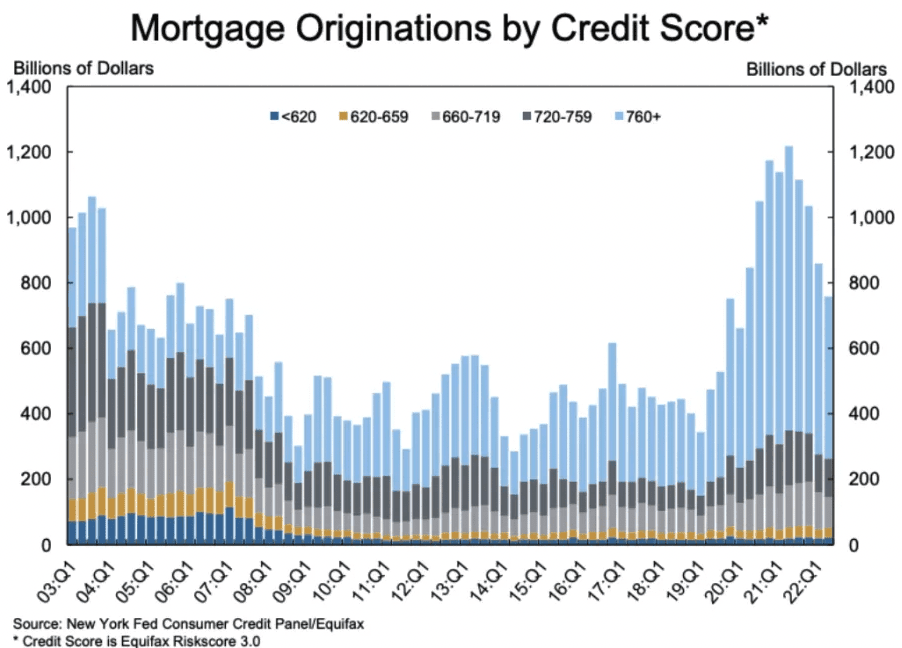
This, in my humble judgment, is still the case as the real estate market is—unlike in 2008—buoyed by much more qualified buyers with substantially more equity in their homes and long-term, low-interest, fixed debt versus the teaser rates of the early to mid-aughts. A chart of mortgage originations by credit score should drive that point home.

mortgage originations by credit score
Mortgage Originations By Credit Score (2003-2022) – Yahoo Finance

However, I was clearly wrong about one thing. I didn’t believe there was sufficient “political will” to really tackle inflation. That still may be true as the Fed could quickly abandon its current course. But given the litany of rate increases and the signals of more to come, it would appear that high-interest rates will be with us for quite some time. 

Indeed, the 3% mortgage I got on my personal residence last year would be more than twice that now. As Dave Meyer put it, the Fed has made it clear that they want a housing correction to take place to reduce inflation and address near-historic levels of unaffordability. 

So, where does that leave us now? 

A Housing Correction and the “Sellers Strike”

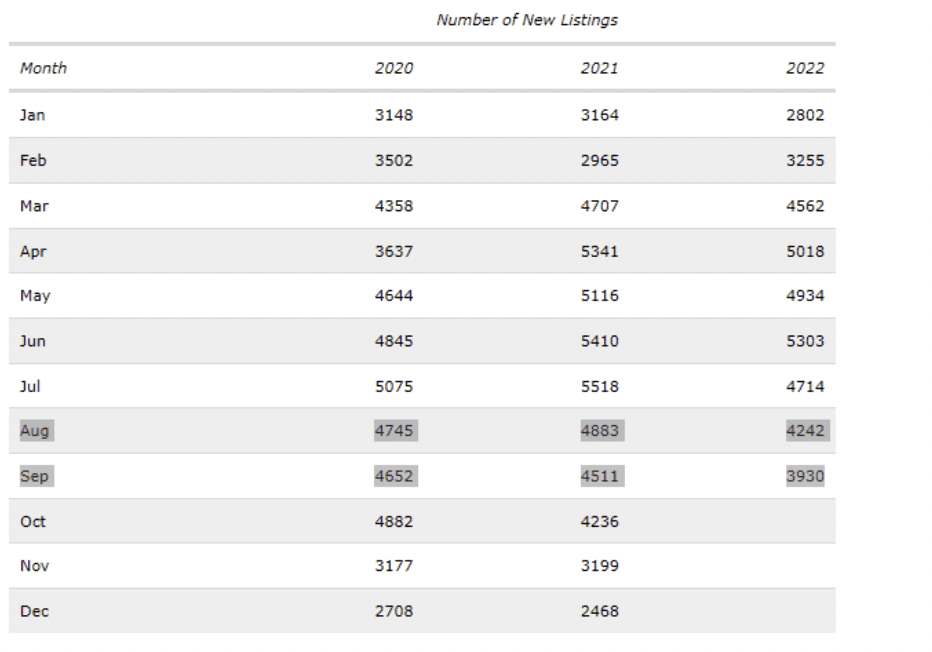
This is what the number of new listings looks like in the Kansas City Metro Area, where I live:

Screen Shot 2022 12 15 at 2.20.26 PM
Number of New Listings in Kansas City (2020-2022) – Heartland MLS

New listings in September 2022 were down almost 600 from 2021, a 12.9% decrease. They were down a full 15.5% from 2020. 

Thus, despite the rate increases, inventory only crept up from 1.5 to 1.7 months in September 2022. A balanced market is six months, so this is still considered a “seller’s market.” (Although I would argue with this, given how odd the current market is.)

It’s important to look at year-over-year (YoY) comparisons here as new listings follow a cyclical pattern and always fall off during the winter. For instance, the year-over-year trend for new listings nationally fell 23.6% YoY in October.

However, homes for sale are still up 5% from last October. This increase in inventory came in large part due to fewer sales and nearly 20% of buyers backing out of signed contracts. There are also some rather amusing headlines, such as “average sale-to-list-price ratio fell to 99% in September.” It had been a shade over 103%, which is, well, not exactly typical.

Overall, this is what Bill McBride calls “the sellers strike.” There simply aren’t very many good reasons for homeowners to try and sell their house right now. So, they don’t. Therefore, we should expect this trend to accelerate and be with us for quite some time. 

Americans Are Staying Put

Of late, Americans have been substantially less likely to move than they had in years past. As The Hill noted in 2021:

“New data from the U.S. Census Bureau shows just 8.4 percent of Americans live in a different house than they lived in a year ago. That is the lowest rate of movement that the bureau has recorded at any time since 1948.

“That share means that about 27.1 million people moved homes in the last year, also the lowest ever recorded.”

Even before the pandemic, record lows were being set. The reasons for this are many, including an aging population, fewer children, and, of course, housing being so expensive. 

In that same vein, the number of new home listings was also falling even before prices went through the roof and the recent interest rate hikes.

The average duration of homeownership went up to eight years, an increase of “about three years over the last decade,” according to The Zebra. The change in the median length of stay is even more dramatic. It has almost tripled from about five years in 1985 to 13.2 years in 2021.

If you think about it, it makes sense. Why move, particularly now?

Most homeowners (approximately 95%) have 30-year, fixed-rate mortgages. Anyone who took out a loan in the last five years has a rate below at least 4%. Why would you ever voluntarily pay off such a loan?

And as we have seen, fewer and fewer people are.

Interestingly enough, the same thing is happening in the rental market. 

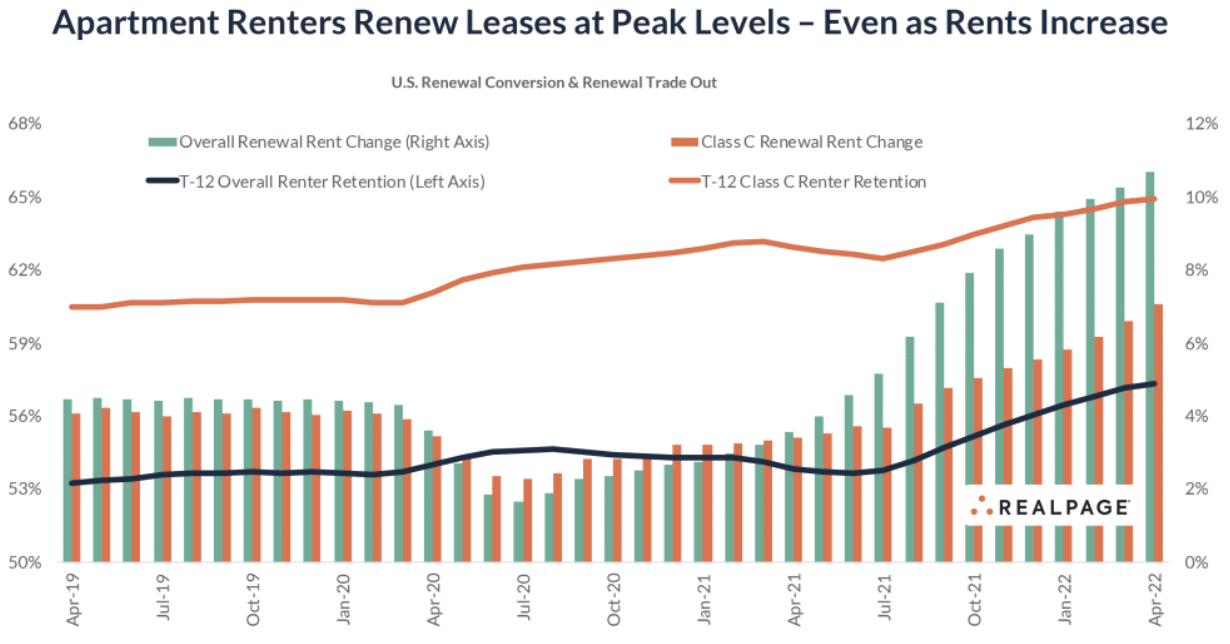
Tenants are renewing their leases at a record level. In April of 2022, over 65% of tenants renewed their lease versus just over 56% in 2019, according to RealPage. 

rental renewals
U.S. Rental Renewal Conversion and Renewal Trade Out (2019-2022) – RealPage Market Analytics

This also makes sense if you understand that the giant rent increases you hear about are just for new listings. For example, back in April, when the year-over-year rent increase for new listings was 16.9%, NPR found that the average tenant was only paying 4.8% more than the year before. 

The reason is that very few landlords are willing to raise rent all the way to market on current tenants. Increasing the rent much more than 5% often inspires a tenant to leave just out of spite. So, if rent is (or at least was) going up 16.9% elsewhere but only 4.8% where you are, you’re likely to stay put.

So, is the United States—birthed in a fight against monarchy and entrenched aristocracy—regressing to a realm of feudal serfs bound to the land they currently inhabit?

Well, for the time being, sort of.

Opportunities In This Very Odd Market

The Homeowner That Rents

The “sellers strike” has and will continue to buoy the housing market as long as interest rates are high (at least by post-2008 crash standards). At the same time, it is likely cooling the rental market, and I suspect many homeowners who need to relocate are choosing to rent out their homes instead of selling them, and thus the volume of rentals is increasing.

Asking rents are starting to moderate. From a high year-over-year increase of 18% in April, they are now down to just 7.4% in November and only 1.2% higher than in October. 

Even still, rents are quite a bit higher than they were even a few years ago, so continuing to hold rentals as a landlord should do fine in the near term.

Furthermore, for any homeowner out there who needs to move for a job relocation or whatnot, the best play is likely to rent your current home and then find a rental where you are moving to. After all, the softening rental market will help you in finding a rental equally as much as it hurts you in renting out your current residence.

And again, why pay off your 2.65% loan on your current home to get a 6.95% loan on a new one? That is not a particularly lucrative form of arbitrage right there.

I suspect the “homeowner who rents” will become much more common in the next year or so. And while such ideas may come naturally to the readership of BiggerPockets, they likely won’t naturally occur to the “normal” homeowner despite it being in their best financial interest. So please make sure to enlighten others about their options in this high (by recent standards) interest rate environment.

Subject To

The next major opportunity is a bit more rife with uncertainty, and this is the infamous “subject to” strategy.  

“Subject to” just means that the purchase is “subject to the existing financing.” Effectively, the buyer assumes an unassumable loan. 

Or in other words, the buyer takes the deed to the property and makes the loan payments, but the loan stays in the seller’s name.

The advantages to the buyer, in this case, are obvious. If you can “assume” a loan at 2.85% on a property, how much does the purchase price even matter? 

There are several problems, though. First of all, you need to seriously build rapport with the seller in order for them to trust you to pay their mortgage on a house they no longer own. After all, if you don’t make the payments, it’s the seller’s credit that will take the hit.

Secondly, virtually every mortgage and deed of trust has a “due on sales” clause. This allows a bank to call the loan due the moment the property transfers ownership. In the past, banks have very rarely done so. It might be different this time around, though. Would a bank keep a 3% mortgage on its books when the going rate is over 6%? 

All we can really say is that we don’t know for sure. If you do employ this strategy, you should have a plan B to refinance or sell the property if the bank does elect to call the loan due.

Lastly, holding a mortgage without the corresponding property will seriously affect a seller’s debt-to-income ratio and make it very difficult to buy a new property. At the same time, as a subject to buyer, I would never want to pay off any mortgage made between 2018 and the middle of 2022. Thus, there could be a long-term conflict and even an ethical issue that wasn’t present so much when subject to’s first became popular in the early 2010s. 

Even though you may not have a fiduciary duty to the seller, you should be very clear about what the ramifications could be with the seller upfront. I would recommend even coming to an agreement or something to that effect about how long you will keep that mortgage in place before refinancing or selling.

Conclusion

As long as rates stay high, the “sellers strike” should continue. Expect very low rates of new listings for the foreseeable future. The real estate market will soften and decline a bit, but without a strong incentive to sell, the sellers strike, amongst other factors, should keep it afloat. 

Find an Agent in Minutes

Match with an investor-friendly real estate agent who can help you find, analyze, and close your next deal.

  • Streamline your search.
  • Tap into a trusted network.
  • Leverage market and strategy expertise.

find an investment-friendly real estate agent

Note By BiggerPockets: These are opinions written by the author and do not necessarily represent the opinions of BiggerPockets.


Source link

The “Sellers Strike” Has Begun—Why The Housing Market Is Going Dark Read More »

Why Investors NEED to Change in 2023

Why Investors NEED to Change in 2023


The housing market is an unstable beast. As soon as you’ve got your footing in one strategy, it violently jerks you into another, often by force. This is how most investors felt during the great recession as flipping profits dried up, home sales fell off a cliff, and investors were faced with a tough question, “who’s going to buy these deals?” While many investors stood on the sidelines, hoping that someone would save them, Eric Brewer did something much different, and it’s a move that’s paid off heavily over ten years later.

Before the crash, Eric was a car salesman, but he wasn’t the type you’re imagining. His main strategy was “talk to everyone,” and it earned him salesman of the month almost every month. But selling cars didn’t make for a family-friendly schedule, so he pivoted into real estate investing and took the dealership’s owner with him. They were flipping hundreds of houses a year, making tenfold what they were used to when selling cars. But then the housing crash happened, and once again Eric needed to pivot.

Now, instead of just flipping, he’s doing wholesale deals, novation contracts (MUCH bigger profits than wholesale), turnkey rental sales, and more. As the housing market has changed, so has Eric’s mindset, never betting on one strategy to be the one that brings home the bacon. Eric has stayed ahead of the game, blatantly ignores the “expert advice” off-market investors like to peddle, and pivots as soon as the market shows signs of a move. In this flip-flop market we’ve experienced over the past two years, this is EXACTLY what investors need to hear.

David:
This is the BiggerPockets Podcast Show 701.

Eric:
That one point right there makes the decision much easier. If I would’ve just realized the tax implications in year one, I would’ve probably started out with a BRRRR model versus a fix and flip model, because once you cut the profit in half for Uncle Sam, it starts to make the $400 a month. I mean, in four years you’ll make that money back.

David:
What’s going on everyone? This is David Greene, your host of the BiggerPockets Real Estate Podcast, the biggest, the best, the baddest real estate podcast in the world, here today with another fire episode with another flame co-host, Rob Abasolo. How are you today, Smokey?

Rob:
Hello. Hello. They call me the baddy of the real estate world. So that’s interesting that you say we’re the baddest show. It all makes sense.

David:
Yeah. In fact, I thought they called you Little Baddy, but maybe that’s just when you’re rowdy.

Rob:
That’s my stage name. Yeah, exactly.

David:
There you go. Today we have an amazing show for you with a person who runs a very successful real estate business. Eric Brewer shares tons of information, stuff that he learned from his career in the military and then his career selling cars, and now with this all inclusive business where he wholesales, he flips, he holds some rentals.
He basically spends over a million dollars a year to generate leads, works them through a funnel, and then figures out which ones will be kept and sold and dispo’d, all kinds of creative ways that you can make money in real estate. Rob, what were some of your favorite parts of today’s show?

Rob:
Man, so Eric is the master of the pivot, or as Ross Geller would say, the pivot!

David:
Pivot!

Rob:
Pivot! Dude, he’s pivoted. He walked us through his whole journey and every single time he sensed a change in the market or in the buyer sentiment, it seems like he was just super quick to get a read on it and pivot his business to still remain active and profitable and everything like that. So I think we could all take a page out of that book and understand how important it is to be able to be adaptable when the market is changing.

David:
Absolutely. That’s one of the themes of today’s show, not just what the market’s doing, but what you can do differently in this market that will work that did not work before. To me, when I listen to a podcast, that’s the number one thing I’m looking for, tell me what’s happening right now, tell me what I can do differently or better that will work right now so I can keep an edge on my competition, and today’s episode definitely delivers.
Before we bring in Eric, today’s quick tip is, remember that real estate is a relationship business and you need to be focused on the relationships, not just the deal. When we say something is transactional is where people put the value on the transaction, not the people in the transaction. Real estate does not work well, much like dating, when you treat somebody that way.
So in anything that’s relationship based, remember to focus on the person, their goals, treat them the way that you would want to be treated, and you’ll find the money comes your way versus just focusing on the deal and treating them like a means to an end. Eric gives some very good examples of that in today’s show. And without any further ado, let’s bring in Eric.
Eric Brewer, welcome to the BiggerPockets Podcast. How are you today?

Eric:
I’m doing well. How are you?

David:
I’m doing fantastic. Thank you for asking. So we’re excited to talk to you today. Before we get into it, can you give us a brief rundown of what your real estate business and your personal portfolio looks like?

Eric:
Yeah. I’ve been investing in real estate since 2006. Currently, we are operating in two core markets here in South Central Pennsylvania, and we also run a market in Ohio. We do a balance of wholesaling, fix and flip, and turnkey.

David:
Okay, so you got a lot of stuff going on.

Eric:
We got quite a bit, yeah. 30% or so of our business is wholesale, 30% turnkey, 30% fix and flip. Then we have a portfolio of about 70 to 75 rentals. It was closer to a 100, and then at COVID decided to sell off some stuff. Regretting a little bit of that now, but at the onset of COVID with the uncertainty that was going on at the time, we sold off a few rentals.

David:
Okay, and do you have business partners? Is that the we?

Eric:
No, I just include everybody that works with me.

David:
Oh, that’s interesting. We’re going to have to ask about how that’s structured. Before we get too deep into that though, tell me how did your journey into real estate look? What was going on in your life? What made you decide to get into real estate? It was clearly the best time in history. 2006 is notorious for being the best time to start a real estate investing career.

Eric:
Before getting into the real estate business, I had spent about eight years in the automotive business. And at the tail end of my career in auto sales had just reached a tipping point where the hours had got to me. I was moving in the direction of having my first child and just really knew that I couldn’t be a great dad and a great car manager and had to make a decision.
So obviously chose to hang up my car salesman shoes and took a few months off just doing some soul searching to figure out what my next move would be and made the selection it would be real estate and thought that it would be wise to start my journey in real estate on the finance side.
So I looked into mortgage businesses and did a couple interviews and ended up … My first job in real estate was basically cold calling for refis in 2006, and did actually really well with it. I was surprised at how easy it was in comparison to me grinding out two and a half hour appointments with car buyers to make 300 bucks on a new car. I was literally spending 45 minutes on the phone calling someone and making a couple thousand dollars on a refi.
And after doing that for, I don’t know, four months or so, my mentor from the car business reached out to me and said, “Hey, I’m thinking about getting into real estate, and I thought of you. Would you like to have lunch?” And we had lunch a couple days later and immediately following the lunch that we had, we made a decision to start flipping houses in February 2006.

Rob:
So you decide to leave behind a somewhat lucrative but tedious business in the car world. You get into real estate, you say, I want to flip my first house. What was that house actually like? Did you know anything going into it about ARVs or comps or budgeting? Walk us through that journey a bit.

Eric:
So the first house that we bought was a bank owned property. I walked the house. My partner had bought a couple rentals and had a real estate agent. And the real estate agent got us into the house, met me there, and we were talking about ARV. I don’t think we called it ARV. We said, what could it sell for after we fixed it up? I didn’t even know what ARV meant. And he gave me a number and we did the math.
And he was really, really well spoken in Spanish and we met a contractor there. The number that I got was $12,000. So I did my math based on $12,000. We ended up negotiating, buying a house from the bank. I met the contractor back there three, four weeks later to tighten up our rehab budget, brought up the number of 12,000 and he said, “Yeah, what about materials?” And I said, “Well damn, I thought that was in the 12.” And he goes, “No, it’s never in that. That was a labor number.”
So now I’m staring down the barrel of what I thought was a 12,000 rehab that’s more like 22. And we got the rehab done and ended up selling it and making a little bit of money, a little, maybe 3 or $4,000, and it was a good learning experience. I understood better on day two how to estimate a rental budget, but the first one I royally flubbed up.
But it was a $90,000 house, so luckily for me in South Central Pennsylvania, $90,000 was very inexpensive. There was more buyers for that stuff than there was homes to buy. So we ended up selling our way out of it.

Rob:
So you go into several flips after that. How long did it take before you started graduating to a little bit more expensive flips, or were you always in that $90,000 wheelhouse for a while?

Eric:
So most of the time in the very beginning we stayed at or around the, and this is crazy to think, 80 to $125,000 property. Now back in 2006, I don’t know what the median was, but it was probably close to that, which if you think about it, it’s a smart decision, but definitely, I wasn’t smart about it back then. It just so happened that that was the stuff you had the best chance to buy on the MLS.
There was less competition because in our area, that house was probably in the city where the taxes are higher, the schools maybe aren’t as nice as what someone might get in the suburbs, and some of the locations can be a little dicey. But for me, we would buy homes for 25, put 35 in them and sell them for 99. I mean, that’s the only place I can get inventory.
And back then, when we first started, I was buying 90% or more of my deals on the market, on the MLS, and that’s where the available inventory was. There was more competition on the higher priced suburbia stuff that didn’t need a full rehab. So we really started on the MLS and buying less expensive stuff.
And then coming from the car business background, I would say we actually sucked at buying homes. We sucked at renovating homes. What we were really good at is selling. So I didn’t sell much of my stuff on the MLS when we started. I would run, yes, I’m going to say newspaper. I was in the business when people still actually ran newspaper ads. We would take out a half page in the Sunday news with color ads and we advertised no money down, monthly payments, to generate a bunch of inquiries.
We’d get 30, 40 leads a week. We’d send them over to a lender, have them pull credit, get them pre-approved and if we got three or four qualified buyers a week out of those 30 applications, that was a good week and then we would sell. Not long after our first full year in business, we did 150 flips. Did 70 some our first full year. Second full year, we were north of a 100.
But we did a really good job of running ads. It’s the same thing I did in the car business. We’ll put a zero down payment on the windshield. People drive by and go, “Yeah, how do I get that Chevy Blazer down there for 299?” We literally took what worked in the car business and said, I think we should run these same type of ads for our house, and it worked.

Rob:
Wow. Okay. So if I hear you correctly, you started off with a flip. You didn’t really know too much. You underestimated the reno in your first one. 365 days after that, you had completed 150 flips. Is that right?

Eric:
It was the second full year.

Rob:
Oh, the second. Okay.

Eric:
So our first full year we did 70 couple, I don’t remember the exact number. It was north of 70. And then the second full year we were over a 100 plus. It was probably closer to 150. Then every year after that, we were right around 200. So by our third year we were doing 200 a year.

Rob:
I’m always just super interested in this part of the story, and I think a lot of people at home, because I think we understand the general concept of going and buying a house. You fix it up, you sell it, you make a profit, you take that profit and then you use it to buy your second house. And then hopefully on your second house you make a little bit more profit and then you take that money and then you go and you buy a third and maybe even get a fourth one concurrently.
But how does one actually get from, let’s say 3 to 5 to flip 50 because doesn’t that require some level of funds and funding and private lenders? That just seems impossible.

Eric:
So it would be under normal circumstances. I was very blessed that my partner was the owner of the car dealership that I worked at, and we didn’t deal with private lenders. I had one private lender as my business partner.

Rob:
Oh, I see. And so what was his role in all of this? Was he just like, hey-

Eric:
We worked side by side. In the beginning, we were driving out to bank owned properties, kicking in back doors, crawling in windows because someone lost the key in the lockbox and walking through properties with flashlights, trudging through wet basements. I mean we did all the crappy stuff that you had to do to buy a property and we did it together.
Literally for the first five years in business, I didn’t look at a budget, I didn’t look at cash flow, I didn’t look at any of that crap. I was blessed to have a partner that managed the backend business aspects, the finances, all of that stuff. All I had to do was go out and buy good deals, get them into construction, get them out of construction, and then work my face off to get them sold. So the hardest part about my job between 2006 and probably 2012 was I literally worked all the time.
The big difference between real estate and the car business, I had more control over when I worked. I could check out for two hours to go pick my son up from school, take him to basketball practice, pat him on the butt, tell him to have a great practice and then go to the parking lot and make 30 phone calls. Where in the car business, you literally have to stand at the car dealership and wait for some sucker to come in to buy a car. With real estate at least you can work sort of from anywhere.
Certain things, it was hard for me back then. I don’t know what the cell phone situation was in 2006. It certainly wasn’t like what we’re dealing with in … There was no Matterport. There was no FaceTime. I think the MLS capped you at six pictures. So you literally had to go to the house and look at it to make a decision about what you could pay.

Rob:
I think I want to say that 2006 was right around when the iPhone came out, the first one, the very first iPhone that’s ever existed.

Eric:
2006, I think I was straight up Nextel. Remember the little … the push to talk Nextels? So yeah, I mean my job, I didn’t worry about any of that stuff. I literally didn’t have to worry about it. And frankly, now I worry about that stuff every single day. We manage an inventory of, excluding rentals, at any given time we might have a pipeline of 45 to 60 properties. And cash flow is a really big influencing factor when we make a decision about will we wholesale something.
I don’t mean to jump ahead, but what we’re noticing right now is there’s a bigger gap. For the last two years, if I looked at what I could wholesale something for versus if I took it down, fixed it, flipped it, there was not much different. I was getting close to my projected income on a fix and flip and I was wholesaling the property.
So I’m like, you know what? I’m not going to go through the hassle of doing construction and funding this deal. I’ll wholesale it and make 25,000 bucks because if I fix and flip it, I stand to make 40. That to me is not … Normally, if it’s north than 50% of what I can make on a fix and flip, I’ll wholesale it.

David:
Now I know Eric, you’ve done several things in life it sounds like that have led you to this point. We briefly touched on selling cars and you did mention some of the things you didn’t like about it, but certainly there were things you learned doing there that set you up for success in this world, like what you just said, I would go in the parking lot and make 30 calls.
I’m a real estate agent, I own a mortgage company. I understand it is pulling teeth to get salespeople to contact possible clients for anything. It’s the hardest part of my job is someone comes to me and they say, “Hey, I want to be a real estate agent, David. Teach me everything.” And we say, “Okay, you’re only going to have to call five people a day.” And that’s like, you’ll maybe get five a month and then it’s like three of them is going to be their mom.
I don’t know what it is that creates such fear of calling people and talking to them, but you didn’t have that and I think it probably played a big role in putting you in the position where you can have this wholesale business and this flipping business and this deal volume that you’re doing that everybody hears and they go, I want to have Eric’s life, but they don’t want to make those 30 calls.

Eric:
Yeah, and there’s lot of other stuff that comes with it. I’ll give you a quick story about the car business. So the first two years I was there, I worked my way up through the service department. I started actually as a lot porter, which is a glorified term for park cars. And the whole reason I applied there is because it was a Mercedes and a Toyota new car franchise. I was like, I literally get paid to drive around Mercedes and brand new Toyotas all day, sign me up.
So I worked my way up through the service department and then that was my first glimpse into sales. I didn’t realize it at the time, but when you take your car and you drop it off with what’s called a service manager or a service advisor, it’s a sales job.
They’re going to compare your car in the mileage and the condition to what is the epitome of safe and then they’re going to make recommendations about, hey, you have 54,000 miles on your car, Dave. Have you considered getting a 60,000-mile service? This is what it includes. We could take care of it while you’re here. It would only cost an additional $448.
By the way, we noticed that your back brakes are getting a little bit low. You could let it ride for a little bit and they may start to squeal. And when you notice that, make sure you call me or we could go ahead and take care of it while you’re here today.
I’m sure that’s not how it sounded when I was doing it back in 1996, but I sold a lot of stuff and it’s only because the technician would come to me and go, “Hey man, these people ought to really get this stuff done.” I’d go, “Well, explain that to me. What is a timing belt?” And he’d tell me. I’d go, “Okay, I’m going to go call them.” And I would just call them and tell them that stuff and then say, “Do you want to get it done?” So I sold all this service and I got awards and stuff. I had no idea what I was doing. I was just following instructions.
And eventually I caught the attention of the sales manager who ended up being my business partner in real estate, and he’s like, “Man, customers really like you. We’ve had a couple people wander out to the sales floor and say, ‘Hey, you guys do such a good job in service. Eric’s working on my car.’ Next thing I know we’re selling them a brand-new vehicle. You ever think about getting into sales?” And I was like, “Sales? I’m not doing sales. You pressure people into doing stuff. I’m not cut out for that.”
So he kept working on me and June 17th, I don’t remember the year, was my first day in sales on the sales floor. So I transitioned from service to sales on June 17th. Typically, back then at this particular dealership, if you sold 20 cars in a given month, you would be salesman of the month or at least in competition.
So I start June 17th, I don’t know the difference between a spark plug and a muffler. I don’t know how to do a great walk around. I don’t know how to do a test drive. I’m like, I’m just going to go talk to everybody. I didn’t know what a buyer looked like. I didn’t know what negative equity looked like. I didn’t know what kind of shoes you should be wearing if you were a good credit customer. All these other salespeople did, they’d go, “That guy can’t buy. They’re probably buried in their trade. They’re upside …” I just went and talked to people.
I sold 21 cars between June 17th and June 30th and didn’t have a clue. So in my brain I went, all I did was talk to a bunch of people, I brought them inside, I got them excited about this Toyota Camry. And then I went and got a manager and said, “Hey, these people really like the car, can you close them?” And I was salesman of the month, sold 21 cars. And then every month after that, I never sold less than 20 cars. Most months I sold 30 cars and I was salesman of the month and made a crap ton of money at the age of 23.
And I think what happened to your point is most people hate car salesmen. So there’s nothing more uncomfortable than walking up to a stranger that you know hates your guts and can’t wait to lie to you and ask them can you help them, because they’re going to tell you no, I’m just looking, and you know they’re not just looking.
So you get this thick skin as a car salesman and when I showed up in real estate, making 30 calls to me was no big deal. So I think the car business, as a matter of fact, right now, it’s a big place we hire from.

David:
I can see why. It makes so much sense.

Eric:
It’s the resiliency that’s required to be in the car business. And frankly, other than the last two years, most car salesmen have to sell a crap ton of automobiles to make six figures.
When I made that decision, I remember saying out loud to my business partner who was my mentor at that time, “Dude, we just made $20,000 on this house. We make $300 a car.” We were just shocked. I remember saying this that I can’t believe we did that for so long. He was in the car business for 20 years by the time he made the transition.

David:
But there’s value that you got out of it that wasn’t just the money. So you learned about human psychology, you learned about working a system, you learned how to be different than other people. Every other salesman was pushy, you were not being pushy in a sense. You were probably listening much better. I can tell that’s something about you is that you listen to what other people are saying and then you have an intuitive nature to see what they really want and then you just offer it to them.
It was brilliant when you said, hey, this could happen with your car. These are common issues with timing belts. Do you want us just to take care of it now? Because if you don’t know about cars, which no one does and you hear that, what you think in your mind, you didn’t create pressure Eric, but the question created pressure because you’re thinking, well, if I say no, am I actually leading myself to having a huge problem later? I don’t know enough about cars to trust that I can say no. Yeah, just go ahead and take care of it. It’s only $1,500, right?

Eric:
Yeah.

David:
Whereas if you didn’t bring it up, the pressure’s never there because they don’t even know that it’s a potential issue. That is a much smarter way of going about it that doesn’t make you feel slimy. And that’s what I’m noticing about you, just talking to you now, I’m not shocked that you have a sales based business that is doing good volume and you like yourself. You’re not the slimy wholesaler that everyone’s worried about.
If we could take one more step back in your journey, I want to ask you about the army and what lessons you learned in the army that helped build the resiliency to be able to succeed in the car business that allowed you to have the fortitude to go succeed in real estate.

Eric:
So at the time, here’s what was going through my head in 1994 when I went to Fort Knox for bootcamp. And at four in the morning I had just got a buzz cut, I had hair back then. They shaved my head, made me drop off anything that resembled the outside world, jammed me into a school bus, took me out to this building in the middle of nowhere with 50 other men.
Just threw us in bunk beds, waited just long enough for everybody to fall asleep and then turned all the lights on and started screaming and yelling at us at five o’clock in the morning and dumped all of our beds, threw them out the window, made us go out in front of the building, stand in a formation when no one knew how to stand at a formation. And we did pushups until 75% of the people either quit or puked.
And at the time I was like, what in the hell am I doing here? Literally last night, my mom made me a freaking peanut butter and jelly sandwich with chocolate milk and celery with more peanut butter on it and now I got some grown man that kills people for a living screaming at me. Why am I here? This is horrible. And you just got through it.
And the next day it happened again. The third day it happened again. And really what they were doing now that I understand it, is they were tearing us down as individuals and everything that we did, we did together. We won together, we failed together, everything we did together.
So now looking back on it, I understand what they were doing is they were stripping us of our personal identity and they were making us a group. They were making us a team and everybody counted on each other and we won and lost as a group. But at the time I didn’t know it, I tried to figure out a way to not be the guy that got the other 59 guys in trouble.

David:
That’s exactly-

Eric:
And I did a pretty good job of that. I was like, I know what you guys are doing. I’m going to fold my socks because literally, you’d have to fold your 12 pair of socks and they would come through and they checked everybody. Take 59 guys, four pairs of socks, so they’re inspecting 240 pairs of socks.
And if one of those suckers wasn’t folded by the exact measurement, the whole 59 people were getting their socks dumped outside, January in Fort Knox, Kentucky, it’s flipping cold. And then you’d have to go outside and do pushups. And then they’d bring you back in, make you fold all your socks again and they’d inspect you again.
So at the time what it taught me was the value of process, the value of the predictable outcome. Everybody does things the exact same way. You don’t say apple when you’re trying to spell out a letter, you say alpha. You don’t say Billy, you say bravo. Everybody speaks the same language. So there’s very efficient communication and there’s very minimal miscommunication in the military because there’s an SOP and a process for everything.

David:
I can imagine your brain because what’s happening is, like you said, the way that you always approach life, your instincts, your habits, the literal neural pathways that tell you, oh this happened, you do this, most people are living without realizing it, a slave to habit in some form.
That all gets torn apart and you’re rebuilt in a way that would make you a more effective soldier or person to be a part of that unit. And I think a lot of today’s culture looks at that as a negative. We throw words on it like abusive and toxic and stuff like that, but in a sense that keeps you alive and it makes everything run much smoother.
And it actually sets you up for success in other team-oriented environments, which is where I’m going with this, because you’ve said many times today, we do this, we do that, even though you may be the leader or the brainchild or you may be playing a bigger role than some of the other people, maybe not, but my guess is whether you ever do or don’t, it’s always a we.
Real estate’s freaking hard, man. Those of us that are doing it know this is very difficult and you need people on your team to win. You’re now in this position that you’ve built a business that is team oriented. Was that happenstance or do you think that some of the background of what you got in the army led to you having a brain that was rewired to succeed as a team?

Eric:
It’s a really good question. And I would say that all of my life experiences have led me to the way that I behave now. So I had someone that was 24 years old, I was at a mastermind three months ago and he said, “All right, if you could go back to being 24 years old or 25 years old in real estate, what’s a piece of advice that you would give yourself?” And my knee-jerk reaction was none. And he said, “What do you mean none?” And I could almost hear what he was thinking. “You mean you haven’t learned anything from when you were 25 years old to now?”
And my response was, is that if I were to change, and here’s where I knew I was old and he was young, I said, “It’s kind of like the movie Back to the Future.” And he looked at me and went, “I don’t know what that is.” And you remember Back to the Future, if he went back into history and he interrupted that interaction between his mother and Biff, that his dad would’ve never saved his mother from Biff and then she wouldn’t have fell in love.
So I said, “Literally, I’d be concerned if I went back and gave myself a piece of advice about what to do at that particular age or when I was early in business, it would’ve changed my experience and my experience is what has led me to where I am today. So I wouldn’t change anything. I wouldn’t give myself any advice. I’d want me to go through …”
Real estate is hard and I’m glad you said that because I think too often people don’t talk about that. I actually don’t love real estate. What I’ve realized I love is I love building meaningful relationships and then nourishing those relationships to get the most out of myself and to give the most to that relationship in exchange.
It just so happens that if you do what I just said in real estate, you should have a pretty good experience. You should make pretty good money, you should be able to get people to come work for you, you should be able to get them to stay and work for you. And if you do it correctly, which I’m still working on, you should be able to create a lifestyle for yourself that requires far less work at some point than what you did in the beginning.
So I think there’s a lot to be said, that real estate’s hard. We don’t talk about it as often as we should. I wish I could go back and keep 40% of the 4,000 deals I’ve done since 2016, I’d be in a much different position. But it required a different level of discipline for those 16 years to not flip that house, keep it as a rental, make a little bit of money each month, not make the $25,000 rip that I made flipping it and say, hey, I’m going to live with getting all my cash out and I’m going to make $400 a month. If I had the stuff that I bought between 2008 and 2012 and I kept 25 to 40% of that inventory, I’d be at peace right now, I think.

David:
So this is such a good point, especially when we go back in time and hindsight’s 20-20. The problem is at the time you’re looking at it like, how do I want to describe … Real estate, it’s hard for us to imagine right now because it is such a competitive asset class, everyone wants it. We’re all fighting over houses. No one has a great deal. Even in a slow market like this where nobody takes it, we’re still scouring looking for the deal. They’re just harder to find because rates went up, so the cash flow has gone down.
But at the time you were doing this, nobody wanted real estate like that. I don’t know how to describe it. It was not super popular. It’s trying to imagine a band that everybody cares about right now that in 10 years no one will even remember. It’s kind of like that, but in reverse. There wasn’t a big appeal to keeping properties.
What you were doing was you were saying, okay, I could have 400 a month or I could have 25 right now. That sounds like a pretty simple decision to make. One of the things that I’ve done with myself, because we still have challenges like this where we don’t know what’s in the future and we don’t know what we should do is I’ve learned to look at money differently.
Instead of seeing, okay, I can have 25,000 cash in the bank or I can have $400 a month in the bank, I say I can have $25,000 in the bank or I can have $25,000 in the property. Instead of calling it cash, I call it energy. If the energy’s in my bank account, we call it cash or money, if it’s in the property, we call it equity, but it’s the same thing.
Now it works differently because when the market shifts, you lose equity in a property and when the market goes up you can gain equity in a property. So it’s more volatile in the property. In the bank, it’s more functional, you can use it for more things, but still it’s energy that behaves differently depending in the environment that you keep it in.
And I think learning to look at it like that has made the decisions easier because I didn’t feel like I was losing on the 25,000 cash. In fact, I would see now, all right, $25,000 rip that’s going to be taxed at 50% for capital gains over the short term. That’s actually 12,500. Then I have to figure out where I’m going to go invest it.

Eric:
That one point right there makes the decision much easier. If I would’ve just realized the tax implications in year one, I would’ve probably started out with a BRRRR model versus a fix and flip model, because once you cut the profit in half for Uncle Sam, it starts to make the $400 a month. I mean, in four years you’ll make that money back.

David:
Even if the property didn’t appreciate. That’s right.

Eric:
Correct. And then the equity only matters when you sell it. And if you’re not selling for 10 or 15 year cycles, you can time it much like a lot of people did. And I sold off a couple of my rentals just after COVID, because I looked at it and I was like, this is an abnormal set of circumstances. Property values are up 40% in one year. I’m cashing in.
And seven months ago, I regretted that decision. Right now I’m not so upset with it because we’re seeing some of that 40% be given back. It’s market specific, but I was looking at a heat map the other day from realtor.com and the amount of inventory in certain places across the country is alarming. In Arizona, it’s up 145%. In Pennsylvania where I am, it’s up 2%.

Rob:
Wow.

Eric:
Not much change in inventory here. So that’s one of the benefits of where I am. In 2006, people in Las Vegas, Phoenix, Arizona made a gazillion dollars. But then with the flip of a switch, anybody that had flips hanging out there were screwed. Literally the value changed.
I had 10 or 12 flips in the pipeline. I remember the day, it was eerie. And buyers’ agents and lenders were calling me like, “Hey man, our deal’s falling apart.” I was like, “What’s up? Something with the inspection, the appraisal?” Like, “No, the bank is out of business. They literally closed their doors at three o’clock today. There’s no deal.” And I was like, “What do you mean they just closed? You can’t just close. What do you mean they’re closed?” Like, “Yeah. Yeah, they’re done. They’re out of business. Everybody’s fired and they went home for the day forever.”
At some point we’ll probably talk about novations, but coming out of that in 2008, that’s how I discovered novations because prior to 2008, nobody was using FHA financing. It’s one of the things I’m seeing in the market right now. It’s funny knowing what I know now that every 10 or 15 to 20 years these cycles repeat themselves.
So if I knew that, I think to your point, back then, real estate was a really well kept secret. There was only this small little circle of people that knew about it. It’s probably because someone in their family grew up that way. They taught them how to do rentals, here’s this tax code that nobody talks about. We don’t want to bring a lot of attention to it because if we do that, they might change it.

David:
That is exactly right.

Eric:
Which we’re seeing now, right? Once everybody finds out about it, you go, oh they’re exploiting it, we’re going to get rid of that.

David:
Call it a loophole and call them a greedy and throw a millionaire on there and yep.

Eric:
Yeah, once too many people make enough money and they see it that, that needs to be corrected, they’re going to change it, which they’re probably going to change-

David:
Well, they’ve already changed bonus depreciation. That’s stepping down lots of things.

Eric:
Yeah, that’s a big impact. There’s a lot of people that would make a decision to buy a property, maybe pay a little bit more than they wanted to, but the bonus depreciation would say, you know what? I’m getting all these tax advantages. I’ll go ahead and pay what you’re asking for it.
I mean that’s the one thing, had I known that back then, I would’ve said it doesn’t matter what it’s worth in four years because I’m looking at a 20-year deal. What’s it worth in 20 years? And for the last 100 years, property values double every 20 years. So I know it’s going to be worth double. Whatever I pay now in 20 years it’s worth double.

Rob:
So Eric, I mean you talked about you sold some of your portfolio here during COVID, but you had one really big pivot in your career and that was in that 2008 era where you were crushing it on your home flips and then all of a sudden maybe you weren’t crushing it as much and you completely changed the direction of your real estate career. Can you tell us about that pivot and why it came to be?

Eric:
Yeah. So it’s happened a couple times. When we started, we were almost exclusively MLS. And then that, the tough part is in 2008, it got really hard to sell a house and predominantly because there was this flood of inventory coming, so there was a ton of competition. And the hardest thing to do in late 2008 was to get a stinking mortgage. There was this opposite reaction to the very forgiving, probably irresponsible lending that was happening for a couple years leading up to the recession that banks made a very corrective set of measures to get super tight. You had to have a 700 credit score and 15% down to get a mortgage unless you were using FHA in 2008.
In 2010, I started doing installment sales agreements. I had people that would come to me in 2009 with a 640 credit score and $15,000 down getting declined by lenders. They didn’t have enough, maybe they couldn’t prove their overtime or they hadn’t been on their new job for two years. It was really, really hard to get a mortgage.
So these people are coming to me, they got 15 grand down, they want to buy my house, they have the ability to pay, they have good income, we started doing installment sales agreements. I had over 140 installment sales agreements by the end of 2011.
And I was getting 15 to $20,000 down on $150,000 property. They were paying me 8 to 10% interest and I was borrowing it from the bank at 5 to 6%, because again, fortunately I had a business partner that was able to leverage his wealth and go to the bank and say, hey, we’re going to structure these deals at 80% of appraised value. We already have basically a highly qualified tenant. So we don’t have any maintenance, we don’t have any of that stuff. And our advance was lower than 80% because we had their down payment plus the equity we already had booked into the property.
So we did installment sales agreements. That was 30 to 40% of my sales for two years on the heels of the crash. In 2011 and ’12, there was more investor activity back in the market and I started to see it become more and more challenging to buy properties on the MLS. So I had to pivot to direct to seller between 2012 and 2015. Now my business is 90% direct to seller, virtually zero MLS activity.
In 2000, about four years ago, I pivoted into turnkey. Got away from retail fix and flip, pivoted into turnkey because rates were coming down and there was a lot of investor activity. I think the Wall Street Journal calls them laptop landlords, people that buy turnkey across the United States. They find qualified rehabbers, good property management companies and they buy turnkey real estate. They leverage it and they utilize the Fannie and Freddie product up to 10 loans in their own name.
And it’s the most desirable rental product you can get on the market. It’s 30 years. Typically, it’s at a discounted rate and you can get up to 10 properties in your own name. And now just in the last six months, that turnkey business has vaporized. So I’m back to pivoting again because the property that was cash flowing $300 a month for this out-of-state investor with the rates where they are, it’s negative cash flow. At an increased rent, the same price, the interest rate has had that big of an impact on cash flow and those buyers have stepped aside for now.
So I’m back to, full circle, selling my properties retail to probably FHA. That’s the thing I was saying, right now for flippers, if you’re not selling your properties to FHA, VA borrowers that need 3 to 6% sellers help and have minimal down payment, you’re missing the highest paying buyer in the marketplace right now.

Rob:
And why is that? Can you explain the math there a little bit, or why is that the uncovered niche?

Eric:
So we all know the market the last two years, right?

Rob:
Yeah.

Eric:
Ridiculous. Probably the most lucrative real estate market we’ll ever see, ever. And if you were an FHA borrower that needed 6% sellers help and had a $500 deposit, you couldn’t probably find a real estate agent that would take you out and show you homes. There’s no way you could buy a house. Anything that qualified for FHA financing, they were getting either cash offers or conventional no sellers help, appraisal waivers, no inspections. As an FHA borrower, you were at a significant disadvantage.
So those people now with rising interest rates, it’s created the opportunity for them to be able to buy a house. So they’re not comparing 7% to three and a half percent because they weren’t active at the three and a half percent rates. They were not an active buyer because the market would not allow them to purchase.

Rob:
So Eric, basically, if I’m hearing you correctly, there’s a very large group of people in the United States, people who are just married or are trying to move, they’ve had no shot at entering the market over the past two years and now they actually have a chance. Interest rates are a little bit higher. Maybe they’re going to be getting something in the sixes versus in the fours, but they still really want the house.
Whereas on the flip side of this, investors are paying 7 to 8%. The cashflow is a lot smaller now, they’re just not penciling out. So they’re not getting quite as competitive because they don’t know where this market’s going to go necessarily. Whereas maybe the homeowners are fine, they want to buy the house so they’re willing to take the risk a little bit more. Is that more or less what you’re describing?

Eric:
Yes. There’s a window because what do you think is going to happen to investor activity the instant rates drop down in the fives?

Rob:
Oh yeah, they’re going to be getting back at it.

Eric:
It’s going to go bananas again, right?

Rob:
I’m seeing a little bit of an opportunity here. It’s like I feel bad, all right. Maybe it’s like I shouldn’t feel bad, but the market has been so dang competitive. Sellers have been so very confident, so they’ve been raising those prices and now there’s terror lurking the streets. And I’m making some pretty aggressive offers like 3, 400K under asking. And I feel bad because I’m like, ugh, but it is genuinely the only way that these deals pencil out.
And I’m actually fine with it. Even on some of these deals where I was used to getting a 20 plus return cash on cash, some of these deals I’m getting a 10 to 15 and I’m like, well, I’m actually fine with it because I think in a year or two when rates go back down, I’ll refi and then it’s going to be the greatest deal ever.

Eric:
That was one of the pivotal moments for me as an investor is when I got less concerned about what I was paying in relation to asking price and what I was paying in relation to the value.

David:
So true.

Eric:
And it’s one of the things that gets in investors’ ways, I’m not paying over list. Well, who cares what list is, what’s the value of the property?

David:
Yes.

Eric:
And can I make money out of it? Is it a reasonable deal? Does the deal make sense? I mean, it took me years to get past that where someone would say I need highest and best and I’m like, screw you.

David:
You know what’s funny, Eric? That you’re saying it took years to get past that, but in the car world, nobody pays sticker price.

Eric:
Well, the last two years they have. They’ve been charging 25 grand over sticker. Back in the day, 2018, you had to sell a house.

David:
You had to work.

Eric:
In order to be a list agent and get multiple offers, you had to price it really well. So I actually would get annoyed when people would put up, I had 17 offers in two days. It’s like, dude, you didn’t do that. Tell me what you did to negotiate those seven offers and find the one that delivered the most value to the seller and how you got it to close on time. Don’t tell me about the offers because none of that credit really belongs with us.

David:
Or house sold in two days. That’s like yeah, it popped up on Zillow, everybody was looking for it. You didn’t do anything special.

Eric:
We didn’t have anything to do with that. If you literally were active in real estate the last two years, you could make money in spite of yourself. It was really hard to get a deal, it was super easy to sell it. We’ve seen 180 degrees now. It’s getting easier already today to get a deal. I know when I go to sellers’ houses, it used to be I’m getting five other offers a year ago, now it’s like, I hope you guys can help me.
But then once I get the deal, I got to work like a dog to go out and find somebody that’s crazy enough to buy it with interest rates at 7.5%, and it’s got to be a good deal. They’re going, you know what? If I brought it to Rob and I was like, Rob, you want to buy this? He’ll go, yeah, I’ll buy it. I don’t care what the rates are, but it better be a good deal.

Rob:
Yeah, a hundred percent. I mean, it has to work, right?

Eric:
Yeah.

Rob:
So Eric, tell me this because I know that you said that you’re selling directly to sellers. How are you actually marketing to get sellers, A, into your system, and what is your deal flow process even looking like at the moment because I know there’s a lot changing right now?

Eric:
Mail’s our number one. It’s the thing that we spend the most on. It generates the most leads. And my average profit per transaction is the highest off of television. Then direct mail, PPC. We stopped doing cold calling. I’ve been fighting that battle for three years. I just finally threw my hands up and said, no one likes to get a cold call, no one likes to do a cold call, we’re just going to stop it. But we have a fair amount of success with texting and we’ve been able to operate inside of compliance.
So that’s generally where we spend the majority of our marketing dollars and we generate about 320 to 350, what I call net leads a month. Inside of our funnel, we expect to make same day contact or live answer with those people around 90%. 65% of those people, we expect to get an appointment with. 90% of those appointments we expect to confirm and show the day of the appointment. And then we look to achieve minimum of 25% contract at appointment. We do all in-person appointments.
So that generally nets when you go through that funnel, would have net us, from net lead to contracts, about 10%. So our goal is to write about 40 contracts a month and I’ll close 32 to 35 of those. You’ll have some fallout, some title issues, seller change their mind, deals that don’t work for one reason or another and ends up getting released. So gross 40 contracts, close 32 to 35.

Rob:
All right. So let me ask you a couple questions here because I think a lot of people are going to have … The way you’ve described it makes perfect sense, funnel marketing 101, but when you say you’re getting a lead at that very top of the funnel, what is the ideal scenario that happens with that lead? You put, let’s say a TV commercial, you do all the process you just talked about. That lead, what are they doing? Are they getting to you to buy one of your homes that you already have listed and ready to rock? Are you wholesaling it to them? What’s the final product that they’re getting when they connect to your company?

Eric:
Sorry. Sellers or buyers?

Rob:
Well, I mean just in regards to your specific business, what is the final output of your funnel?

Eric:
Yeah, so now … And I learned this through some of the data aggregates that we work with. Shout out Audantic, they run a bunch of our data sets for us. You know who buys the most property as an investor in every market all across the country? What demographic of investor buys the most inventory? First time investor. It just so happens they pay the most.
So the largest volume of homes are sold to a first time investor in every market and they actually pay the highest percentage of “value,” however you calculate that. They pay the most money and they buy the most. But what does everybody teach you about wholesale when you’re going to go out and try and sell the property? Pull a buyer’s list. Where does your buyer’s list come from? Someone that’s already bought a property in that area, in that zip code or in that school district in the last 12 months. Well, the guy that’s buying their first investment property is not on a list anywhere.

David:
That’s true. You got to go find them.

Eric:
Right? So you got to look at, what we found is, it’s called a DINK. Dual income, no kids between a certain age that makes a certain amount of income is the most logical person to buy their first investment property. And then on the back half of it, there’s people that are more between my age, 45 to 60, that are at the tail end of their professional career, are looking at their 401k and going, that’s not going to cut it.
So now they’re looking to start to produce tax savings. They’re tired of paying Uncle Sam. So if they get a rental property and they depreciate it, it’s going to chip away at their tax bill. If they put enough of these properties at the age of 45 into a portfolio, 15 years from now they could have $2 million in equity that the tenant paid down for them.
So what you have to do is get a data set for predictive analytics for potential investors because they’re going to buy the property at a high enough price that you can get it under contract with the seller and still exit that property and make a reasonable profit.
The problem most people have is they’re locking up deals today at 2021 prices and buyers are paying 2023 prices or what they think they’re going to be. Sellers are still operating on the misconception that we’re still in a market that we were seven months ago, and buyers are forecasting how bad it can get six months down the road. So sellers still want a little bit too much, and buyers are willing to pay a little bit too little.

Rob:
Well, we’re always willing to pay a little too little.

David:
Well, that sums up the market in general, and it also has to do with understanding that in the business, you have to pivot. You cannot just copy a blueprint that you saw other people do and say it works when everything is going great. You learned this lesson when 2006 became 2008. You learned you had to pivot. Now what you’re describing are techniques that people have to use to pivot. It is easier to buy something than it was, it is harder to sell it the last, God, like eight years.
If you’re a real estate agent, getting a listing was incredibly difficult. Finding a buyer client was incredibly easy. And then getting that buyer into contract was hell and selling your listing was the best thing ever. It’s changed. Sometimes now we’re like yeah, give me some buyers that are willing to buy something. I don’t want another listing because like you said, sellers have the idea in their head that their house is worth what it was at the peak. And with rates doubling or more than doubling in some places, buyers are not going to pay that.
And there is a problem with communication between those two sides. And that’s how real estate works. And then we have this lag while sellers have to have their expectations adjusted and buyers aren’t going to budge. It gets to the point where the market will reset, we’ll have equilibrium and then boom, something will change, we’ll have another. This could go away very quickly, just rates drop. Imagine how fast all the stuff you’re talking about how, oh, I need five people on the dispo side.

Eric:
Five and a half percent solves all of that crap.

Rob:
Yeah. So Eric, tell us, because you’ve explained funnel marketing really great, I just wish we could do a whole episode on this. I’m very giddy about it because if people just understood the simple, I guess metaphor of hey, it’s a funnel, your customers go from top to bottom, the more you lead them to the bottom of the funnel, the more conversions you have on that final product. That could make so many millionaires out of the listeners if they can just master this.
So now that you’ve talked us through your funnel, obviously you’re getting a lot of leads, can you tell us a little bit about your qualified leads, the distressed ones versus not? And can you explain this seesaw concept that I know that you’ve mastered as well?

Eric:
Yeah. I hate the Q word, qualified. I think most people that do direct to seller have gotten so good at disqualifying sellers, they’re actually able to disqualify qualified sellers now. We’ve been so protective over what we think our version of motivation sounds like, that when a seller calls in, if they don’t say, I’ll take 60% of Zillow, I’m behind all my payments, the house is a wreck, I just want to be done with it in 30 … Literally, I talk to people and they’re like, “Yeah, if they’re not looking to sell in 60 days, we don’t even attend the appointment.”
You know one of the problems with that? When you ask someone, are you looking to sell in the next 60 days? I think a fair amount of those people are actually answering a different question. What they’re answering is, am I ready to move out of this house? And they might be ready to sell today, but they’re not ready to move. Or they don’t know that they can move because you haven’t come out to the house and made them a reasonable offer and help put those pieces to the puzzle together.
So too often we go through this. Here’s what someone has to qualify in order for us to go to an appointment. They’re a decision maker and they’re asking less than 200% of retail. So I could care less about what they ask for the property. I’m more interested in, are you a decision maker and are there any circumstances surrounding your situation that might contribute to you being willing to sell to someone like me at a price that might be a reasonable discount.
And then again, even with that being said, people are like, well, you’re closing percentage might suck. No, we’re historically, year over year, north of 25%. In a whole year, I can’t achieve 30%. But we literally attend any lead that has a pulse and make an offer. Have you ever bought a property, Rob, that you didn’t make an offer on?

Rob:
No.

Eric:
This goes back to the funnel, if you want to buy more homes, what should you do?

Rob:
Make lots of offers.

Eric:
So is turning a “unqualified seller” away contribute to us making more offers or take away from making more offers? It takes away.

Rob:
Yeah, it takes away.

Eric:
So every time you “disqualified” a seller … And I tell you, anybody that’s listening to this, go back and look at your pipeline from six months ago. Do a data scrub and look how many leads that you disqualified six months ago sold to someone at a price you would’ve gladly paid. I bet it’ll make your stomach turn upside down.
So we have this little box of what we believe “motivation” looks like. I would tell you, particularly in higher price point properties, we’re solving first world problems. And I’ll use this analogy. I’ve had a pretty successful business career. Real estate has provided me with some amazing opportunities in regards to income. I barely graduated high school, didn’t go to college. It’s amazing, right?
If I go to Chick-fil-A and I’m waiting in line for seven minutes, I’m in distress. If you came to the back of the line, you’re like, Eric, if you pay double, you can skip the seven-minute wait and we’ll get you your food right away, I’m paying double every time.
But when we have someone that calls in with a property to sell, we look for are they behind on payments? Is it vacant? Do they have issues? When they might have a set of first world problems that we’re not even aware of. Convenience becomes a source of distress for people that aren’t in financial crisis, but we don’t look for that stuff. We disqualify someone if they don’t have visible signs of these five or six points of motivation that we think would historically drive someone to sell us a property.
So to answer your question, the seller’s seesaw for me is, when you look at property conditions, so if on one side of the seesaw is condition and the other side’s motivation, as condition deteriorates, motivation and distress goes up.

Rob:
Nice. Okay, cool.

Eric:
The problem with qualified is we’re making a decision about qualified or unqualified normally after a five-minute phone call, and you’re asking a very high impact question, when do you want to move? What’s the least amount you would take? And we’ve had a very low impact relationship with the seller so far.
So it’d be like the equivalent of going out to a bar or a nightclub walking up to a young lady, buying them one drink and asking them if they want to get married for the rest of their life.

Rob:
It rarely happens.

Eric:
That approach might work for some people, but that’s what it’s like getting a seller on the phone and saying, are you looking to move in the next 30 to 90 days, and what’s the least amount that you would take? You can’t look for high impact transparency from people until you’ve had a high impact conversation with them. And that doesn’t happen in five minutes over the phone when they called you off a postcard. It’s just not. You’re a stranger, they’re not going to be open and honest with you at that point.

Rob:
Yeah, especially if you’re just calling them out of the blue or you’re texting them out of the blue. Why would they let down all their barriers and all their guards to someone that’s just trying to basically, in their mind, swindle them into selling their property. You got to build a little bit of trust.

Eric:
Yeah. So that’s how I look at qualified versus unqualified. It’s just a bad set of terminology in our book because too often we’re … So the other thing I realized is when I started in this business, I did acquisitions and at some point I was managing acquiring properties, managing renovations, selling them. I started to become more selective about the seller appointments I would attend.
So as the owner of the company, we start to become more and more selective about the seller appointments we’ll attend. And then once we hire people, we don’t go back and undo that process to say, hey, I got two acquisitions agents now, the best thing they can do every day is go to a seller’s house, make an offer, and ask them to make a decision.
So we have this buy box for what qualified is, and we’re very strict about what we’ll go to and make an offer and I mean, quite frankly, it costs us tons of opportunities each and every month because we’re over qualifying.

Rob:
So can I ask you this, where do novations fall into your seesaw strategy? Do you think you could just give us a brief explanation of what a novation is?

Eric:
Yeah. So the novation is a wholesale style transaction, but we’re exiting at retail price. So by wholesale, what I’m saying is, we don’t have to put our cash in it, we’re not rehabbing it, we’re not closing on it. So that’s what makes it wholesale style. But we’re able to pay a good bit more for the property because we’re selling to retail buyers.
So if you think about wholesale, I always say we’re looking for a needle in a haystack. It’s that 10% unbalanced seller seesaw. We’re looking for someone with high distress. That normally comes with a property that needs at least a little bit of work, and then once we buy it at a discount, we have to sell it to a cash buyer because an assignment’s not a financable transaction to a retail buyer. You can’t get an FHA loan on an assignment from a wholesaler. It won’t work. It’s not a financable, insurable transaction.
So we have to sell to an investor cash buyer. So we’re buying one needle in a haystack and then we’re going out and trying to sell that needle to another needle in a different haystack. That’s a cash buyer that’s willing to do a bunch of work to a house and then hope that they make a couple bucks versus novations allow you to, now I can actually make something out of the haystack.
How many people do you think call in an average funnel and they have a decent property that they would sell a little bit below retail? A lot.

Rob:
Yeah, I was going to say more than getting the people that are willing to sell for a lot less.

Eric:
And we turn those people away.

Rob:
Yeah.

Eric:
So basically novation means replacement. So general wholesale is I buy a property, I sign my interest in the property to a end user. Novation means replacement, so when we replace our agreement, we alleviate the seasoning, we alleviate the arms length transaction, and now it becomes a financable transaction to the end buyer because I’ve conditionally released my original A to B contract, which now makes it a financable transaction and I can sell it to an FHA, VA, Fannie Freddie borrower, and I can still make my spread in between.

Rob:
Is it a little bit more of a micro, I don’t know, wholesale transaction? Whereas if you’re a typical wholesaler, you’re going to go and find, let’s say something a 100K under, you’re going to sell it to a flipper. They’ll put 50K into it so that they can make a $50,000 profit. Whereas with the novation, it sounds like you’re finding someone, just a regular person, house maybe needs a little bit work. You get a much smaller fee to sell it to another basically buyer, like a normal buyer, not a flipper, and they make a smaller fee.

Eric:
So it’s actually, normally, the fees are more.

Rob:
Oh really?

Eric:
The average novations, we’ve taught it to … I think it’s just shy of 300 people that I’ve taught novations to, our average profit’s $26,000. If you look at normal wholesale profits across the country, most people are between 15 and 20K, because when you sell a property to an investor, they’re looking at how much is my rehab? How much can I sell it for? I got carrying cost. A retail buyer’s not looking at any of that. They’re going, can I afford it? Am I approved for it? How does it compare to the other two homes on the market? If you fit in that sweet spot, they’re going to buy your house.

Rob:
And they may be willing to do some of that work and rehab over time. They’re not super worried about-

Eric:
Yeah. So imagine this, and this is what really pumps up the numbers, is you can still get a deal at wholesale price. And if you understand novations and the contracts and the language and the scripting and the legality of it, you can buy it at wholesale price, get permission from the seller as long as you’ve disclosed your intentions and sell it retail without ever closing on it. You can’t do that in a standard assignment. You can only assign it to another cash buyer that’s going to pay their version of discounted price.
Versus you can get a property under contract at a wholesale price that is in a financable condition and take it to the open market or the MLS and sell to a retail buyer. So now you’re buying it wholesale and exiting it retail. Those spreads are huge.

Rob:
Yeah.

David:
Yep.

Eric:
Then the other. So there’s two opportunities, you can lock up the same deals that you’re buying now at wholesale price, but rather than being handcuffed to a cash investor buyer, once you understand novations, you can take them to the open market and sell it to a retail buyer.
The second way that you can positively impact your profit and your volume is the deals where the seller won’t take your MAO. But let’s imagine, on a house that’s worth 220, this is the value no one talks about in wholesaling. They talk about after repaired value, they talk about rehab, they talk about MAO. When do we ever say what’s it worth in its current condition to a retail buyer? Never, because as a wholesaler, we can’t get to that buyer unless I close on it. Now I need transactional funding. Now I got seasoning.
Some people do wholetail, but wholetail requires you to pay for the property. If you have a property that’s worth 229 in its current condition and the seller will take 200, are any of you locking up that deal currently? Probably not. Because by the time I close on it, I clean it out, I do all that stuff, my $20,000 or $30,000 spread’s now 8 grand and I’ve tied up 200 grand. I’m not doing that.
But with a novation, if it’s worth 230 in its current condition, you can lock it up with the seller for $200,000, which is well more than they’ve got offered by any other investor, take it to the MLS at 229, pay out 4 to 6% commission total, net 220, make a $20,000 profit and give the seller the 200 that they wanted when everybody else offered them probably 140 or 150.

Rob:
Okay. I don’t know, it’s very interesting, it seems like there’s probably a lot less tension in these kind of conversations, whereas maybe sellers are used to, like you said, getting super low balled and then they’re just like, ugh, I’m tired of these low balls. If you come in with a reasonable offer, then they’re like, well, that’s actually not bad, I’ll do it.

Eric:
Yeah, and it goes back to the balance, right? It’s like they’re kind of motivated, they’d prefer to sell this way or a little bit different than what they’re accustomed to with a real estate agent, but they’re going to say things like, Rob, this sounds good, but I’m not going to give it away. David, this sounds good, but I’m in no hurry. That should be a trigger for you to go, this sounds like a good novation opportunity for me.
And if the property’s in good enough condition that you could sell to a retail buyer without a laundry list of inspection repairs, either on an FHA, VA appraisal or a home inspection, that is an ideal novation opportunity. It’s a property that’s in good wholetail condition that you can’t buy at wholesale price and you don’t have to close on it, go through seasoning, funding, all that stuff. You can take it to the retail market, sell to a finance buyer and never have to close on the property.
I call it wholesale 2.0. This should be the new way of doing business. Again, we go out normal wholesale, you’re looking for a needle in a haystack and then you’re selling that needle to another needle in a different haystack. You got to find a super distressed seller that has a house that’s all messed up that’ll sell it to you for 50 cents on the dollar. Then you got to go out and find a cash buyer that’s willing to fix it up and make a couple hundred bucks a month cash flow or to make 25 grand flipping it.
Now you can shop and when you take your deals to the MLS, which is what I mean by the open market, it’s the best buyer’s list in the world. Remember I told you about, if you go back and look, new investors pay the most for real estate. Think about me, the first deal I bought, what did I tell you today? I screwed up. I paid too much because I didn’t understand that there was materials that I had to add into the rehab budget that I got from my contractor.
I was a first time investor. I paid too much because I wanted a deal so bad and I was trying to figure out a way to make it work, which is a bad situation to be in as a buyer, right? The best situation to be in is, it’s not for me. That’s when you get the best deal, when you’re okay saying no. So where do you think most first time real estate investors shop?

Rob:
MLS.

Eric:
MLS. It’s the best buyers list in the world. So this gives you the ability to take your deals to the MLS.

Rob:
I’m going to re-listen to this because there’s just so many nuggets throughout this episode from a masterclass on how to pivot when you’re detecting market changes to really just owning a new space like this or wholesale 2.0. I know the concept’s been around, but I like that you’re calling it 2.0, because with the market changing right now, it makes total sense that this could be a new path for people looking to get into the wholesaling business specifically, because if you’re trying to sell a property to a flipper right now, they’re probably being pretty cautious, is my guess. They’re probably not going to be taking the same deals they were three months ago, whereas going direct to seller, which is the greatest buying pool right now, it’s like yeah, it seems like a good opportunity.

David:
And the seller hasn’t really had that come-to-Jesus moment where they recognize, oh, my house isn’t worth it.

Eric:
I think it’s just now starting to sink in. We bought two homes this week in pre foreclosure. I haven’t bought another property in pre foreclosure in 18 months. They didn’t have to sell it to us. They could take it to the market, it would sell. They weren’t getting foreclosed on. You couldn’t even start foreclosures until, I don’t know, 6 or 12 months ago. You couldn’t even start the process because of COVID. Some of that’s catching up to people right now. The options have been reduced a little bit versus what they were six months ago. So we’re at the onset of sellers starting to come back to planet Earth.

David:
And as long as rates stay somewhat stable, we’ll find this equilibrium. The problem is they freaking tinker with it so much that every time you start to think the kid’s ready for bed, somebody gives them sugar and then they’re bouncing off the walls again.

Eric:
I think even if they just stop raising rates and everybody would just sink into the reality that 7% is a good number, you’d see buyer confidence go back up.

David:
Yeah, we need stability. People don’t like when they don’t know, is the car going to be worth 50 grand or 20 grand? Nobody wants to buy when they don’t know what’s happening. It’s a great point, Eric.
All right. Well, this has been a fantastic show. I’ve thoroughly enjoyed hearing your insights on what’s going on and more than just your insights, but practical applications of how to take this information about the changing market and apply it to the offers you’re writing, the way you’re having conversations with sellers, the people that you’re hiring, how you’re structuring your business, and how to pivot when these things hit.

Rob:
Eric, if people want to learn more about you and your business and what you have to offer and all that good stuff, where can people learn more about you?

Eric:
So the best place to find me, if you want to follow me on Instagram is Eric Brewer Invest on Instagram. If you want to learn more about novations, you can go to brewermethod.com.

Rob:
Awesome, man. Thanks.

Eric:
Thank you.

David:
We’re going to let you get out of here because we would talk to you all day long and we could probably turn this into two or three shows. I thought it was a fantastic time. But thank you very much for sharing what’s going on in your world and your business.

Eric:
I appreciate you having me.

David:
This is David Greene for Rob Pivot, Pivot-

Rob:
Pivot!

David:
… Pivot Abasolo signing off.


Help us reach new listeners on iTunes by leaving us a rating and review! It takes just 30 seconds and instructions can be found here. Thanks! We really appreciate it!

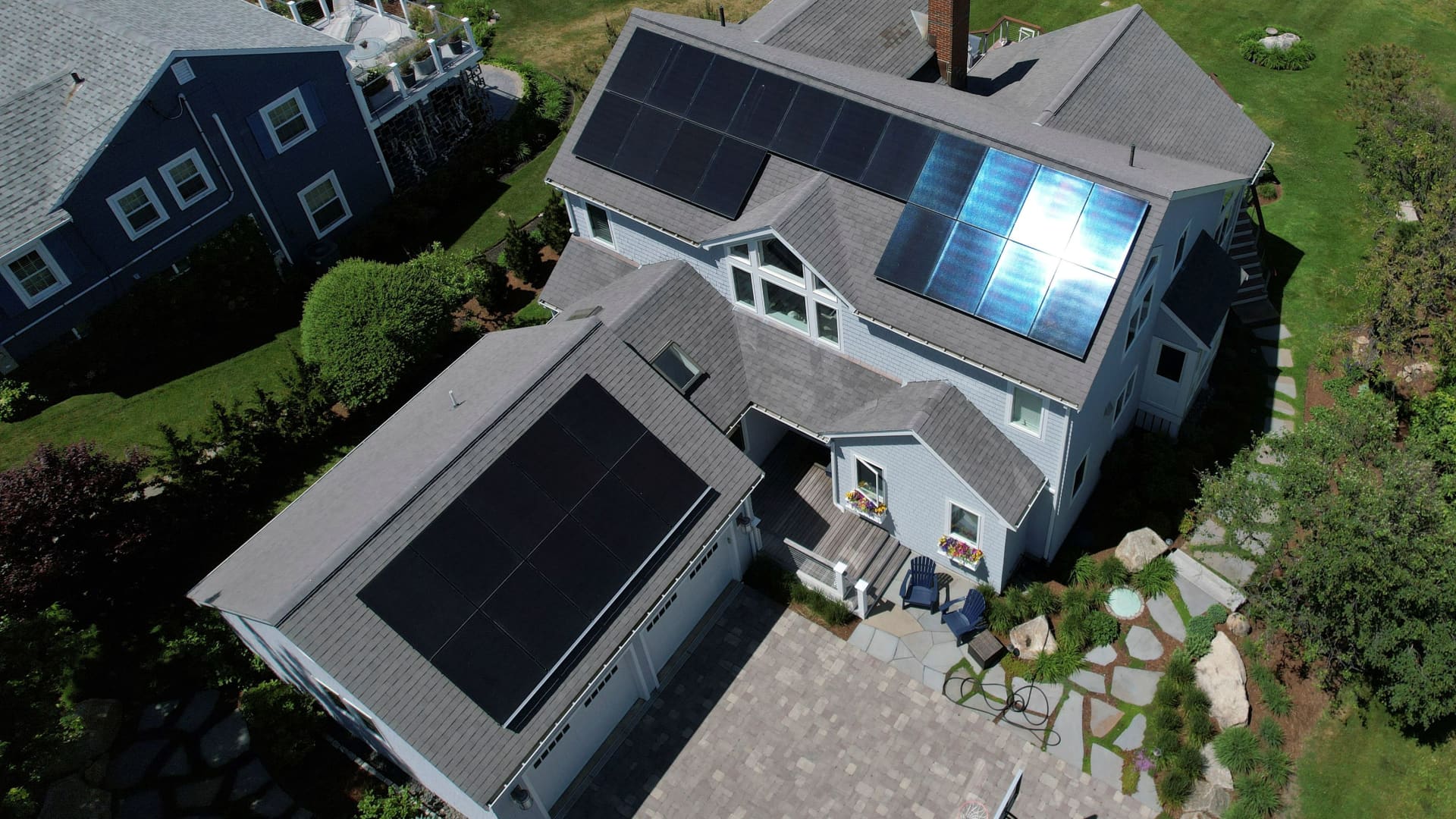
Interested in learning more about today’s sponsors or becoming a BiggerPockets partner yourself? Check out our sponsor page!

Note By BiggerPockets: These are opinions written by the author and do not necessarily represent the opinions of BiggerPockets.


Source link

Why Investors NEED to Change in 2023 Read More »

The Short-Term Rental Cheat Code for More Bookings and Fewer Fees in 2023

The Short-Term Rental Cheat Code for More Bookings and Fewer Fees in 2023


Building a short-term rental business is surprisingly simple. You buy a property, furnish it, then throw up some pictures of it onto booking sites like Airbnb and VRBO. After a few weeks, a booking comes in, and from there you’re in the game! This is all great until a poor review comes in, sending your listing to the bottom of the pile and your profit with it. Through no fault of your own, your income stream just got cut off, and now you have a mortgage to pay without a calendar full of bookings.

For many hosts, this type of scenario seems like game over for investing. But for Mark Simpson, it’s the start of something even better. Mark grew up in hospitality, marketing his family’s bed and breakfast nestled in the British countryside. His family was frantically cleaning, cooking, and booking with spreadsheets and no system to streamline their business. This ongoing problem led Mark to build Boostly, the software allowing hosts to take their bookings into their own hands.

Mark has helped numerous short-term rentals bring in millions in direct bookings, helping hosts and guests minimize the amount spent on fees while maximizing their experience. So how do vacation rental hosts start doing direct bookings? What benefits come from leaving the big booking sites behind? And how can hosts regain autonomy so their business is never forced to stop? Mark answers these questions and more in today’s episode!

Ashley :
This is Real Estate Rookie episode 243.

Mark :
So the first thing that I feel like everybody should be doing on the Airbnb profile, that first line, and this is general copy talk. Everybody talks about the hook in copyright. And the hook is just basically getting someone’s attention so they take action, right? The first line is you should be saying, “Hey, I’m Mark, founder of X.” You can’t put a direct web link in there. Airbnb will spot that. The bots will spot that, but you can get creative. So I always used to put, “Hey, I’m Mark, founder of X. Check out our online reviews. They’re rather good,” or, “They’re really good.”

Ashley :
My name is Ashley Care and I’m here with my co-host Tony Robinson.

Tony :
And welcome to the Real Estate Rookie podcast where every week, twice a week, we bring you the inspiration, motivation, and stories you need to hear to kickstart your investing journey. And this week I want to shout out someone from the rookie audience that goes by the username irissaid, and Iris’s review says, “By far my favorite real estate investing podcast. Ashley always knows how to ask the best questions that a rookie would want to hear, and Tony brings so much advice and knowledge from his own experience. Both have a great chemistry and I love their personality.” So Iris, we appreciate the honest rating and review, and if you haven’t yet, if you’re a listener, you’re part of the rookie audience, please leave us an honest rating or review on Apple Podcasts or whatever platform it is you’re listening to. The more reviews we get, the more folks we can help, and that’s always the goal here.
So Ashley, I’m super excited for today’s episode. Our guest is actually someone that I’d known online for a little while, then he and I actually met at a conference last summer and when I heard him speak, I recognized or I realized there was a big gaping hole in my business. And today’s episode is all about how all investors can fill that big gaping hole that exists in their own businesses as well.

Ashley :
I’ve got to say, Tony, you’re starting out talking about meeting online, meeting him in person, and then a gaping hole. Where is this going?

Tony :
This is for the aftermath.

Ashley :
But isn’t it funny how many people you meet in your network that are from online? Growing up, and especially when there was AIM and AOL, you don’t meet people online. Your parents drilled that into you. You don’t go and meet them in person. And honestly, that’s been some of the best friendships that I’ve connected with and have people in my network is meeting them online, and it’s just so funny how things have changed. And obviously meeting them in a safe, public place or at a conference or something like that.

Tony :
Yeah.

Ashley :
When Tony slides into your DMs and invites you over to his home, it’s probably a spammer. Do not go.

Tony :
Yeah, totally. And yeah, can we just touch on, if anyone’s getting messages from either me or Ashley or Sarah or anyone asking you to… If we just hit you with a, “Hey, how are you?” and then the conversation quickly flows into crypto, just know it’s not us. It’s a scam. But today’s episode is not about getting scammed. Today’s episode is, again, a good buddy of mine, his name is Mark Simpson, and he’s here all to talk about direct booking. And when we talk about direct booking, it’s for all of those folks that are in the short-term and medium-term rental space that rely solely on Airbnb and VRBO to get all of their bookings. And Mark in today’s episode highlights the dangers of doing that as a short-term rental investor and also gives you a really clear framework on how to build your own platform outside of sites like Airbnb and VRBO, and how he’s had millions of dollars worth of bookings come through his websites to help other hosts do the same thing.

Ashley :
And I really don’t know a ton about this, so this was super informational for me. Tony was like a kid at a candy store, word vomiting over everything he was saying and asking really great questions and follow up too, and giving some personal stories about his experience with just bookings through Airbnb. And then the difference between using direct booking and how he’s setting it up. So this is a great episode for short-term rentals. Medium-term rentals, this can even be used for. Or even if you are somebody looking to book a property sometime in the future as to where other places you can go besides Airbnb. And I think with Airbnb making all of these changes recently, maybe it is going to be an advantage to somebody to actually go ahead and start setting up this direct booking site. Mark, welcome to the show. Thank you so much for joining us today on the Real Estate Rookie podcast. Why don’t you go ahead and give us a brief overview of who you are and what you do?

Mark :
Yeah, thank you very much for having me. So my name is Mark Simpson. I founded a company called Boostly back in 2016. As you can tell from this accent, I’m over the pond in the United Kingdom. Born and raised here, born in hospitality, raised in hospitality, which is really weird in this industry. So many people fall into it from other investment strategies or from other careers, but I was born in it. And so ever since I can remember, I’m just so used to having strangers in my house in our family business, which was a bed and breakfast. It was a 14-bedroom bed and breakfast right in the middle of nowhere in the United Kingdom, right in the woods. And that was the appeal. So we had lots of guests coming to stay with us because we were in the middle of nowhere with farm animals. We had highland cows. I don’t know if you’ve ever seen or heard of a highland cow before. Those big cows with horns and shaggy hair.

Ashley :
Oh yeah.

Mark :
That was us. That was us. That was our appeal. And bizarrely, there was a niche of people, there was an army of people who would travel around just to go and visit highland cows. They would come and stay over us just because of them, which was bizarre. But I grew up in this little bed and breakfast. I grew up and I wanted to, in my teenage years, do one thing and one thing only, and that was escape. I wanted to be a soccer player, but there was one problem. I’m crap at playing soccer. So I resorted to coaching soccer and then had an amazing opportunity to come out to America, so that was pretty much 2000 to 2010 coming to America, five months, got my visa, came out, traveled all over the States, coaching it, doing youth development, and then eventually ended up back in England, back in London, fell into sales and marketing for Yelp. It was Quip at the time before they got bought out. And that’s where I learned all about social media, marketing, emails, SEO, you name it.
And then eventually in 2012, my parents, who had had the business about 25, 30 years at this point, they needed one of me or my siblings to come into the business. I was the oldest out of the four, and it was ideal. And I just took all that stuff I learned in London and put it into the business. And for four or five years we just focused on marketing it, taking that offline word of mouth, putting it online. And it worked really well. When TripAdvisor was popular, we got to the top of TripAdvisor in the north of England for most recommended places to stay. Our social media was popping and it just all resulted in 80% year on year of our bookings that came in was from direct. So 20% was Airbnb, 20% was booking.com, 20% was Expedia, 80% of it was direct bookings, and it went really well.
And then in 2016 I started a Facebook group called The Hospitality Community, which is still active and live right now and people come and join it from all over the world. And they were coming in because they were frustrated with Airbnb, booking.com, and they wanted to learn around diary bookings. And that’s literally what I’ve been doing every day since 2016, helping people figure out this whole world of hospitality, guest experience, diary bookings, and which is why we’re here today, so thank you for having me.

Tony :
Yeah, Mark. Super excited to have you, brother. And you just recently posted something, I think in one of the Facebook groups, about a statistic about all of the direct booking websites that you’ve helped create. Do you know what I’m talking about? Would you mind sharing that figure with our listeners?

Mark :
Yeah, so this is really exciting. So for the last four years we’ve been building direct booking websites using WordPress. And for the last four years, I know that these websites work, but it’s just me saying, “Hey, these work, trust me.” And so about two years ago we created a really cool piece of technology where we were able to track every booking that came from one of our websites. And in 2022, so we’re about 11 months in now to 2022, we’ve generated and tracked £2.5 million, which is around about $3 million worth of direct bookings that our websites have generated, which is an amazingly high number. I would love it to be double. My goal is to get that double next year. But it just shows that you can do this yourself. There are ways to making your own bookings and it’s just a case of having the foundations and the blueprint in place to make sure that you’re enabled to do so, which is hopefully what we’ll dig into today.

Tony :
Mark, that’s a tremendous achievement. And I think more and more people need to be aware that… Let me put it this way. In any other business, people spend money on marketing, but in the world of Airbnbs, everyone relies on the platforms to drive all of their revenue. But can you think of any other industry where 90% of the folks in that industry don’t spend anything on marketing? And it just doesn’t exist. And I think the message that you’re driving around really taking ownership of your business and not relying on these platforms is a step that’s often overlooked by a lot of new and seasoned investors in this space.

Mark :
You’re a hundred percent right. I honestly can’t. And I’ve tried and tried and tried, and if anybody knows in the comments, please let me know because I can’t think of any other industry where you can go take a couple of pictures, upload your business to a said listing site and be pretty much guaranteed to generate revenue. And it is a blessing and a curse. And let’s not get it wrong. We’re not here to slate Airbnb. They’ve built a fantastic business model, as did VRBO, which is the Expedia group, as did booking.com, TripAdvisor before them. And they’ve enabled anybody, any rookie, any real estate rookie to get started on the platform, literally throw up a couple of images. And there are specific dates in your calendar, doesn’t matter where your market is, that you know could just sell out five times over because we’re in the industry of making experiences. We’re in the hospitality industry and we create memories.
I say this a lot and I hope that people start to realize this is every booking, there’s a story behind it. So every reservation that you get, whether it’s a staycation or workcation or whatever, there’s a story around it and it’s all about making memories. And so because of that, you can get a lot of bookings very easily from one platform. But the curse is that because it is so easy, and all these spinning plates that you’ve got, it’s very easy to go, well, that’s the market ing sorted. I’ll just leave that to them and you’ll just go, sorted. And then because of that, you are then reliant on one platform, let’s just say Airbnb. And when you are over-reliant, you are then culpable to anything potentially bad happening. And there are so many examples of those bad things happening in literally this year, but over the first three years of this decade at least.

Tony :
So Mark, I’m so glad you mentioned that, that you become reliant, and not just reliant but almost at the mercy of, is probably a better way to say it. And we took a new listing live over the summer. It was an older property we purchased, we rehabbed it, one of my favorite rehabs we’ve ever done. And the property, we listed it, it was doing well. And our fifth review came back as a one star. Not anything I think that we necessarily did, just disgruntled guests, we couldn’t get the review removed, so our rating went from a 5.0 to a 4.3. And when that happened, the bookings just immediately slowed down. And we’ve been fighting and struggling to breathe life back into that listening. And as that was going on, I kept thinking, man, had we just had our own direct booking website, it would’ve been another way to get the revenue coming in.
And when I look at other listings that are doing really, really well, especially in Joshua Tree, because Joshua Tree is a very trendy, Instagramable, social media heavy market, some of the best listings in that market are booked out months and months in advance. And it’s because they’ve built this massive following off of Airbnb and off of VRBO. So they’ve got the big Instagram following, they’ve got their own direct booking website, they’ve got a YouTube channel. They’re doing these other things to drive traffic to their listings outside of just waiting for Airbnb and VRBO to pass those bookings onto them.

Mark :
Yeah, a hundred percent. Again, you’re right. And my goal is to help one million hosts to never have to worry about getting a bad review on Airbnb, never have to worry about the algorithms again. Because when you are so worried about that, you then become reliant on the guest as well. And when a guest books with you via an OTA, you can’t really control who that person is. As much as there is inquiry-only mode, instant book is everything now, and Airbnb force you to go down that route. And because of it, anybody can book. And when that happens, we talk about it a lot when we say customer avatar, and customer avatar is just fancy marketing spiel for your ideal guest. And ideally with the properties that you’ve got, whether it’s in Joshua Tree or Upper State New York or in the Smokies or wherever, you’re going to have your ideal guest. Now, the ideal guest for the area, but also the ideal guest for your property.
And then once you figure out… I talk about it in the book there at Playbook, it’s all about you’ve got to identify, you’ve got to locate and you’ve got to attract. And when you get all of them down, then everything becomes so much easier to the point, like you’re saying, you can build a social media following, your website copy is a hundred percent speaking to your ideal guest. So everybody who walks through the door, it’s an instant five star. You never have to worry about a one or two star coming in. And then you don’t have to worry about it on Airbnb because you are dictated, because that one bad review knocks your ranking down to say 4.3 average, which then means super host is going to be harder to achieve. And every three months, you’re fighting an uphill battle, and this is review five. That’s guest five. That could be potentially five weeks in and you’re thinking, ugh, should I just switch this to a long-term? Should I just forget about this?
And that’s crazy, but that’s the short-ism that you get when you are so reliant on one platform. So yeah, it’s all about putting in that sort of blueprint, those foundations. And this is why I’m really excited to come onto this podcast, because this is where I guess a lot of people are getting started in it and it can feel so overwhelming. So I just wanted to break it down and go, hey, let’s do this, this, this, this, let’s get an actioned and then everything else just becomes so much easier.

Ashley :
Let’s talk about that then. So your software, what is the most important piece to this and how can everything be linked? Okay, so you need to do some marketing, advertising, you need to draw people to it. How are people booking it? How is it tracking? When are days booked, when aren’t they booked? How are people paying for it? How are you taking those common things that make Airbnb and VRBO work so well and then putting it into your own website here in the software?

Mark :
Yeah, a hundred percent. So I talk about never build your house on someone else’s land, but before you build that house you need to have a solid foundation in place. Now, the problem is, and this is the problem, and so many people listening to this or watching this will be able to go, yeah, that’s me. So what happens, property number one, you go and list it on Airbnb, just Airbnb. And then what happens, you’ll maybe get something like Hospitable as a smart messaging tool. Hospitable used to be called SmartBnB. Now it’s changed to Hospitable. But you got SmartBnB or Hospitable because you wanted that smart messaging automated feature that just makes it more automated. And then what you do, you go, well, I’ve got my Airbnb listing. Let me just go and create one of these VRBOs. Let me go create one on there, but I’ve got to link my calendar. So what am I going to do? I’m just going to go grab my Airbnb iCal link and I’m going to paste it into VRBO so I don’t get a double booking.
So then what you’re doing, you’re doing exactly what Airbnb wants you to do and you are building your foundation on the Airbnb land. Instead, what you’ve got to do is you’ve got to hit a hard reset. And what you’ve got to do, first thing, even at property number one, and there’s a lot of people who will push back on this, but I swear by it. You’ve got to go and get, from property number one, a property management software tool. It’s otherwise known as PMS, PMP, and there’s good and bad news. So there’s some fantastic technology available. When I first came back into my family business in 2011, they were using pen and paper and Tippex. It was a mess. We had 14 bedrooms, we had three holiday cottages. The phone would ring, a guest would book in, my dad would forget to take the booking. And then literally I walked home, came in from being a weekend away, my mom was frantically running upstairs, she was stripping and changing her bed and her bedroom because a guest had arrived. My dad forgot to put the booking in. So it was a crazy time.
So by getting his technology, it means that life is so much easier for a newbie in the business. So a property management software tool, fantastic. The problem is, there is 1,140 different solutions around the world. That’s crazy. There’s too much. There’s too choice and it’s just a case of getting overwhelmed. What we have been doing over the last four years is we’ve been creating a blog post on the Boostly website, B-O-O-S-T-L-Y. And on there, what we did is we interviewed 100 hosts and we said, “Right, who are you using for your PMS? What’s the pros? What’s the cons?” And we built out a really cool blog post. It’s probably our most viewed blog post. Just head to boostly.co.uk. You’ll go and find it. So there’s about 14 of the top ones. So go to there, go and pick one. There’s tons of different contenders. You’ve got Hostly, you’ve got Host Away, you’ve got Guestly for Hosts. Hospitable now is classed as a channel manager PMS because they do all that linkage. You’ve got Uplisting. There’s tons of them.
So go and pick one. And once you’ve got the property management software, everything becomes easier because then what you do is you link your Airbnb to the PMS, number one. You can go and link VRBO to the PMS. That’s fantastic. Then you can go get booking.com and anything else they can link to. And the cool thing about that is that instead of you linking it to Airbnb, you’re linking it to your foundation that you’re starting to put in place. So that’s step number one. Everything works off the property management software tool.

Ashley :
Mark, I have a question for Tony real quick actually on that. Tony, which one are you using and what do you recommend?

Tony :
Yeah, the same exact one that Mark recommended. It’s Hospitable. Yeah, we honestly only dabbled with the few options when we first started. It was either Hospitable is a big one, Your Porter was another popular one that some of my friends were using. And then OwnerRez the third one. And OwnerRez I think by far probably is the most powerful tool, but it was also the most complicated to get set up, and as a newbie in the space that just didn’t have the brain power to make that work. And Hospitable at the time offered a good mix of automated messaging along with all the other tools that you want from a channel manager, so that’s the one that we use in our business.

Mark :
The funny story about Hospitable is that they were powered by their community to turn themselves into a PMS and their channel manager for. And I know Pierre and I know Matt really well behind the scenes because with Boostly, what we do now is we partner with all these providers so we can do that trackable booking that we told you about. And for years they were saying to me, “Listen, we’re not a PMS. We’re not a channel manager. It’s our community.” Because they’re going out and saying to everybody, “Oh yeah, I’m with SmartBnB, Hospitable. We’re the channel manager.” And they’re like, “We’re not a channel manager,” but they’ve changed because of that. And this is what I love about that platform. I love it because they are so young and fresh and so they’re able to pivot really quickly. So right now, they’re adding in payments, so Stripe payments.
So again, the reason why you have a PMS, a property management software tool, and if somebody… So say Tony wants to come and stay at my place and he’s like, “Hey, I’ve seen you on Instagram, fantastic. I want a book with you. I want to book direct. How do I book direct?” And you’re like, “Well, I don’t know. I haven’t got any of the systems in place.” But if you’ve got Stripe set up, with Stripe, you can create an invoice, you can create whatever and I can send it to Tony. And you can pay me direct via there, and then you just go on manually, in your own property management software tool, mark it off on the calendar and it’s down as a direct booking, which is lovely. So the second thing to put into place is having a payment gateway.
Now, Stripe is the easiest. There are so many other options and a good buddy of ours, Rafa, I know Rafa is looking at getting into crypto and all those cool things, but Stripe is the easiest. And the one thing I love about Stripe, a couple of Irish boys set it up. They’ve got a history in hospitality. They grew up in a hotel. So I think it’s just a fantastic little easy fit, super low-cost, takes two minutes to get set up and it links into every single good PMS. Yeah, that’s what I will say.

Tony :
I love Stripe. Have you used Stripe at all before, Ashley, for anything?

Ashley :
No, the only thing that I really collect payments from is for the liquor store, but we use a POS system called Corona. Yeah.

Tony :
So we’ve used Stripe in different parts of our business and I love Stripe as well. Super easy to set up. It integrates with a lot of different platforms. The only thing I don’t love about Stripe is that if you have a longer lead time between when you process the payment and when that service or product is actually delivered, Stripe has a tendency to hold a certain percentage of your funds in reserve. So for us, for our events under the Real Estate Robinson and Short-Term Rental Summit, our average ticket is sold between 70 days to 60 days before our event. And when Stripe sees that there’s a long delay between purchase and sale, they hold 10% of all your money in a reserve account in case there are any chargebacks or things like that. So that’s the only thing I don’t like about Stripe. Other than that, it’s a fantastic tool and it does definitely work and integrate with a lot of different platforms.

Mark :
Yeah. That’s the payments down, which is step number two. Should we go onto another biggie, which is another part, which is when I get the biggest pushback on in all of this? Do you want to move on to that one?

Ashley :
Yeah, what is that?

Tony :
And if I can tee it up, because I think this is the question I had for you, Mark, when we first started working together. And was, everyone knows Airbnb. Everyone knows VRBO. No one knows Tony J Robinson’s rentals in Joshua Tree, California. Why would someone go onto my website and book direct where they don’t know me, they don’t know who I am, they don’t know my business, versus going on to a reputable platform like Airbnb or VRBO?

Mark :
And this is a two-parter. And this is mostly, I feel like 90% of the hosts that I speak to, and it’s the problem that we’ve created, but it’s also a thing that Airbnb have created as well. They are fantastic at building brand loyalty. I know not one person who walks around going, “Hey, I just booked a VRBO. I’m a VRBO host.” Well, people walk around saying, “Hey, I booked an Airbnb.” They are Uber in this industry. And as much as I try to stand on my little soapbox here and say, “Don’t do that. Don’t brand Airbnb,” people are doing it, right? And because of that, and this has been done by design. All you have to do is load up YouTube, type in TED Talk and type in Joe Gebbia. He was one of the co-founders of Airbnb. He’s since recently left, but on his TED Talk he spoke about how Airbnb built for trust and it’s been done by design, and this is a hundred percent done from the offset what they wanted to create. Because this is literally, they’ve got millions of people walking around branding their business on a daily basis.
So that’s issue number one. But as a fix, we simply brand our business. So you say if anybody comes up to you at a party or an event or whatever, “Hey, what do you do?” Say, “Oh, I’m a short-term rental host. My business is X,” whatever you want to call X. And by doing that and by keep spreading the word, then you start to build that brand loyalty. You get a domain name that fits, you brand it, whatever that may be. And to answer the question directly, how do you build that trust when a stranger is on your site? There’s two things that you can do. Number one, there’s a software, an accreditation service called I-PRAC. I-PRAC. And my British accent is so dodgy that I’m going to have to spell it for you. So it’s P-R-A-C. So i-prac.com.
They are the world’s leading accreditation software platform tool. And what that means is that when a guest books with you directly, the guest is instantly covered with the I-PRAC guarantee, that if they come to your property and your property is for whatever reason not there, then they will ensure that that guest has got a place to stay. It’s part of the guarantee that you have by joining them. Now, not everybody can join. You have to fill in a form and prove that you say you are. But once you’ve got that verification, they’ve got some fancy technology in the blockchain that means that you get a badge on your website, a badge that you can use on your social channels, even, if you want to, your Airbnb and VRBO listings, but it shows that you’re a proper and true business.
And the second thing is Superhog. So this is guest verification. Now there’s Superhog, there’s Proper, there’s all these different types of insurance that is available. But by having that, when a guest books and a guest verifies who they say they are, your property is uncovered for $5 million. Okay? Now, one of the things that I always get a pushback on this is, well, Airbnb make it easy with AirCover. Now, you’ve always got to remember this. When Airbnb create anything, the main people that they are benefiting is Airbnb. So you’ve got Airbnb dynamic pricing. That covers Airbnb. That benefits them. And it’s the same with AirCover. AirCover is just fancy marketing spiel. And it is there and it is a lot better than what it used to be, and that is being amended to make sure hosts are a little bit more protected.
But there’s some really worrying news that’s coming out with Airbnb and AirCover in when a host puts a claim in, if a host puts, let’s say, five claims in out of 30 bookings, Airbnb are turning around and saying, “Hey, you are using this far too much, naughty Mr. Airbnb host. We’re going to actually pause your listing, cancel your listing and suspend your listing,” which is crazy. But also as well, there’s just other really worrying stories coming out. ‘Cause at the end of the day, what you’ve got to remember is that an insurance company is going to try and get out of X, Y, and Z payments and they’re going to delay the process as much as possible. So what you need to do is you’ve got to make sure you’ve got a third-party coverage that’s going to cover your back as well. Because you don’t want to…
For example, somebody comes to my property, they smash it all up. I then report it to Airbnb. Or even if it’s just a minor breakage. Let’s say they smash the TV. And I am not going to place that claiming at Airbnb until the guest has left the review. Because I’m afraid that if I turn around and go in the review, “One-star review, guest broke the TV, didn’t tell her, da da da da,” then the guest is then going to use that as leverage to then write me a crappy review that means that my algorithm tanks. You are so worried about the review that the guest is going to leave that you’re just going to end up going, “Ah, you know what? It’s only a cracked TV. I can go and get another one of them,” and it shouldn’t be like that. You know what I mean? So by having that third-party coverage, i.e. Superhog, superhog.com, then you’re no longer worried about putting in a claim for things like that.
And so that is the other two things. So you have the I-PRAC for the verification of you as a business, so it gives that extra level of trust. And then you get the Superhog, which is again for the guest verification, so you know the guest who’s coming in, and that means you are covered in your property.

Tony :
Ashley, let me ask you a question. Have you ever booked direct?

Ashley :
No, I haven’t.

Tony :
Neither have I.

Ashley :
I’ve never even booked on VRBO either. I’ve only booked on Airbnb.

Mark :
You’re going to make a British man cry right here.

Ashley :
Mark, a question I have about that stuff is how are those things being paid for? Is this paid on the host side? Is this fee covered on the guest side? How are you getting this much coverage?

Mark :
So with I-PRAC, for example, the host or the business, you pay an agency rate and it’s based over a year. It’s an annual subscription. Let’s just say for example if you were going to sign up for a Netflix subscription for you, it’s the same sort of thing, so you pay that. When it comes to Superhog, it’s actually built into the guest side. And the cool thing is as well, if you use Superhog correctly, it can actually be a revenue generator for you as a business. Because when a guest verifies who they say they are, you can actually end up generating revenue from the insurance company that works alongside Superhog and the guest verification. With Stripe, obviously there is a percentage to pay per booking, but that is a very low percentage in comparison with the commission costs.
And commission costs is something that I think is really important to note, and this is very time-sensitive, because very recently, in the last 48 hours, Airbnb announced that on the platform now they’re going to get rid of cleaner fees, they’re going to get rid of all those things, and they’re just going to have state taxes, whatever those taxes may be. This is to fall in line with booking.com and the Expedia group. Now, there’s definitely something behind this and I would love to think that this is all swings and roundabouts and roses and lovely things that’s all for the good. But booking on Airbnb used to be 3% commission to you, the host. And then they charged the rest of the percentage to a service charge to the guest. Very recently, when they bought Hotel Tonight, it’s their pivot to taking on booking.com and VRBO. 2017, Airbnb had 15% of the whole market. The prediction is, by 2025, they’re going to have 60% of the market. They are not going to just catch up with booking.com and VRBO. They’re going to overtake them massively.
And to do that, what they need to do, they need to get rid of that niggling thing that is in the way and that’s the service charge. So they’ve already started, as soon as you try and connect your Airbnb account to a property management tool, they say, “Hey, you are a professional host. Let’s get rid of that,” and you’re whacked up to 14% commission, right? My worry and my fear, we talk about they’re trying to become the VRBO of the taxi industry. My fear is that they’re trying to become the Amazon of the world where if I sell a product on Amazon, I have to spend up to 60% commission for everything that I sell. It’s crazy. And they dictate everything. I don’t get any data. I don’t even get a name of who buys anything, a book or whatever on Amazon, but I have to go down that route. I don’t have a printing company behind me. I can’t print all these books off, so I have to go through Amazon to do it.
Now, the way that it’s going is that if Airbnb continue to dominate this industry, and we’ve got so many people who are branding themselves as Airbnb businesses, Airbnb could easily turn around in 2025 and go, you know what, Mr. And Mrs. host? This relationship that we’ve got here isn’t fair. We’re generating 80% of your revenue. I feel this 14% commission is not right. Let’s bump that up to 20. Let’s bump it up to 25, 30, 40, 45. We think this is a 50/50 relationship. And you know all this data that you get? The phone number? The name? You’re not going to get that. You’re just going to get this little NFT notification, whatever they’re going to do in the future. You know what I mean? Which is worrying, because then you literally have no way of communicating with your guests. You’ve got no way of potentially generating a repeat booking, a repeat guest, a direct booking.
So we have to start doing these things now. We have to start sucking up a little subscription fee here and there, because if we don’t and we continue to let them dominate the way that they are dominating, then this game’s going to get so much harder. So this is why it’s really important everybody watching this puts us into practice at property number one. Don’t wait until property number 10 or 20.

Ashley :
Something that I did think of, back to that question you asked me, Tony, if I have done a booking off of a direct website, I haven’t, but I’ve done almost word of mouth. So it’s actually very common around here for lake houses that the same families re-rent them every single year, so these people don’t even have any kind of online presence and it’s just word of mouth. But imagine how much further those people could take it if they have these same families that are coming in, they’re putting up a website, those families share it with other families that are going through and they still have no need to be on Airbnb or any other platform too?

Tony :
Ashley, that’s a great point and an example came to mind as you were talking about that, and it’s AutoCamp. Have you heard of AutoCamp?

Ashley :
No, I don’t think so.

Tony :
Mark, have you heard of AutoCamp?

Mark :
No.

Tony :
So AutoCamp, it’s a resort, but instead of it being like a traditional hotel, say, all they offer is Airstreams. And they’re in places like Yosemite. They opened up in Joshua Tree. I think they’re in Utah somewhere. But that idea of doing the whole Airstream thing was really popularized on Airbnb. That’s where a lot of these unique stay started to originate. And AutoCamp took that idea and they said, hey, we’re going to do this at scale, but you actually can’t book an AutoCamp Airstream on Airbnb. You can only book direct through their website. So it’s an interesting model, right? They’re taking something that was popularized by Airbnb, yet they’re saying, if you want to book this, you actually can’t get it from there. You have to come direct to us. And I haven’t seen AutoCamp on Expedia’s website, on booking.com. I only see them direct book. So it’s an interesting thing, right? You can build it out, it just takes a little bit longer.

Ashley :
I opened Airbnb the other day and it went right to… I was viewing it as a guest and I wasn’t in my host account, and this beautiful property popped up and I looked at it and it was somewhat close to me. And I went through their listing and it was like, check us out at this website, follow us on Instagram. And it was their brand and they had four or five other properties and I went and looked them up, I started following them. But do you think there are people out there that are putting their listing up on Airbnb but directing people to their website? I don’t know what Airbnb monitors, but are there people out there saying, “Hey, if you want a 20% discount, go to the website to book directly?” Or…

Mark :
Now you’re making me happy. And this is literally what this book is about. The book I wrote, Playbook, I’ve got 101 tips in there. And one of the things I talk about, and it’s what I talked about on the Bigger Pockets podcast, it was 680. I spoke about how to optimize your listing to drive a guest from Airbnb to your direct booking website. And it is a simple walkthrough, because there are so many cool little checkpoints on your Airbnb listing that you can do so. And it’s not going against any T&Cs. It doesn’t hurt your algorithm in any way, shape or form. And that makes me happy. You made me cry earlier when you’re talking about you’ve never direct booked, but that little story there that’s made me happy.
And the cool thing is about the story about the lake houses, that is a direct booking. It doesn’t have to be on a fancy website. A direct booking is when somebody reaches out to you on the phone, on the email, your website or social medias, just say, “Hey, how do I make a booking?” And the problem is that, as hosts who are so reliant on Airbnb, you get overwhelmed ’cause there’s 101 different things that you could be doing. And so that’s why I put that book together. So when you open it up, just like a playbook, like a coach’s playbook, you open it up and go, right, I need help on social media. Follow it, implement it, you’re sorted. And there are so many case studies, there are so many stories, which makes my world happier because, again, proof is in the pudding. Nearly $3 million worth of direct bookings generated this year. And that’s just tracked. That’s not including phone calls, emails, WhatsApps, social media messages, emails, letters, you name it. That’s things we can’t track, but it is happening.
And the good news is that direct bookings year on year is increasing. So obviously OTAs take up tons of the overall amount of bookings, but direct bookings are increasing as well. COVID has sped that up because there was a point in time, especially in the UK, if you wanted to book in the UK, you couldn’t on Airbnb or booking.com because they shut out the calendar. But there were still people that needed accommodation. I know you’ve just had the amazing and Sarah [inaudible 00:37:37] on talking about medium-term rentals and about how they help place insurance people, displaced people, healthcare workers, et cetera. Those were all needing accommodation in the UK during 2020. They could only book direct. And this is the cool thing is that all it takes is some simple proactive marketing.
The problem in this industry, too many people are reactive. They’re literally sat there waiting for the ping notification on the phone going, “Oh, I’ve got an Airbnb booking.” But instead, you should be being proactive and doing 30 minutes of new business every day. It amazes me how many people, when I say just do 30 minutes of new business, the first thing every business owner should do, not just hospitality, everyone. Doesn’t matter if you’re a PT, hairdresser, first thing you should do, 30 minutes of new business. And people look at me like I’ve asked them to go and run a marathon. They’re just like, I’m not doing that. It’s 30 minutes. It’s like an episode on Netflix. You could do it while watching Netflix, so it’s so easy to do.

Tony :
Mark, I want to talk about the direct bookings increasing, but I want to tie it back to what, Ashley, you had mentioned about the Instagram handles being in the profiles or on the listings. And I think, Mark, tie back to where we initially started this first little conversation was about the trust piece. I feel like if someone can go to your listing on Airbnb and you have your Instagram profile that gives the story of who you are as a host, who you are as a business, and maybe there’s a link in there to your direct booking website, it still builds the trust. And then maybe if they saw you on Airbnb, but now you’ve got this cool Instagram profile and there’s a link in there to go book direct, maybe that does build the trust for them to actually book with you directly.
And the other thing you mentioned, Mark, about the direct bookings increasing, what do you think? I don’t know. Is it getting easier or harder do you think to build that presence of your own direct booking platform? As Airbnb and VRBO gains more popularity, do you think that’s going to make it easier or harder for hosts moving forward to build out their own direct booking platforms?

Mark :
If I have my way, it’s going to be easier. And the whole thing is that we have to start doing something now. It is so easy. The thing is that we make it seem so hard, and when we think it’s hard, we get overwhelmed. We just go, “I’ll just deal with it another day.” And the really cool thing is that your Airbnb profile, so not the listing, but your profile is an untapped real estate of Airbnb that nobody uses. I’ve been onto so many listings, ’cause I do a tons of marketing reviews. So every month in the hospitality community group, I pick one person at random, I do a marketing review. And when I do this review, I look at everything from social media to their listing sites. And I always look at Airbnb and I look at the profile, and so many people in their profile just put, “Hey, I’m Bob.”
It’s like, Bob, calm down. You’ve got 400 characters of description that you can use here to present yourself as a professional business. Now, I love, Tony, yours and Sarah’s. Your Airbnb profile gets straight into that. You explain exactly who you are, why you do it, and then from there, people can go and find out more about you. So the first thing that I feel like everybody should be doing on the Airbnb profile, that first line, and this is general copy talk. Everybody talks about the hook in copyright. And the hook is just basically getting someone’s attention so they take action. The first line is you should be saying, “Hey, I’m Mark, founder of X.” Now, you can’t put a direct web link in there. Airbnb will spot that. The bots will spot that. But you can get creative. So I always used to put, “Hey, I’m Mark, founder of X. Check out our online reviews. They’re rather good,” or, “They’re really good.”
So what’s the first thing that you do? They’re going, “Oh, I’m going to go find these online reviews.” So I’ve given them my name, I’ve given them the business, I’ve told them where I’m located. So if they went and Googled business name and location, the way that Google works, it’s going to show you your business website because it’s there. The keywords are very low. Now, the cool thing that we’re doing at the moment is I’m showing people to put check out our IG, which is Instagram. And then you put the little at symbol and then you put the handle straight afterwards. So everybody now knows what IG means and they know the apps and they’re there. And again, you’ve been driving them from Airbnb, they’re going to have literally… They’ll have the Airbnb app up on the phone and they can instantly then open up the Instagram right next to it and they can come and find you.
And then if you’ve got your Instagram listing optimized, as in a pinned post saying, “Hey, this is how you book.” So it’s being differential and being direct and showing this is how you book, having a pinned post showing it, whether it’s a video or whether it’s a post. And then you’ve got a Linktree in your bio. So many ways we can do this. You’ve just got to start.

Ashley :
Mark. I want to take us to the pricing part of this. So if you’re using Airbnb, they have their pricing tool, it’s like their dynamic pricing, or Price Labs I think is another one where you can integrate it to figure out how much you should charge per night. And I’ll be completely honest, there’s three or four other short-term rentals in the area that I have my Airbnb, so there’s literally no data that comes up when looking at any of these things. Also AirDNA, there’s no data from those, so the easiest way for me is just going on Airbnb and looking what other people are charging. But for somebody who’s in this huge market, how are you able to incorporate this with doing direct bookings? And where is the data being pulled from, I guess, too?

Mark :
Yeah. Well, there’s Price Labs, there’s Wheelhouse, there’s Beyond Pricing. There are so many cool tools available now that wasn’t around when I first got started. This is that my biggest regret as a hospitality owner is that every year when it came to pricing, we would just put the price of a dollar. We had a set price for the whole year, which is mental, but we didn’t want to upset our loyal customers or whatever. Very typical Yorkshire mindset. And if I say Yorkshire mindset to you, you’re going to think what’s he talking about? Anybody who’s been to England, you’ll know what the Yorkshire mindset means. We would just basically just go, right, that’s the price this year. And it’d be a set fee of £80 a night, which is madness. But now with pricing tools, we have got access to the technology that was only available to the Las Vegas casinos, the Marriotts and whatnot, and it’s available to everybody. Doesn’t matter if it’s property one or property whatever.
And where they get their data from is where everybody gets their data from. From the booking sites, from the listing sights, AirDNA and all that cool stuff. They’ve got access to so much data. And the main thing that I want everybody to take away from this is never, ever, ever, literally slap yourself on the wrist if you ever go onto Airbnb and go, “Oh, I’m going to check out their pricing suggestion. I’m going to see what they suggest I charge,” because they’re only going to benefit one person and one person only, and that’s Airbnb. You need to use this third-party tool, and it’s so cost-effective, it’s so cheap. Whether it’s Price Labs. Wheelhouse is free. You can’t get more cost effective than that. And then you’ve got Beyond as well. There’s loads of cool ones.
And you’ve got to take it with a pinch of salt, so do your research on that. I always say to everybody in the Boostly community, go and get active on Price Labs. Go get a listing on Wheelhouse, go get a listing on Beyond, and use it as a guide. Don’t use it as the be all and end all. Yes, you can set your price rule sets, et cetera. But Ashley, for your scenario, it’s literally a case of going on, look at what everybody else is charging, and then look at what you offer as well and go, right, well I’m going to charge this because I know that I can charge this because I offer an extra whatever that may be. The amenity may be a hot tub, it may be whatever. Whatever it may be.
And then you use it as a guideline. You’re not going to have a set price throughout the year because there’s going to be set dates in your calendar that you know could sell free or four or five times over, because that will go up or down. Now, the more you go down this rabbit hole, yes, you can then pay Price Labs, Wheelhouse, Beyond for their pro services that does this all automatically and you literally don’t have to worry about it, or you can do a combination of the two. But the main thing is, never, ever, ever use Airbnb’s suggestion because it’s only going to benefit one person and one person only.

Tony :
So Mark, Airbnb’s goal is to make their pricing as competitive as possible. And the way that they want to really scale their business isn’t necessarily by getting hosts to charge more. It’s by increasing the supply of hosts on the platform. If they have a larger inventory of available listings, that’s how Airbnb continues to scale. Or to your point earlier, Mark, maybe it’s now they’re charging the host a little bit more for being on the platform, but their goal is to always be super competitive when it comes to pricing. So if you listen to what they’re suggesting, you will always, always, always price yourself lower than what people are actually willing to pay.

Mark :
Do you want to hear what my Airbnb prediction is for next year or maybe the year after?

Tony :
Yeah.

Ashley :
We would love to.

Mark :
I don’t know if you’ve watched this, but have you checked out the Spotify Netflix series?

Tony :
No.

Mark :
If not, go and check it out. It was created in Sweden, but it was dubbed in English and it was really interesting ’cause it told a six-part story from every single angle, from the founder to the CTO to the coder to the artist. And one thing, I think it’s episode five, that was really controversial, is when Spotify wanted to charge an extra commission to the artist to get their song appearing higher on the list. All right? Now, let’s bring this back to hospitality. Booking.com have done this for years, so you pay a flat 15% fee, but if you want to get an extra boost in your listing visibility, you then up that commission from 15% to 18% to 20%. With everything that’s been happening very recently, they are moving towards that model. I can pretty much foresee it in my mystical meg ball, and I hope to pin this and come back to this when they do it and go, “Told you so.”
Airbnb will turn around and go, “Hey, Mr. host. At the moment our algorithm is based off price, review and availability.” They don’t care about Super Host by the way. Everybody, every quarter who puts up that little super host badge saying, “Hey, I’m a super host,” guess what that’s doing? That’s branding Airbnb on your social media channels. It’s genius branding, and it does one thing or one thing only. And I’ve got this set post I put out every three months and saying, “Super Host means nothing,” right? And they all come back to me saying, “Well, it means I get more visibility on their platform.” No it doesn’t. They care about price, they care about reviews and availability.
And there’s going to be a case and point in time where everybody’s got the same price, the same reviews, the same availability. So then they’re going to go, “Well, Mr. host, Mrs. host, how can you get more visibility on our site? You are struggling with bookings. Here’s what you can do. It’s called Airbnb visibility boost. Let’s knock that 14% up to 20% and we’ll whack you up here.” And that’s what’s coming. And it just makes so much financial sense for them because they know the hosts that are desperate, the hosts that just rely on one platform will pay for extra commission to get that booking. Now, that is a bad thing. So this is why you’ve got to start doing all of this now. Go and get the playbook, put it all into practice, and you’ll never have to worry about an Airbnb algorithm change again. You’ll literally go, “Oh, that’s cute. Let me now go back to running my business and I’ll just [inaudible 00:48:45] because that’s just a nice little change, so…”

Ashley :
It’s like social media. If you have a huge Instagram following, and then all of a sudden social media goes down, you have no way of reaching your platform, all your followers, the people that you engage with, and it’s just gone. Instagram controls all that. The same with Facebook or Snapchat or any of those. And that’s why it’s so important to create… The most common thing I see is create an email list so that if one of those programs go down, that software, then it’s creating that email list that you have it, so capturing emails from people, giving away free stuff or whatever that is. And having your own website too, and being able to reach people in a more way you can control.

Mark :
Can I give you a Boostly top tip for 2023?

Ashley :
Yes, please.

Mark :
Which you’ll all love. So there’s a company called Stayfi, and again, my British accent is awful, so I’ll spell it. It’s S-T-A-Y-F-I. Now, this is not my company. I’m not affiliated by them. I just love them. And what they do, and the best way of describing what they do is when was the last time you were in a Starbucks or an airport or a Marriott? If you wanted to use their Wi-Fi, what did you have to do? You had to give up your email address to use the wifi. And I’ve been talking about building an email list since 2016. I bang on about it and there’s so many pluses to it, but Stayfi is fantastic because there’s been nothing for the short-term rental industry. I dabbled with something in 2014. It wasn’t ready. Stayfi now makes it ready.
So when you get a guest come and stay at one of your properties, and if you’ve got a larger property that sleeps, let’s say, 12 to 14 people, if you’re doing it right, you’ll get the guest’s, booker’s information: name, email, phone number. And there’s so many other ways of doing it, right? But this is the cool thing is that you don’t just get the booker’s information, you get everybody in the party’s information. ‘Cause to use the Wi-Fi, they have to give up their email, and they readily do it because everybody wants Wi-Fi. Everybody wants their Wi-Fi. So you’ve got 14 people. Now just imagine that the guest booker, he’s booked it for a friends and families meetup. That guest is never going to go back to Tennessee again. He’s never going to go back to Gatlinburg or wherever it may be. But that doesn’t mean that somebody else in the party.
And by getting all those 14 guests’ data, if you do this regularly, do it over a year, you can easily get a thousand emails. Now the cool thing about what Stayfi are doing next year is that they are building an email CRM, but they’re also building in text messaging and they’re building templates and automation that just makes it so easy to collect but also then distribute and use. So as a prime example-

Tony :
Even if there aren’t going back to Tennessee, if you have properties in other places, if you have properties in multiple markets, now you’re able to market those other options in them. And if they enjoyed their stay with you in City A, there’s a good chance they’ll enjoy that stay with you in City B.

Mark :
And that’s called Building a brand. Yeah, building a business. That is it.

Ashley :
Yeah. I actually just pulled it up real quick, and it’s so easy. They send you a device, you plug it into the router and then when the people try to sign into the Wi-Fi, they just put in their information. It’s very easy. Why not do it?

Tony :
So Mark, you’ve been fantastic by the way, and every time we chat I always learn a little something new, man. So I’m glad we got to share your vast knowledge with the rookie audience here. So I want to start to wrap things up, I want to move into our rookie exam. These are the three most important questions that we ask every single guest that comes on to the show, so we’ll jump right in. Question number one, Mark. What is one actionable thing a rookie should do after listening to your episode?

Mark :
First thing everybody should do is go and check out property management software tools. And I don’t care if you’re at property one or property three. Just go and implement it in your business right now. PMS. Go get that.

Ashley :
So the next question is, and we might already know the answer to this, what is one tool, software, app or system in your business that you use?

Mark :
I’m going to say obviously PMS, but also as well what I have built with the family business, which was The Granary, and also Boostly, is a really good email marketing software tool. I use MailChimp and it’s fantastic. M-A-I-L-C-H-I-M-P. And it’s free. It’s free to use for the first 2000 subscribers, and it’s that place where you start to build that list. So important to do, so please do it soon.

Tony :
All right, Mark. Last question. Where do you plan on being, or where do you plan on Boostly being five years from now?

Mark :
Everywhere. Yeah, I want to continue just making sure that Boostly is visible to all. Doesn’t matter how you take in content, whether it’s blogs, whether it’s books, whether it’s Audible, audio, whether it’s video. I just want to make sure that Boostly is everywhere, because if I can help, my big goal is to help one million hosts cut down on their reliance on Airbnb. And that means that I need to make sure that it is visible everywhere. It doesn’t matter how people take in content on all the platforms. So yeah, it’s just continually striving to make sure we are everywhere.

Ashley :
So Mark, for our next segment, we usually highlight a rookie rockstar, but we wanted to switch it up this week. And we want to ask you, what is your advice for somebody who they’re just starting out in their journey and they want to become a rockstar in 2023? You as an entrepreneur obviously have become successful. You’ve got your hands in many things to put together these websites. What kind of advice would you give to somebody who has identified what they want to do, how they can actually take action and become that rookie rockstar?

Mark :
So I’m going to give the same advice that somebody gave to me in 2016, and that’s imperfect action applied at speed is the key to success. So many businesses are destroyed on procrastination. So imperfect action applied at speed is the key to success.

Ashley :
That’s great. I like that. Well Mark, thank you so much for joining us this week. Can you let everyone know where they can reach out to you and find out some more information about you?

Mark :
So the best place and the only place is this one. It’s The Book Direct Playbook. Go and find it. Audible, Amazon, wherever it may be. Go and find it. And once you get that, you get access to my Instagram, you get access to a course and all that cool stuff. So go and grab that. Come and say hi. I do love an Instagram DM, so come and say hi in the DMs and if you’ve got any questions at all, just throw them at me and we’ll see how we can help.

Ashley :
And I know you guys love to slide into people’s DMs, so make sure you guys follow Mark on Instagram. What’s your Instagram handle, Mark?

Mark :
It’s @boostlyuk, B-O-O-S-T-L-Y-U-K.

Ashley :
Well, thank you guys so much for joining us. I’m Ashley at Welcome Rentals and he’s Tony at Tony J. Robinson, and we will be back on Saturday with a rookie reply.


?????????????????????????????????????????????????????????????????????????????????

Interested in learning more about today’s sponsors or becoming a BiggerPockets partner yourself? Check out our sponsor page!

Note By BiggerPockets: These are opinions written by the author and do not necessarily represent the opinions of BiggerPockets.


Source link

The Short-Term Rental Cheat Code for More Bookings and Fewer Fees in 2023 Read More »

You Can Predict Economic Cycles On Skyscrapers—Here’s Why That Matters Right Now

You Can Predict Economic Cycles On Skyscrapers—Here’s Why That Matters Right Now


Here are some weird but important facts. 

My friend and marketing expert, Perry Marshall, pointed this out:

  • Plans for construction of the Empire State Building started in a boom time, 1929. It was completed in a bust, the Great Depression, in 1931.
  • The Willis Tower started construction during a boom in 1970. It was completed in a bust, the energy crisis of 1973. 
  • The Petronas Towers started in the boom time of the 1990s. They were completed just before the dot-com bust of the early 2000s. 
  • The Burj Khalifa broke ground in 2004. It was completed in the worst financial crisis since The Great Depression, in 2009.

What do these buildings share in common? They’ve all been the world’s tallest buildings at some point. Coincidence? I don’t think so. In fact, there was an entire study done on this in 2008 and an Investopedia definition to boot.

Right now, most of the world’s large skyscrapers are set to be built in China. It just so happens that China’s economy has had the fastest GDP growth of all major nations over the past few years. It’s also potentially heading for a serious downfall in the coming years. Coincidence again? Nope.

People make big expansion plans when things are going well. They contract their plans, cancel, and downsize when things are going poorly. But as real estate investors, you should do the exact opposite. 

A lot of investors are going to make disastrous moves in the next 2-3 years. In chaotic economic times, that’s what happens because most investors don’t really get how economic cycles work and how to take advantage of them. Most importantly, many don’t know how to avoid making foolish decisions that can tank their portfolios. 

If investors don’t understand these cycles, we can’t possibly make the best strategic decisions about how, when, and where to invest.

Hedge fund manager Howard Marks wrote an outstanding book, Mastering the Market Cycle – Getting the Odds on Your Side. I recommend you pick it up. 

But until then, I recommend you internalize one of his most important concepts: The worst of deals are made during the best of times. And the best of deals are made during the worst of times. 

Are we entering the worst of times? I can’t say. I won’t predict the future. However, I can see signs of a massive contraction in the real estate investing realm all around me. You can see them, too. Credit markets are tightening, price growth is falling drastically in several of the boom markets of the pandemic, interest rates in the multifamily space are surpassing cap rates, large firms are constantly changing their price forecasts for the worse, and consumer confidence is way down.

Things sound rough. But I encourage you to keep your head on straight and prepare for opportunities. Investments you may not find when everything is rosy and all signs are pointing up. 

Investing With A Downturn In Mind

I’ve been to several recent conferences, and I’ve been on dozens of investor calls. It’s funny. I’m getting the same question everywhere: “How are you investing differently in light of the current economy?” 

I don’t mean to sound snooty in reply, but I say something like: “No different at all. Smart real estate investors always invest with a downturn in mind.”

What steps can investors take in good times and bad to invest with a downturn in mind?

  • Invest in a diversified portfolio of recession-resistant asset types. 
  • Perform rigorous due diligence and say no to almost every opportunity you review.
  • Set up a system to acquire off-market deals from (typically) mom-and-pop operators.
  • Conservatively underwrite your assets and look for what can go wrong more than what will go right.
  • Structure your deals with conservative, fixed, long-term debt.
  • Look for hidden intrinsic value and execute proven strategies to raise both income and asset value, creating a wider margin of safety between debt and income.
  • Plan to hold for the long haul. Then wait for the ideal time to market your portfolio to the right buyer. These are sometimes institutional investors who pay a premium for their stabilized assets or portfolio. 

In all fairness, I’m a commercial real estate fund manager. I have a particular bias toward what we do best. You should modify these answers to best fit your situation.

Conclusion

So how does this apply to your situation? As I said, my niche is diversified commercial real estate. While I love what we do and believe in it with all my heart, you are likely in a different situation. But I believe these boom and bust principles should apply to whatever you’re doing. 

So how are you investing with a downturn in mind? Are you investing differently now, given the looming economic contraction? Are you prepared to make “the best of deals” in any upcoming “worst of times?” I know I am.

Run Your Numbers Like a Pro!

Deal analysis is one of the first and most critical steps of real estate investing. Maximize your confidence in each deal with this first-ever ultimate guide to deal analysis. Real Estate by the Numbers makes real estate math easy, and makes real estate success inevitable.

real estate by the numbers

Note By BiggerPockets: These are opinions written by the author and do not necessarily represent the opinions of BiggerPockets.


Source link

You Can Predict Economic Cycles On Skyscrapers—Here’s Why That Matters Right Now Read More »

How Rob Fits Family, Real Estate, and 0M Businesses

How Rob Fits Family, Real Estate, and $100M Businesses


Rob Dyrdek is one of the most well-known pro skaters, entrepreneurs, and media figures of all time. He essentially owned the MTV lineup for years with hit shows such as Rob & Big, Rob Dyrdek’s Fantasy Factory, and Ridiculousness. At first glance, Rob may look like a phenomenal skater who turned his passion into something profitable. But behind the half pipes is an almost unbelievable amount of discipline, wisdom, and time optimization that only a select few know about.

Rob, like many entrepreneurs, ditched school early on when he realized that his talents were best used elsewhere. He left high school at sixteen, went on to compete in the highest level of skateboarding, and started his first company at seventeen. He was bringing in millions of dollars a year at an age where money is almost incomprehensible. Rob was fueled by creation, starting dozens of businesses that were doing millions in revenue but weren’t making a financial difference in his life. So, he took a high-level view of what was worth keeping and cut out everything but that.

From then on Rob began investing down two major avenues—businesses and real estate. Most people who follow Rob know about the former, but very few know about the latter. Now, Rob’s on the show to help us celebrate the 700th episode of the BiggerPockets Real Estate Podcast and show us how we too can make millions of dollars by tracking every minute of our day as intelligently as possible.

David:
This is the BiggerPockets Podcast show 700.

Rob Dyrdek:
The first thing that I did is I began to look at my life as this ongoing daily, weekly, monthly and yearly rhythm and I began to design my time, right? It eventually scaled to the point today where I track every bit of my time and tag it and it pumps into a dashboard so I could tell you exactly where I spend every single hour of my life over the last three years.

David:
What’s going on everyone? This is David Greene, your host of The BiggerPockets Podcast here today with a special edition, our 700th podcast here today with my lovely co-host Rob Abasolo. Rob, how are you today?

Rob Abasolo:
Wow, man, I can’t believe, you and I, we’ve sat behind this microphone 700 times. It’s just crazy, man. It feels like I’ve only been doing this for a year.

David:
Yeah, but with you, a year flies by so fast it’s like it’s only been 11 months.

Rob Abasolo:
That’s right.

David:
Well, the cat’s out of the bag. There’s no shock who our guest is today unless you’ve been living under a rock you’ve seen. We have Rob Dyrdek of MTV’s Ridiculousness, Rob & Big, top skateboarder in the world, business entrepreneur venture, owner of Outstanding Foods, a whole bunch of other stuff that we would use the whole episode if we talked about all of Rob’s accomplishments. And he is here today to talk with us about real estate, wealth building and more importantly, tracking your quality of life. Today’s show is nothing less than stellar epic really. You definitely want to listen all the way to the end because Rob’s last little, I don’t know what you want to call that, his grand finale is an absolute mic dropper.

Rob Abasolo:
His magnum opus.

David:
The magnum opus, that’s exactly what it was. He left us speechless. And I’m just humbled that Rob was here to share so much of what’s going on in his personal life, his philosophy for how he attacks life. He really pulls back the curtain and shares things that most people wouldn’t do. It’s very easy to let yourself just be seen as an incredibly successful person who never struggles with anything. And Rob is very, very humble and transparent and it was a joy to be able to interview. What were some of your favorite parts, Rob?

Rob Abasolo:
Man, just a master, honestly. It’s cool because a lot of people think when you’re super successful and wealthy and you’re crushing it, that you’re just good at this stuff. You’re just naturally born this way. And he actually talks about how when he first started, he knew nothing and he failed. He actually started a bunch of companies. They were making money then not breaking even, then he shut them down. And through all that, he kind of became this master business man, but it didn’t always start out that way. And that’s what I really like about this, is that it’s just honest. It’s a honest look at a true genius.

David:
Yeah, he’s one of those people that doesn’t stumble through life just hoping he figures it out. If life has passed him anything, he’s dissected it, analyzed it, understood it, and then tweaked it and replicated it to a huge level, which is why he’s been able to have so much success with his business ventures, the Dyrdek Machine, all of his production endeavors that he’s put out there, as well as the system he’s come up with that he shares today.

David:
Before we bring Rob in, we have a brief quick tip for you. I just want to ask you a question. What are you tracking? I talked a little bit in this episode about an epiphany I recently had with tracking and the work I’m putting together for BiggerPockets to help you be more successful by utilizing this incredibly powerful force. And Rob expands on that and really hammers it home. So as you listen to the show, you’re going to get exposed to this concept of tracking. And you’re also going to hear Rob Abasolo talk about why he doesn’t do it, which I bet many of you, including he, can relate to. So make sure you ask yourself that question, “What am I tracking and what matters to me?” as you’re listening to today’s show. All right, let’s get to Rob.

David:
Rob Dyrdek, welcome to the BiggerPockets Podcast. It’s great to finally have you here. You’ve been on my wishlist and you came in just in time for Christmas, so thank you for that.

Rob Dyrdek:
No, hey, thank you for having me and making me feel honored and feel like a gift. Thank you for making me feel like a gift.

David:
Well, thank you for being the gift that you are for anybody who’s had insomnia, wasn’t able to sleep, maybe ate too much food and was struggling with some acid reflux, Ridiculous has been there for all of us. And I don’t know how you’ve taken America’s Funniest Home Videos, rebranded it, made it cool and kept it fresh and exciting for as long as you have. So first off, just props for being able to take a show that’s pretty simple and just keeping it cool all the time.

David:
But we’re not here to talk about Ridiculousness. You’ve done so much more than almost every human being on the planet has any idea you’ve accomplished. And that’s what I really want to get into today, is what’s going on in that head of yours, what are you doing, what are some of the things you’ve learned, because I know that’s going to benefit all of us. So let’s start with your journey if you don’t mind sharing us. What was your early days of your entrepreneurial journey like? How did you get into business making money and kind of taking charge of your own life?

Rob Dyrdek:
I like to say I was raised by entrepreneur wolves, right? Because the first move I made at 11 years old is I called the local skate shop that had a ramp in the back that you had to pay to skate. They were having a contest and I said, “If I got 10 people to pay and skate, would you let me skate for free because I didn’t have any money.” And they were like, “What? This is ridiculous. Just come down here, we’ll let you skate.” And so when I skated that ramp, I was able to skate that ramp so good at such an early age that they were telling me I had so much potential and I didn’t even know what the word meant. They sponsored me based off of that very first time when I was 11 years old and went to the skate shop.

Rob Dyrdek:
Now, the person who owned that skate shop was a guy by the name of Jimmy George who was a 19 year old serial entrepreneur. And so not only did I watch him run that skate shop, but then he built a distribution company. Then I started watching him build clothing companies and other retail stuff and then the other influential skaters in Dayton started to build companies. So for me, I just looked at building a company was part of my natural path and that’s what I would do also on top of being a professional skateboarder. So I quit high school, turned pro at 16, moved to California and then started my first company when I was 17. So that’s sort of like what sort raised my mind, if you will, in sort the entrepreneurial mindset in the early nineties when it really wasn’t something that was more broad as it is today.

David:
Yeah, I believe that you talked your parents into letting you drop out of school so you could go become a professional skateboarder as well, right?

Rob Dyrdek:
Yeah, no. And to this day she’s still mad about it. Look, I’m 48 years old, worth hundreds of millions of dollars and she is still angry, still angry that I was able to talk her into convincing the counselors and my father to let me quit high school. You know what I mean? She’s still mad about it.

Rob Abasolo:
Can you tell us a little bit about how that conversation actually came to life? Did you sit them down at the dinner table? Had they seen the writing on the walls previous to that? Tell us about that day.

Rob Dyrdek:
Yeah, and look, we have two different memories or two different versions of it, me and my mother. The truth is I’ve done a lot and a lot has faded in including the details of that exact process. But really I was building a case of like, hey, I was giving the value of long term, I can always go to college. I will take night classes and get my diploma, have enough credits to graduate because I was only a few credits away. And then it really came down to convincing both this counselor, the principal and my parents that this was going to be the better thing for my future. And at the end of the day, it was pure salesmanship that convinced all of them that, “Well, we might as well let him give it a shot.”

Rob Dyrdek:
And I left. That was my last year of school. And then I immediately went to Europe for the world championships and got fourth place in the world championships in Germany. And it kind of validated it for everybody, “Oh look, he was almost a world champion.” So it was an unusual form of salesmanship at a early age.

David:
Now this is just part of the crazy life that you’ve lived up to this point. You went and became one of the best skateboarders in the entire world. This was really at a time where… I was never a skateboarder so don’t let me say anything incorrectly here, but I don’t remember there being a whole lot of opportunity to learn skating at a high level, right? At one point, basketball was a new sport and there wasn’t really anyone to learn from. Now you’ve got so much basketball, you could be in camps from the time you’re five years old learning how to play the game. So you almost had to go out there and figure out, “How do I get better at skateboarding?” without a ton of examples. At least there wasn’t YouTube videos you’re watching every day like you can right now. Did something happen in your mind that you think led to the entrepreneurial journey as you had to learn how to do something as creative as skateboarding without a whole lot of direction that you could follow? Or do you think this was just something that was in you already?

Rob Dyrdek:
Well, I mean, you got to think about what it is as a sport, right? It’s really about failing over and over and over and continuing to make adjustments until you finally get it. Then it turns from this constant failure and adjusting to actually find success. Then it’s about mastery, right? And it goes a step further. So if you can imagine that process, if I began to apply that to a lot of different areas of my life on top of the fact that now you are in this space where you’re thinking entrepreneurial, you’re always thinking about different angles and different ways for things to, whether that be deals for when I was first developing a designing shoes or even the first company that I created, I always put a lens of creativity into the way that I looked at business and deal making that I think for sure is from sort of the creative outlet and the expression side of what skateboarding gave to me at an early age.

David:
I mean, you were very unique in the sense that you didn’t just focus on your craft of skateboarding. You then said, “Now I want to get into business,” and this is all at a super young age. What were some of those initial early business ventures like for you? And then where did you go? How many businesses did you actually have at one time before you realized it gotten out of hand?

Rob Dyrdek:
Oh, I mean, in that era there was a lot of moving parts in that evolution, but it started at below zero. You’re talking about a guy that didn’t understand money in any way, shape or form. He just left high school, was bad in math. I had no even concept of anything other than if you work really hard and have big ideas and they become successful, then the money will come. That’s really the energy I took into everything. The problem with that is that led to making a lot and losing a lot of money because you were never totally sure what was making something successful, right?

Rob Dyrdek:
So some things you would create with a group or partner or start yourself and they would find success or not work and finding what those through lines were was the thing that was most difficult for me I’d say in my 20s into my 30s because I had record labels and skate shops and I had signature products that were super successful and I had skateboard accessories that I would start. I was doing all of these different companies and some were working and some were not and I was confused by it because I never ever thought of myself of like, “Hey, there’s so much you need to learn.” Instead I just thought you could will your way to being super successful that it really wasn’t about this is this incredible process of learning and what you want to do is guide your evolution to building a skill set of building and creating businesses so that long term you get better and better at it. I didn’t discover that even as a concept until I got into my late 30s.

Rob Abasolo:
Man, yeah, I totally get it, man. When you’re in the trenches of a bunch of different companies, it’s sort of like you see what works, you see what doesn’t, and it’s really hard to just prioritize because you’re just trying to get through the mud. But was there ever a moment in the beginning of all of this, like an aha moment or a light bulb moment where you’re like, “This is working.”? Like, this company right here is working where you really wanted to focus on a specific one?

Rob Dyrdek:
Well, it happened in more of a nuanced way, right? So when I was offered to have a Signature Shoes, a signature pro model, so your own signature shoe, Michael Jordan style, when I was 22 years old from my clothing sponsor, Drawers Clothing was going to create this new company DC shoes. And so they offered me a signature shoe. That signature shoe gave me the opportunity now to make a lot more money that I can invest in a lot of different things. But watching the journey of that shoe company be built from an idea stage to being sold for $100 million was probably the bigger aha moment to me of like, “Wow, there’s actually a cycle here where these guys that were just my friends all just made $30 million.” You know what I mean? Like, “I want to be in the business of building assets that are acquirable” is sort of what my mind began to see when I watched that entire process happened.

Rob Abasolo:
I actually have always wondered this. So you got a shoe, your first shoe, right? Did you ask for 20 pairs of that shoe that you could wear for the rest of your life? Do you still have that first model that ever came out?

Rob Dyrdek:
Look, there is nothing as incredible as having a signature shoe. It is the most incredible. And look, I went on to have 36. I have one of every single pair and almost every single color saved to this day. You know what I mean? It never got old. It’s something that I became quite obsessed with, like just the shoe design process. And even in my journey with DC where I made millions of dollars in my 20s and being entrepreneurial, is I did a deal with DC that like, “Hey, if I design shoes and present them to the sales team and they get chosen, can I get a 2% royalty on that one instead of a 5% royalty that I got on my signature shoes?” And so they said, “Sure, no problem.”

Rob Dyrdek:
And at one point I had a-third of the entire line and 30 different shoes that I was getting paid off of, right? That’s one of the first places that I made a ton of money. But yeah, when you get into the world of creating something on paper that ends up on someone’s foot that you see walking around, it’s really special and you want to make sure you have some keepsakes of your signature shoes.

David:
Now I understand, Rob, you didn’t just have a business, you had several businesses. In fact, it seems like once you realized, “Oh, I know how to make money through business,” it sort of became a whole bunch of new skater tricks that you had thrown into your arsal and you’re just like starting businesses all over the place. I don’t know if that’s an accurate reflection of what it was like, but tell me, did you catch a bug and just started like, “I’m going to do this and I’m going to do that”? Was there a greed component? Was there a fear of missing out component? Was it just so much fun that you just wanted to keep doing it? What was motivating you? And then how many businesses did you have at one time?

Rob Dyrdek:
Well, look, I like to say that I was fueled by the joy of creation, right? I’m a creator and I loved creating all these different things. What I was blind to is creating business requires seeing business multi-dimensionally. And it’s beyond the product and the brand and it’s the operations and the financial side and the leadership side and market side, market timing. There’s all these different aspects that I didn’t fully understand. And I didn’t think I needed to know. I just thought I would keep making cool stuff. That trailed into a lot of different areas, right?

Rob Dyrdek:
As I continued to create, then I created Rob & Big and now had this platform and then I started ROGUE STATUS, a clothing company and had all these multiple signature products. The bigger I created my television platform and saw the impact of that, I began to do partnership deals with all these different brands and Monsters and Red Bulls and Chevys. And then I’ve said, “Well, look at this. I should just create a show that’s just about promoting brands that I create and doing brand partnerships.” And then I wrote the concept Fantasy Factory owned my integration rights. So now not only am I building two or three companies a season and promoting them through the platform, I’m doing multiple brand partnerships with the Chevys and the Monsters and Microsoft and all these different companies and I’m getting paid as talent on the platform.

Rob Dyrdek:
So I really began to see what the potential was of being a multi-platform brand as yourself. And then I launched Street League and Wild Grinders on Nickelodeon. I had just done so many different things that it was almost like I was pulling myself tight where I was doing so many different things in so many different directions, but I was basically breaking even with the cost structure of how the entire integrated universe work together. So I’d be making a ton of money on this thing and losing a ton on this thing. And it really just ended up where I got 12, 15 different companies and two different shows and a professional skateboarding league and a cartoon on Nickelodeon and all these brand deals, but I’m basically breaking even.

Rob Dyrdek:
I think that was really more of the epiphany of like, “You’ve got to put structure to why you’re doing all of this. What is the unified theme in all this? And then what are you learning and growing into on a long term basis?” is what I grew into eventually having as sort of my aha moment in my mid 30s.

David:
One of the issues real estate investors have that I’ve noticed is we tend to focus on metrics like the return on investment, which we usually only look at the cash-on-cash return when we talk about ROI. And because we’re only looking at that number, we forget about all the rest of the investment we’re putting into the opportunity.

David:
So for instance, you can say I bought this property and it makes me an 18% return and all the other investors get jealous because they’re only getting a 6% on theirs. But what isn’t talked about is this is a short-term rental that you’re managing yourself and it’s basically become a full-time job and there’s an energy component where you’re dealing with frustrated people and now you’re in a bad mood and you’re taking it out on your relationship or your kids. You’re not focused on what you’re doing because you’re thinking about what could go wrong. Yeah, your return is higher, but there’s time, there’s energy, there’s emotion, there’s other resources that are going into that deal that because we don’t measure, you don’t factor in to the actual thing and it makes it look like you’re doing much better than you are.

David:
I would imagine in a scenario you just described where there’s this much creativity flowing out of you, time, energy, you’ve created an empire and you’re breaking even and that much mental calories are being expended to do it, that that had to be an aha for you, that like, “What I’m tracking isn’t right because I’ve ended up in this wolf… I got the wolf by the ears sort of scenario here.” That had to have an impact on just the way that you structured your life where you valued things. Am I way off with that or was there a moment that you realized, “I’ve been going about this all wrong”?

Rob Dyrdek:
Yeah, and look, I think it’s a great analogy because I think it is the… I preach like try to build a real estate portfolio where your cash pays for your living expenses, right? It’s this beautiful model to live a very peaceful life and be able to hold your property through cycles and never be over leveraged and these sort of fundamentals of real estate investment. Yet that is the optimism, tip of the spear happy version of saying it because it’s like, “Oh of course, I would love to have passive income and live my whole life just chilling.”

Rob Dyrdek:
And so real estate is a perfect example of like, then they go and buy a building, then the pipe breaks, then the renter stops paying rent. It is utter and complete mayhem that sucks the soul out of you that then you get caught in the wrong end of a market cycle, then basically you can’t afford to take the loss anymore and now you got to get out of it and lose your equity that you’ve spent your whole life saving up to get into it. That is when you don’t understand all of the different layers, if you will, what I like to refer to as everything is multi-dimensional and you’ve got to look at everything in your life as an ROI on energy and time.

Rob Dyrdek:
But to your point, what happened to me in that era is I realized above all I just wasn’t happy. I just wasn’t happy. And it’s like I didn’t know what I was doing all of this for. I had accomplished so much, but what was the end game and what did I even want money for in the first place?

Rob Dyrdek:
I ended up finding a book called Start at the End. It was a business book that essentially said if you want to create a company, you should decide what you want out of that company from the very beginning. If you want to build a company and sell it for 25 million, then you need to know how much revenue you got to create and what it trades at and who’s going to buy it. If you want to create a business that does a million and kicks off 200,000 in profit that you live off of, then you got to build the plan backwards from there. That changed my entire view of not only business but then I turned that back on, “I’m going to treat my life like that.”

Rob Dyrdek:
And so then I decided, “What is happiness to me? What is money to me? What do I want money for? What am I doing all these companies and all these shows for in the first place?” And ultimately I realized it was I love to create and I love to take risks, but I want the sustainability and security that comes along with living this lifestyle that I see for myself. And that’s really when I discovered multifamily real estate as sort of, “Hey, this is the perfect balance for me,” is I need real estate that can create this tax efficient cash flow that I don’t operate by doing it with a group and having great operators.

Rob Dyrdek:
And then my goal is to get that grow that takes no time and energy. Then focus on keeping my expenses low as I grow that portfolio and then taking risks in my own ventures and things that are related more to the Start at the End mentality that I’m going to build to sell. Which in turn took me from breaking even to building a company and selling it for 190 million, having two of the companies that I invested in early stage selling for 200 million, it’s like where it’s just in a short amount of time.

Rob Dyrdek:
This wasn’t like some like, “Hey you did this over 20 years.” I had made a few hundred million dollars from being broken even in less than five years. You know what I mean? That’s the significance of the amount that you can accomplish when you design an entire vision for your whole life and then create pathways and plans to achieve the ideal version of your existence and then go chase it with that energy instead of chasing all these things and not knowing what you’re doing them for.

Rob Abasolo:
Yeah. So there was a moment. Because you had a lot going on, you’re breaking even. Obviously, that ends up catapulting you into a lot more success, but there was a moment there where you had to walk away from a few of these companies, right?

Rob Dyrdek:
Oh, look, literally, in that era, I think I had 13 operating companies at the time and I got rid of all of them. I got rid of all anything that I had. I put all my money to cash and then the only thing that I kept was my professional skateboarding league and then the label that was Superjacket Productions where we hadn’t even built the company yet. You’ll see a lot of times where celebrities have a production company and they have a producing title on their show and it’s just for show. You know what I mean? And that’s what ours was. Superjacket Productions. We produced it, but we didn’t. It was just the name of what me and my partner named the company as executive producers.

Rob Dyrdek:
And then what did I do? I looked at, “Okay with the Start at the End mentality, where’s the opportunity here?” Well it’s actually to build and sell a production company because I have the unfair advantage of having a television show on air, right? So what did I do? I looked at the trade value of a production company. It’s six times EBITDA. “Okay, how do you create EBITDA?” You’ve got to own the production, you’ve got to get margin from the producing the show, finishing the show, editing the show and the music in the show. And then if you have three years at EBITDA, someone will buy you for six times EBITDA. And that literally is the plan that we built. And of course, our goal was to sell that business for 50 million. And now that we had that clarity, we were able to focus how we grew that business and ended up selling it for 190 million.

Rob Abasolo:
Okay, so you have 13 companies that actually they’re sustainable, right? They’re just breaking even and then you’re like, out with the old, in with the new. And so then you go on to create this company. Where’s the real estate aspect landing at this point? Are you doing the real estate stuff concurrently with the production company? When did you actually get into that first deal?

Rob Dyrdek:
Yeah, so 2014 would’ve been the first deal, right? So if 2013 was sort of the discovery and the development of the beginning of the end and then the first deals started happening there, then now I’ve wrangled in my core spending and was continuing to grow my ordinary income and then I was literally just investing in new ventures that had that Start at the End structure and real estate, multi-family syndicated real estate only. I didn’t put one diamond in public equities or anything, like strictly chasing that depreciated cash is where I started back then.

Rob Abasolo:
Oh okay. Cool. And so the syndications, that was sort of appealing to you because it was very passive. So you could still, I imagine, focus on the production company but you still of reap a lot of those tax benefits, right?

Rob Dyrdek:
Well yeah. I mean for me, when you look at it, depending on the operator, you can 1031 exchange them, right? In this era over the last seven years, eight years, there have been significant returns, right? We’re talking 42, 43, 35, big IRRs for this sort of wave that multi-family’s been on. But I’ve always been focused on the cash and driving up the cash. But then along the way I really learned what’s a quality operator, right? How do you leverage? How much do you have in each one of the deals yourself? Are you vertically integrated with your management or do you outsource it in your property management?

Rob Dyrdek:
All these things that lead back to the quality of the actual operator. Have you ever lost a product through the cycle? Have you owned through the cycle of 2008? All these things that I began to see. But the appeal of that is I don’t mind giving up management fees in 20% of the carry because I don’t have to… There’s zero effort in energy. That was what was really the most appealing to me because I had had rental properties when I was younger and it just sucked the soul out of me. Sucked the soul out of me.

Rob Dyrdek:
Man, I remember I’m getting a call that the basement had flooded. We were trying to figure out the basement flooding and then there’s floating to the surface, it’s like eight dead rats. It’s like, “What? Now we’re in the rat game?” It’s that type of energy had always kind of turned me off of real estate. And it was only after I had met somebody as I was laying out, “This is the vision that I have for my life. Where do you see me investing in order to support this vision?” And this individual suggested specifically, “You need to do multifamily and you need to do it in syndication and you need these type of operators.” He guided me there in a pretty significant manner that proved to be the anchor of my core philosophy to this day.

Rob Abasolo:
Sure. sure. So obviously you’ve got some pretty specific viewpoints here on your operators. Are there any nonstarters for you for someone running this indication? Is there something that operators kind of offer to their different LPs that you’re like, “Ugh, I don’t want to be a part of this” or, “This isn’t the deal for me”?

Rob Dyrdek:
Yeah. I mean, look, for me, if you don’t own the management, you’re not vertically integrated with management, that’s where the arbitrage is and the quality of keeping those buildings healthy in my mind. I would never do a deal with somebody that over loan the value beyond 65. You know what I mean? Somebody that would get their initial loan and then try to pull cash out by refinance and now being over leveraged, I would never do anything like that. I would never do a deal with somebody above a 20% carry. A lot of these guys that syndicate now have much higher fees than some of the more experienced operators. So for me that’s sort of how I look at it.

Rob Dyrdek:
But I’ve really found when you are regionalized and then you are vertically integrated from a management perspective, that’s when you can optimize for excellence and you really understand how to keep that building occupied and maximize the rent growth and any value add that can be done on an ongoing basis. To drive that rent growth I think is what’s been more clear to me than anything. What I would never do is somebody that has a deal… I have so many people that approach me that are just early in the game because of riding this new wave that’s been hot for the last decade and will be like, “I got this building. We’re going to build it and sell it and it’s going to do a 27% IRR.” Because in this game everybody’s selling you the IRR all day long because they’re like, “It’s never going to go down.” They’re not even thinking about what would happen if you get clipped in the cycle.

Rob Dyrdek:
And it’s really cool. You know what was beautiful about the pandemic as it relates to this sort of world, is it stress test all the operators that I have buildings with, right? Because in that first couple months when the national average was 30% delinquencies and all the buildings that I were in were at like 5%, that gave you a real clear indication of the quality of those operators and the quality of the product if you will versus some of the other people that were holding on for dear life in that first four or five months of the pandemic there before obviously the stimulus kicked in and everything sort of gave us a double bubble, really a triple bubble, gave us a triple bubble kind of where we’re sitting at right now.

David:
I was going to ask you about what you’re tracking and we’ll get to that, but I’m fascinated by what you just mentioned. It’s so odd to me that the economy is this huge, incredibly important thing. The way that the Fed handles money, it just never gets talked about, right? It’s like we’re ignoring the huge macroeconomic forces and we’re just zoomed in on these little tiny details of a deal. And so I always ask this question. Most people aren’t very comfortable answering it, but if you don’t mind, I’d love to get your opinion on how do you look at the way the government intervened with the quantitative easing and the printing of the money when we were… We basically shut our country down for almost a year and minimally were affected for the significance of what we should have been feeling from the impact of what we did. We actually had an incredible run up where everyone felt wealthier, especially if you owned assets, you were raking it in, right? And now we’re getting the first hint of, “Oh, this might not have been that good,” but the decisions are made three years ago.

David:
It’s hard to kind of tie it together so could you share your perspective as someone who is responsible for managing assets and protecting wealth and creating wealth for other people, how you see what happened with the economy, where we are and where we’re going?

Rob Dyrdek:
Yeah. And look, I’m not an economist. I’m a generalist. But when you look at it bigger and what that stimulus did and that double bubble, it needed to be done, in my opinion, right? Sure, there’s a lot of different ways. The same way that putting pressure on everybody and driving up in the rates to put pressure on everybody to fight off inflation. These are all extraordinary circumstances that are already in an already stressed cycle, right? Because you got to think, all the recessions that we’ve lived through, they didn’t talk about the recession for two years coming in like a giant cloud and this continual recession talk. They came out of nowhere. The bubbles popped and now we are in deep dark waters.

Rob Dyrdek:
And to me, I believe what has been happening on the core fear, if you will, of everybody who’s in all of these different asset classes. We are talking even in the venture space, we’re talking in the art world, we’re talking in luxury goods. All of every single asset class inflated to such an unrealistic level that then everybody’s talking the economy tight. Nobody’s talking about their revenue being down, they’re talking about preemptively striking by laying people off now and preparing for just in case revenue is reduced, right? It’s this super unusual way which to me is actually taking pressure off of the bubble that we’re in and the overall sort of inflated asset class on all aspects. We’re naturally sort of easing everything and it’s going to take something extraordinary like a Chinese invasion of Taiwan or Russia with a nuclear weapon. It’s something that shocks the world that then hammers it down into recession in my opinion, not as an eco economist, but through the lens of a broader way of seeing how the previous cycles that I have lived through have gone through.

Rob Dyrdek:
And again, I don’t build my life through the lens of worrying about whether or not a recession is coming or a cycle’s coming. What am I doing? Some of the buildings I’m in now, I did it like 50% leverage. You know what I mean? These are 10, 12 year holds that are going to be through the cycle no matter when it is. And then I keep a substantial amount of cash at all times. I don’t own any public equities.

Rob Dyrdek:
I have all of my buildings, my personal real estate, I still have a lot of capital draining personal real estate to be fancy and then my core venture business. And then I keep a ton of cash always. I have that in whether it’s California tax free munis or other cash efficient ways that kick off cash.But I built my own personal financial system that’s built around weathering any cycle because I believe in the United States’ resiliency in the long term and the economy long term even though if you read Ray Dalio’s latest book, the Principles for the Changing New World Order, you’ll be sad and freaked out. But it’s still the idea that you can control your money, your universe with a lot more probability based off of what you choose to invest and how you choose to deploy that capital that may not be smartest to your traditional money manager or the way that someone would suggest to you, but you’ve got to create it in a way that makes you most comfortable. And to me that is keeping a ton of cash at all times.

David:
Yeah, there’s a dance that you’re describing where you have to have a lot of cash at all times and at the same time you have to recognize inflation’s going to keep coming, America’s resilient. We’ll probably do what we did last time. Again, we’ll probably print more money. It’ll create assets going up. So you also have to invest. And I frequently said this is the challenge of today’s market, is it’s not as simple as do nothing or go all in. You almost have to, in a weird way, be able to do both.

David:
And so what I’ve said is you have to continue earning money. You can’t just stop. This is not the world where you, “I worked for 10 years. I worked for 20 years. I sold my company. I’m just going to ride off into the sunset and do nothing all the time” because things change so fast. So I agree with you. I think Ray Dalio’s video about the Changing World Order is scary. But other countries are still putting their money into American real estate. They’re putting into American businesses. It’s coming here, right? We still are the cleanest shirt in the dirty laundry, so to speak.

Rob Dyrdek:
Hey, but even to that point, think about we’re the only culture in the world where it’s being ambitious and driven and entrepreneurial is part of our DNA.

David:
[inaudible 00:39:13].

Rob Dyrdek:
No, it’s our part of our DNA. The rest of the world is they take siestas and whatever. We’re like, “We could build it bigger, better.” We are that. And our economy is still so much… It’s still by far the biggest economy in the world. And again, I’m not an economist. I’m an economist of the Rob Dyrdek family office and the Rob Dyrdek personal energy. I still look at the way that I invest capital as, “What’s it going to provide me from a mental capacity and mental health perspective?” and owning public equities doesn’t matter if I miss out on the growth of a market. It doesn’t matter to me because I like the stability and comfort of the cash that comes along with the equity growth depending on the cycle and the real estate side, right?

Rob Dyrdek:
And for me, I was investing in buildings that were getting 7, 8, 9% cash. I haven’t even seen any for a long time now since we’re in this deep crunch. But even the last few that I did, we’re talking, they’re 4.5%, 4%, much smaller but I’m still deploying millions of dollars into it as long as it’s not over leveraged and it can still create a, call it 11, 12% IRR over a 10, 12 year period, right? Because at the end of the day, I know that that’s my strategy. And then the other buildings that I’ve had since 2014, ’15, some of those are doing 12% cash right now. So I look at it as each year and every building that I buy or invest in is like a wine, and it’s almost like you see all these vintages of the different eras and those vintages are tied to rates and cap rates and leverage. It’s so fascinating when you look at them from that lens.

Rob Dyrdek:
And then for me, especially when you began to see some of the compounding in the 1031 exchange from your basis standpoint, you really begin to see the snowball effect that can begin to happen if you play this game for 30 or 40 years versus trying to use it as like, “How can I make money off of this and build my wealth quickly in this space?” I think that’s the problem with the real estate flipping market and then even value add rental properties. There’s this dance with like, “I can do this quickly and build up a big basis to get rich off of” rather than looking at it more from this long term sort of compounding lens that a lot of the younger real estate investors today wouldn’t look at it from that lens.

Rob Abasolo:
Yeah, I couldn’t agree more. I mean, definitely it’s never an ideal time to just print cash out the wazoo, right? But to your point, Rob, we didn’t want to the world to collapse during the pandemic, right? Absolutely we’ve had so much time to prepare. We’ve been talking about the recession and the crash and the great crash of 2022 literally for a year and a half now. And so I think that it’s all about going into something. The people that are going all in and trying to get rich quick versus build wealth slowly, I think they’re the ones that are going to get burned, right? Those are the people that are like, as much as I advocate for building your life through real estate, trying to take the quick approach can quickly turn the opposite once those housing correction numbers come in. Because I know a lot of flippers right now that are into a six month flip right now where their ARVs and their comps were based on six months ago and they’re kind of hurting right now. You know what I mean?

Rob Abasolo:
And so I tend to advocate for really trying to never use your cash flow. I mean, when I got started I wanted to subsidize my life with my cash flow just like you talked about. But now I’m just like, “Well, I like the cash flow to just go back into that machine.” And then the equity, that’s really what’s going to matter in 30 years, just like you said, compounding over and over and over again.

Rob Abasolo:
It’s slow. It takes a lot of discipline. A lot of times I do like to… I wish I could use my cash a little bit more, but I’ve been preparing also keeping a lot of cash on hand. I keep a 20 in my wallet every day now.

Rob Dyrdek:
[inaudible 00:43:51].

Rob Abasolo:
I’m just kidding. But yeah, I’ve been really keeping the cards close on my chest for this moment actually, because now sellers are getting kind of nervous. I’ve made several offers that were 300, 400K under in the last two weeks and it hasn’t been a “hell, no” from all the sellers. Whereas a year ago they would effectively not even respond to my realtors. So because I’ve been keeping a lot of that cash, I’m ready.I’m ready to jump in. I’m really excited for it.

Rob Dyrdek:
Yeah. And look, I think for me, I still make a lot of ordinary income, right? And then I make a lot of long term capital gains from these acquisitions and these big sort plays on the venture side and how much money I make from shooting TV from the ordinary side. So when I look at peace of mind, I look at the cash and my living expenses like, I’ll make over a hundred million, but I’ll still keep my personal lifestyle expenses in the 2 million range, right? So then I will pay my blended tax rate that’s long term capital gains, fully depreciated and ordinary income and then deploy that capital into buildings and into cash reserves to just keep cash and/or my venture projects, right? Because I’ll invest, call it between a million and 10 million in each of my venture deals, right?

Rob Dyrdek:
So it’s this sort of piece of mind for me in the system that I’ve created that is always about being able to capitalize on the opportunity but have a system and a principled way of operating that is recession-proof and cycle-proof and pandemic-proof is really what I try to implore in people and as they’re trying to find essentially financial harmony. You know what I mean? You’re really trying to find what is the balance of where money does not disrupt you or stress you out, but actually fuels your balance and the harmony in your life. And that takes you to design a way that you understand and manage it fundamentally in a way that if you do get scared and save extra cash knowing there’s going to be opportunity because you’re an expert in the market, it’s like those are the type of things you got to look at.

Rob Dyrdek:
And for me, I remodeled and sold a house in my neighborhood. I own a ton of houses in this neighborhood and land and I’m building a house. I bought this house for 6.9 and sold it for 9.6 in two years. I got multiple offers and sold that thing in one day and broke a price per square foot in this neighborhood, right? 1,429 square foot for this particular neighborhood. It felt like it was four years ago. You know what I mean? This was last month. You know what I mean? It was like the market had already turned, the rates are through the sky and I’m like, “All right, let me just throw this thing on the market.” Multiple offers above asking and I’m like, “What year is this?” You know what I mean?

Rob Dyrdek:
And in the sense of knowing that the winds has changed, the market had shifted, but back to this idea that the right product and the right area is always going to trade at a premium and at a pace that is different, it’s that fringe product that people get killed on because it’s cheap in and cheap out and gets murdered in a cycle. And that’s the thing in real estate that people just don’t… They know the word location, location, location, but they don’t understand really how important that means in the sense of the quality of the real estate product that you’re even looking at.

David:
I’m so glad to hear what you’re saying. It just goes to show if you understand overall wealth management success in life, that these principles that we talk about in real estate, show up even if you’re not a real estate expert, you’ve mentioned taking the long term view, I could not agree with that more like the vintage of a wine. The best deals that I have are the ones I bought the longest to go. It just works that way. The best returns come on as the oldest stuff you have. And that takes delayed gratification and the avoidance of relying on real estate to create your income, right? It’s like how you sort create icing on the cake, but you still got to work hard. You still have to create, you still have to do hard things for the money that you want right now.

David:
And then the other thing you just mentioned, which is avoid that, the siren song of that $50,000 house and a D class neighborhood, but on a spreadsheet it looks like the ROI would be so great. It’s like that flea market thing that you’re like, “Yeah, I know I’m not supposed to buy from a flea market, but that one might be the one thing. That CD might not be scratched” or whatever the case would be, right? And then you always end up regretting it.

David:
I love your point because when you’re in the right location, the people buying your house did not care what interest rates were. Straight up. It just doesn’t matter to them, right? Money is a different thing to them than it is to other people. You have something to say about that?

Rob Dyrdek:
Yeah. And look, it’s a gated community in Beverly Hills that has a hundred homes. You know what I mean? So to get into one that’s been done really nice and is nearly impossible, right? So you got to fight for it when it pops up. But another thing that I think real estate investors have to be thoughtful of is the way that real estate values spread, right? It goes from the high value areas, the great neighborhoods are where that initial acceleration of value starts. And then it slowly makes it way out to the smaller cities and around the bigger cities. And then it’s like, “Oh, there’s where the value is.” But make no mistake, it seems cheaper because the market’s cheaper, but it’s going to take a bigger hit and have a lot longer road to making it back when you start investing in B class, C class regions that at the top of a cycle that feel cheaper. You know what I mean? I think you can see that happening all the time and then it’s like it’s the first place that takes the biggest hit.

David:
That’s exactly right. Yeah, I’m glad to hear you saying that because especially for the newbie, man, they’re just always tempted by that. “No, it’s safer. It only costs $35,000” and I’m like, “I bet if you look at the title history of that freaking thing, it’s changed hands every 18 months because nobody wants it after they buy it.”

Rob Dyrdek:
That’s it, man. And that world, that’s the world that I think this bigger sort of wave of like, “Real estate. Real estate. Real estate. All great fortunes have been made in real estate.” They haven’t been made flipping $80,000 houses. You know what I mean? It’s been compounded and build wealth over time is how they did it. You know what I mean? I’ve seen so many people go through it.

Rob Dyrdek:
Even when you think about the 2008 cycle, right? What was happening in 2008? It was the kid making 40,000 a year had a… Well, at least out in California. The kid making 40,000 a year got an all interest loan and had to put down like 5% for a house for 300,000. He sold it for 450,000 and then bought a $600,000 house. I watched people that had no business owning $800,000, $900,000 houses out here flipping their way into the house and then losing all of it. You know what I mean? Thinking like, “Oh, I’m going to keep doing this over and over.”

Rob Dyrdek:
I watched a friend become worth millions. This particular person was a personal trainer. I watched them begin to get in and over leverage all the assets to keep buying more, be worth millions, and then lost all of them to zero because of not understanding how dangerous that leverage could be. And in that era, everybody was a mortgage broker, right? Everybody was selling mortgages. Everybody had a big house with a ton of equity in it before that thing imploded. The same way now, the big wave for this cycle has been everybody’s a real estate agent. You know what I mean? That’s sort the other arbitrage of the money that’s been being exchanged in sort of the flipping world, if you will.

David:
Yeah, we saw similar patterns happen in the NFT space and the cryptocurrency space. Bitcoin caught on and then there was a whole bunch of other like… I mean I’m not a crypto expert, but there was a bunch of people just made a coin, like, “Let’s just make up a coin and let’s just say it’s worth this.” FTX is in the news right now. That was a huge scandal. When you look at how that thing fell down, it’s almost laughable. This guy made his own coin and then leveraged against the coin that he created that he gave his own value to go borrow money to buy. How on earth did that get this far? His company paid to have the naming rights to I think the Miami Heat or to some stadium. Wild, wild professional things that was just based on a complete sham. And I love the point you’re saying, these fundamentals of building wealth don’t change. You don’t get around it. You can’t cheat your way through this.

David:
Now another thing that you’re very, very big on that I think is incredibly valuable to share, just like what we talked about, is rather than just making sure you invest your money into scarce resources that are not easily replicable, like a coin you could just create on your own, is the understanding that your other scarce resources are your time and your energy. You cannot just create more energy or more time. You have what you have. They have a huge impact on the quality of life you’re living. You’ve mentioned that several times. “How do I optimize my quality of life?” Can you tell us what your system is for making sure that you get the most out of the other resources you have other than just money?

Rob Dyrdek:
I mean, look, I kind of look at my entire life as one big integrated system, right? That system is basically exchanging time and energy for everything. And so the first thing that I did is I began to look at my life as this ongoing daily, weekly, monthly and yearly rhythm and I began to design my time. It eventually scaled to the point today where I track every bit of my time and tag it and it pumps into a dashboard so I could tell you exactly where I spend every single hour of my life over the last three years, right?

Rob Dyrdek:
And what that does is when you get to that level of designing time and then continually optimizing time, time slows down for you and now you understand the value of your time in a very clear and deep manner that it makes it so much easier to say yes and no to things because you’re looking at it through the lens of first, second, third order consequences for committing to something beyond just committing to just going, “I’m going to go to this movie tonight” versus, “I’m going to start this new company. Okay, what is the time long term that this is going to take from me?” But if I design my time, track it all and understand it, that is then calibrated through qualitative and quantitative data.

Rob Dyrdek:
So every single day I track how I feel zero to 10 about my life, my work and my health. And by putting a number to how I feel about my life, my work and health, this now gives me over the long term insight to what things would pull and take energy from the quality of my life through the lens of what’s happening in my work, how I’m taking care of myself and what’s going on in my life. And if you can imagine, I’ve done that since 2014. My numbers used to be so low and I would see these same things that were constantly bringing me down and I just slowly began to get rid of them and optimize my time against my energy and then became a more evolved, happier human being. And then along that way I began to see like, “Oh man, if I stay committed to my health, the results are a much more organized, efficient use of my time and higher qualitative numbers.”

Rob Dyrdek:
So I began to track in my every single day, “Did I get up at 5:00? Did I brain train? Did I meditate? Did I get in the gym? Did I eat clean? Did I take my supplements and did I not drink?” And by tracking that every day, you can imagine when I look at my life, I look at a percentage of how disciplined I was, so quantified discipline. I look at how happy I was through a qualitative numbers. And then I can look at exactly where I spent my time over the time of those triangulated numbers to drive home how truly happy I am when I stay disciplined and focused on an ongoing basis. Way more complex than you expected, but that’s just how far it goes. You know what I mean?

Rob Abasolo:
Okay. So you track things like mental things, you track obviously how long do you spend watching Robuilt YouTube videos, you track your fitness, all that kind of stuff. How do you actually do it? Is there a system? Is it a spreadsheet? Is it a mobile app? How does one get started tracking?

Rob Dyrdek:
Yeah. So for me, I just basically used everything in my Google Calendar. So I tracked all my time. And then in my calendar daily schedule, then I say how long I slept and then I have an aura ring that tells me the quality of that sleep, I have a number. Then it has a readiness score that I track. Then I put in like, “Did I do my core six?” I just say yes or no. And then I ask my wife to give a rating every day so I have insight on her. And then I weigh myself every day so I have body composition to tie against all of that. But I had a programmer come in and write a script over top of my Google Calendar that pulls all of that data and then puts it into a Google Sheet so I have it all in dashboards on an ongoing basis that I just did for myself.

Rob Dyrdek:
And so again, I know how effective this deeply intentional way of living and really using qualitative and quantitative data for motivation and insight to live a better future present experience. And so one of the big projects I’m on now is building a software that anybody can build their version of it and begin to create that discipline by design and be able to create more of a harmonious high quality existence through their own framework, but having the support of a software, because the way that I do it is pretty complex.

Rob Abasolo:
Okay, I have to ask. Do you track how much time you spend time tracking?

Rob Dyrdek:
No. And again, I should because then it’s like, “Oh my God, I just wasted my whole life tracking tracking.” But again, it takes no time, right? It’s about five minutes in the morning when I get up because it’s all fully automated. It seems hard to you because you’re like, “Oh my God, think of what are all those things you just said? How could you even do that?” But it’s effortless, yeah, because it’s systematized and automated. And then just all of these, my entire life, I refer to it as the machine mindset. How can I either design, automate and optimize every single aspect? It’s either create a system or hire a body to get back more time and energy, right? And I just do that over and over in every single aspect of my life.

Rob Dyrdek:
I shoot 252 episodes of television a year. It is 4% of my time. And to give you an idea of how much 4% of your time is on your scale, that would be if you just did one thing a day for an hour, that’s 4% of your time. And for me, I have optimized the way that show is created, ran, shot and delivered to where it takes this very minimal amount of energy and effort. And then I tie that back to the ROI of what I get per hour from an ordinary income standpoint, which I can tell you I will never make that much money per minute in anything I do anywhere in my life for the rest of my life.

Rob Dyrdek:
But if you look at those two together, if I shoot 252 episodes a day for 42 times a year, basically four times a month and for five hours a day, and you then divide that into the amount of income that I make from that, then you look at my real estate income and the amount of time and energy I put into that, those are two extraordinary ROIs on time and energy as it relates to earning money. You know what I mean?

Rob Dyrdek:
And when you think about life through that lens and you think about the energy it takes and time it takes to earn money, it really, really shifts your perspective on where you should be dedicating your time and energy to earning income and how you can continually look for ways to do it in a more efficient, more optimized way regardless of what you do. You know what I mean?

David:
I recently had an epiphany on what you’re talking about, not nearly to the level you are. This is very good and humbling for me, is like every time I start to think I’m doing something good, you see the black belt at this thing. So it helps keep you in perspective, which is also awesome you’re sharing this for all of us because it gives us something to work towards. But it was just on the importance of tracking.

David:
So I’m writing a book for BiggerPockets right now that’s just about how a basic blue collar way anybody can build wealth if they want to, how you can develop the discipline to save money and delay gratification, how you come up with a plan for paying off debt, putting money aside than how you get good at making money. There’s actually a skill and a pattern that you can pick up like what you were describing. You came up with a plan to build this production company. That wasn’t an accident that you came up with working backwards, all right? They sell for six times EBITDA. How do you build EBITDA, right? That’s a great question to ask. Most people don’t put a plan and work backwards. They just keep stepping forward hoping that they step into the right opportunity and it happens for them not knowing where they’re going.

David:
And then you invest the difference. You don’t just like, “Ugh, should I pay $12,000 for this late night infomercial on how to flip $80,000 house program? Because I don’t want to have to learn how to earn money and save money to invest it. I just want to be able to do it without that.” One of the epiphanies I had was how important tracking is, especially if you’re not disciplined naturally in that area. So for me, I make enough money that I don’t really have to track where I spend that money. And I never really thought enough about how important tracking was because it wasn’t a struggle for me. I don’t like spending money. Like you said, you make a hundred million, you live off 2 million. If you stop tracking your money, you wouldn’t go broke. The habits you have would sustain you. But other people are just not naturally good at money or no one’s taught them how money works. This is a huge struggle. They don’t know where their money’s going.

David:
I recently realized that I have struggles in other areas where I do need to track what I’m eating. There’s certain people that just don’t struggle with food. All they ever want to eat is kale and celery and they don’t need to track how much kale they eat that day because that’s all they eat. But if you’re someone who’s struggling in that area, tracking is incredibly important. In fact, I’ll never be in good shape or fit if I’m not tracking what I’m eating, when I’m working out. That’s the thing I have to do.

David:
And Rob, something clicked where I was like, “Oh, if I could get people who are bad with money to track their money, they would see the results that I get when I’m tracking what I’m eating or I’m tracking like… Whatever your struggle is. You don’t spend enough time in your relationship, you got to put more time into it. What you’re describing is you’re tracking everything. You’re like, “If it’s important to me, I freak and track it. I don’t leave it up to fate. I don’t want to wake up having a bad week and I lost seven days of my life and I don’t know why. And I can’t fix it because I don’t know what went wrong.” You’re actually tracking the things that would lead to a better life.

David:
I don’t know. This book I’m hoping will help a lot of people because it’s just focusing on, “Where’s your money going? Do you know what you’re spending money on? Do you look at your credit card statement and know how much of it went to rent, how much of it went to food? How much of it went to dumb (beep) that you didn’t need and didn’t even make you happy anyways? You traded eight hours of your life to get the money that you spent on that pair of shoes that you don’t even think about anymore, whereas that could have been going towards paying off debt or something else.

David:
Is there anything you can share with the audience just on how important tracking has been in the quality of life that you feel you’re leading?

Rob Dyrdek:
Let me say a couple things to this. You see it in the power of tracking and this thing that you need to see it, you need to be motivated by you checking off the box and looking at it. It motivates you, it keeps you honest, it drives you for something that’s more difficult to stay consistent and disciplined at, right? And then your goal through that process is to go from trying to be disciplined to it being a habit, to it being intuitive, right? That is the process we’re trying to drive all aspects of our existence. But you cannot change one part of your life without changing all of it. You are a fully integrated, multi-dimensional being. And having measurement and tracking in all aspects of your existence is the only way that you can grow into the ideal version of yourself that only you can design, define and then build the measurement to get there. That’s the holistic side.

Rob Dyrdek:
Now, from the financial side, it was my Achilles heel. Why I was so lost in breaking even is I never even looked at the money. Money was too hard for me. I just gave all my money to people to invest it for me. I had no idea if there was a rate of return. I knew nothing. I had no plan. I was the person you are writing the book for. And then the moment I learned money, I began to understand my expenses, I began to track it. In my case, I basically hired a CFO consultant to build a personal financial model and began to treat myself like a business and began to build strategies and plans for the money I would earn and then what I would do with it and what it looked like post tax and where was I going to spend it.

Rob Dyrdek:
Once I finally had that clarity, then I finally understood why I was keeping my expenses low and what the purpose of investing this money was and how I expected it to grow to eventually keep me in this place that gave me financial freedom, right? Because at the end of the day, if you can have the hope and the energy that you’re leading to a place of financial freedom, that is what you’re seeking as opposed to earning income till you retire. And you need to design that, track that and measure that because the universe will conspire. When you begin to have that organized thought and begin to put that type of energy and organization into how you’re measuring where you want to get to, man, the universe conspires to bring more opportunity and more income and different things and different investments that come along that help accelerate you towards that end goal that is ultimately financial freedom.

Rob Dyrdek:
And if you can track and know that like, “Okay, it’s 20 years from now” and then you have two good years and now that 20 years just went down to 12 years, guess what’s going to happen? You’re going to be even more motivated to spend less and invest more and get there even faster. And then you’re like, “Oh my goodness, I’m five years away,” right? And then when you get to five years, you have reached financial freedom which gives you financial harmony, personal security, self-worth, belief in the ability to create your own reality and you’re just getting started. You’re not just going to stop right there. You have learned so much into that point about money and about wealth that you are going to continually see where like, “No, I can grow it to here and then I can eventually do this and all these things you never thought possible.” That’s what happens when you build a framework of growth, letting measurement be your guide especially on the financial side and then you grow into it over time.

David:
Wow. I feel like Papa Doc at the end of 8 Mile right now. You just save the best rap for the end. That was really, really good. I’m actually going to spend some time thinking about that. Thank you, Rob. I know you attract every single minute of every single day, so we’re going to be respectful of your time. We’re hoping we can have you back some time. Thank you for being here. Thank you for sharing so much of what’s actually happening in your personal life. This isn’t the stuff people get to hear if they just watch you on MTV or anywhere else that you’re on TV. So we appreciate the transparency and what you’re sharing here. Robbie Abasolo, do you have any last words for we let Mr. Dyrdek go?

Rob Abasolo:
I don’t, man. I’m inspired. I’m horribly bad at tracking because I’m scared of the results, but because of this episode, I’m going to do it. Because every time I track something, I would realize how bad I am at the efficiency side.

Rob Dyrdek:
Hey, but that’s where it is. You also get to begin to see where the growth is. Then you get motivated by getting more and more consistent and seeing your numbers grow. That’s where the motivation is born and grown rather than being afraid where you just let life happen. Live it with intentional, track it, measure it, and grow into it. And you will be extraordinarily disciplined.

David:
Rob Dyrdek for president, everybody.

Rob Dyrdek:
Thank you, guys. [inaudible 01:10:22] it here. Appreciate it.

David:
All right, thank you Rob. Last question. Where can people find out more about you if somehow they’ve been living under a rock?

Rob Dyrdek:
It’s just robdyrdek everything. Dotcom, Twitter, Instagram. It’s just robdyrdek living life in a harmonious high quality way.

Rob Abasolo:
Oh wait, also you have a podcast, Rob, right? What’s the name of your podcast for everyone at home?

Rob Dyrdek:
Yeah, my podcast is Build With Rob. Essentially, it is basically everything that we’ve talked about today. I even recently did a podcast on financial harmony and what it means, but it’s really about living with that machine mindset and learning how to systematically fuse art, science, and magic to manufacture an amazing existence. A little short 25 minute episodes of just sort of my philosophy on an ongoing basis.

Rob Abasolo:
Well, that’s amazing. Well, just don’t ever come for Robuilt that name is taken.

Rob Dyrdek:
I see it. I see it.

David:
All right. Thank you Rob.

Rob Dyrdek:
Appreciate you guys, man.

David:
And that was our show with Rob Dyrdek. Rob Abasolo, the other Rob, what are you thinking?

Rob Abasolo:
Hmm, mine melted several times. I feel like I was watching the podcast out of my body. That’s always when we have a really good guest on the podcast, I always feel like I’m not really here. I’m like floating above my body, watching myself just transform into the next level of Rob. So I’m excited. I’m excited to transform into Rob Dyrdek.

David:
What does your cloth look like from an angle looking straight down at it?

Rob Abasolo:
Honestly, lots of volume, but that’s just mostly because of my conditioning routine.

David:
Yeah. We need to see a YouTube video on that in the future by the way. That’s whatever everybody asks, the one question. By the way, do you make videos where you start off by saying, “Everybody asked me” and then answering the question that no one actually asked but you wanted to make the video at? Have you ever done that before?

Rob Abasolo:
All the time. Are you kidding me? It’s the greatest hook ever. Look, I’d say the most common question that I’m asked is… Blank. And then it’s like… Yeah, I mean it’s probably true. I don’t track it. If I tracked it, it could be true.

David:
I think for some reason I don’t mind the most commonly question I’m asked as, but everyone always asks me, it always gets under my skin. Because it’s always like everyone asks me, “How do you get amazing abs like this?” Everyone always says, “How are you so incredibly better than every other human being?” And you know, “The truth is…” And then they sell you on whatever their course is.

Rob Abasolo:
Yeah. Okay, well now I know. Now I know [inaudible 01:12:32].

David:
But you know who did not do that was Rob Dyrdek. He didn’t have to tell us anything about himself because his actions speak for themselves, the level of success the guy has, the lessons he’s learned. I think a lot of people probably for their first time were being exposed to, he’s not just the funny guy on Rob & Big, right? He’s incredibly smart, brilliant level business acumen.

David:
What’s cool is someone who’s so good at the thing, then doesn’t value it. You never hear Rob talked about how much money he makes as a way of saying, “This is where I get my value from.” He’s almost saying, “Yeah, I have to have financial harmony. Now that I have all this money, it cannot actually affect me negatively.” He’s tracking, “How do I feel about the money that I’m making?” And he’s putting more of his emphasis on did he work out, did he train his brain, did he eat his supplements, did he get enough sleep, did he drink any alcohol that day. It’s not that it has nothing to do with making money, which would be very tempting because he’s so good at making money to always focus on it.

David:
Was there anything that you took away from this that you’re going to implement in your own life moving forward?

Rob Abasolo:
You know what? There’s a couple times in the last year where I looked at my bank account and it was the same and I was like, “Wait, I thought I made money this month.” They were break even months for me. I mean, I don’t want to get into it, but basically it was just like I was investing a lot, I was deploying funds, I was just really trying to grow my businesses and just carelessly doing that. I didn’t realize that I was breaking even. And so that actually kind of lit a fire under my butt to track. And I’ve been more carefully tracking.

Rob Abasolo:
And then now I’ve recently fired a bookkeeper. I just hired Matt Bontrager, we just had him on the pod a couple weeks ago. I just hired him. He’s going to be officially doing… Not him specifically, but his company’s going to be doing my books.I’m actually more wanting to get super in the weeds of financial tracking with real estate a lot more than I have been because it gets a lot harder in the future if you don’t start a lot sooner. So yeah, it’s inspiring to see that there is merit to actually tracking everything else in life too. So yeah, I’m into it.

David:
Awesome, man. Well you did a great job today. Rob gave a fantastic interview. This was just a great time. So hopefully we can have him back and hopefully we can get more great guests like that.

David:
If you enjoyed today’s show, please do us a favor. Leave us a rating or a review. If you can log in to wherever you listen to podcasts, whether it’s Spotify, Apple Podcasts, Stitcher, whatever it is, and leave us a five star review, that’s all that we would ask for. We bring you the content for free and it really, really helps us get guests like Rob, because he’s not going to come on here if we’re not ranked at the top of our genre, and that’s what we got to do to stay there.

David:
Thank you listeners for always being here and spending your time getting your education from us. Rob, if you’re listening to this, thank you for being on the show. And Rob Abasolo, thank you for being such a vibrant thing.

Rob Abasolo:
Thank you. Thank you. Thank you.

David:
All right. This is David Greene for Rob, the other Rob, Abasolo, signing off.


Help us reach new listeners on iTunes by leaving us a rating and review! It takes just 30 seconds and instructions can be found here. Thanks! We really appreciate it!
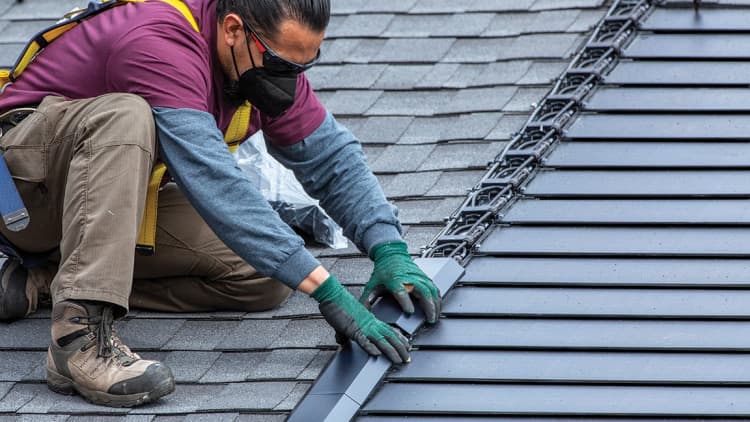
Interested in learning more about today’s sponsors or becoming a BiggerPockets partner yourself? Check out our sponsor page!

Note By BiggerPockets: These are opinions written by the author and do not necessarily represent the opinions of BiggerPockets.


Source link

How Rob Fits Family, Real Estate, and $100M Businesses Read More »