Leaving Seattle because of housing costs? We want to hear from you

Leaving Seattle because of housing costs? We want to hear from you


Paul Roberts

It’s not news: the Seattle area is one of the least affordable places in the country. The median single-family home in King County now goes for an eye-watering $914,000, up 14% from a year ago, and buyers now need to make an average of $214,000 a year to afford a home without being stretched too thin — more than anywhere except California.

But while some residents have found ways to stay in this expensive area, others have had enough and moved to less costly communities — or even less costly states.

Some of these real estate refugees are retirees looking for a less burdensome mortgage. Others are younger, would-be first-time buyers who simply can’t figure how to stay in Seattle and still have the dream of owing a home.

The Seattle Times is looking at how higher housing prices have changed not only how people live, but where — and what these changes mean for the Seattle area’s economy, culture and future.

If you left town in search of a more affordable home, or if you are giving it serious thought, we’d like to hear your perspective. What was the tipping point for your decision to leave? How far did you have to move to find an affordable home? What other changes, good or bad, have come with move? And would you ever come back?

Use the form below and we’ll be in touch.


Source link

Leaving Seattle because of housing costs? We want to hear from you Read More »

How to Forecast Sales With a CRM

How to Forecast Sales With a CRM


Now, let’s get into the nitty-gritty of sales forecasting using a CRM.

As a reminder, sales forecasting can mean the difference between sleepless nights.

  • Sleepless Night A): Worrying about your business
  • Sleepless Night B): Partying in Vegas with your sales on autopilot.

Here are the top two easiest ways to predict sales as an SMB owner.

1. Forecasting by Sales Funnel (My Favorite)

Forecasting by Sales Funnel involves analyzing each sales funnel stage to predict future sales.

The sales funnel typically includes stages like lead generation, lead qualification, proposal, negotiation, and closure.

Businesses can forecast sales volume and revenue by examining the conversion rates and time spent at each stage.

Example:

Here’s an example of what each stage of the funnel looks like:

  • Initial Prospects: 10% likelihood of conversion
  • Qualified Prospects: 25% chance of progressing
  • Proposal Stage: 50% expected conversion rate
  • Negotiation Phase: 75% likelihood of winning
  • Finalizing Deals: 90% probability of closing

Business owners can project sales outcomes more accurately by quantifying the potential success rate at each of these crucial milestones.

Pros:

  • Detailed Insight: Offers a detailed view of the sales process, allowing for targeted improvements at each stage.
  • Customizable: Can be tailored to the specific sales process and stages of a business.
  • Predictive Power: Helps in predicting sales volume by analyzing historical conversion rates.

Cons:

  • Data-Intensive: Requires detailed and accurate data on conversion rates and time spent at each stage.
  • Complexity: It can be complex to set up and maintain, especially for businesses with long or complicated sales cycles.
  • Assumption-Based: This relies on the assumption that past performance indicates future results, which may not always hold.

2. Forecasting by Lead Score

Forecasting by Lead assigns a score to each sales opportunity based on its closing likelihood.

Factors such as customer engagement, buying signals, and historical data are used to calculate these scores.

Sales teams can then use these scores to prioritize efforts and forecast sales revenue.

Example:

Imagine assigning a numerical value to each lead source based on its likelihood to convert:

  • Referrals: Scored at 8.1, referrals often bring in high-quality leads due to the pre-established trust.
  • Email Campaigns: With a score of 7.2, they can target and nurture leads effectively with personalized content.
  • Landing Pages: Designated at 6.5, these are the bread and butter for capturing interested parties and gathering data.
  • Social Media: Scoring a 5.4, social platforms enable you to engage with a broad audience, though with varying levels of intent.
  • Cold Calling: Rated at 3.6, it remains a tool for outreach, despite its lower conversion rate in today’s digital age.

Pros:

  • Prioritization: Helps sales teams prioritize their efforts on the most promising leads and opportunities.
  • Dynamic: Scores can be updated in real time based on new data, making the forecast more responsive to changes.
  • Efficiency: Increases sales efficiency by focusing resources on leads with the highest likelihood of closing.

Cons:

  • Complex Scoring Models: Developing and maintaining accurate scoring models can be complex and require advanced analytics capabilities.
  • Data Quality: The accuracy of forecasts depends on the data quality used for scoring.
  • Adaptability: Scoring models may need frequent updates to remain accurate as market conditions and customer behaviors change.

Both Forecasting by Sales Funnel and Forecasting by Score offer powerful insights for sales forecasting.

The choice between both is up to you!

Sometimes (I hate to say this) sales is more of a feeling than a fact…


Source link

How to Forecast Sales With a CRM Read More »

Creative Ways to Invest in Real Estate With No Money

Creative Ways to Invest in Real Estate With No Money


Not many new real estate investors enter the game with unlimited funds. Most of us need to figure out how to invest in real estate with little money.

In fact, some people start investing in real estate with just $1,000.

But that limits your options, so how do you invest in real estate with no money, or with little money?

We have plenty of our own thoughts on the matter, but to broaden the ideas, we polled a series of expert real estate investors on their tactics to invest without much money.

Why Invest In Real Estate?

With the broad range of financial instruments available to people—stocks, bonds, derivatives, deposit accounts, etc.—you might be asking why bother with real estate specifically?

Well, that’s because real estate offers multiple benefits that don’t inherently come with other financial instruments. Here are some of them:

ReasonDescription
Passive IncomeRental properties can generate steady cash flow, providing a consistent income stream.
AppreciationOver time, real estate values generally increase, offering potential for capital gain.
Tax BenefitsReal estate investors can take advantage of various tax deductions and benefits.
LeverageInvestors can purchase property with a relatively small initial investment.
DiversificationAdding real estate to an investment portfolio can reduce risk through diversification.
Inflation HedgeReal estate often retains value and purchasing power even during inflation.

Notice number 4 on the list: leverage. As indicated, real estate investments allows investors to get into the game with little to no money. 

Doing that, of course, requires further discussion. 


Ways To Invest In Real Estate With Little To No Money

 There’s a big world of creative financing available to you when you get into real estate. So, let’s look at your options: 


Live-in Flips

You know all about flipping houses. But have you ever considered moving into the property while you renovate and flip it?

Liz Hulz from The House Guys explains how she got into flipping: “Finding the seed money for your first project is the first and often the most challenging hurdle to overcome. A good solution is to make your first investment property your temporary home. This method works well for youngsters who have yet to get on the property ladder.

“Living in your investment property can cut down costs significantly. The money saved on rent and costs associated with renting a property can boost your renovation budget. Being on site cuts travel costs to and from the property. It also means you will be readily available to answer contractor questions avoiding delays based on communication.

“Having more time in the property, you can tackle easy DIY tasks yourself. Every small task you complete yourself reduces expenses and increases the return on your investment. Certainly, for the first investment you will find yourself counting every dime. After several investments, finances become easier and you have the confidence to take on more challenging projects that have a higher return on investment.

“My partner Andy and I bought our first house just after college, and it was so successful that we ended up starting our own real estate investment business! We love flipping houses and living our best lives together.”

As an added bonus, you can take out an owner-occupied mortgage, such as through Credible. That keeps both your interest rate and down payment lower than they would be with a hard money loan.


House Hacking

Deni and I are huge proponents of house hacking, and have each used several house hacking tactics over the years.

The classic house hacking technique involved buying a small multifamily property, moving into one unit, and renting out the others. You can use conforming mortgage loans for properties with up to four units, and again take advantage of lower down payments, lower interest rates, and lower minimum credit score requirements. Check out this duplex house hacking case study for details on exactly how it works.

But multifamily house hacking isn’t the only way to skin that cat. I’ve rented out rooms to housemates, covering the bulk of my mortgage payment. Deni has rented out storage space in her garage, and even went so far as to host a foreign exchange student for four years. The stipend covered most of her monthly payment.

You can also rent out an accessory dwelling unit (ADU) to cover some or all of your mortgage.

And if you don’t like the idea of sharing part of your property with long-term neighbors, no one says you have to sign a long-term lease agreement. You might prefer renting to short-term guests on Airbnb, and possibly earn higher returns to boot.


Real Estate Wholesaling

Also known as flipping contracts, wholesaling real estate involves putting a property under contract at a bargain price, then selling that contract to another investor — with a margin built in for you.

“For example, suppose you locate a $85,000 home and put it under contract for $55,000,” explains Corey Tyner, founder of Buy Yo Dirt. “You then sell the rights to that contract for $65,000 to another real estate investor. At the closing table, the seller receives $55,000, you receive a $10,000 finder’s fee, and the real estate investor gets a fantastic deal on a home.

“If everything goes right, you will never have to take title to any properties. You do, however, make a healthy profit.

“It won’t cost you much money; all you’ll need is a bit earnest money deposit to pay the seller, which might be as low as a few hundred dollars. Many first-time real estate investors begin by wholesaling to learn how to invest in real estate with little money. After a few wholesale deals, they have enough wealth to start retaining properties for themselves.”

Real estate wholesaling requires you to master two skills: scoring great real estate deals and building a network of real estate investors to sell to.


Borrow the Down Payment: Business Credit

Who says you have to come up with a down payment out of your own savings?

One way to invest in real estate with no money is to borrow the down payment from a business credit line or credit card. Because they’re not secured by collateral, they tend to come with relatively low credit limits and high interest rates. But you can combine many different credit lines and business credit cards to come up with the down payment, and then quickly pay it off with the flip profits or cash flow from the rental property.

In fact, many business credit cards come with an introductory 0% APR period ranging from 12-24 months. As long as you pay off the balance before then, it’s an interest-free loan.

Check out this video on how to open unsecured business credit lines as a real estate investor, using credit concierge service Fund&Grow. And while you’re at it, read up on other creative ways to come up with a down payment for a rental property.


(article continues below)


Source link

Creative Ways to Invest in Real Estate With No Money Read More »

A 0K house was built on the wrong Hawaii lot. A legal fight is unfolding over the mix-up

A $500K house was built on the wrong Hawaii lot. A legal fight is unfolding over the mix-up


HONOLULU (AP) — A woman who purchased a vacant lot in Hawaii was surprised to find out a $500,000 house was built on the property by mistake.

She’s now mired in legal wrangling over the mix-up.

Annaleine “Anne” Reynolds purchased a one-acre (0.40-hectare) lot in Hawaiian Paradise Park, a subdivision in the Big Island’s Puna district, in 2018 at a county tax auction for about $22,500.

She was in California during the pandemic waiting for the right time to use it when she got a call last year from a real estate broker who informed her he sold the house on her property, Hawaii News Now reported.

Local developer Keaau Development Partnership hired PJ’s Construction to build about a dozen homes on the properties the developer bought in the subdivision. But the company built one on Reynolds’ lot.

Reynolds, along with the construction company, the architect and others, are now being sued by the developer.

“There’s a lot of fingers being pointed between the developer and the contractor and some subs,” Reynolds’ attorney James DiPasquale said.

Reynolds rejected the developer’s offer for a neighboring lot of equal size and value, according to court documents.

“It would set a dangerous precedent, if you could go on to someone else’s land, build anything you want, and then sue that individual for the value of it,” DiPasquale said.

Most of the lots in jungle-like Hawaiian Paradise Park are identical, noted Peter Olson, an attorney representing the developer.

“My client believes she’s trying to exploit PJ Construction’s mistake in order to get money from my client and the other parties,” Olson told The Associated Press Wednesday of her rejecting an offer for an identical lot.

She has filed a counterclaim against the developer, saying she was unaware of the “unauthorized construction.”

An attorney for PJ’s Construction told Hawaii News Now the developer didn’t want to hire surveyors.

A neighbor told the Honolulu news station the empty house has attracted squatters.


Source link

A $500K house was built on the wrong Hawaii lot. A legal fight is unfolding over the mix-up Read More »

Top Goal Setting Frameworks – Small Business Bonfire

Top Goal Setting Frameworks – Small Business Bonfire


Just like most things in life, there are frameworks for goal setting.

I would highly suggest NOT reinventing the wheel.

Choose a framework and stick with it.

S.M.A.R.T

The oldie but goldie, SMART goals (Specific, Measurable, Achievable, Relevant, and Time-bound) have been my go-to for structured planning.

Golden Circle

Dig into the ‘why,’ circle through the ‘how,’ and then land on the ‘what.’ Simon Sinek’s Golden Circle flips the traditional model on its head.

Goals Pyramid

Stack your goals from the base up, with your mission at the bottom and your tasks at the top.

Locke and Latham’s 5 Principles

These principles pivot around Clarity, Challenge, Commitment, Feedback, and Task complexity to make goals stick.

B.H.A.G. (Big, Hairy, Audacious Goals)

Not for the faint-hearted, B.H.A.G.s are transformative goals that shift how you think about scaling and growth.

HARD

Heartfelt, Animated, Required, and Difficult – HARD goals tap into your emotional energy and fully engage you in the goal-chasing quest.

WOOP

This mental strategy stands for Wish, Outcome, Obstacle, Plan – a mental contrasting technique that helps cement goal achievement.

Here’s a cool graphic that I created about all these B.A. frameworks.


Goal Setting FrameworksGoal Setting Frameworks

Pro Tip: If you’re new to setting goals, start easy. You’re looking for a goal snowball where you CRUSH a goal and then set another one.

When you make your goals too lofty, you lose steam when you fall short.


Source link

Top Goal Setting Frameworks – Small Business Bonfire Read More »

Do You Have to Put a Down Payment on a House? Down Payment Hacks

Do You Have to Put a Down Payment on a House? Down Payment Hacks


Coming up with a down payment for a house presents the greatest barrier to buying for homeowners and real estate investors alike.

But do you have to put down a down payment on a house when you buy it? Are there creative workarounds that homebuyers and real estate investors can use to minimize the down payment?

It turns out there are ways to minimize down payments, especially for real estate investors. Of course, they have to come up with a far larger down payment than the average homeowner.


Why Is There A Down Payment Requirement For Most Real Estate Loans?

For the lender’s side, down payments are used to hedge against the risk of a non-paying client. It also gives the impression that the clients are capable of managing their finances to meet loan obligations over a long period.

For the borrower, a down payment can affect the overall state of your loan, including interest costs and monthly payments—and, yes, it also reduces risk on the buyer’s side. Higher down payments can lead to lower interests and monthly payments, or even shorter loan times.


How Much of a Down Payment Do I Need?

Homeowners must typically put down 5-20% of the purchase price when buying a house.

While it’s commonly known that 20% is the expected amount, this has changed in recent years, with the average down payment for a home in the US coming in at 14.4%. However, the government does sponsor some loan programs with particularly low down payments.


Loan TypeHouse Down Payment Requirement
FHA Loan3.5% with a credit score of 580 or higher; 10% with a credit score of 500-579​​
VA Loan0% (No down payment required for eligible veterans and service members)
USDA Loan0% (No down payment required for eligible rural homebuyers)
Fannie MaeAt least 3% for HomeReady and standard loan programs for a single-family home​​
Freddie MacSimilar to Fannie Mae, often starting at 3% for first-time home buyers and those meeting specific criteria


As we can see, FHA loans require only 3.5% down from borrowers with credit scores over 580. On the conforming side, Fannie Mae offers a 3% down mortgage program, as does Freddie Mac. Military veterans can even score 0% down mortgages from the VA!

Several factors impact the down payment required by your mortgage lender. Your credit history makes a huge impact, so if you have a few dings on it — or haven’t established much credit history — work to repair or build your credit fast. Lenders also look at the stability of your employment and income because they ultimately price and structure loans based on the perceived risk that you will default.

Remember that if you put down less than 20%, you must pay private mortgage insurance (PMI). PMI can add $1,000 or more to your annual mortgage costs, seriously affecting your budget.

Real estate investors, in contrast, must typically come up with a greater down payment. Expect to put down between 15-30%, with strong borrowers generally putting down 20-25% depending on their credit, investing experience, and the lender.

That higher down payment requirement leads some investors to get creative and look for loopholes in using homeowner financing to buy investment properties.


Tips To Minimize The Down Payment On Your House

 Let’s go over your options on how to lower the down payment for your next house purchase. 

Loophole 1: Occupy the Property for One Year

To qualify for a homeowner mortgage, you must live in the property for at least one year. After a year, you can move out and keep the property as a rental.

This strategy keeps your down payment and interest rate low. Some conventional loan programs require just 3% down! You can compare instant prequalified interest rates and down payments on Credible*.

That said, this strategy has several drawbacks. First, it sets a speed limit of one property per year. If you’re relying on owner-occupied financing, you can’t build your rental portfolio faster than that.

Second, these mortgages all report on your credit. One or two mortgages reporting on your credit can boost your credit score, but five or ten? They can ruin your credit.

Third, most conventional mortgage lenders limit the number of mortgages that can appear on your credit. For many loan programs, that limit is four—after that, you’ll have a hard time getting a mortgage.

Finally, you have to buy the property under your name rather than under an LLC or other legal entity to maintain your privacy as a landlord and avoid personal liability in the event of a lawsuit. If you want to borrow a loan for an LLC, plan to get a proper rental property mortgage from a portfolio lender.

This strategy is how the Hoeflers built their rental portfolio and reached financial independence. It worked especially well for them because they combined it with house hacking.


Loophole 2: House Hack a Multifamily

Another way real estate investors can use homeowner financing to minimize their down payment and interest rate is through house hacking a multifamily property.

While there are many ways to house hack to live for free, the classic model involves buying a small multifamily, moving into one unit, and renting out the others. Take Tim, for example, who house-hacked a duplex. His neighboring renters pay enough to cover his monthly mortgage payment and much of his maintenance and repair costs.

And, like the Hoeflers, you can always move out after a year and buy another multifamily!

(article continues below)


Source link

Do You Have to Put a Down Payment on a House? Down Payment Hacks Read More »

The homeowners who beat the National Association of Realtors

The homeowners who beat the National Association of Realtors


When Rhonda Burnett went to sell a home in 2016, she knew she would have to pay a commission to her real estate agent.

The house was a second home — she and her husband, Scott Burnett, had purchased the three-bedroom house in the Hyde Park neighborhood of Kansas City, Mo., as a place for their oldest son to live after he was accepted to law school in Kansas City in 2008.

Her real estate agent presented her with a form that detailed how much commission they would pay, with choices in four boxes: 6%, 7%, 8% or 9%.

Burnett was instructed to select one, and she picked 6%.

The rest of the form, which stipulated that the commission would be evenly split among the buyer and seller agents, was already filled out; Burnett asked if she could lower the commission paid to the buyer’s agent, but her agent told her doing so would discourage agents from showing her home.

“I shop sales,” Burnett, 70, said with a laugh. She spent three decades as a stay-at-home mother while her husband, Scott Burnett, 72, worked for a waste management company and spent 20 years working as a local legislator. “I’m always looking for a break. But when I asked her if I could negotiate, she said, ‘No, you really can’t.’ ”

Three years later in 2019, Rhonda Burnett became the lead plaintiff in a landmark legal case about home sale commissions against the National Association of Realtors that led to a settlement this month that real estate experts say will rewrite the housing industry in the United States.

The settlement followed a federal jury verdict in October in favor of the Burnetts and four other plaintiffs, on behalf of 500,000 Missouri home sellers, that ordered NAR to pay $1.8 billion in damages. Under the agreement, sellers’ agents will no longer be able to make offers of commission to buyers’ agents on most of the databases where homes are listed for sale, a shift that will, experts say, lower commissions across the board. For decades, most agents in the United States have charged an industry standard of between 5% and 6%, which is higher than in nearly any other developed country.

The plaintiffs argued that NAR and several large real estate brokerages had conspired to inflate real estate commissions, pointing to several NAR rules that required a seller’s agent make an offer of commission to a buyer’s agent. Those commissions, the home sellers argued, were negotiable in name only, and unnecessarily high, forcing home sellers to pay unnecessary fees to close a sale.

Burnett spoke for both herself and her husband. She told the jury how she felt that the rules of the real estate industry had seemed fixed, and she believed she was forced to pay a commission that was never truly negotiable.

In an interview, Burnett stressed that she didn’t blame her real estate agent, whom she believes was just doing her job. Burnett spent several years as an advocate for the Kansas City public schools, meeting with educators and parents that helped her district. Her real estate agent was also a school advocate, and they often saw each other at district meetings. She blamed the industry, and the powerful National Association of Realtors, which had set the rules.

“It’s not the Realtors. But the Realtors are controlled by a huge spiderweb,” she said. “After I joined the lawsuit, I learned so much about how the industry is run. It goes all the way to the brokerages and up to NAR.”

Despite the settlement, which is pending a federal judge’s approval, NAR continues to deny any wrongdoing in terms of its rules for agent compensation.

“NAR does not set commissions, and commissions were negotiable long before this settlement. They are and will remain entirely negotiable between brokers and their clients,” the organization said in a recent statement.

Before the lawsuit went to court, NAR — a powerful trade organization with 1.5 million members, more than $1 billion in assets and a cash-flush lobbying arm — seemed impregnable. It had fended off a Justice Department inquiry into anti-competitive behavior for more than a decade, and successfully sued upstart real estate companies that challenged its stance. The Justice Department inquiry is ongoing.

But in U.S. District Court for the Western District of Missouri, the home sellers were speaking directly to a jury of their peers. It offered them an opening.

Michael Ketchmark, 58, a plain-spoken personal injury lawyer who became lead lawyer on the case, sensed his advantage on the first day of the trial.

Stepping to the front of the courtroom on Oct. 17, he gestured to his mother and father, who are in their 80s and attend all of his trials. On that day, Margaret and Eugene Ketchmark were seated in the front row.

“I told the jury that everything I needed to know about this lawsuit, I learned from my mom and dad when I was in kindergarten,” Ketchmark said in an interview. “If you take something that doesn’t belong to you, you have to give it back. And that’s what this case was. It was a refund case. It was about giving the money back.”

Ketchmark was referred to the case by a friend and fellow attorney who knew the Burnetts. He then began looking for other plaintiffs across Missouri who might have similar grievances.

Ketchmark had never tried a housing case before, but he was no stranger to big wins — in 2002, he won a $2.2 billion civil judgment against Eli Lilly and other drugmakers, claiming that they failed to uncover the scheme of a Kansas City pharmacist who was diluting chemotherapy drugs. The drugmakers, who never admitted any wrongdoing, later settled for $72.1 million.

Ketchmark had a similar upbringing to the plaintiffs in the case against NAR, with parents who didn’t make a lot of money and who saw a house as their biggest investment. He grew up in West Des Moines, Iowa, as one of four children, and his father worked at a bank. His mother didn’t finish college until he himself was in law school — she put herself through night school.

He had a strategy: Talk to as many average Americans as he could about the case, and find out what resonated. His team began running and filming mock trials.

“We would watch the tape, and start developing out the themes of the case,” he said. By the time they got to trial, Ketchmark estimates he had watched 2,000 hours of video of mock jurors discussing the case.

“I intuitively knew when the trial started that if we could win this, that if the jury followed the law and reached the right result, that it would change the industry. And it has,” he said.

He pressed Burnett, who grew up in Georgia and met her husband when they were both working in President Jimmy Carter’s White House — Scott did field organization, Rhonda worked as an administrative aide — to describe her childhood with a stay-at-home mother who sold Tupperware and a father who worked at the federal penitentiary and took on shifts selling sporting goods at the local Sears for extra cash.

Burnett’s agent listed the house for $275,000 but it sold for $250,000. Burnett paid $15,298 in commission.

Ketchmark guided Jerod Breit, 42, another plaintiff in the case, to share stories of working as a police officer in St. Louis before saving up enough to buy his first home in south St. Louis. And he encouraged Hollee Ellis, 53, to tell the jury about her mother, who worked as a real estate agent.

Ellis, a former high school English teacher who now works in nonprofits, talked about joining her mother at real estate showings as a child, and later even working as an assistant at her brokerage at one point. She joined the lawsuit, she told the jury, not in spite of her mother but because of her.

If real estate agents were actually able to negotiate commissions, she said, she believed her mother could have made more money, rather than less.

“She operated under that assumption and that practice and that standard for so many years,” Ellis said of the split 6% commission. She shared with the jury that her mother is now suffering from Alzheimer’s and has advanced dementia. “Whereas I know she worked very, very hard for some of her buyers and possibly could have negotiated a different rate.”

Ellis described selling a modest three-bedroom, single-level brick house in 2016 and feeling that she could not negotiate the 6% commission she paid that was split between her agent and her buyer’s agent. “It’s not about money at all,” she said of the case. “It’s about reversing a practice that I feel is unfair.”

Ellis and her husband, Jerry Ellis, a forklift driver, were looking to sell their house in Ash Grove, Missouri, because Hollee Ellis had a new job opportunity at a nonprofit in South Carolina.

They owed $107,000 on their mortgage. They hired a real estate agent who sold the house for $126,000, netting them just over $18,000. Forty percent of that ended up going to real estate commissions for both their agent and the buyer’s agent.

“It was a hard pill to swallow that we were walking away with so little,” she said.

Breit also said he felt he had money taken from him.

He spent more than a decade as a police officer. He bought his first home, a two-bedroom brick Tudor in south St. Louis he described as a “gingerbread house,” with the help of a fellow officer’s father — a retired paramedic who worked as a real estate agent on the side.

When it came time to sell that home, Breit said, that same retired paramedic offered to help again, he said, and promised he would only take the “law enforcement special” of 5.5% commission.

Breit took issue with the commission to his buyer’s agent, and had joined the class-action lawsuit when lawyers began reviewing the contracts of his home sale. It was only then, one day before he was scheduled to take the stand, that he learned he hadn’t been offered a law enforcement special anyway.

He sold the home for $149,900 in 2017. He was charged $4,946.70 in commission to his seller, and $4,047.30 in commission to his buyer, totaling $8,994. When the numbers were brought to his attention, he did the math in his head several times, disbelieving. His agent, using forms that were preprinted, had gone ahead and charged him the full 6%.

“I know people say it’s negotiable,” he said. “But it’s really hard for me to believe that it’s negotiable when the documents are pre-filled and we don’t question it.”

Breit left the police force in 2017 and now serves as a regional executive director for Mothers Against Drunk Driving.

“I’m just a person who sold a house,” he said. “I don’t go to Jiffy Lube to pay for an oil change next week, and I don’t pay for someone else’s Hulu account because we live on the same block. People should only have to pay for what they use.”


Source link

The homeowners who beat the National Association of Realtors Read More »

How to Grow Your Business by 3

How to Grow Your Business by 3


You might be wondering how exactly you can attain such groundbreaking growth.


The path to increasing your business by 33% is filled with actionable strategies, innovative approaches, and untapped potential just waiting to be explored.

Ready?

Increase Your Prices by 10%


How to Grow Your Business by 33%How to Grow Your Business by 33%

You can approach this tactic in a few ways to suit your business model and customer base best:

  1. Yearly Price Increases for Existing Customers: Implementing a systematic annual increase for your existing customers can be a practical method to boost revenue. Pro Tip: Bake this into your contracts.
  2. Increase the Price by 10% for New Customers: Alternatively, you can opt to increase the price of your products or services by 10% for new customers. This strategy enables you to test the market’s response to your pricing and adjust accordingly.

Example:

Imagine a business coach:

The business, which offers professional development workshops, currently charges $200 per participant. With an average attendance of 50 participants per workshop, the revenue per session is $10,000 ($200 * 50).

By implementing a 10% price increase, the charge per participant would rise to $220 ($200 + $20). Assuming the attendance remains constant at 50 participants, the new revenue per workshop would be $11,000 ($220 * 50).

If most people were willing to pay $200, they wouldn’t blink an eye at $220. Wouldn’t you?

Get 10% More Customers


How to Grow Your Business by 33%How to Grow Your Business by 33%

Acquiring 10% more customers is a critical step toward achieving your goal of 33% growth.

This task can be approached through three main strategies: Referrals, Outbound Selling, and Inbound Marketing.

Each strategy requires a tailored approach and presents unique growth opportunities.

Here’s how to get started with each:

Referrals:

Referral Programs: Encourage your existing customers to refer new customers by offering incentives for the referee and the referrer.

Easy Start: Create a simple referral form and email it to your current customers, explaining the benefits for them and the person they refer.

Outbound Selling:

Cold Emailing and Calling: Reach out to potential customers who fit your ideal customer profile but are not currently in your network.

Easy Start: Identify 10 potential businesses each week and send personalized emails or make calls introducing your offering.

Social Selling: Leverage social media platforms to engage with potential customers and showcase your products or services.

Easy Start: Start building your brand on LinkedIn by writing great content (daily). From there, connect with your target audience and strike up great conversations.

Inbound Marketing

There are TONS of ways to do inbound marketing.

If you’re not currently doing inbound marketing, get started.

If you are doing some of these methods, expand into others.

SEO: Optimize your website to rank higher on search engine results, making it easier for potential customers to find you.

Easy Start: Include relevant keywords in your website’s titles, headers, and content.

AdWords: Google AdWords allows you to skip the line and pay for placement at the top of Google’s SERPs (search engine results pages).

Easy Start: Start with a small budget ($500/month) to test different keywords and ad copy to see what brings the best results.

Email Newsletter: Keep your customers engaged and informed by regularly sending out an email newsletter with updates, offers, and useful information.

Easy Start: Set up an opt-in form on your website. From there, write a weekly email newsletter in your niche.

Organic Social: Leverage social media platforms to build relationships and communicate with your audience without paid advertising.

Easy Start: Choose one social media platform where your target audience is most active and post valuable content daily.

All of these are easy to say and hard to do. Get started today.

Increase Buying Frequency by 10%


How to Grow Your Business by 33%How to Grow Your Business by 33%

Encouraging customers to buy more often boosts sales and deepens customer loyalty and engagement.

Here are some practical ways to encourage customers to make purchases more frequently:

Upselling:

Offer customers an upgraded or premium version of the product they’re interested in at the point of sale.

Example: If you’re a business coach, offer a 1/2-hour and a 1-hour time slot.

Cross-Selling:

Recommend related products or services that complement the customer’s original purchase.

Example: Using the coaching example, let’s say you offer coaching around social media growth and social selling. Start offering social templates.


Source link

How to Grow Your Business by 3 Read More »

10 Alternative Real Estate Exit Strategies All Investors Should Know

10 Alternative Real Estate Exit Strategies All Investors Should Know


4. Guerilla FSBO Tactics

Real estate agents are expensive for exit strategies, and aren’t always necessary. Sure, unique and upscale properties probably need a realtor to do some serious sales maneuvers, but an average middle-class house? The primary marketing is a simple MLS listing.

Today’s real estate investors can list their properties on the MLS using flat-fee listing services such as Clever and Houzeo that cater to For-Sale-By-Owner customers, at a fraction of the cost of a traditional realtor. But MLS listings are just the beginning.

There are entire Facebook groups dedicated to local real estate available for sale. If you’re targeting investors, there are also Facebook groups for local real estate investors, not to mention local real estate investing clubs. For that matter, you can take advantage of our nationwide Facebook group for real estate investors, with roughly 32,000 members!

It doesn’t take a realtor to put a “For Sale” sign in the window, or host an open house. Or, for that matter, to post flyers in the local grocery stores, fitness clubs, coffee shops, etc.

In some ways, this technique is the opposite of hiring an auction house. You’ll do all the work yourself instead of handing it off, but you’ll maintain much more control over the process, and you can wait for the right price. You’ll also be in an excellent position to offer seller-financing as part of the package, to help encourage buyers along (more on this later).


5. Auctions

Auctioning off properties works great when you need a quick sale.

Don’t expect top dollar – auctioning real estate prioritizes sale date over sale price. But when you absolutely, positively need to sell a property by a certain date, auctions are a reliable way to sell.

As anyone who has auctioned anything can tell you, who you choose as the auctioneer matters. A lot. Reputable auction companies attract serious, reputable bidders, who trust that the auctioneer is not deceiving them. It takes time for auctioneers to build trust – just ask Sotheby’s, who has been around since 1744.

Established auctioneers also have powerful marketing machinery in place, to reach the maximum possible audience. They cultivate extensive mailing lists, standing ad slots with local publishers, familiarity with the best ways to reach the right prospects in the local market.

But even when you use a reputable, experienced auctioneer, the outcome remains a gamble. Your final price will come down to who turns out that day, which can be affected by random variables like the weather, or seemingly unrelated events like a conference taking place across town. Maybe the traffic is just exceptionally bad that day, and prospective bidders decide not to make the drive.

Auctions aren’t quite an act of desperation, but they certainly won’t attract top dollar, either.


6. Dodge Taxes by Rolling Your Profits into a Larger Property

Taxes suck, even lower capital gains taxes on real estate. They siphon off money you could otherwise put toward building passive income and reaching financial independence. 

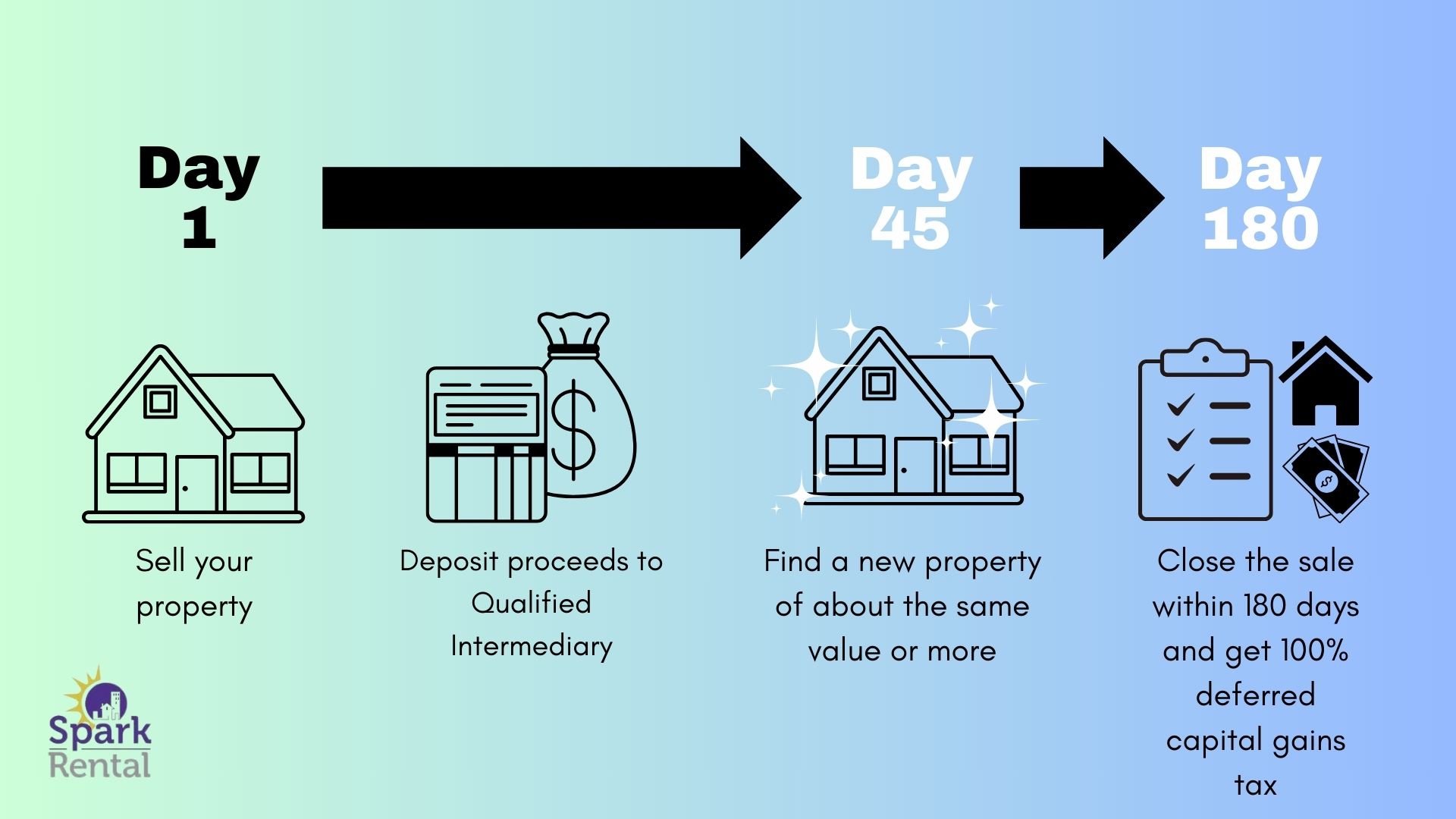
Fortunately, you don’t have to pay taxes on your profits from selling real estate. Not if you use them to buy another property, using a 1031 exchange. 

Within 45 days of selling your old rental property, you identify a replacement property you plan to purchase. You must then settle on the new property within 180 days of selling the old one. 

The new property must cost at least as much as the property you sold — it’s a tool for scaling your real estate portfolio, after all. 

Read up on how 1031 exchanges work before pulling the trigger, and keep rolling your real estate profits into ever larger rental properties with greater cash flow!


7. Pull Out Equity with Loans (Which Your Tenants Pay Back)

One of the most common real estate exit strategies is to sell the property to cash out the equity. But then you lose the asset, and no longer benefit from ongoing cash flow or appreciation. Where’s the fun in that?

Alternatively, you could keep the property and still pull out the equity through a rental property loan. It clips your cash flow, but you get to keep the property, which continues appreciating, and you can keep raising the rent each year. You get paid out for your equity, but you don’t have to pay taxes on it. Quite the opposite: you get to deduct the interest as a landlord tax deduction!

In other words, you can have your cake and eat it too. And your tenants can pay the mortgage back down again, just like they did the first time around. 

Win, win, win.


Source link

10 Alternative Real Estate Exit Strategies All Investors Should Know Read More »

FBI is investigating Eastside real estate firm iCap, lawyers say

FBI is investigating Eastside real estate firm iCap, lawyers say


The FBI appears to have launched an investigation into a Bellevue-based real estate investment firm, the first indication that the company’s former executives could face criminal charges connected to allegations they ran a Ponzi scheme.

For at least the last decade, iCap raised money from investors in Washington state and elsewhere, promising to invest in Seattle-area real estate projects. But last spring, investors grew concerned as the company stopped making monthly interest payments. By the fall, iCap filed for bankruptcy and a third-party restructuring firm, Paladin, took over.

Paladin said last month it believed iCap was a Ponzi scheme, using investor funds to repay other investors while doing little of the real estate redevelopment it promised. According to bankruptcy filings, the company owes 1,800 investors and other entities a total of $250 million.

As part of the bankruptcy case, attorneys for former CEO Chris Christensen wrote in court filings last week that the U.S. Securities and Exchange Commission and FBI “recently opened a criminal investigation into iCap.” 

“It is too soon to know whether the investigation will lead to any indictments or who the targets are,” Christensen’s attorneys wrote, urging the court to hold off on determining whether the company was a Ponzi scheme “until the parties have a clearer understanding of the criminal investigation.”

Christensen has denied that the operation was a Ponzi scheme.

The restructuring company last month urged a bankruptcy judge to find that iCap operated a Ponzi scheme, alleging that most of iCap’s income came from investors, not from real estate projects, and that iCap used most of its cash to make payments to investors, not for real estate projects. A Ponzi finding could allow the company to tap into more financing to fund the ongoing bankruptcy, according to court filings.

The dispute appears to have attracted the attention of federal regulators in recent months.

The SEC notified Christensen in February it was investigating iCap, and the “federal government confirmed its investigation of the same” this month, Christensen’s attorneys wrote.

Both agencies declined to comment. It’s unclear how the investigations are related. The SEC does not conduct criminal investigations.

While investigations are in their “nascent stages,” Christensen and others have received subpoenas from the SEC and the Washington State Department of Financial Institutions, the attorneys wrote.

Christensen’s attorneys did not respond to a request for comment Monday, but have denied in court filings that he operated a Ponzi scheme. 

Attorneys representing iCap investors, who are still waiting to find out if they will ever recoup their investments, welcomed a federal probe. Investors “should feel encouraged knowing that federal investigations are underway,” John Bender, an attorney representing the committee of investors in the bankruptcy proceedings, said in a statement. “We will support federal investigators however we can.” 

TALK TO US

Do you have information or tips about real estate projects in Western Washington? Get in touch with reporter Heidi Groover at hgroover@seattletimes.com or 206-464-8273.

Christensen, the former CEO, “vehemently disputes” the Ponzi scheme allegations, his attorneys wrote.

ICap “bought, developed and sold or otherwise exited out of approximately 60-70 real estate projects in Vancouver, Seattle, Tacoma, Bellevue and Renton, generating hundreds of millions of dollars in proceeds,” they wrote this month. That work included securing permits and paying for construction work, “a large business operation that completed a large number of complicated real property projects.”

That activity “stands in stark contrast to the typical Ponzi scheme,” they argued, adding later, “Even an unprofitable business is not synonymous with a Ponzi scheme.”

Christensen also disputed the conclusion from a consultant Paladin hired that iCap was a Ponzi scheme, claiming the consultant lacked expertise in real estate and based his findings on incomplete records.

Christensen, the restructuring company and other parties in the bankruptcy continue to argue about whether iCap operated a Ponzi scheme and whether a bankruptcy judge should decide on that question any time soon.

Christensen’s attorneys contend the criminal investigation could interfere with Christensen’s Fifth Amendment right against self-incrimination and that the government could use the bankruptcy process to get “premature access” to evidence relevant to the criminal case. 

Bankruptcy Judge Whitman Holt appeared sympathetic to that argument during a recent hearing, saying he found “this dynamic very troubling” and was “concerned about rushing forward in a way that steps on other people’s toes or creates problems.” 

Investor attorney Jay Kornfeld noted that a year has passed since iCap stopped making interest payments to investors. “For investors and individuals [who] have lost in many cases their life savings, that is a long time, and we would urge the court to keep this process going,” he said.

The next hearing in the case is set for Wednesday. 


Source link

FBI is investigating Eastside real estate firm iCap, lawyers say Read More »