HSBC pulls some UK mortgage deals as fears of rising rates hits home buyers once more

HSBC pulls some UK mortgage deals as fears of rising rates hits home buyers once more


“Persistently high inflation and the recent spike in lending rates will trigger a correction in the UK (Aa3 negative) housing market,” Moody’s Investor Service said in a report.

Matt Cardy | Getty Images News | Getty Images

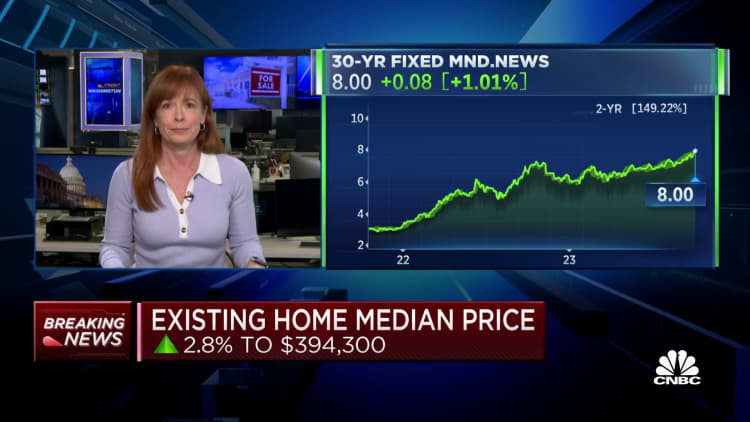
LONDON – The U.K.’s biggest bank temporarily withdrew mortgage deals via broker services on Thursday, as the effect of higher interest rates ripples through the British housing market.

HSBC told CNBC Friday that it was reviewing the situation regularly, but did not specify whether the new deals would differ from its previous offerings. Higher rates are a possibility, given that the Bank of England is continuing to increase interest rates.

It comes eight months after hundreds of mortgage deal offers were pulled in one day after market chaos at the time sparked concerns about rising base rates.

In a statement issued Friday, HSBC said: “We occasionally need to limit the amount of new business we can take each day via brokers. All products and rates for existing customers are still available, and we continue to review the situation regularly.”

The banking group said the protocol was in order to ensure it meets “customer service commitments” and stressed that it remains open to new mortgage business.

Soaring rates

Watch CNBC's full interview with the Bank of England's Andrew Bailey

Prices tumbled 1.1% year-on-year, logging their first annual decline since June 2020.

The Bank of England raised its interest rate to 4.5% from 4.25% as the central bank attempts to tackle high inflation that currently sits well above the 2% target, at 8.7%. 

The Organization for Economic Cooperation and Development predicts the U.K. will have the highest inflation rate out of all advanced economies this year.

Lenders and homeowners will be watching the central bank closely for its next base rate decision on June 22. It is widely expected the bank will agree its thirteenth consecutive increase.


Source link

HSBC pulls some UK mortgage deals as fears of rising rates hits home buyers once more Read More »

How To Create A Psychologically Safe Workplace – And Why You Need To

How To Create A Psychologically Safe Workplace – And Why You Need To


More than metrics, kick-off meetings or the promise of year-end bonuses, team performance is driven by culture. One sign of a toxic culture is high turnover, something supportive and empathetic leaders work to avoid. While some industries have higher attrition rates than others, a toxic corporate culture is 10 times more significant than compensation in predicting voluntary departures.

In contrast, a hallmark of work environments people want to inhabit is psychological safety, which encourages initiative taking and innovative thinking. It’s up to leadership to create psychologically safe workplaces for their teams. Here are a few ways to do it and why it matters.

ADVERTISEMENT

Encourage Diverse Perspectives

It’s not always bad for everyone on a team to agree—it’s called consensus. But when it arises out of fear, the result is groupthink. When groupthink occurs, expressed loyalty to the group or boss outweighs the best choices. The dangers of groupthink include making unethical decisions and having one person dictate the team’s direction. History shows that groupthink has been linked to disastrous outcomes such as the space shuttle Challenger accident.

If you’re not sure whether groupthink is happening within your team, look for the telltale signs. Are people radio silent when asked for their opinions? Is there a general feeling of apathy or complacency? It may be because team members don’t believe leadership values their perspectives, a reasonable conclusion when diverse opinions are actively shot down or passively ignored.

According to advisory firm McChrystal Group, only 37% of leaders encourage their teammates to voice alternate or opposing points of view. While not asking for others’ perspectives doesn’t constitute resistance to diverse ideas, it does discourage their expression. A psychologically safe environment is one where employees can openly disagree with leadership without fearing they’ll get penalized for using their voice.

ADVERTISEMENT

When you ask for diverse opinions and empower your team members to express them, you ensure the best ideas bubble to the surface. You reinforce healthy debate by promoting group discussion about the merits of each concept. Instead of putting your stamp on every initiative, demonstrate a willingness to listen to—and act on—team members’ contributions.

Make Room for Mistakes

In fear-based work environments, employees are afraid to make mistakes. It’s not the usual trepidation of slipping up and having an uncomfortable conversation at quarterly review time. Instead, it’s a fear that leads to hiding serious problems through questionable behaviors.

Say your company only evaluates sales teams based on closed sales. On top of this, there’s constant pressure from leadership to beat the numbers by achieving continuous growth. While expansion goals are admirable, what if the company is already the top dog in an oversaturated market? Surpassing last year’s numbers may be unrealistic, causing employees to find “creative” ways to mask underperformance.

ADVERTISEMENT

Furthermore, expecting perfection from your team can discourage the kind of risk taking that leads to innovation. Employees may experience stunted professional growth because they’re not in an environment where they can safely fail. Perfectionism can also lead to micromanagement, another factor that impedes psychological safety. When teams are micromanaged, they hold back, waiting for the boss to tell them what to do.

You can help your team without resorting to micromanagement if you time your offers of assistance right. Rather than swooping to prevent an error, which conveys a lack of trust, allow team members to proceed and experience any difficulties firsthand. By remaining available but not imposing yourself, you enable your subordinates to ask for assistance when they’re ready to receive it.

Set Clear Expectations

Have you ever worked hard on a project only to be told by the higher-ups that you went in the wrong direction? You had to start over because the work you did doesn’t come close to matching the new road map. You probably felt defeated or even got angry, wondering why leadership didn’t outline their expectations more clearly beforehand.

ADVERTISEMENT

Now imagine this scenario happening repeatedly on every project your team works on. They’d have to develop some thick skin and a nonchalant attitude to keep themselves in the game. But underneath it all, team members would lose confidence in their abilities to perform—or your ability to manage. They’d no longer feel safe taking initiative and would run every move by you first. Perhaps they’d notice problems and just wait for the chips to fall where they would.

Teams without clear performance expectations soon realize they’ll miss the mark anyway. Consequently, they conclude that there’s no percentage in putting forth top-notch effort. To avoid that fate, create psychological safety for your team by defining expectations clearly from the outset.

If there will be wiggle room in a project’s scope and outline, it’s OK to state that at the beginning. But asking your team to produce work and then completely changing the parameters afterward will demotivate them. In contrast, giving them clear expectations will encourage them to approach their work with confidence rather than doing only the bare minimum.

ADVERTISEMENT

Creating Psychological Safety

Leaders are responsible for making their teams feel safe when they express themselves at work. This includes voicing concerns and suggesting ideas for overcoming challenges.

Absent psychological safety, employees become anxious and motivated by negative consequences rather than positive possibilities. Team performance suffers as initiative and talent walk out the door. That’s why creating psychological safety is one of the most critical things managers can do to help their teams reach their potential.


Source link

How To Create A Psychologically Safe Workplace – And Why You Need To Read More »

Investing Later in Life? You’re Still in Luck!

Investing Later in Life? You’re Still in Luck!


Think it’s too late to retire with real estate? Maybe you’re in your forties, fifties, or sixties and have decided that now is the time to put passive income first. With retirement coming up in a couple of decades (or even years), what can you do to build the nest egg that’ll allow you to enjoy your time away from work? Is it even possible to retire with rentals if you didn’t start in your twenties or thirties? For those tired of the traditional route to retirement, stick around!

You’ve hit the jackpot on this Seeing Greene show; it’s episode number 777! But, unlike a casino, everything here is free, and we’re NOT asking you to gamble away your life savings. Instead, David will touch on some of the most crucial questions about real estate investing. From building your retirement with rentals to investing in “cheap” out-of-state markets, buying mobile homes as vacation rentals, and why you CAN’T control cash flow, but you can control something MUCH more important.

Want to ask David a question? If so, submit your question here so David can answer it on the next episode of Seeing Greene. Hop on the BiggerPockets forums and ask other investors their take, or follow David on Instagram to see when he’s going live so you can hop on a live Q&A and get your question answered on the spot!

David:
This is the BiggerPockets podcast show, lucky number 777. You don’t have to buy more real estate. You have to continually be active in adding value to the real estate you have, and when you’ve got to the point that you’ve increased the value as much as you can by doing the rehabs after you’ve already bought it at a great price, sell it or keep it as a rental. Move on to the next one and continue adding value to every single piece of property that you buy. That will turn into the retirement you want.
What’s going on everyone? This is David Greene, your host of the BiggerPockets Real Estate podcast here today with a Seeing Greene episode. In today’s show, I take questions from you, our listener base, and I answer them for everybody to hear. And you have struck the jackpot with episode 777 because this is a very fun and informative show. Today we get into several questions, including how to know if your property will work better as a long-term rental or a short-term rental, the spectrum of cashflow and equity and what that means, if the 4% rule of financial independence still works today and what may be changing about it, as well as what you can do if you get started investing later in life and you feel like you’re behind. All that and more on another awesome episode just for you.
Before we get to our first question, today’s quick tip is very simple. Check out real estate meetups in your area. Many of you are in certain markets in the country that we don’t talk about all the time on the show. In fact, I bet you the 80/20 rule applies. We talk about 20% of the markets 80% of the time, but what does that mean for the other 80% of the people that live somewhere else? Well, you still need to get information about your market and opportunities you have available, and there’s no better place to do that than a good, old-fashioned real estate meetup where you can meet other investors and hear what they’re doing that’s working, what challenges they’re having, and how they are overcoming them. If there isn’t one in your area, good news, you get to be the one that starts it, and you get to build the throne upon which you will sit as the real estate king or queen of choice. All right, let’s get to our first question.

Sam:
Hi, David. Thanks for answering my question. My name’s Sam Greer from Provo, Utah, a recent college graduate. My wife and I bring in about 180K a year. We have no debt, wanting to get into real estate, want a three bedroom as we both work from home and have a one-year-old. Rent here is about 2,200 for a three bed. A mortgage with a 5% down payment would be about 2,800. We’re wondering if we should continue renting, buying real estate outside of Utah as it’s much cheaper, buy here, try to house hack, although if you do a duplex, it’s about 2,800 accounting for the rent on the other side. Things are expensive around here. We’re wondering what we should do if it’s best to try to find a deal here or go out outside of Utah in a cheaper market. Any advice would be greatly appreciated. Thanks.

David:
Hey there. Thank you, Sam. So let’s start off with this. Real estate being cheaper somewhere else does not necessarily mean better somewhere else. There’s a reason that real estate is expensive in Provo, and that’s because you’re getting growth. So I want you to look at the way that real estate makes money. It really makes money in 10 different ways that I’ve identified, but there’s two main sources, which is cashflow and equity. Usually, a market that is stronger in cashflow will be weaker in equity and vice versa. So that doesn’t mean it’s a cashflow market or an equity market, although most of the time it would lean in one direction or the other. That means there is a spectrum, and on one end of the spectrum you’ll have equity. The other end, you’ll have cashflow. And you got to figure out where you’re comfortable fitting in there.
The Provo market is growing because population is growing. People are moving there, and people are moving there from California and other states that have money, which means rents are going to continue to increase. Values of real estate are going to continue to increase. That is a healthy robust market that you’re likely to do well in, but as you’re seeing, that means it’s not affordable. Now, here’s where I want you to change your perspective, and I want you to start Seeing Greene. It is not affordable right now, but it’s going to become even more expensive in the future. Now, I’m saying this because if you don’t buy in these high-growth markets, your rent continues to go up and up and up. So you mentioned that you can rent for 2,200 but own for 2,800. Right off the bat, that makes it seem like renting is cheaper.
It’s always like that in the beginning. Remember the story of the tortoise and the hare, where the hare came out the gates and was really fast, and the tortoise was really slow? The hare always looks like they’re winning the race in the beginning. That’s what it’s like when you think about renting and instead of owning. But over time, rents continue to go up. Your mortgage will be locked in place at 2,800. You actually even have some potential upside that rates could go back down and that 2,800 could become even less on a refi. So you might get some help on both sides, both from rents going up and from the mortgage coming down if you buy. So if you’re taking the long-term approach, buying is going to be better, and this is before we even get into the equity. We’re not even talking about the house gaining value and the loan being paid off. We’re only talking about the cost of living, which means buying is better.
Something else to consider is that you’re probably going to get tax benefits if you own that home. So if you get a benefit of say, $300, $400 a month in taxes that you’re saving from being able to write off the mortgage interest deduction, that 2,800 now becomes 2,400 or 2,500, which is much closer to the 2,200 that you’d be spending in rent. So as you can see, it’s starting to make more sense to buy. Now, that’s before we even get into house hacking. Can you buy a four-bedroom house or a five-bedroom house and rent out two of the bedrooms to family, friends? Maybe your wife isn’t into that. She doesn’t want to share the living space. Can you buy a property that has the main house that you guys stay in and has an ADU, has a basement, has an attic, has a garage conversion, has something in the property where you can rent that out to somebody else?
So your $2,800 housing payment is offset by collecting 1,200 or 1,400 from a tenant, which is house hacking, making your effective rent much more like 1,600. Now, that is significantly cheaper than the 2,200 that you’d be spending on rent plus you get all the benefits of owning a home. Now, I’ll give you a little bonus thing here. For every house hacker out there that feels like you’re not a real investor, that’s garbage. Let me tell you why house hacking is awesome. Not only do you avoid rents going up on you every year, so that 2,200 that you’re talking about here, Sam, that’s going to become 2,300, then 2,450, then 2,600, and it’s going to go up over time, but you also get to charge your tenants more. So you’re winning on both sides. Rather than your rent going up by a $100 with every lease renewal at the end of the year, your tenant’s rent is going to go up by a $100 with the lease renewal at the end of the year, which means a savings of $200 a month to you every single year.
Over five years, that’s the equivalent of a $1,000 a month that you will have added to your net worth to your budget. Now, how much money do you have to invest to get a $1,000 return every single month at a 6% return, that is $200,000. So house hacking and waiting five years in this example is the equivalent of adding $200,000 of capital to go invest and get a return, right? It makes a lot of sense, so take the long-term approach. Talk to your wife, find out what she needs to be comfortable with this. Go over some different scenarios, whether it’s buying a duplex, or a triplex, or renting out a part of the home, or changing a part of the home so it could be rented out. Maybe you guys live in the ADU, and you rent out the main house for $2,000. And now with your payment of 2,800, you’re only coming out of pocket $800 a month.
You save that money, and you do it again next year. When you first start investing in real estate, it is a slow process that is okay. You’re building momentum just like that snowball that starts rolling down the hill, it doesn’t start big. But after five, 10, 15 years of this momentum of you consistently buying real estate in high-growth markets and keeping your expenses low, that snowball is huge, and you can take out big chunks of the snow that have accumulated that’s equity and invest it into new properties. Thank you very much for the question, Sam. I’m excited for you and your wife’s financial future. Get after it. All right. Our next question comes from Laura from Wisconsin.
“My husband and I began investing in real estate in 2018. I’m 57. He’s 58. We got a late start and are now trying to navigate our way through to get us to retirement in the most efficient way possible. We weren’t always financially savvy, nor did we think about retirement as we should have, which has led to us now trying to play catch-up. I began listening to podcasts and reading books to get educated and use that to take action. We invest in B-class neighborhoods in Southeastern Wisconsin. Our business plan has been to rehab these properties so that we don’t have to deal with capex or maintenance. My husband is a contractor. We purchased our first single-family fixer in 2018 and fully rehabbed it to about 90% brand new. We did a ‘burb but then sold it in 2021 to capitalize on the market being in our favor. We 1031-ed that into a four family, then sold our primary residence that my husband built last fall and used that money to buy a single-family residence from a wholesaler and are now doing a live-in flip.”
“This has allowed us to personally live mortgage free. We do have a mortgage on the duplex and the four family. I don’t have a specific question. Just what advice do you have for those of us investors who got a late start? There haven’t been a lot of podcasts related to this topic. Cashflow is important to us, but appreciation is nice too. We aren’t comfortable investing in markets that provide the most cashflow. We also want ease of management. We love a good property that we can take advantage of Jeff’s strengths and add value to. We don’t want a huge portfolio, but are hoping to have enough properties to make a difference in our ability to retire comfortably. I realize this is a broad question, but maybe it’s a topic you can tackle in the near future. Thanks for all you do for the real estate investing community.”
Well, thank you Laura and I got some good news for you. You and Jeff were actually in a pretty good state. What I can do here is I can provide you some perspective that you may not be getting now. Most people look at real estate investing from the training wheel perspective they get when they first get introduced to this. So when we at BiggerPockets were first teaching people how to invest in real estate, it was a very simple approach. “Here is how you determine the cash-on-cash return. Here is how you make sure that you’re going to make more money every month than it costs to own it because that’s how you avoid losing real estate.” Now, this was important because BiggerPockets came out of the foreclosure crisis where everybody was losing real estate. So Josh Dorkin started this company because he had lost some real estate and he wanted to help other people avoid that same mistake.
At that time, it was just if you knew how to run numbers and you bought a property that made money not lose it, it was that simple. You were going to do well. And if you bought anything in 2011, ’12, ’13, 10 years later, you’ve done very well. So you understand what I’m talking about. Fast-forward to 2023, it is a fast-moving, complicated, highly-stressful, pressure cooker of a market, and we need a more nuanced approach to real estate investing that’s simple. Just calculating for cash-on-cash return and that’s all-you-got-to-do approach, it’s not cutting it anymore. So let’s break out of the training wheel approach of just buy a single-family house, get some cashflow, do that again, hit control C and then control V 20 times, you’ll have 20 houses, you can retire.
Real estate actually makes you money in more than one way. I’ve broken this into 10 different ways, and a couple of them are buying equity which means getting a deal below market value, paying less for a property than what it’s worth, forcing equity which is just adding value to the property, natural equity which would be the fact that prices of real estate tend to increase over time because of inflation, and then market appreciation equity which is investing in markets that are more likely to appreciate at a greater rate than the areas that are around them. Again, it’s not guaranteed, but it’s reasonable to expect. If you buy in a high-growth market with limited supply, it’s going to appreciate more than if you buy in a low-growth market with plenty of land and tons of homes everywhere, so they can’t go up in value. Now you’re already doing the first thing I would’ve told you, which is take advantage of your competitive advantage.
In Long-Distance Real Estate Investing, the first book I wrote for BP, I talk about this. Buy in markets where you have a competitive advantage. Where do you know a wholesaler that can get you deals? Where do you know a bank that will fund them? Where do you know a contractor who’s really good and reasonably priced? That’s the market you want to take advantage of. Now, you happen to sleep in the same bed as an awesome contractor, which is great. He’s always going to take your jobs first, and he’s going to communicate with you quickly. That’s the problem all the rest of us are having, but your husband does this for a living. You’re taking advantage of that. You’re also buying equity. You mentioned that you sold the house that you lived in, and you made the sacrifice, which was sacrificing your comfortability of loving that home that your husband built from the ground up with his own hands to get a good deal from a wholesaler and start over.
Now, when you bought that single-family residence from the wholesaler, you bought equity because you paid less than it was worth, and now you’re forcing equity by having Jeff work on it. That’s exactly what you should be doing. I understand you’re playing catch-up. That doesn’t mean you need to take more risk. That doesn’t mean you need to hope deals work out and just like buy a whole bunch of property. It means that you need to be more diligent about getting more out of every deal that you buy, which you’re already doing. You’re not paying fair market value for properties, and you’re not buying turnkey things. That’s a mistake a lot of investors make is they want convenience. They go buy a turnkey property, or they go to a market, like you said, where it appears that you’re going to get a lot of cashflow but you get no growth. And they end up either losing money or breaking even over a 10 to 15-year period.
You have already sacrificed comfortability in the name of progress, and I love that you’re making the right financial decisions. Hopefully you guys are also living underneath a budget, so keep doing that. I like the idea of you guys doing the live and flip. Buy a house that’s ugly, torn up, but in a great market. I call that market appreciation equity, it’s B-class areas, A-class areas. Just like you said, those are going to appreciate at a higher rate than C and D-class areas. Fix up the house. After two years, you’ll avoid capital gains taxes. You can sell it, and you can buy another one and repeat that process, or you can keep it as a rental, and you can put 5% down on the next house. You aren’t going to need a ton of capital. Because your husband does this work, you have an advantage over other people. Because your husband does this work, he has contacts in the industry.
Maybe he’s too old or his body can’t keep up with the demands of it, he can oversee the work that someone else is doing. Maybe he even mentors some younger kid that wants to come in and learn construction, and your husband can use his brain instead of his body to bring value into forcing equity. That’s another thing you should think about. As you do this, the equity that you’re growing with every deal should continue to increase. At certain points, rip off a chunk of that. Go buy yourself another four family. Go buy yourself another triplex. You’re already doing the right things. So to sum this up, you don’t have to buy more real estate. You have to continually be active in adding value to the real estate you have.
And when you’ve got to the point that you’ve increased the value as much as you can by doing the rehabs after you’ve already bought it at a great price, sell it or keep it as a rental. Move on to the next one and continue adding value to every single piece of property that you buy that will turn into the retirement you want. Thank you very much, Laura. Love hearing this story and glad that we have BiggerPockets are able to help you out with that retirement.

Vince:
Hey, David, thanks for taking my question. This is Vince Herrera from Las Cruces, New Mexico. I’m in the middle of closing on this property that I’m in right now. It’s my parents’, I made a deal with them to pay off the remainder of what they owe. And they sign it over to me, and I’m the owner free and clear. So right now, it’s really good. It’s only 30,000. So I looked up just really quick numbers on Rentometer and the areas around it, and it looks like I could probably rent, this mobile home for around a $1,000 a month. It’s a four bedroom, two bath. It’s in really good shape. It was recently remodeled. So I’m wondering, after I do this, should I try to use it as a short-term rental or long-term?
Obviously, I know I would probably make more as short term, but I don’t know how successful mobile homes are for short term, and I just don’t know what factors I should be looking at to make that determination. If you could help me out with that, that’d be great. My overall goal is to house hack small multifamily properties to build up my portfolio. So when I have something done with this property, whether it be short-term or long-term rental, I’d like to get into a small multifamily duplex, triplex, fourplex and house hack that, and then just keep going hopefully. So appreciate you taking my question and hope you have a good day. Thanks.

David:
All right, Vincent, thank you very much for that. This is a good question. To go short term to go long term, that is the question. All right. Now, like I mentioned before, what I usually need to give a good answer on this is an apples-to-apples comparison. So a lot of what I’m doing in real estate when I’m looking at two options is trying to convert the information into something that’s apples to apples. So what I wanted was to know what would you make per month as a long term? What could you make per month as a short term? Then I would look to see, because it’s going to be significantly more work to manage the short-term rental, is the juice worth the squeeze? If it’s an extra two grand or three grand a month, you can make as a short term rental, I’d compare that to what you’re making at work.
And I’d try to figure out would that make sense for you to put the effort into it versus if it’s another $300 a month, and it’s going to be a lot of work? Maybe it doesn’t make sense. So I use the BiggerPockets Rental Estimator, which anybody can use if they go to biggerpockets.com and they go to Tools and then Rent Estimator. And I looked up four-bedroom, two-bathroom, mobile homes in Las Cruces, New Mexico, and I used the zip code 88001. I don’t know exactly what the address was, but that’s the one that I picked. And rents seemed like they were anywhere in between $1,100 and $1,700, right? So we’re going to use an average above that, $1,300 for this property as a long-term rental. The next thing I would need you to do is to ask around at property managers that do short-term rentals out there and find out how much demand you have for short-term rentals?
You’re going to want to talk to either another investor that does it or a property manager that manages short-term rentals to figure it out. My guess is the people that would be renting out a mobile home as a short-term rental would probably be either a traveling professional that needs a place to stay for a month or two or a person that wants a budget deal because otherwise they would just stay at a hotel. So at a $100 a night, you would basically need to rent that thing out for around an average of 13 times a month in order to get similar revenue to the long-term rental. Now, of course there’s cleaning fees and other fees associated with short-term rentals, but it’s about half the month it’s going to have to be rented for at a $100 a night. Compare that to hotels. Can people stay at a hotel for less than that or more?
If a hotel out there is $200 a night, maybe you could get 150 or 125. That’s the approach that you want to take. I can’t answer your question on which way you should go until I know how much demand there is and how many people are traveling to Las Cruces, but I have given you enough information that you could figure this out for yourself without a ton of work. Also, congratulations on using the resources you have available to you, which was your parents to get this property, pay off the note, and take it over free and clear. I would love to see what you would do with this. This could be a great building block, a foundational piece to get some of the fundamentals of real estate investing down that would then help you buying the next house, which is hopefully a regular, construction, single-family home that you can buy with 5% down.
Reach out to me if you’d like to go over some lending options and come up with a plan for how to do that, and hopefully we can get you on another episode of Seeing Greene to give progress on the next property that you buy. Now, Vincent, at some point you may want to finance that mobile home, and you’re going to find that financing is not the same for mobile homes as it is for regular construction. You’re not going to get the same Fannie Mae, Freddie Mac 30-year, fixed-rate products, and that throws a lot of people off. There are still financing options available to you though. You just got to know where to look. Check out BiggerPockets episode 771 where I interview Kristina Smallhorn, who is an expert on this, and we go over some financing options as well as other things you should know if you’re going to be buying mobile homes or pre-fabricated properties.
All right, this point of the show, I like to go over comments from previous episodes that people left on YouTube. I find it as funny, I find it is insightful, and I find it as challenging, and sometimes people say mean stuff, but that’s okay. I’m a big boy, I can take it, but I like to share it with all of you because it’s fun to hear what other people are saying about the BiggerPockets podcast. Make sure that you like, comment, and subscribe to this YouTube channel, but most importantly, leave me a comment on today’s show to let me know what you think. Today’s comments come from episode 759. Let’s see what we got. From PierreEpage, “You should make turning on the green light part of the show, and then it will be harder to forget, almost like a quick tip being said in a certain way so consistently.”
Pierre, that is a great idea. This is why I like you guys leaving comments. I could not do this show without you. It could be that, like (singing). [inaudible 00:21:58] is that, isn’t that Sting or something that sings that? Is it Roxanne? (singing) Yeah. We could even make that the theme show for the Seeing Greenes, but we just have green instead of red. Maybe I should do that. When I start the show, I’ve got the regular blue podcast light behind me, and then we know it’s time to get serious because I flick it to green like Sylvester Stallone in that movie, Over the Top, where he turns his hat backwards. And it’s like flipping a light switch, and I go into Seeing Greene mode. Might have to consider that, Pierre. Thank you very much for that comment. In fact, if I can remember your name, I might even give you a shout-out when I do that for the first time.
Next comment comes from Patrick James 1159. Before I read this, I just want to ask everyone because I do Instagram Lives on my Instagram page, @DavidGreene24, and you try to read the person’s name that has the comment. And it’s always Matt_Jones_thereal.76325, and I wonder is there that many Matt Joneses that they need this many? Patrick James, are there 1,159 of you, and that’s how far you had to go? But as I read this, I realize the hypocrisy of what I’m saying because I’m DavidGreene24, and there probably were 23 before me, but I picked a number. However, my number was my basketball number in high school. I don’t know what number 1159 could be. It’s not a birthday. I’m curious, Patrick, if you hear this, leave us a YouTube comment on today’s show, so we know why you chose to throw such a big number at the end of your name.
All right, Patrick says, “I wish the best for everyone, but I’m leery of inflation and higher and higher rates. Two things that I can’t control, a grizzly burr.” Ooh, I see what you’re saying there like grizzly bear, but using burr, and you’re saying bear because it’s a bear market which has you nervous, which is why you said you’re leery of inflation at higher rates. Okay, you probably meant this as a joke, but I’m going to run with this in a serious way. It’s a problem, my brother. This is literally why I think the market is so hard, and I won’t take the whole episode to explain it, but if you’re struggling finding deals that make sense compared to what you’re used to seeing, you are not alone. We have created so much inflation that you cannot beat it by investing your money in traditional and investment vehicles, bonds, CDs, checking accounts, ETFs, even most mutual funds. Unless you’re an incredibly talented stock picker, you’re not beating inflation right now, and depending how inflation’s measured, that’s different, right?
The CPI think came in at 4.9, but if you look at how much currency has been created, there’s people that think inflation is closer to 30% to 50% a year. You’re not getting a 30% to 50% return on any of these options I mentioned. Where can you get it? With real estate, and that doesn’t mean a cash-on-cash return, I’m saying more like an internal rate of return. If you look at buying equity, forcing equity, market appreciation equity, natural equity, natural cashflow, forcing cashflow, buying cashflow, all the ways that I look at how real estate can make money when I’m Seeing Greene, you can start to hit those numbers over a 10-year period of time. And that’s why everyone is trying to buy real estate right now, even with rates that are high, even with cashflow that’s compressed. It’s hard, but it’s still the cleanest shirt in the dirty laundry, and everyone’s fighting for it.
So I hear you, Patrick. It’s rough. Patrick then says, “There be a grizzly burr in them woods.” This is a very corny Seeing Greene fan, and I love it. Thank you. Guys, who can out corn Patrick? I want to know in the comments. From Justin Vesting, “Hi, David. I just want to touch on something that I’ve noticed. You guys never interview or speak on the Northeast market, New England specifically, the toughest market in the US and where I’m located. I live in Rhode Island. Please do a show regarding the Northeast market, and if you could, Rhode Island would be fantastic. Hope you can make it as I would love to hear some insight in my market. Thank you.” All right, Justin, as I read this, I realize I forget that Rhode Island is a state in our country. I’m probably not the only one. There’s other states like Vermont and Maine that I can very easily forget exist. New England you hear about, but with Tom Brady gone, you hear about it much less.
So you’re right. We don’t do a whole lot of Northeast talk. We don’t have guests on that have done really well in those markets. Maybe we need to get someone to reach out to BiggerPockets.com/David and let me know if you’re a Northeast investor, so we can get you on the podcast because it’s tough. And I can see how you live there, and you’re trying to figure out what can be done to make money in those markets, and you’re not getting any information. So first off, thank you for listening even though you’re in a forgotten part of the country that I don’t know exists. This is like when you go through your closet, you find that shirt that you forget you had. You’re like, “Oh yeah, I haven’t worn this thing in three years. I remember I used to like this sweatshirt.’ But it’s like it’s brand new. You just reminded me we have 50 states and not just 47.
But on a serious note, yeah, we do need to get some people in to talk about that. I believe that we had someone from Bangor, Maine, it was like the first BiggerPockets episode I ever co-hosted with Brandon. We interviewed somebody from that market, and it was very rare. So if you’re a Northeast investor, let us know in the comments. And if you’ve got a decent portfolio, include your email, and our production team will reach out to you and interview you to be on the show. All right, a call to action before we move on to the next question. Get involved with your local real estate investor association or meetups. This is your best way to connect with investors in your market and get real-time info about what is working. If you’re investing in New England, please apply to be on the show at BiggerPockets.com/guest.
We also have an episode with Pamela Bardy coming up, so keep an eye out for 785, and she is from Boston, and you’ll love it. So if you’re in a market like the Northeast and you’re not getting as much information as you’d like, it’s more important that you make it to meetups and learn from other investors what they have going on. All right, we love and we appreciate your engagement, so please keep it up. Also, if you’re listening on a podcast app, please take a second to leave us an honest review. We love these and they’re super, super important if we want to remain the biggest, the baddest and the best real estate podcast in the world.
A recent five-star review from Apple Podcast from Legendary. “Finally took a second to write a review. Listened to you since the beginning, kept me going when I wanted to throw in the towel in my own real estate biz. Keep up the great work.” And that is from Jake RE in Minnesota. Thank you very much, Jake, for taking a second to leave us that review and especially for being so kind. So glad you’ve been here from the beginning. Love that we’re still bringing you value, and thank you for supporting us. All right, our next question comes from Tomi Odukoya.

Tomi:
Hey, David. My name is Tomi Odukoya. I’m an investor in San Antonio, Texas. Behind me is my vision. I have a question. I’m also a Navy veteran. I love your idea and thank you so much for pushing house hacking. I’m currently in my primary residence. I used my VA loan. I’m getting ready to close on a new bill duplex using my VA loan again. Current house, my primary has interest rate at 3.25%. I’m wondering when I close on the duplex and move into it, my current primary, should I transfer the deed to my LLC, or how should I take care of that, so I can rent out the current primary and also not have to worry about the liability, but hold onto the mortgage at 3.25%?

David:
Thanks. All right, Tomi, first off, thanks for your service, man. Really appreciate that you’re in the military, and love that you’re listening to the show. If we have other military members that are BiggerPockets fans, send me a DM on Instagram, @DavidGreene24 and let me know you’re either a first responder or military. Would love to get to know you guys better, and gals by the way. Okay, let’s break down your question. The good news is I think you’re probably overthinking it because you have the right idea, and I can see that you’re trying to keep your low interest rate. But you’re wanting to move out and get another house, which frankly, if I could just tell anybody what they should do with real estate, I’d be telling them to do what you are doing. Don’t overthink it. House hack one house every single year in the best neighborhood you can possibly get in with the most opportunities to generate revenue, whether that’s the most bedrooms possible or the most units possible, whatever it is. Just keep it simple. Put 5% down every single year. So you’re already on the right path.
Now, regarding your concern, if you’re saying that you may want to move the title into a new vehicle through a deed, so like starting an LLC to take a house that was once your primary residence and take it out of your name for liability reasons, I’m not a lawyer. I can’t give you legal advice. I can tell you if I was in your situation, I wouldn’t be worried about that. And I’m saying this from the perspective that LLCs are not airtight guarantees, much like your bulletproof vest which you’re going to wear if you’re in a position where you need to. It’s better than not having it, but it is far from a guarantee, right? The bulletproof vest doesn’t stop everything that comes your way, and you know that.
LLCs are like that. People tend to look at them like these airtight guaranteed vehicles that you’re protected in case you get sued and they’re not. They can actually have what’s called the corporate veil pierced. If a judge looks at your LLC and says, “That’s not a business. That was just his house. It’s still him that owns it. He doesn’t have a legit real estate business. He just took his house and stuck it in this LLC.” If you’re found negligent or at fault, they will still let that defendant come after you and take what they’re owed in the judgment. One thing people don’t realize is that your regular homeowner’s insurance will cover you in case you’re sued up to a certain amount. I would just talk to the insurance company, and I would make sure that you’re covered for an amount that is in proportion to what a judge might award somebody if you end up getting sued.
That’s one of the reasons I’m starting an insurance company is to help investors in situations like this as well as to ensure my property. So reach out to me if you would like us to give you a quote there. But the properties that I bought in my name, I didn’t move all of them into an LLC. The first properties I bought, they’re still in my name, and they’re just protected by insurance. So I think a lot of people assume LLCs are safer than they are. Doesn’t mean they’re not safe, doesn’t mean they’re not important. They have their role. But oftentimes the people that I know that are putting their properties into legal entities, it’s not always for protection. It’s more so for tax purposes. And the last piece that I’ll say is this becomes more important to put them in legal entities like LLCs when there’s a lot of equity, or you have a high net worth.
If you’re in the military, you’re grinding away, you’re getting your second property, you’re probably not in a huge risk of being sued. When you get a $1 million of equity in a property or within an LLC, now, there is incentive for someone to go after you and try to sue. But until you get a bigger net worth, it’s not as important. Because if you only have $50,000, $60,000, $70,000 of equity in a property, after legal fees, it doesn’t make sense for a tenant to try to sue you for something unless you really, really screw up because there’s not a whole lot for them to get. So don’t overthink it. I think you’re doing great. Make sure that you’re well insured. Buy the next property. After you’ve got several of these things, we can revisit if you want to move their title into LLCs.
Another reason that I’m not leaning towards it is when you do that, most times, you trigger a due on sale clause in your agreement with the lender that they have the right to come and say, “Now, we want you to pay our mortgage back in full.” They don’t always do that, but they can. And here’s my fear that isn’t talked about very often. When rates were at 5% and they went down to 3%, for a lender to trigger the due on sale clause and make you pay the whole mortgage off, they would lose the 5% interest that they’re getting from you, and they would have to lend the money out to a new person at 3%, which is inefficient. So of course, they don’t do that. But what have rates been doing? They’ve been rising.
So now I’m warning people, if you’re getting fancy with this type of thing, if you’re assuming somebody else’s mortgage and the lender finds out about it, or if you’re doing this where you’re moving the title from one thing into the next and hoping they don’t find out if your mortgage is at 3% or three to quarter, whatever it was you said it was at, and rates go to 7%, 8%, 9%, 10%, now the lender can triple their money by calling your note due and lending that money to someone else at 9% or 10% instead of you at 3%. You might actually see banks going through their portfolio of loans and saying, “I’m calling this one, I’m calling this one, I’m calling this one.” That would make sense to me.
So now with rates going up instead of down is not the time to try to move things out of your name and into a legal entity if there’s a due on sale clause. Hope that my perspective makes sense there. Again, I’m not a lawyer, but that’s the Greene perspective that I’m seeing. You guys have been asking great questions today. Our next question comes from Jeff Shay in California, where I live. Side note for all of you that don’t live in California, first off, no one calls it Cali in California. I don’t know where that started, but everyone outside of California refers to as Cali, but none of us call it that. It would be like calling Texas, Texi or Arizona, Ari. I don’t know where that started. It’s just a lot of syllables maybe, but you are guaranteeing that people will know you’re not from California if you say Cali.
And when someone says they’re from California, your next question should be, which part, Northern or Southern? Because they’re basically two different states. They have hardly anything to do with each other. So I’m not sure where Jeff is from in California, but if it’s in Northern California, it might be near me. Jeff says, “I’m 31, and my wife is 33. We’ve been investing in real estate. Our properties are more appreciation heavy, and eventually the plan is to sell off to purchase more cashflow-heavy properties or dividend stocks to maximize passive income. How do we begin to calculate when we can start doing this? Does the 4% rule still work in today’s financial landscape? Thank you very much.”
Jeff. I love this question. You’re doing it the right way. Let me give some background into why I think you’re taking the right approach here. So in general, real estate makes money in several ways, but the two main focuses are cashflow and equity, and it tends to operate on a spectrum. So it’s not like it’s cashflow or equity. It’s a lot of cashflow and less equity or a lot of equity and less cashflow, but there is some markets that fit right in the middle. Dave Meyer refers to these as hybrid markets. If you would like to know more about that, check out the bigger news shows that I do with James here on the BiggerPockets podcast network.
But the point is you have less control over cashflow. This is one of the ways I teach wealth building for real estate. Of course, we all want cashflow, and for you, Jeff, you’re trying to maximize how much cashflow that you’re going to get in retirement because that’s when it matters. When you’re not working anymore is where you need that cashflow. But I don’t control cashflow. The market controls that. I am at the mercy of what the market will allow me to charge for rent. That’s the only way I can increase cashflow is either raising rent or decreasing expenses, and it’s very hard to decrease expenses. You can only decrease them so much. Paying off the mortgage is one way, trying to keep vacancy low, trying to keep repairs low. But when things break in houses, your tenant controls that much more than you do.
So what I’m getting at is you have a lot less control over the outcome of cashflow. You have more control over the outcome of equity. You can buy properties below market value. You can buy them in areas they’re likely to appreciate. You can buy at times when the government is printing more money. You can force equity by adding square footage, fixing the properties up, doing something to increase the value. See what I’m getting at? Equity allows a lot more flexibility, but it’s not cashflow. So the advice I give is to focus on equity when you’re younger, grow it because you have more influence over that. And what I mean is you can add $50,000 of equity to a property much easier than you can save $50,000 of cashflow. I mean, think about how long it takes to save $50,000 of cashflow after unexpected expenses come up. That’s a long time.
During that period of time, you probably mill a lot more than $50,000 of equity. I mean, it might be 10 years before you get $50,000 of cashflow, but equity doesn’t help you when you want to retire. It’s a number on paper. It’s not cash in the bank. So the advice, just like Jeff is doing here, is to build your equity, grow it as much as you can. Then when you’re ready to retire, convert that into cashflow. Now, Jeff, you said, “Does the 4% work rule still work in today’s financial landscape?” I’m assuming what you’re meaning is you should invest your money to earn a 4% return because you’re going to live for a certain period of time, and that then your money should last you for how long you’re going to live. All right, so what is the 4% rule?
According to Forbes, the 4% rule is easy to follow. In the first year of retirement, you can withdraw up to 4% of your portfolio’s value, if you have 1 million saved for retirement, for example, you could spend $40,000 in the first year of retirement following the 4% rule. Now, I’m assuming what this means is if you can earn a 4% return on that money and only withdraw 4% of said money, you won’t run out of money in retirement. If that’s not exactly the 4% rule, I’m sure the FI people are going to be screaming. Let me know in the comments on YouTube. But it’s not super important if I have the rule down. What is important is that Jeff is asking, “How much money do I need before I can start withdrawing it, so I don’t run out of money in retirement? And at what point do I want to convert this equity into cashflow?”
So the good news is you’ve got the equity to convert, meaning you’ve run the race well. Good job, Jeff and your wife. You guys are 31 and 33, so it doesn’t need to happen anytime soon. Okay? Keep investing in these growth-heavy markets. Keep buying under market value and keep adding value to everything that you buy. I would wait until you no longer want to work or enjoy working. If you could find a job that you work until you’re 60 or 65 and you like it, it’ll be a lot less stressful to just keep working than it would be to try to retire at 50 and always wonder what’s going to happen. Now, here’s something that I think are headwinds that are working against you. Inflation is growing so incredibly fast. If I gave you a $1 million 30 years ago, you would feel a whole lot more secure than with a $1 million today.
What’s it going to be like 30 years from now when you’re in your early 60s? Is that million dollars going to be worth the equivalent of a $100,000 or $200,000 in today’s dollars? You wouldn’t feel very good retiring with a 100 grand. That might be what a $1 million is worth 30 years from now. It might be worse than that. I know this is hard to imagine, but if you went back 30 years and you looked at how much houses cost, you’d probably find that they were like $80,000, $90,000, a $100,000 in areas that they’re now $600,000, $700,000. They’ve gone up a lot, and we’ve printed more money recently than we have over the last 30 years. So I’m expecting inflation to be a beast. Now, this is good if you own assets. This is good if you have a lot of debt. This is very bad if you don’t want to work anymore.
In fact, when I first realized this, my plan of retiring at 35 and never working again evaporated because I realized the $7,000 of passive income that I had accumulated at that time was not going to be enough to sustain me for the rest of my life because of inflation. My rents were not growing at the same pace of the cost of living and all the things that I wanted to do. That’s when I realized, “I guess, I got to keep working, but I’d rather be a business owner than work at W-2. I got out of being a cop. I got into starting a real estate sales team, a mortgage company, buying more rental properties, doing consulting, the stuff that I do now, writing books.
Can you find something like that, Jeff, that you like doing, so you can keep working? Because my fear would be that the $40,000 that you might be living on right now, if you had a $1 million and you were using the 4% rule, would be the equivalent of $8,000 when you actually want to retire, not enough to live on in a year unless you move to a Third World country. So it’s a moving target is basically how I’m going to sum this up. By the time you retire, I don’t know if the 4% rule is going to work in today’s financial landscape, but I’m betting on, no. I’m betting on inflation being really, really bad and cashflow being hard to find for a significant period of time. So rather than investing to try to make money so I can retire, I’m investing to try to maintain the value of the money that I’ve already earned.
So if I earn a $100,000, I want to put that $100,000 in a vehicle like real estate where it is going to lose less, even if it doesn’t keep pace with inflation. If inflation is at 30% to 50%, I’m not bleeding as much as if I put it in a different investment vehicle. I realize that this is not a sexy concept, but it’s defense, and I think more people should be thinking defensively, including you and your wife. So keep doing what you’re doing, but we’re not going to make our decision on when you take out that equity and convert it into cashflow until much later in life, when you’re not able to work anymore. Now, what you still could do is you could take off some chunks. Let’s say you grow to $2 million of equity investing in California real estate, maybe you rip off 400,000, 500,000. Put that into a market that cash flows more heavily or an asset class that cash flows more heavily like a short term rental.
And then to get some cashflow coming in from that while you keep a 1.5 million in equity, let that snowball to another 2 million. At that point, rip off 500,000. Repeat the process. You could probably do three, four, five cycles of that before you retire if you do it every five or six years. All right, Jeff and Jeff’s wife, thank you so much for submitting this question. It was a great one to answer, and I got to highlight what I see going on with our economy and the future. And that is our show for today. I am so grateful that you all join me for another Seeing Greene episode. I love doing these, and I love your questions. If you’d like to be featured on the Seeing Greene Podcast, submit your questions at BiggerPockets.com/David because that’s my name, aptly titled, and hopefully we can get you on here too, especially if you can keep it under two minutes, one minute. Those are even the best.
And when we first started doing the show, we got a couple complaints that we had people submitting seven-minute questions, so we’ve done a much better job of getting those narrowed down. But we could not do the show without you, the listener base, so thank you very much for being here. If you would like to know more about me, you can find me online at DavidGreene24, or you could follow me on Instagram, Facebook, Twitter, whatever your fancy is at DavidGreene24. Send me a DM there, and we can get in touch. All right, if you’ve got a minute, check out another BiggerPockets video, and if not, I will see you next week. Thank you, guys, and I’ll see you then.


Help us reach new listeners on iTunes by leaving us a rating and review! It takes just 30 seconds and instructions can be found here. Thanks! We really appreciate it!


Interested in learning more about today’s sponsors or becoming a BiggerPockets partner yourself? Email [email protected].

Note By BiggerPockets: These are opinions written by the author and do not necessarily represent the opinions of BiggerPockets.


Source link

Investing Later in Life? You’re Still in Luck! Read More »

What the Federal Reserve’s expected interest rate pause means for you

What the Federal Reserve’s expected interest rate pause means for you


damircudic | E+ | Getty Images

The Federal Reserve is likely to temporarily pause its aggressive interest rate hikes when it meets next week, experts predict. But consumers may not see any relief.

The central bank has raised interest rates 10 times since last year — the fastest pace of tightening since the early 1980s — only to see inflation stay well above its 2% target.

“We are living in uncharted territory,” said Charlie Wise, senior vice president and head of global research and consulting at TransUnion. “The combination of rising interest rates and elevated inflation, while not uncommon from a historical perspective, is an unfamiliar experience for many consumers.”

“A pause is not going to make things better,” he added.

More from Personal Finance:
Even as inflation rate subsides, prices may stay higher
Here’s the inflation breakdown for April 2023, in one chart
Who does inflation hit hardest? Experts weigh in

Although the Fed’s rate-hiking cycle has started to cool inflation, higher prices have caused real wages to decline. That’s squeezed household budgets, pushing more people into debt just when borrowing rates reach record highs.

Even with a pause, “interest rates are the highest they’ve been in years, borrowing costs have gone up dramatically and that isn’t going to change,” said Greg McBride, chief financial analyst at Bankrate.com.

Here’s a breakdown of how the benchmark rate has already impacted the rates consumers pay:

Credit card rates top 20%

The federal funds rate, which is set by the U.S. central bank, is the interest rate at which banks borrow and lend to one another overnight. Although that’s not the rate consumers pay, the Fed’s moves still affect the borrowing and savings rates they see every day.

For starters, most credit cards come with a variable rate, which has a direct connection to the Fed’s benchmark rate.

After the previous rate hikes, the average credit card rate is now more than 20% — an all-time high, while balances are higher and nearly half of credit card holders carry the debt from month to month, according to a Bankrate report.

Mortgage rates are near 7%

The U.S. Fed will probably stay hawkish, strategist says

Adjustable-rate mortgages, or ARMs, and home equity lines of credit, or HELOCs, are pegged to the prime rate. As the federal funds rate rose, the prime rate did, as well, and these rates followed suit.

Now, the average rate for a HELOC is up to 8.3%, the highest in 22 years, according to Bankrate. “While typically thought of as a low-cost way to borrow, it no longer is,” McBride said.

Auto loan rates are close to 7%

Even though auto loans are fixed, payments are getting bigger because the price for all cars is rising along with the interest rates on new loans.

The average rate on a five-year new car loan is now 6.87%, the highest since 2010, according to Bankrate.

Keeping up with the higher cost has become a challenge, research shows, with more borrowers falling behind on their monthly loan payments.

Federal student loans are set to rise to 5.5%

Federal student loan rates are also fixed, so most borrowers aren’t immediately affected by the Fed’s moves. But as of July, undergraduate students who take out new direct federal student loans will see interest rates rise to 5.50% — up from 4.99% in the 2022-23 academic year and 3.73% in 2021-22.

For now, anyone with existing federal education debt will benefit from rates at 0% until the payment pause ends, which the U.S. Department of Education expects could happen in the fall.

Private student loans tend to have a variable rate tied to the Libor, prime or Treasury bill rates — and that means that those borrowers are already paying more in interest. How much more, however, varies with the benchmark.

Deposit rates at some banks are up to 5%

While the Fed has no direct influence on deposit rates, the yields tend to be correlated to changes in the target federal funds rate. The savings account rates at some of the largest retail banks, which were near rock bottom during most of the Covid pandemic, are currently up to 0.4%, on average.

Thanks, in part, to lower overhead expenses, top-yielding online savings account rates are now over 5%, the highest since 2008’s financial crisis, according to Bankrate.

However, if the Fed skips a rate hike at its June meeting, then those deposit rate increases are likely to slow, according to Ken Tumin, founder of DepositAccounts.com.

Subscribe to CNBC on YouTube.


Source link

What the Federal Reserve’s expected interest rate pause means for you Read More »

Was Selling Waze To Google A Good Decision? Founder Of Waze answers

Was Selling Waze To Google A Good Decision? Founder Of Waze answers


In June 2013, Google acquired Waze for $1.15 Billion, at the time the highest price ever paid for a consumers app and certainly a life-changing event for me, my co-founders, all of Waze employees, and the Israeli hi-tech ecosystem.

People often ask me if it was the right decision and what has changed in the last decade. Here are some of my thoughts.

I believe there are right decisions or no decisions. If you ask me if Waze would have been worth more than $1.15 Billion today, the answer is yes. Today, the app has 10X more users, and 100X the revenues compared to 2013, if not more.

So, the answer is definitely yes, it was the right decision. But in reality, we do not know what would have happened if a different path had been taken. We don’t even know if Waze would have become what it is today, or if it would have even survived. I believe it would have, but we cannot really know that for sure.

Blockbuster said ‘no’ to the offer to acquire Netflix (twice). Yahoo said ‘no’ to the offer to acquire Google twice, both times for less than five million Dollars. Today, we look at these decisions and say, ‘Big mistake’, but we don’t know what would have happened if they had said yes. While we would like to believe that Netflix and Yahoo would still have followed the same path, this is unlikely.

Waze on the day after

So, What Did Happen To Waze In The Last Decade? Well, it is still the most popular driving app in the world, with about 650 million downloads, and definitely the most loved and used app. When I ask people who are using Waze how often they use it – the answer is ‘every time I get in the car’ while with other apps the answer is be ‘when I need it’.

Some people would say it is better than a decade ago, others would say it is not as good as it used to be. However, traffic jams, the problem we tried to solve when building Waze, are worse than before almost everywhere.

What became of Waze’s management team? They stayed in the startup scene, and in time, most of them moved on to their next startup. For me, it was moving on to build around a dozen new startups.

If I had a time machine, would I have done anything differently? Probably not.

The biggest miss of Waze, in my opinion: it was unsuccessful with car-pool which could have made a way bigger impact on traffic jams than the Waze app itself.

Now, let’s imagine a world without Waze.

In 2012 Waze was growing faster than the entire navigation industry combined – all apps and in-car navigation devices with about 20 million users – while Waze had 25 million new users in 2012. The use of driving apps was not that popular then.

Today – most drivers in the world use a driving or a navigation app, and Waze probably has more mileage driven than the rest of the industry combined.

The End Is Just The Beginning Of A New Journey

Ten years later, I am proud to be one of the founders of an app that is used by so many people and creates so much value (a lot of value for a lot of people).

Since then, I was part of another startup that is somewhat similar, Moovit, Waze for public transportation, but in this case with even more users – about 750 nillion – when it was acquired for over a billion dollars as well.

I’m happy that I left Waze after the acquisition, so I could build more startups, become even more impactful, create more value, and help make the world better for more people.

Among the starups I built or became invloved in are Pontera that helps individuals retire wealthier by allowing them to work with their financial advisor on held away accounts like 401(k); FairFly that addresses the biggest secret in the travel industry of what happened to airfare AFTER the booking, and helps corporates to save on their travel budget. In the agritech sector, SeeTree, which responses to the particularly devastating challenges in permanent crop farming such as crop losses, epidemics etc., by providing a unique intelligence platform for tree-farmers fusing AI/ML, IoT multi-sensory data, and other advanced technologies

In the healthcare sector, Kahun, an evidence-based AI clinical reasoning tool that tackles the challenges posed by Generative AI models and leverages the advanced capabilities of Language Models (LLMs) to create a clinical assessment tool, mapping over 30 million evidence-based medical insights. In the mobility sector, there’s Pumba, that helps local drivers in big cities to find street parking close to home, and there are more problems I am working on solving.

I think choosing this path enabled me to realize my personal destiny. I have since also became a teacher and mentor to entrepreneurs as well as a serial entrepreneur.

In time, this decision also allowed me to make the next step and write my book, Fall in Love with the Problem, Not the Solution: A Handbook for Entrepreneurs, and make a greater impact by helping others build their own successful businesses, learn from the successes and failures I have experienced in my career.


Source link

Was Selling Waze To Google A Good Decision? Founder Of Waze answers Read More »

No Money for Real Estate? 2 Side Hustles You Can Use to Fund Your First Deal

No Money for Real Estate? 2 Side Hustles You Can Use to Fund Your First Deal


Don’t have enough funds for real estate deals? Today, there’s no excuse. Beyond strategies that allow you to invest in real estate with no money down, you can always start a profitable side hustle and put the earnings towards your next deal.

In this episode of the Real Estate Rookie podcast, we’re chatting with Ava Yuergens and Josh Janus—two young entrepreneurs who managed to launch their own profitable side hustles to help fund their first real estate deals. Shortly after Ava and her fiancé launched their very own couch-flipping side hustle, they were able to generate enough cash to invest in real estate. Josh was a student by day, so he needed a side hustle that he could work outside of school hours. After seeing the schedule flexibility that DoorDash provided, Josh started making food deliveries—often using multiple apps and two phones to maximize his earnings.

If you’ve ever wanted to start your own side hustle, this is the episode for you! You’ll learn how to launch your own successful side hustle from square one, sharpen your entrepreneurial skills, and generate more than enough income for you to put towards your first real estate deal. Finally, Ashley and Tony tie the bow on this showdown-style episode by evaluating these side hustles for upfront capital, earning potential, time commitment, and risk!

Ashley:
This is Real Estate Rookie episode 294.

Ava:
We were making about 10 grand a month with couch flipping. On average, I would say if you’re like consistent and dedicated, you could do anywhere from 2 to 5 a week.

Josh:
You don’t want to drive 10 miles delivering $20 in food, and you make a $2 tip. There’s DoorDashers making $10 an hour, and then there’s other ones making 40 or 50.

Ashley:
My name is Ashley Kehr and I’m here with my co-host, Tony Robinson.

Tony:
And welcome to the Real Estate Rookie Podcast where every week, twice a week, we bring you the inspiration, motivation, and stories you need to hear to kickstart your investing journey. And Rookies, we got a great, great episode for y’all today. We’ve been torn around with this concept in the background for a while now, but one of the biggest obstacles or challenges that we hear from aspiring investors is the capital that’s required to get started. While there are certain types of real estate investing or strategies where you can get in for little to no capital, a lot of times you need some cash to get started. And we thought what better way to overcome that obstacle than bring back some previous guests from the Rookie show and from the Real Estate Podcast who used their side hustles to fund their real estate business. So today we’ve got Ava Yuergens and Josh Janus to come back and talk about their side hustles and how they use that to fuel their real estate business.

Ashley:
Then at the end of the episode, we kind of break down three different criterias that we have set as to how to weigh out these two side hustles. And the first one is upfront capital, income potential, and then passiveness, what is the time commitment. And then we kind of threw in a fourth one there too as to, what is the risk? How much money could you lose on this? So make sure you guys listen all the way through and kind of check these out. Maybe one of these side hustles will be great for you, guys. Make sure to leave a review on YouTube or wherever you may be listening and let us know if you like these Side Hustle episodes. I think they’re great for everyone listening, but also if you have kids and you want them to start making money somehow, this may be a great episode to have them listen to.

Tony:
Yeah. And honestly, that was part of how this whole episode came to be, was because my son’s 15 and he’s trying to save up for his car right now and he’s debating on these different side hustle ideas and we thought it’d be cool to hear firsthand from folks. So maybe we’ll get my son Shawn in one of these episodes in the future as well so he can interview some folks firsthand.
But just a few quick housekeeping things before we jump into Josh and Ava’s episode. If you guys can head over to biggerpockets.com/reply, we’ve got a new landing page up where you can submit your questions for the Real Estate Rookie Reply episodes. We’d love to hear from our Rookie audience. It’s one of our favorite types of episodes to do, is to hear from y’all and answer your questions directly.
And second, I got to give a shout-out to someone by the username of Nico and Casey. They left us a really heartfelt five-star review on Apple Podcasts. The title of their review is My Lighthouse in the Storm. It’s a very deep and touching title, but Nico and Casey say, “There is so much advice out there. Most of it’s contradictory for real estate investing that it feels like you’re being tossed about in the ocean during a storm. There seems to be risk and the potential for losing large sums of money no matter where you decided to go. Worst of all, you feel like you were in it alone. BiggerPockets and particularly the Real Estate Rookie Podcast has been my guiding light. Your advice is sound and the guests you interview remind me that anyone can start this journey. I haven’t closed on my first deal yet, but I’ve been making many connections in and out of state, and it’s only a matter of time. Keep up the great work.”
Nico and Casey, probably one of my favorite reviews I’ve read as of late. We appreciate that. For all of our Rookies that are listening, if you haven’t yet, please do leave us an honest rating review on whatever platform it’s you’re listening to. The more reviews we get, the more folks we can reach. And more folks who reach, more folks we can help.

Ashley:
Ava and Josh, welcome to the show. Thank you so much for taking the time today to teach us about your side hustles. I want to start off with you guys telling everyone a little bit about yourself. Ava, we’ve had you before on the Rookie Podcast. Josh, you were on the podcast with David for the BiggerPockets Podcast. So let’s jump in with you. Ava, can you start off with telling us just a little bit about yourself and what side hustle you are going to be teaching us today?

Ava:
Yeah. So hi, my name’s Ava Yuergens. I started a real estate investing company when I was 15 with my now fiance, Ben. We were able to acquire 900K in residential real estate before I graduated high school. And now, basically we were able to acquire a lot of real estate because of this side hustle called couch flipping, which we will talk more about today.

Ashley:
And Josh, what about you?

Josh:
Hey, I’m Josh Janus. I’m 22. I am a real estate agent and investor based in Cleveland, Columbus, Ohio. Basically I was DoorDashing as I’ll talk about later in college, not really knowing what my journey was going to be. I was listening to the BiggerPockets Podcast and listening to all their educational material regarding finances and real estate, and that led into where I am today.

Ashley:
So Ava, you were on episode 271 of the Rookie Podcast and Josh was on episode 749 of the Real Estate Podcast. So thank you guys so much for coming back. We want to break down these side hustles so at the end of this episode, someone listening can go out and replicate what you guys did or maybe something very similar. So Josh, how did you even hear about your side hustle and doing DoorDash?

Josh:
Yeah, I didn’t really want to work a traditional job. I wanted to work a job where I could maybe listen to podcasts or audiobooks or do something while working to try to improve my overall education. So I was just kind of Googling what could you do. I had a car, I had some money saved up, but I didn’t have anything particular. I think some Uber Eats ads popped up. I was like, “Oh, maybe I’ll try that out.”

Tony:
Josh, it’s such a weird world that we live in now. My wife and I, we’re notorious for not cooking. 90% of the food that we eat gets delivered by someone else. So either we’re Instacart-ing from the grocery store or we’re doing DoorDash or all these other things. So it’s cool that there’s side hustles out there that people can use through that kind of stuff. So you hear about DoorDash. I mean, how old were you at the time when you started?

Josh:
18 or 19.

Tony:
I mean, as an 18 or 19 year old, was there any hesitation about driving around your local city delivering food to strangers? I think for a lot of people, that might be part of the hesitation around DoorDash. I might be getting ahead of myself, but just, I don’t know, all the interaction with strangers, was that a concern for you at all?

Josh:
Yeah, I mean a little bit. Just navigating, like figuring out where to go. Some people’s apartment complexes or building arrangements could be complicated to somebody that isn’t experienced to it, I guess. So that might make people nervous.

Tony:
So let me ask this, man. Who do you feel is the ideal person to take up the side hustle? What are some of the skills or traits or tools that someone needs to be successful doing this?

Josh:
I think it’s somebody that’s self-driven because you really only get paid for as much as you work. But at the same time, you can be really flexible with it. You don’t have to do it a set number of hours or set number of days. There’s always those commercials talking about it, but it’s true, you can set your own schedule.

Ashley:
And Josh, what made this a good fit for you? Was it the schedule or was it something else that really enticed you as to this is something you wanted to do?

Josh:
For sure. It was definitely the scheduling because I had classes during the day and I wanted to find something that I could make money with after school or in general, between 5:00 and 9:00. I don’t want to be out too late. And then I also wanted to be able to either listen to books, audiobooks, podcasts, et cetera. And this job allows you to do that almost the entire time.

Ashley:
Josh, can you just explain how it is flexible? How are you setting your own schedule? Is there an app you’re going into and putting in when you’re available to work? Do you have to set it ahead of time? Can you just give us the glimpse as to how exactly you are setting your own schedule?

Josh:
So certain markets, you’ll actually have to set your schedule in advance because it’s competitive. Wherever hours was working, you can just log on and start working and you don’t really have to tell anybody when you’re going to do it. So it’s kind of the ultimate level of freedom.

Tony:
Josh, this isn’t necessarily about the side hustle, but you talked a lot about wanting to have the freedom to listen to podcasts and all this other stuff. Just out of curiosity because you said you were 18, 19 at the time, what sparked that initial interest for you?

Josh:
Yeah, I’ve always been kind of entrepreneurial. I made duct tape wallets, sold shoes, sold virtual currency. I kind of had some money saved up and I didn’t really know where to take that, but I figured if I just kept jamming information in my head, eventually I’d figure something out.

Tony:
I love that, man. We got to have both you and Ava back because I know both of you guys have multiple side houses that you’ve tried. Next question for you, Josh, what was the cost of entry? What were the startup costs for you to get the side hustle rolling?

Josh:
If you have a car that’s within the last 10 years, I believe that’s their guidance. And you have a valid driver’s license and you have enough money to pay for gas in the beginning, that’s really all you need. You can borrow somebody else’s car and rent it, but yeah.

Ashley:
I didn’t realize that you needed to have a car within the past 10 years. Is that just because they want your car to be reliable so that the food is actually getting delivered and there’s less risk of breaking down?

Josh:
Yes.

Ashley:
Okay.

Josh:
Yeah, I had a couple, one or two flat tires they actually would assist in paying for, which is kind of helpful.

Tony:
I was going to ask, because I know I’ve heard Uber, I’ve been in Ubers before where the driver says, “Oh, this isn’t even my car. I’m renting this car from Uber.” And Uber will rent you a car. They take care of all the maintenance and the service. So just for anyone else that’s thinking of… Even if you don’t have a car, some of these gig based things will actually give you a vehicle and then you just have to do the work of actually driving it around.

Ashley:
Yeah. And Josh, you mentioned right there that they helped you with your tires. Did they give you money when you got flat tires? Or how did they assist you with that?

Josh:
I believe they did credit me for a flat tire and they also paid me for what I would’ve made if I completed the delivery. I think it was both. I could be wrong, but…

Ashley:
Oh, that’s interesting. Okay. So Josh, you’ve started your gig. Were there any other kind of startup costs besides having a vehicle and having to spend money on gas?

Josh:
If you buy a magnetic thing to put on your car by your front windshield, that’s very helpful. So you’re not constantly looking down, a good set of headphones, have some snacks, have some water in your car, and just be ready to just live in your car for a couple hours a day.

Tony:
Basically, Josh, it sounds like the startup cost for this are relatively nothing, right? Most people already have a vehicle. Most people already have what they need to get started. So if I wanted to right now, I could probably start making money with this side hustle tonight if I wanted to?

Josh:
Yeah. The actual registration sign up was a couple days.

Ashley:
Okay. And then Josh, once you got going, how long was it? So since that initial day you started the signup process, how long until you actually made your first dollar?

Josh:
I made money on the first delivery. So you make money right away. You get paid out once a week, so you wait a couple days to actually get it. But you need to learn what is a good delivery to take and what isn’t. So making sure people are tipping you and things like that. But really you get paid from day one.

Ashley:
Yeah. How do you tell what is a good delivery or a bad delivery? I didn’t even know that there was actually a difference.

Josh:
Oh, yeah. I mean there’s Door Dashers making $10 an hour and then there’s other ones making 40 or 50 because you have to learn how like… You don’t want to drive 10 miles delivering $20 in food and you make a $2 tip and it takes you an hour round trip. But maybe you drive 10 minutes there, 10 minutes back and you make $9 and you waited five, 10 minutes at the store. That’s a lot better utilization of your time. So I think DoorDash really allows you to learn the value of time as well.

Ashley:
So are you able to see? Like when an order comes in, are you able to see all of that information as to what the tip will be, where the food is that you’re picking up, where you’re dropping off?

Josh:
You’ll see where it is and you’ll see where it’s going. They hide the tips. You can go on Reddit and other forums and figure out how they hide it and learn it. But for the most part, it’s very transparent. And actually, every single delivery is like its own independent contract. So you can either accept it or deny it and get another one presented to you.

Ashley:
Oh, so even after when you accept it, you can see all the information and then you can go back and cancel it and then go and take another one?

Josh:
Yeah.

Ashley:
Oh, okay.

Tony:
Does DoorDash help you optimize your routes as you’re going through this? Because you talked about making sure that you’re getting the best return on your time. Does it have a routing functionality that says, “If you’re picking up multiple deliveries, go here, then here, then drop off in this sequence”? Or do you have to figure that out yourself?

Josh:
It does do that, yeah. If you’re in an area, if you’re in a city or somewhere busy, it works really well. If you’re kind of doing it in the middle of nowhere a little bit I was doing, it’s not as great, but yeah.

Tony:
That’s pretty cool. Ash, I don’t think I’ve ever shared this with you before either, but I have such a colorful history. But when I was in college, me and my friends had a startup and it was called Tumee, T-U-M-E-E. And this was before DoorDash and Uber Eats really blew up. They were just early phase startups and we were trying to essentially be the kayak for deliveries. So if you went to Tumee, you would put in what you wanted and then it would give you the best price between DoorDash, Postmates, and whatever the other apps were at the time. We never really got off the ground. We had a really cool looking app where we couldn’t get funding. But I don’t know, just tidbit for you to know more about Tony’s history.

Ashley:
Yeah, always having you surprise us with all these ventures or jobs or different things you did.

Tony:
All right, Josh, so next question for you here, brother. And this might be a silly question, but how many people are on your team to do this DoorDash thing? Are you always by yourself? Are you tag teaming with a buddy? What does that look like?

Josh:
I had a friend that did it along with me, so we would be on calls sometimes. But the way to that I grew it was I started to use multiple apps at the same time. And then once I got the hang of that, I actually used multiple phones to get different orders. And you try to line everything up. You don’t want to have people wait too long for their food. You got to be strategic with it. But if you do it right, you can do pretty well with it.

Tony:
Wait, so walk me through why you need multiple phones. Why can’t you do it all with one phone?

Josh:
Because you could potentially get two similar delivery requests on two different accounts that maybe one house is two miles away from the other and you wouldn’t necessarily get both of those requests at the same time on the first phone. So you can kind of stack deliveries that way.

Ashley:
So it’s almost like you’re two people then? You’re signed in on under different logins to the app?

Josh:
Yeah, you’re essentially two people. Yep.

Tony:
So what’s the most number of phones you’ve been logged into at one time? You got five phones that you’re running around with doing-

Josh:
No, that that’d be pretty chaotic. Just two. I think I’ve had six different deliveries on my car once. I think that was my max.

Ashley:
Well, all I could think about is that song. I got two phones. One for the [inaudible 00:16:10].

Tony:
Yeah.

Ashley:
Okay. Well awesome, Josh. We just want to kind of dive in and get the background information on DoorDash. And now we’re going to turn it over to Ava. So Ava, how did you hear about the side hustle that you chose?

Ava:
We found couch flipping just because we searched up on YouTube, just side hustle ideas and couch flipping just seemed like the most intriguing one.

Tony:
Just, Ava, I think everyone understands what DoorDash and Postmates are, but for folks that maybe haven’t heard of couch flipping before, can you just even define what that means? What does it mean to flip a couch?

Ava:
Yeah, I’ll just go step by step. So the first step is you go on apps like Facebook Marketplace OfferUp. And then you look for couches that people are selling that are just underpriced or maybe need a clean and you could sell it for higher. But then you basically just make your offer. You can low ball it just like real estate. And you get the couch, you can clean it or if it doesn’t need cleaning, you just leave it as it is. But then you take really good pictures and then you upload it back on those apps for just a higher price.

Tony:
So you’re literally almost like flipping a house, but you’re flipping a couch. You’re flipping furniture that people have. That’s wild. So who is this side hustle for? What are some of the skills or traits you need to be successful with couch flipping?

Ava:
I would say kind of like DoorDash, you figure out what couches are going to be the most profitable and what ones just aren’t worth your time. I would say it’s not necessarily a skill, it’s just something you learn over time. But I would say you do need to have some muscle, have some meat on your bones because couches are really heavy, so you definitely need to be able to lift it up. But I will say you can do it with just one person. You can either get the owner of the couch to help you actually get it into your vehicle. Or there’s a side kind of hack. You just put one end up on like if you have a truck, you put it in the truck bed and then you go around on the other side and lift the other end and just push it in. So it’s possible to do it with just one person, but you just got to be strong.

Tony:
So just on the skill side piece, so Josh talked about how with DoorDash you got to be smart about which deliveries you take and which ones you denied and make sure that you’re maximizing your time and maximizing your revenue. How do you get good at analyzing a couch? How do you know like, “Okay, this is how much this couch is going to make when I resell it on the back end”?

Ava:
Yeah. So over time you’ll realize which couches sell the fastest. Where I live personally, everyone loves a good huge gray sectional. I don’t know what it is, but I mean I guess they’re modern and they’re pretty. So we always know if we can find a gray sectional for 200 bucks, we could probably sell it for 1,200 if it’s good quality, if it’s big. So you will learn over time which couches sell the best. It’s different in each market, but for me personally and for a lot of other different places in the US, gray sectionals do really well. And then you can also look at how far away is this couch. Is it in your city? Is it in the city over? So drive time. I mean, also just if you have to clean up the couch, take that into account because to clean up a couch, it could take anywhere from 10 minutes to an hour.

Ashley:
For that you know the fact that the gray sectionals go great, in the very beginning, how did you do your market research as to what kind of couches you wanted to buy? Was it trial and error? Were you going up and seeing what things were selling for on Facebook Marketplace or OfferUp? How did you learn what couches go for and what the true value is?

Ava:
Yeah, so like you mentioned, we saw that, for example, gray sectionals, they were selling really fast where we live. And also we watched a lot of YouTube videos and we knew that this one guy who couch flipped a ton, he just did sectionals because they were so good. So we tried to stick to just sectionals. And then also some of it’s just self-explanatory. Obviously, you don’t want to get a leather sectional that’s ripping all over, so that’s something you can’t fix. So I guess it was a lot of trial and error, but also some strategy that you just kind of learn over time.

Ashley:
And when you were watching these YouTube videos and you found this couch flipping online, what made you decide that this was going to be a good fit for you?

Ava:
Mainly just because my fiancee Ben, he had a truck and he’s strong. So yeah, I mean, I won’t take full credit, he was pretty much the whole driver of it. And also just it was very attractive because it could make a lot of money. I mean, you’re making anywhere from on average 200 to $700 an hour. So it’s a great return on time.

Tony:
And then Ava, what’s the cost of entry? If I wanted to get started couch flipping today, what kind of capital do I need to put up to get started?

Ava:
So you can get couches for free or 100 bucks? What we did for our first one is we got it for free and we already had the truck so it didn’t cost anything. But if you don’t have a truck, this is where it can get pricey just because you need to be able to have a car that’s actually going to fit a couch because couches are huge. You got to have some way of transportation. The only way you can work around not having a truck is borrowing someone, like if your grandparents have it, your relatives, any friends or renting one or maybe having the people deliver the couch to you. But I mean there’s a couple ways around it, but I would say having a truck is pretty important.

Tony:
I didn’t even realize. So you’re saying, Ava, that at times you would find couches that people were giving away for free and then clean them up and turn around and sell. So your initial capital investment would be zero on those couches, is that what you’re saying?

Ava:
Yeah. And some people like that we got them for free, they’d be really upset because sometimes people will message you after and they’re like, “This is my couch.” But yeah, you can actually do it and get them for free.

Ashley:
There probably are people though that just want to get rid of it and they’ll give it for free just to have somebody haul it off of their property so they don’t have to dispose of it. Where I live, there’s like a town dump and they have trash day every once in a while where you can bring appliances, things like that, and you have to load up the trailer of all the stuff and then drive it there and take it to the dump. I could see if people don’t have a truck, they don’t have a trailer, they really don’t have any way of getting it there, plus it’s an inconvenience to have to drive there. So I could definitely see the value of finding those people that just don’t want to get rid of the couch themselves, that they’re willing to give it away, just have somebody haul it.

Tony:
I opened up Facebook Marketplace on my phone while you’re talking Ash, and the very first couch that showed up says free. The very first couch on Facebook Marketplace is free. So there you go. I never even would’ve thought of that.

Ava:
Yeah, sometimes they’re free when either they’re just really bad or they need a good clean or maybe they need same day pickup or something like that. And also we’ve been able to get couches for free by… It’s just like real estate. Like a fast close, you can get a discount. Same with couches. You’re like, “Same day pickup? Oh, that’s like a hundred bucks off.” So yeah, it’s literally just like real estate.

Ashley:
Let’s go into the kind of that negotiating a little bit, because with DoorDash you really can’t negotiate. You’re pretty much told what the cost is. But as far as negotiating couches, what are some of your tactics for that?

Ava:
Yeah, so like I just mentioned, same day pickup is huge. People just usually when they post it, they just want to get rid of it. So same day pickup’s a great one, and you can get a couple hundred off for that if you’re lucky. Usually it’s like 50. Also, you can just maybe bid against other people. In the summer is when you’ll usually get in bidding wars because everyone’s looking for new furniture. And obviously, buying a new couch, you’re paying a couple thousand. And then on Facebook Marketplace you can get it for a couple hundred. So a lot of people buy couches on there. Negotiation, there’s some, but it’s pretty much slim to none. But one way you actually can get more money out of people when they’re buying it is offering delivery because again, everyone has a truck, so how are they going to get it to their property? So if we deliver, we’re able to up the purchase price by 50 to 100.

Ashley:
So along with your startup cost, when you take these couches, it’s usually you’re probably not selling them same day. So do you have a storage unit that you’re paying for? Or where do you store the couches until you’re actually able to sell them again?

Ava:
That’s actually a really good question. So since we started this when we were 16, we were still in my parents’ house, so we would just put all the couches in my parking spot and I just park outside. But then my parents just got, they’re like, “I’m tired of these couches in my garage.” Because they also, sometimes, they just have a stench of someone’s home, even if it’s not bad, it’s just… I don’t know. So they wanted them out. So eventually we did get a storage unit. I believe our storage unit is about a hundred something a month. But you can fit a bunch of couches in ours. It’s like ours isn’t very big, but we just stack couches on top of each other.

Ashley:
And then do you offer delivery or do you have people just come right to the storage unit and pick it up?

Ava:
Yeah, so it just depends on how far away they are. If they’re super far away and they ask for delivery an hour away, we usually won’t do it unless we’re actually getting a good price for it. But if they’re close and they really need delivery in order for it to close, then we’ll go ahead and deliver it for them.

Ashley:
So with all of this couch flipping, what was the reason that you wanted to make this extra money anyways?

Ava:
Yeah. So again, since we were making a couple hundred dollars an hour, it was a great way in order for us to make a lot of money as just young people in order to invest in real estate. I talked about this on my episode a little bit, but for our first investment we did a 50/50 partnership split with my parents. And if you add up the down payment, closing costs and then any repair costs, and then you split that in half, my parents paid half and then we paid the other half and then we paid our half with all our couch flip money.

Tony:
Yeah. So you literally use your couch flipping business to fund your first real estate purchase, which is the whole purpose of this episode is to show our listeners what’s possible when you get a decent side hustle so that can generate some revenue. So let’s go back to that first couch, Ava. You said that you got that first couch for free. How long did it take after you purchased that couch to actually get your money back from selling it?

Ava:
So it did sell same day and then we delivered it the day after. But we got it for free. And again, with the skill over time, you realize what you can actually price it, but we just wanted to make sure we sold it. So we put it up for maybe 200. And so on our first one, we got $200.

Tony:
Just transactionally, what are you using to get the money? You just sell Venmo or are you sending PayPal invoices or something?

Ava:
Usually it’s just Venmo and then sometimes just cash.

Ashley:
So when you did that first transaction, how much time did you actually put into it with picking up that free couch, delivering it? Did you have to clean it at all? How much did you make hourly for that first $200?

Ava:
So on our first couch we did clean it. I would say it was about an hour and a half worth of work because it wasn’t too far away. So we just had to pick it up, clean it, take pictures. And then actually something I do want to mention, again, with the skill is over time you’ll realize how to sell it in the description. It’s just a listing for a house. You got to talk about it in the listing, make sure you clarify things like colors. And then also always include measurements like height, width, and length, because people are always going to ask and it’s just a pain to go remeasure it. So always measure it, put those in the description. But I would say all in all, since it was our first one, it took a little longer, so maybe one and a half to two hours.

Tony:
Out of curiosity, Ava, have you found one platform being better than the others to list your couches? Do you get more interest on Facebook Marketplace or are you on OfferUp? What are all the platforms that you’re on and which one has been the best one for you?

Ava:
Yeah, so I always say you can do it on OfferUp and Craigslist as well, but we have only ever used Facebook Marketplace because it’s the best for selling and buying.

Tony:
All right. So last question here before we kind of switch gears. You mentioned you and your fiance, but is there anyone outside of the two of you? How many people do you need to make the side hustle of couch flipping a realistic goal for people?

Ava:
Just for our end, it is just one or two people. But of course you need people who are actually selling their couches. But just to actually do it, you just need yourself. Obviously it’s going to be easier to lift a couch with two people, so keep that in mind. But yeah, you can do it by yourself.

Ashley:
Awesome, Ava, thank you so much for sharing the start of your side hustle. We have some more questions for you, guys. So Josh, let’s go back to you. Can you recount a crazy moment? Maybe it was an interaction with the customer, a big order you had, or maybe something went wrong. Can you kind of give us that entertainment?

Josh:
Yeah, it was… I don’t know. It was 2:00 PM on a Tuesday or something, like middle of a workday, and I was delivering Taco Bell to this house that had a big gate. So I had the code and I got through the gate and it was a quarter mile driveway in this huge house with like… It had a Lamborghini and a Rolls-Royce in the driveway. It was absurd. I was like, “Why are you guys ordering Taco Bell?” I don’t know. I thought it really funny.

Tony:
You know what you should have did Josh? Have you seen those videos where it’s the people going up to millionaires homes and saying, “Hey, what do you do for a living?” Did you get to ask that question?

Josh:
I wish that was happening when I was doing this because I could have just done that also. And then maybe you had two businesses going.

Tony:
There you go, man. That would’ve been been a really good idea. Oh, I love that. So you never had anyone that was like, I don’t know, belligerent or drunk or just anything crazy like that where you were fearful for where the situation might go?

Josh:
Luckily, the majority of what I was doing was during COVID, so actually I didn’t meet too many people, but I am sure there are some funny stories out there about that.

Tony:
Ava, what about you? Flipping couches, meeting up with people, any crazy stories about either who you sold to, who you bought from, anything in between?

Ava:
Yeah, so there’s the small things where couches have, like we’ve been lifting them and they just fall down the stairs. Or one time, actually a couple weeks ago, we were lifting one and then all of a sudden we were going out the door and their cat just jumped right out of the couch. But there’s this… Yeah, so we almost took their cat. But there was this one time we were going into the city downtown. I don’t know, it was kind of this sketchy area. The neighbor’s house… We were going into the house to get the couch, but then the neighbor, I don’t know what they were doing, but they were on the porch and then all of a sudden we made eye contact and he pulls up his AR, not pointing at me, but he just pulls up and just show it. We just sprinted to the car and left. Honestly, I just couldn’t. But yeah, those are the crazy stories I can think of right off the top of my head.

Tony:
Yeah, I guess getting a gun pulled on you is [inaudible 00:31:27].

Ava:
Yeah.

Ashley:
And that’s the one thing we didn’t talk about with either of them is pulling up to strangers houses. And especially Eva, if you’re going into the houses to get couches, what are some ways to kind of protect yourself? I know at this one property that I’m at right now where I’ve been working a lot, we’ll order groceries here because we have a full kitchen and everything. It’s just this very random dirt road that Josh says goes back a quarter of a mile, but this is all dirt and the property’s overgrown. There’s like a haunted house looking things at the end. You know could tell they’re not sure if they’re in the right place. So how do both of you navigate as to like are there certain areas you won’t deliver to Josh, or Ava you won’t pick up couches from?

Ava:
For me personally, Ben’s… Well, he always says this, Ben’s a really good wrestler, so he is like, “I’ll be fine. I’ll beat him up. Don’t worry.” So I’m always with Ben when I do it. But he went to state every year. He’s good, so I’m okay.

Ashley:
And Josh, what about you?

Tony:
Yeah, is there ever a DoorDash you’re like, “No, I’m not picking that one up. I’m not going there.”

Josh:
I would utilize the tips as a way of judging the area. So if I’m delivering $60 in food and you’re giving me $2, it’s like I’m probably not going to go over there.

Tony:
That’s interesting. I don’t even think I ever noticed what the tip is because DoorDash just has a default tip amount. I don’t think I’ve ever changed that. But now hearing from a DoorDasher, I might need to pay more attention to that to make sure that I’m getting my fruit delivered quickly, right? Because can you change your tip amount on DoorDash after you’ve submitted your order?

Josh:
You can change it after. I’ve had both sometimes like I can’t open up the food, I don’t know actually what’s in there. And people would be like, “Oh, they put onions” or something on the food and then they’d take half their tip away and it’s like, “Dude, I had nothing to do with that.”

Tony:
Wow, I didn’t know that. I didn’t know that. All right. Let’s go to our next question here. What about longevity, just in terms of how sustainable the side hustle is? So Josh, let’s start with you, man. I mean how sustainable or how… I don’t know, I guess how long do you feel you could keep up doing DoorDash as a side hustle?

Josh:
I think it pairs really well with a W2 job or something where you can work at night or maybe you’ll work on a Tuesday or a Saturday morning. I think it’s sustainable as long as you want to do it.

Ashley:
And Eva, what about you for couch flipping? I would think that maybe lifting couches may take a toll on your back eventually, but what would you say the longevity is for doing couch flipping?

Ava:
Yeah, I would say you can hurt your back, so you got to be careful. But as long as you’re fit enough and you can lift heavy objects. And also, I guess if we’re talking about if you have a job while doing this, a lot of the times the only downside about couch flipping really is it’s not really on your own time. It’s whenever a good couch pops up because they’re not on there 24/7 all the time, because obviously if it’s good, it’s going to go fast. So you have to be constantly looking at your phone, refreshing the page in orders to text the person right away like, “Oh, I want this couch.” So pairing with the W2 job, I mean you can only take so many bathroom breaks, so I don’t know. But I would say it’s good for the weekends and stuff. But yeah, longevity wise, as long as you’re good with lifting heavy objects, you can do it as long as you want.

Ashley:
And Ava, if I remember correctly, you have a bunch of virtual assistants for your other business. But for a side hustle, do you think you could hire a virtual assistant to basically just comb through listings every day or have them set alerts and where you’re not even having to worry about logging in and checking for all these listings?

Ava:
Definitely. I definitely think you can because if you just plug in the location, anyone can do it from anywhere. So for sure.

Tony:
Man, now my head’s spinning. Could I build a couch flipping empire where I have VAs across every single-

Ava:
People do. People have huge warehouses and buy them at wholesale. It’s crazy. You should just look it up on YouTube.

Tony:
Well, I guess that leads into my next question. And Ava, I’ll start with you on this one in terms of consistency of income, because you said people aren’t posting couches all day every day. So I guess how many couches could you flip in a month? What’s the average number that someone could expect to do? Am I flipping a couch every day? Is it once a week? What does that look like?

Ava:
I would say it depends on… Obviously in spring and summer, people are moving, so it’s more common. But on average, I would say if you’re consistent and dedicated, you could do anywhere from two to five a week. So just from a income perspective also you could do less couches, but just raise the price higher, just all that kind of stuff. But we were making about 10 grand a month with couch flipping, especially during the summer when we didn’t have school.

Tony:
Yeah. And gosh, so 10 grand a month, how many couches is that, like ballpark?

Ava:
I’m thinking like 10 to 20. 10 to 20, okay. I’m going to say 10 to 20.

Tony:
Yeah. Wow, that’s a lot of couches in a month. 15 couches a month, that’s like a couch every other day. That’s a lot of volume. I didn’t realize there were that many couches out there. I wonder if it’s somewhat market dependent.

Ava:
It is.

Tony:
Like you probably have to be in a bigger kind of city to get that kind of volume. Whereas if you’re in a more rural or remote area, the volume of couches might be smaller. Like every house in your neighborhood is on acres and acres. So the density just isn’t the same as mine where I can see my neighbor’s house out my window right now. So I wonder what that looks like.

Ava:
Yeah, I agree. It is really market specific because we live right outside Milwaukee, so there’s a lot of couches for sale all the time.

Ashley:
Josh, what does your income look like on a bad month, a good month, and how long are you actually spending time driving and how many deliveries on average would you say?

Josh:
Yeah, when you start out, you need to learn what orders are good to take and what aren’t. So you can probably be around $15 an hour, maybe 20 in the beginning. But as you kind of pick up the pace, you learn when to go. The hotter hour’s during lunch and dinner, especially more on the weekends versus weekdays. I mean, you can push 40 to $50 an hour pretty consistently. Of course it is market dependent. I kind of did it in an area where there were three main shopping centers with five to 10 restaurants at each, and I kind of just cycled through those. But it’s kind of probably averages around 30.

Tony:
So Josh, you said you would cycle through the same restaurants. So were you friends with the people at the local Johnny Carino’s because they saw Josh coming in every other day? Or was it multiple deliveries from the same restaurant on a daily basis? What’s the frequency at one location?

Josh:
Yeah, I mean, you could probably do 10 to 15 at one restaurant and almost just be their delivery person during the entire day. And bonus, you actually, if you start to make friends, they will give you the food that nobody picks up and you can get a bunch of free lunch and dinner. I mean, I had almost every single major meal covered for free.

Ashley:
That’s another cost saving tip there to save money not having to pay for food for your meals. Well, that’s awesome guys. I want to bring you guys both in to do a group discussion here and maybe you guys have questions for each other too on your side hustles. But looking back, is there something you would’ve done differently to make your side hustle maybe more profitable, maybe more passive or efficient? Ava, let’s start with you.

Ava:
Yeah, so I would probably say that now we go… We set a certain profitability goal. For example now, if a couch isn’t going to make us 500 within the hour, we’ll probably not get it just because we have our other businesses now. So yeah, we have a goal. But now on average our couches make anywhere from 500 to 1,000 for every one to two hours because that’s how long it takes to flip a couch.
But I would say I wish sooner I would’ve just gone for the bigger fish because at first when a couch was priced at $400, it would kind of be scary to buy. But now knowing what I know, I wish I would’ve bought some of those couches because if it’s a gray sectional and it’s priced for 400, well you could sell that for over 1,000. So you’re still making a huge chunk of money. But I was just scared because it was just a lot of money when I was used to getting couches for free. So I say something I wish I knew sooner or now I know is just you don’t have to be scared of the bigger price couches just because they’re higher priced. It’s the same as flipping a million-dollar house and selling it for a couple more million.

Tony:
Ava, did you ever lose money on a couch?

Ava:
Yes, we have. We have broken even before. A lot of the times it’s because we were 16 and really nervous. So when the pictures looked really good and we would go to the house, we’d be scared to say, “Oh, nevermind, I won’t want it anymore.” So we would just take it, which eventually we learned to be like, “No.” But yeah, so we have. Those obviously are majority of the times, that’s when we’ve broken even or even lost a hundred dollars or something. But losing money on a couch flip, it’s very rare, but it does happen.

Tony:
Josh, I wonder for you, have you ever lost money on doing DoorDash? If you looked up your week and maybe what you spent on gas, it didn’t equate to what you actually made during the deliveries. Has that ever happened?

Josh:
No, I wouldn’t lose money that way, but sometimes you would be expecting a cash tip. Like this one delivery, I drove almost an hour away from the store and it was catering. It was $350 in food. I went in their house and I put it all… I set it all up for their family, and I didn’t get a single dollar tip and I was really annoyed. So there goes two hours of time for 10 bucks.

Ashley:
Yeah, I guess that’s like how you lose money is that your hourly rate goes down significantly. So it becomes to the point where it’s not worth your time, even though you’re not physically losing money, but you’re losing your time and it’s not worth the value. Okay, so do you guys have any questions for each other before we kind of close this out?

Ava:
I do. Do you have a DoorDash hacker secret that no one else knows that you think it would be interesting to share?

Josh:
They do catering now, so I’m not sure how to sign up. But if you could just deliver catering orders. And I know one guy that does it and he was doing really well. Multiple apps. People don’t really do that very often. And then go on Reddit and try to learn the tips like how they hide their tips. I’m not going to explain it here, but basically you can figure out like, “Ooh, this one’s going to be over $12′ or something like that.

Tony:
Josh, I feel like the two phone thing and being able to be in two phones on multiple apps… Because what? There’s Postmates, there’s DoorDash, there’s Uber Eats, I guess, do you have a favorite between those? Do you prefer DoorDash or have you tried Uber Eats or Postmates?

Josh:
I probably prefer Uber Eats to be honest. It’s so market dependent in the hours if you really get in the weeds on it.

Tony:
Dude, I wonder if you could be an Uber driver who does Uber Eats and Uber at the same time. So you’re picking up people, but then you’re like, ‘Hey, I got to stop by McDonald’s,” pick up this meal and then you drop off the food in and the person. Awesome. Josh, what about you Have any questions for Ava on the couch flipping side?

Josh:
Definitely, yeah. This is like a follow up question after this. How often do you see the same couch or one really similar?

Ava:
When I’m buying them, just how often do I see a repeat couch that I’ve seen before?

Josh:
Yeah, I’m asking because maybe you could take blank or template photos and then almost pre-sell them.

Ava:
We have done that.

Josh:
Nice.

Ava:
We have done that. Oh, we got in trouble though. So one time this one couch, it went up on Facebook Marketplace and it was going crazy. Everyone wanted it, but we got it first and we got it for a couple hundred bucks. We made a thousand dollars on this couch. But before we even got it, we just uploaded the pictures because it looked gray in the pictures, which people like, but it was green in person. This kind of weird soft, green gray. But we put in the description it’s green. Don’t worry, I wouldn’t do that. But the pictures that she took just looked so much better. So we just uploaded them. Everyone, since it was so popular, people were trying to get it, everyone’s coming like, “Someone already tried to post this for hundreds of dollars less.” And then other people were commenting, “Appreciate the hustle kid.” Yeah, but we have reposted the same pictures, but we haven’t ever used stock photos because usually people think those are scams most of the time.

Tony:
Yeah, I wouldn’t take stock photos either. But yeah, I like the idea of like, “Hey, maybe before you even get it, if it’s the same couch… If there’s an IKEA couch that’s always selling in your neighborhood, then just having those photos might work.”
Well, Josh, Ava, both of you I think have given so much value to the Rookie audience in terms of ways that you can generate some additional capital to fund your real estate business. And like we said at the top of the show, both of you were guests on BiggerPockets Podcast. Ava, you were episode 271. Josh, you were 749 on the Real Estate show. So if anyone listening wants to go back and get their full backstory, check out those episodes.
But one final question before we let y’all go. Josh, we’ll start with you and then Ava, we’ll go to you. But if someone wants to start your side hustle today, give me the 30-second step-by-step game plan of how to get started if I want to do it this afternoon.

Josh:
Make sure you have a car that’s reliable. Good tires. Good brakes. Once you got that, sign up for as many apps as you can. Use an actual address. Use all the real information and map out where you’re going to try to focus on. If you don’t know your local area very well, try to see where all the stores are and hit those areas up. And then maybe even take a day and kind of drive and walk through some of the restaurants and figure out which ones seem to be running efficiently and which ones aren’t. And try to focus on the ones that are quicker and just get going.

Tony:
Ava, how about you?

Ava:
Download Facebook Marketplace. Make sure you have a truck or a truck you can borrow. Start making offers on couches, get an offer accepted, go get the couch and then take pretty pictures and upload it.

Ashley:
Awesome. Thank you, guys. One last question. How has this helped you guys with your real estate investing careers? Have you used money from the side hustle to purchase properties? Have you learned the actual valuable skills that have kind of translated into your real estate business? Ava?

Ava:
Yeah. So I obviously have used couch flipping to not only get my first rental property, but our second property was a short term rental and there’s like 10 grand worth of just mattresses, decorations, just housing supplies that you’d need in an Airbnb. So we saved up 10 grand from couch flipping in order to buy all that stuff. And then also just skills wise, this was our first time ever doing sales and making money and negotiating. I say we learned lot of that. And also me and Ben are both kind of more introverted, so this definitely helped us crack out of our shells and talk to people who we didn’t know, so yeah.

Ashley:
And Josh, what about you?

Josh:
It’s a pretty good way of maybe being eligible for your first house hack if you do it for two years because you can establish two years of tight income and then you can also actually… I’m not a tax advisor, but you rack up a lot of miles and you can write it off and actually not pay that much in tax on the income. But I basically used it to fund a few of my first deals and I was able to listen to a ton of podcasts and books and set myself up a lot better for when I was ready to start making some investments.

Ashley:
Awesome. Thank you guys so much. Josh, can you tell everyone where they can reach out to you and find out some more information?

Josh:
Definitely, yeah. Josh Janus on BiggerPockets. And then Josh Janus on Instagram.

Ashley:
And Ava?

Ava:
Hi, I’m just Ava Yuergens on Instagram, TikTok, YouTube, and you could just reach out through DMs and then also Ava Yuergens on BiggerPockets.

Tony:
Just really quick, if each of you can spell your last name, just so people know how to find you. Ava, you go first.

Ava:
All right. So it’s Y-U-E-R-G-E-N-S.

Tony:
Cool. And then, Josh?

Josh:
J-A-N-U-S.

Ashley:
You guys can reach out to them to talk about side hustles or even real estate investing. Make sure you go back and listen to their episodes. We had Josh on Real Estate Podcast episode number 749, and Ava on the Rookie Podcast episode number 271. Thank you guys so much for joining us, Ava and Josh, and provided a ton of value today with the side hustles.

Josh:
Thank you.

Ava:
Thanks.

Ashley:
Well, that was really interesting, Tony, learning about those two side hustles. You and I have the worst shiny object syndrome because we both are already thinking, “How can we make these work?”

Tony:
I’m going to have the biggest couch flipping business in America by the end of the year. Yeah, it was really cool. I mean, Ava and Josh, I think both gave different perspectives. I think what’s so cool, Ashley, is that there’s so many different ways you can fund your first deal. So there are literally no excuses around why you can’t get started in real estate investing, because both Josh and Ava approved no matter what your age, no matter where you’re at in your life, with very little resources, you can start generating additional revenue to put towards your first real estate deal.

Ashley:
Yeah. So we thought for this segment we would kind of weigh these side hustles with three different elements. So the first one is, what is the upfront capital? How much money do you need to start the side hustle? What is the income potential? How much can you actually make? And then is it passive or is it going to take up a lot of your time? What does that commitment look like? So as far as the upfront capital, I feel like these were actually very similar, the two side hustles. What I could see is that you needed a vehicle or access to a vehicle being kind of the main priority of these two side hustles.

Tony:
Yeah. And I’d say the majority of folks listening to this podcast already have access to a vehicle. Only caveat is that I guess with DoorDash it can be more than 10 years old. And then with the couch flipping, you probably need a truck or at least maybe like a minivan where you could pop out the seats or something. But neither one required a significant amount of money to get started. So let me just quickly break down how the scoring’s going to work. So 1 would be poor, 2 would be average, and then 3 would be great, okay? So if we give something a 1, it means we’re not super stoked about. If we give something a 3, it means we’re really stoked about it.

Ashley:
So I think for the upfront capital, Tony’s at a 3, I’m at a 2 just because you do need to have that vehicle expense. And with a vehicle comes paying for gas, it has maintenance on the vehicle that you have to maintain.
So our next category is the income potential. So as far as these two different hustles, I honestly think couch flipping has a way greater potential at making money than DoorDash because I feel like DoorDash, you’re kind of limited as to how much you can actually drive. And as Josh talked about, you can get really good at logistics and have two phones and different apps on them and try to coordinate as best as possible, but it’s still you physically having to go around and make these deliveries, where couch flipping, I see it as there’s a part of it where you’re monitoring, you’re negotiating online where it’s not physically having to drive yet to work this business and then you’re going to pick up. And yes, there is a max as to how many couches you can actually pick up in a month. But with the couch flipping, it seemed that per a couch, there was a greater span or greater hourly rate that they were getting compared to doing DoorDash.

Tony:
Yeah, I’d agree with that completely. I think that the upward income potential for the couch flipping… Like Ava says she was making 10 grand a month flipping couches. Not to say that you couldn’t potentially do that with DoorDash and Uber Eats and Postmates, but the time commitment will probably be significantly higher to try and get to that level of income. So yeah, I think I’m going to give couch flipping a 3 when it comes to the income potential. And I’d probably give Uber Eats a 2.

Ashley:
Yeah, I agree with that. I think there’s something else that we could put into this category too as to your risk also. As to DoorDash, there’s not a lot of risk. You’re not really putting up money up front, where with couch flipping, you could be spending $400 to buy this used couch and then you sell it at a loss for 200 and now you’re out $200. Where with DoorDash you may be out a little bit on gas money, but Josh said that’s really never happened where he hasn’t at least made back his gas money. But as far as his time, he might have driven somewhere and ended up being $5 per hour he ended up getting paid and making. So I think that it’s important to weigh that difference too.

Tony:
That’s a great point, Ashley. Yeah, there’s no risk really to DoorDash because again, all you got to do is jump in your car and maybe you spend a little bit of gas, but that’s it.

Ashley:
And also I would say you’re more guaranteed to actually have business where couch flipping it depends on what’s being listed in your market, how well are you at negotiating, how well you know what a couch sells for and what it’s actually worth. So a lot of research and a lot of learning. Where DoorDash, you’re given the business, it’s there and you can take it above and beyond like Josh said and really figure out the tip system. But at least you know you’re going to get paid to something for the standard rate from DoorDash.

Tony:
All right, I guess our last category then is passiveness. This is passiveness/ time commitment. I think both of them kind of have some pluses and minuses to each. Josh with DoorDashing, I think the benefit from a time perspective is that you control when you work and when you don’t. If you just want to do this around your day job and say, “Hey, I’m at work from 9:00 to 5:00 and I’m going to DoorDash every day from 5:00 to 8:00,” then you can commit to that time window and more likely than not, you’re going to be able to generate some revenue. Whereas with the couch flipping, like Ava said, you’ve got to kind of be monitoring that throughout the day because if you’re late on the trigger, you could miss what is a really good deal. So I think from a flexibility standpoint, I do like DoorDashing a little bit more than the couch flipping.

Ashley:
Yeah. I think as far as the research, the analysis, DoorDash is I think a lot easier to like, “Let’s just go and do it” and you’re making money day one. Where couch flipping, you do have to actually learn and do some research on your market onto the value of a couch. And so I think the time commitment of researching couch flipping and really understanding your market definitely can take up a lot of time, especially with just getting experience of buying and selling to get good at it and also negotiating.
So as far as passiveness, I think mentally DoorDash may be more passive. If you have one app, you get the alert. Okay, this is where you have to go pick up the food, then you’re delivering it. Where with couch flipping, you have to really think, “Is this couch worth it? Is it going to be a deal? How far is it going to take me to pick it up?” And all these different things that are kind of aligned with that. So I guess as far as passiveness, as far as time commitment, what do you say your ratings are for that?

Tony:
Yeah, I guess just one last thing to add on to that. I do also like, and we just barely scratched the surface with this, but there is the ability with couch flipping to hire virtual assistants that can kind of reduce that time commitment yourself. So if you have a VA that’s oversees and their whole job is to go through all of the Facebook Marketplace listings, all of the OfferUp listings, whatever the little platform you can think of and they’re just monitoring that, looking for couches that fit your criteria, and then once they find something, it’s all through the messaging apps anyway, so if they’re just in that app and they’re messaging for you and then when they lock something in, then you’re just going out there and picking it up and validating all that stuff.
So obviously that’s a little bit more involved. But I would say if we exclude the virtual assistant thing, I would probably give the couch flipping a 1 just because I think that there’s a little bit more friction there. And I would give DoorDashing a 2 only because it is always tied to your own time. So I give couch flipping a 1, DoorDashing a 2.

Ashley:
And with the couch flipping too, cleaning. That is your time cleaning. First of all, lifting the couches is physical labor, cleaning the couches is the actual labor you’re having to physically do yourself. I mean, with couch flipping, I think you could hire everything out and still make a little bit of profit at the end of it, but I think the people that are probably working for you are probably going to catch on like, “Why am I going and picking up these couches for somebody else? I can do this myself.”

Tony:
“I can do it myself.” Yeah.

Ashley:
Yeah. But so thankful to have these two guests on today to talk about side hustles. Before we close out today, I do want to give a shout-out to a real estate Rookie, gfrproperties19 on Instagram. He used the hashtag #realestaterookiepodcast and I saw his post where he actually used the BiggerPockets calculator reports on biggerpockets.com and he showed us a sample of an analysis he did on a property recently. And he said, “As the market has been evolving, we have had to evolve our approach to find our next property. We are now looking for a small multifamily property to house hack as our loan terms will be more favorable as interest rates continue to go up.” Then he asked for other people to comment as to different ways they’re having to evolve or pivot their strategy and how they are analyzing deals. So go follow @gfrproperties19.
And if you guys want to submit a question, make sure you guys go to biggerpockets.com/reply and submit your question or submit your side hustle so we can have you as a guest on the show. As always, thank you for listening. I’m Ashley, @wealthfromrentals, and he’s Tony, @tonyjrobinson, and we will be back on Wednesday with a guest.


https://www.youtube.com/watch?v=EwuQTRQ-ShA123??????????????????????????????????????????????????????????????????????????????????????????????????????????

Use RentSavvy, the only nationwide tenant placement service for filling your rental property quickly for one flat fee.

Interested in learning more about today’s sponsors or becoming a BiggerPockets partner yourself? Email: 

Note By BiggerPockets: These are opinions written by the author and do not necessarily represent the opinions of BiggerPockets.


Source link

No Money for Real Estate? 2 Side Hustles You Can Use to Fund Your First Deal Read More »

Delinquencies for commercial office spaces are going to rise, says Marcus & Millichap CEO

Delinquencies for commercial office spaces are going to rise, says Marcus & Millichap CEO


Share

Hessam Nadji, president and CEO of Marcus & Millichap, and Tim Seymour, Seymour Asset Management CIO, join ‘Power Lunch’ to discuss a pullback in commercial real estate for offices, concerns about older property loans reaching maturity, and individual bank issues around lending.


Source link

Delinquencies for commercial office spaces are going to rise, says Marcus & Millichap CEO Read More »

How To Develop An Emotionally Resonant Digital Marketing Strategy

How To Develop An Emotionally Resonant Digital Marketing Strategy


Emotional resonance is all but mandatory in today’s marketing landscape. You can’t just make a stellar product and count on buyers to come to you—you have to lure them in. And with inflation prompting customers to prioritize savings, you can’t count on brand loyalty to keep them coming back.

To gain and retain a customer’s attention in an increasingly competitive and unpredictable marketplace, you need to build deep and lasting connections. Then, like a good romantic partner, you must make them feel truly seen and understood. Here are some ways to get started.

1. Study Your Customer’s Feelings

Research shows that people’s decisions are driven more by emotion than by logic. If you can figure out what’s in your customers’ hearts, you can calibrate your strategy to tug on the right strings.

You can use traditional market research tools like customer analytics, surveys and CRM data to do this. But these might not give you the level of depth you’ll require to really identify with your customer. You don’t just need to anticipate your customers’ behavior and decisions. You really want to understand why they make the choices they do and how they feel about their decisions.

Focus groups and other qualitative research tools give you more insight, but they demand a lot more time and money. Instead, you can partner with companies that are innovating the science of collecting emotional data, developing more advanced methodologies for understanding customers’ reasoning. Through advanced analysis, they can quickly determine what motivates customers and figure out how to persuade them to act.

2. Rewrite Your Story

Once you understand what’s meaningful to your customers, you can start to realign your messaging with their—sometimes surprising—feelings. If you sell hybrid cars, you may discover your audience cares more about feeding their families than saving the planet. If your current brand story is about environmental benefits, you could start proselytizing about the long-term savings of going hybrid instead.

Or you can go in a different direction with emotions, one that has little to do with the story of your brand. You can simply use your customers’ motivating emotions to gain visibility, as in the case of “sadvertising.” The messaging doesn’t even need to relate to the product if you convince customers your brand shares their values.

Do you remember the do-gooding protagonist of the Thai life insurance commercial that went viral a few years ago? The spot played into consumers’ sense of empathy and desire for connection, without really saying anything about the product. Such ads work because they make customers feel something, and that makes them remember you.

3. Segment and Curate

Besides tweaking your overall brand story, you need to curate emotion-based content for different types of customers and interactions. To do this, segment your marketing based on the motivating emotions of different customers. Maybe you have one demographic that’s moved by fears about toxic chemicals in their food. Another is driven by extreme jealousy of their fitter, slimmer friends. Those two groups should get very different ads for your vegan meat substitute.

When developing your marketing strategy, you can also think about how you want customers to act in response. You can curate your content around different business goals, like establishing more online presence or earning customer loyalty.

Research shows that anger and awe tend to go viral the fastest. If you want to reach more people quickly with a new product, target your ads around those emotions. If your goal is to build brand loyalty, on the other hand, research shows your marketing should evoke fear.

4. Use Testimonials and Word of Mouth

One of the best ways to connect with customers is by making them feel closer to the product. Social media marketing, testimonials and other word-of-mouth strategies can be some of the best emotional marketing tools. In fact, 81% of customers said social media posts from influencers or personal connections made them consider buying something.

Hiring trusted influencers to promote your product to their social media followers is one way to do it. Another is creating viral content that people will share voluntarily on their social media. A link from a friend makes a customer feel much closer and more connected to a product.

Getting more customers to review your offering can also go a long way toward fostering that sense of connection. Research shows people trust online product reviews almost as much as personal recommendations and more than they trust brands.

5. Give the Right Cues

There are other, more subtle ways digital marketers can play into customers’ emotions. Certain colors and word choices, for instance, evoke particular emotional responses in customers.

Blue can signify trust and dependability, increasing customer confidence in hospitals or health insurance companies, for example. Green signifies nature and is great for selling environmentally friendly products and fresh food. Red can evoke urgency or make a customer feel hungry, so it’s a good choice for clearance sales or fast food.

If all else fails, you can go the old school route of making customers insecure about their looks. But in this day and age, inclusivity and positive marketing will get you a lot more bang for your buck.

Know Thyself

The core of an emotionally resonant marketing strategy is, first and foremost, knowing and catering to your customer. Before making big changes, audit your current marketing strategies to see what’s already resonating. Get as clear as you can on what your brand has to offer and expand on what’s working.

Bear in mind that you can always tailor, segment and recraft your emotional marketing—to a point. But be wary of ever straying too far from your brand’s core message and values. The most important core emotion you need from your customers is trust. To earn it, you need to keep your story straight.


Source link

How To Develop An Emotionally Resonant Digital Marketing Strategy Read More »

Home Sales Forecast and Returning to a 1990s Housing Market

Home Sales Forecast and Returning to a 1990s Housing Market


Home sales have been falling fast since interest rates rose last year. After a spree of house shopping and record-low mortgage rates, homeowners sit comfortably in 2023. They’ve got affordable monthly payments, a home that is (probably) bigger or better than their last one, and expect a potential recession sometime soon. So why would today’s homeowners give up all that security to buy in a hazardous market? Mark Fleming from First American has been trying to uncover the answer.

Mark serves as Chief Economist for First American, one of the United State’s leading title companies. Mark’s job is to predict and forecast the housing market, home sales, and buyer activity. And in 2023’s topsy-turvy economy, this is becoming a little more difficult. Mark has built a model to help predict home sales, looking at key factors like household formation, affordability, current mortgage rates, demographics, and more. And he’s got some interesting findings to share.

The days of low interest rates and property upgrading may be over. Homeowners are now staying in their houses for twice as long, holding off on buying their next home until favorable conditions arise. But, this creates a “prisoner’s dilemma” for home sellers and buyers. With most of the United State’s potential property inventory sitting in the hands of those who refuse to sell, we’re answering, “What happens next?” in this episode.

Dave:
Hey, everyone, it’s Dave. Welcome to On the Market, and I’m going to completely lose my credibility here and just tell you all that we have one of our best shows ever. I know I just keep saying this, but we have had so many good guests and so many good episodes recently that I genuinely think this is true today. I am here by myself, as you can probably tell, but I am having a great conversation with Mark Fleming, who is the chief economist for First American. If you’ve never heard of First American, he explains it a little bit, but it’s one of the major title companies in the country.
Mark, who is a professional economist, and his team have built some incredible models that help us understand what is going on with home sales volume in a way I’ve honestly never heard before. People, I think headlines when you read the newspaper, listen to the media, always concentrate on home prices. That’s like the sexy thing to talk about. But the more you learn about the housing market, I think the more you see that one of the, if not the more important measure of the housing market health is actually the number of home sales that are going on. Because this doesn’t just affect investors, it affects real estate agents, loan officers, property managers, title companies.
The whole industry is really dependent on how many times a year homes are changing hands. Mark has built a really fascinating model to predict how many homes should be changing hands based on things like demographics, household formation, inventory, affordability. It’s really fascinating. I really had a great time having this conversation with Mark, and he tells it in such an engaging and easy to understand way. I think you guys are going to absolutely love this episode. If you do like this episode as much as I think you’re going to and as much as I did, please make sure to leave us review on either Apple or Spotify.
It takes just a couple of seconds and it means a whole lot to us. We are going to take a really quick break, and then we’re going to bring on Mark Fleming from First American. Mark Fleming, welcome to On the Market. Thanks for being here.

Mark:
My pleasure. Thank you for having me.

Dave:
Mark, can you just tell us a little bit about your involvement in the real estate world?

Mark:
Sure. I’m Mark Fleming. I’m the chief economist at First American. That’s the easy part. My involvement in the real estate world is… Well, first of all, I’ve been studying it as a real estate economist for my professional career a little over 20 years now. At the moment, in the capacity of chief economist of First American, my job is essentially to monitor the markets and understand what’s going on to help our business make the right decisions, as well as obviously provide lots of content to everybody who wants to listen to our podcast or read our blog posts and disseminate what we think might be of value to people who make decisions in this world.

Dave:
Wow, that’s great. You said for your business. I know First American is a giant title company, right?

Mark:
Yes. The thing that nobody knows or understands until they actually get involved in it. How many cocktail parties do people go to outside the real estate industry? Like title what? Title insurance, insurance that you own your property or insurance that the lender has first lien position rights on the loan that they give to you, critical in the closing of a transaction in most cases, whether it’s with a mortgage lender or a purchase.

Dave:
All right, great. What are some of the things that you’re following most closely in the unique housing market we’re in today?

Mark:
Yeah, very unique. I was talking to a colleague last week and they said, it must be really interesting right now with everything that’s going on. I thought, actually studying the market as an economist, the more bad things or odd things are happening, the more interesting my job gets, right?

Dave:
Oh, totally. Yeah, yeah.

Mark:
It’s not fun when it’s just growing 3% a year, right?

Dave:
I wouldn’t be on this podcast now, would I, if there was going to be nothing to talk about. We just went through a pandemic. I don’t think many real estate economists ever get that opportunity. It’s been a fascinating ride. Honestly, we look back historically at the real estate market. When was the last time it was normal?

Mark:
Yeah, that’s a great point. I don’t know. The ’90s?

Dave:
Yeah, exactly.

Mark:
We think somewhere in probably the late ’90s was about the last time it looked normal. We had a housing bubble in the first decade, the latter part of the first decade of the 2000s, and a very long and steady recovery for the last decade, a pandemic in 2020, cutting rates and inflation now. Yet all of these things are exciting. And because so much of what’s gone on in the last decade in particular has influenced interest rates in general and thereby mortgage and commercial real estate rates by association, we’ve ridden a low rate environment for the last 10 to 12 years. What’s most interesting now is that’s changing.

Dave:
Well, I want to ask you, you brought up something I’ve been wondering about. Are we just in a new normal? Like you said, it’s not normal, but do you think… If you look at the data back to I think like World War II is probably what I can think of in my mind, the housing market was much less volatile than it has been in the last 20 years. You just cited some reasons. Do you have any reason to believe that we are ever going to get back to that less volatile, stable linear growth, or do you think now the way the Fed policy is and things are working that the market is going to be a little bit more unpredictable?

Mark:
Obviously I think the volatility in the market is in large part driven by volatility of interest rates. You’re right, the latter half of the 20th century, most of it was more stable rates, although there are many that suggest that there’s an 18.6 year real estate cycle. Very specific there. Those 0.6 years are important.

Dave:
Okay, I haven’t heard that.

Mark:
That cycle has actually held in some way, shape, or form. Most of our data starts to come to bear in the late ’70s and early ’80s, so I like to start the time series charts in 1981 or 1980 when Paul Volcker was trying to ring inflation out of the economy. Sound familiar? And at that point drove, get this, the 10-year Treasury yield up beyond 10%. 10%.

Dave:
That’s wild.

Mark:
The 30-year fixed rate mortgage peaking in 1981 at 18.1%. Now, what happened? There was an affordability crunch. People lost a bunch of house buying power and the number of sales cut in almost half in the early ’80s because of that attempt by the Fed, successfully, to ultimately ring inflation out of the economy. Since then, I think your point is definitely valid. Once we got through that phase and interest rates basically started from 1981 up until just last year, a long run downward trend. At any point in time in all odds would be you buy your home. Two, three years later, you refinance it.
Why? Because rates are lower. Two, three years after that, you sell. Why? Because rates are lower. We’ve had that very, very long 40 year run essentially of declining rates, most recently hallmarked by a 10-year period over the last 10 years of rates at rock bottom rates. Mortgage is at four and three. I thought I’d never ever see it, but below 3% 30-year fixed rate mortgages last year and the year before.

Dave:
We’ve had some guests on this show who have suggested that given monetary policy, it’s really been swinging back and forth. It used to be, I guess, little less interventionist in the past and now it’s a little bit more maybe leading to continued volatility in interest rates. I know no one knows for sure, but I’m just curious if you have any thoughts on that.

Mark:
The economist in me wants to say, well, first of all, you have to understand that there’s monetary policy and there’s fiscal policy, and both need to be done potentially in concert with each other. I don’t know if that necessarily happens that well, but in lieu of fiscal policy, monetary policy has been used as the tool to try and do more. Of course, it really only operates through the financial markets. That’s how monetary policy works. When you try and do a lot with monetary policy, it doesn’t necessarily work as efficiently as fiscal policy does ultimately if you’re loosening policy economic stimulation.
But what it does do is it changes the behavior around the value of assets. That could be stock market assets, that could be bonds, that could be real estate. To your earlier point about volatility, I think the monetary policy has input volatility particular into our asset class of real estate in the last couple of decades for sure.

Dave:
And just to be clear, and Mark, you’re much smarter than I am, so correct me if I’m wrong here, but just to make sure everyone understands, monetary policy is basically what the Fed does. They control interest rates in a way, and they now do things like quantitative easing or tightening to control monetary supply. This impacts everything from inflation and obviously their goals are dual in controlling inflation and trying to maximize employment. Fiscal policy is basically the power of the purse, like what Congress does, basically how much is spent and on what.
As Mark was saying, both of them have huge impacts on the economy, but I think we’ve seen or at least felt the impact of monetary policy a bit more recently. But obviously fiscal policy, like the stimulus packages, for example during COVID, obviously also have big impacts on the economy.

Mark:
You did an excellent job in describing the two. Honorary degree in economics granted.

Dave:
Oh, thank you.

Mark:
I didn’t know you have that power, but that’s great. You’re absolutely right. The last couple of years have been fascinating because the pandemic was this unique circumstance where we loosened monetary policy, increased the money supply, encouraged consumption with less expensive money, lowering the interest rates, and at the same time, obviously very, very large fiscal policy packet. It was the double whammy to overcome the influences of COVID. The truth is now obviously we are suffering the consequences of all of that stimulus being put into the economy by both methods in the form of higher inflation.

Dave:
Yeah, absolutely. It was perfect storm of stimulus all at once. Great. Well, I diverge, but I enjoyed that. Thank you. But you were talking a little bit about just what you’re seeing in the housing market right now. We talk about a lot on the show, I feel like, the word of the year for the housing market is just inventory right now. We’re always just talking about inventory. But I’m curious what you make of the situation with inventory, given what we’ve already talked about. Is this do you think a trend that’s going to continue or we’re going to have a lot less on the market?
Because when I hear you saying, yeah, for basically 40 years, interest rates were going down and people had an incentive to move and to refinance, no one knows exactly what will happen, but it seems like we’re heading in the other direction. Do you think this could be a structural shift in the supply and demand dynamics in the housing market?

Mark:
Absolutely. I don’t call it inventory, I call it noventory, because that’s fundamentally the problem. You’re absolutely right. The last 40 years of that downward trending long run interest rate stimulated not only refinancing behavior, but most importantly for the housing market, purchase behavior, selling and moving, turnover in real estate parlance. Prior to the early 2000s, typical amount of time spent living in a home between two purchases was anywhere from five to seven years. That’s now almost 11 years.

Dave:
Wow!

Mark:
Yeah, so double, right? If you take a stock of 100 million, make the math easy, so there’s a little bit more of that, but 100 million residential housing units in the United States, if everyone’s turning over once every five years, you get a certain amount of volume of inventory. If they’re only turning over once every 10 years, it’s half as much. You have to go back and look, well, why were people selling so frequently on a five year cycle? That was because of declining interest rates. There was a built built-in incentive to move and buy the next house up and the next house up, and ultimately that new home for your family.
That move up buyer concept worked financially because rates were in the long run coming down. And now that has changed. Something like 80% plus of all mortgaged homes today have a mortgage of under 5%. That means most of those homeowners, if they were to make the move decision, there’s a financial penalty to be paid in. Even if they were to buy the same home back from themselves proverbially, it would cost them more per month because they’d lose that low rate, let alone the people at three and less than 3% mortgage rates. That turn to an upward rise in rates has created what we refer to as the rate locking effect.
We believe that is one of the fundamental reasons why we see a lack of inventory, and in particular, a lack of new homes being listed, because the vast majority of homes brought to market for sale are brought to market by an existing homeowner. That existing homeowner is very likely to have one of those mortgages, and it doesn’t make financial sense for them to move. There’s one other aspect to this, which gets a little trickier. You could call it the chicken and the egg problem. The economist game theory concept is the prisoner’s dilemma. I’m a prisoner. I have a dilemma, which is homes are unique.
I might not feel too strongly about the rate lock in effect. You know what? I’ll pay the penalty. I’ll want to move. The problem is, it’s not like I can just buy any home. Homes are what we refer to as heterogeneous goods. I need to try and find a home to buy that is better than the one that I live in today. Otherwise, why pay the penalty of the rate lock in effect? I’m trying to find something better to move into. Well, because you can’t just buy any home. The fewer homes there are to choose from, the riskier it is to make the sale decision, because the buy decision is being made at the same time, the seller and the buyer is often the same person.
You’re saying, I don’t know that I want to move or participate in the market because I’m worried about being able to find something that I like to buy. Another analogy that might resonate, it’s Match.com for homes. The more people there are on the Match.com site, the more likely it is I’ll be able to find just the right person to match my preferences. Housing is a matching problem as well. I have to find the home that I want to date the most and maybe marry in this analogy.

Dave:
That makes so much sense too though. With matching romantically, it’s not like there’s this time pressure where you have to make the decision to go look for a potential partner, and then you have a limited window to find that partner. But in the housing market, you often make the decision to sell your house before you’ve necessarily bought a new one because you need the money, the down payment for them, your sale to close before you purchase your next one. Is that the chicken and the egg thing? Because people, they have fear that it’s not worth taking that risk of putting their home on the market because there’s just nothing to buy.

Mark:
There’s nothing to buy. You fear not being able to find the home to buy once you make that decision. The prisoner’s dilemma issue here is that everybody’s sitting back and saying, “I’m not going to participate because I’m worried about being able to find somebody to buy because there’s not enough homes to date on the market.” But if everybody made the same decision to enter the market, there would be plenty of supply. The prisoner’s dilemma is it’s risky to be the first one.
Because if I make the decision and everyone else doesn’t, that’s bad. But if I make the decision and everybody else does too, then we’re all okay. The game theory that goes through this basically says everybody sits back and no one takes the chance. You get this housing liquidity problem, like the market seizes up for fear of being the first one and getting burned.

Dave:
We just need to coordinate somehow all these people who are thinking about selling and just get them all to list it on the same day.

Mark:
Exactly.

Dave:
Just have a Black Friday of housing inventory and kickstart the market again.

Mark:
It really is like a kickstart, how do you get the flow going and get people comfortable with the idea. I know if I sell, there’ll be plenty of options for something to buy.

Dave:
It’s so interesting just how much of economics, you obviously know this, but is just psychology and people’s fear. It’s a less than perfect science.

Mark:
Exactly.

Dave:
And at this point also the dismal science, unfortunately.

Mark:
Yes. As they say, the dismal science. Yes.

Dave:
I understand that you and your colleagues at First American, in order to understand this problem have developed a model to predict home sales and what they should be. Can you tell us a little bit more about that?

Mark:
That’s right. I mean, we always have to ask ourselves the question, since there’s been so much volatility in the number of home sales, we start to ask, well, what should it be? And then what should it be usually has us asking, well, what are the fundamental drivers of people wanting to sell homes or the amount of home sales that exist? Obviously a couple things come to mind. One is demographics. The faster the population is growing, the more households are being formed, the more demand there is for housing. The economic situation. People tend not to buy big, expensive purchases like a home if there’s a recession or they fear losing their job in the next 12 months.
The unemployment rate and the health of the economy is very important. And then affordability. Affordability gets a little trickier because affordability is a function of the interest rate, obviously, or the mortgage rate, but it’s also a function of what’s available to be purchased. For example, Jeff Bezos can buy any home. Affordability is high for him. At the other end of the income spectrum, the pickings get much smaller. The question is, how much of what’s available for sale is actually affordable to that potential first time home buyer who we classify as a renter? I don’t worry about demand and affordability for the existing homeowner.
They’ve solved the problem. They’re an existing homeowner. It’s that renter. We put all the information in about what are renter incomes, what are the mortgage rates, what is the trend in household formation, these fundamental drivers to estimate what we expect the underlying support is for the number of home sales. Right now it’s close to five.

Dave:
Close to 5 million annualized. Existing home sales, seasonally adjusted annualized rate, SAAR, million a year. What are we at? We’re at like 4.8 now.

Mark:
4.5 or 4.6. Yes, it’s not that far.

Dave:
4.6. 4.6. Okay.

Mark:
It’s a little under, but it’s not woefully under the expectation given the situation. Well, could it be higher? Yeah, it could be as high as six if we had lower mortgage rates and higher affordability, if we had more household formation. One thing that’s happened in the past 18 months is household formation has slowed down dramatically. That’s because in part, people coming out of college right now are like, wait a second, with all this uncertainty, I might just stay home. And also because we’ve just had a really big boom in household formation, demographically driven by millennials, that’s now fading.
All of these things are contributing to what the right amount is. We right now are attributing the difference between what we expected to be closer to five and where we are at 4.5, 4.6 to that rate lock-in inability to find something to buy problem because that’s really hard for us to model, if you will. We don’t have any data to know otherwise in the last four years.

Dave:
Wow! Super interesting. Okay, great. This is really helpful. It sounds like a really fun project from an economics and analytical standpoint. I respect that. I’d love to just break down some of those variables a little bit if you’re okay with that.

Mark:
Sure.

Dave:
First and foremost, you said household formation, and I just want to clarify with everyone what that is. We’ve talked about it a little bit on this show in the past, but basically a household is a group of people living together. It doesn’t necessarily have to be a group. Actually it could be an individual too, or it could be a family, roommates, that sort of thing. Basically how many independent people are living in unique houses.
That’s a great measurement for the housing market because it measures total demand both for rentals and owner occupied properties. I think you said something, Mark, that is really important that a lot of times I hear people conflate household formation and demographics. Demographics in my mind play a big part in household formation, but it’s also an economic decision, right?

Mark:
Exactly.

Dave:
There’s also this other part to it that is more proactive and conditional upon what’s going on in these people’s lives, right?

Mark:
You’re absolutely right. There is obviously the underpinnings. I mean, we’re in the business of shelter, right? Real estate, whether it’s multifamily or single family owned homes, essentially it’s the service of shelter to households. The more people there are demographics, the more demand there is. But within the longer run, very slow moving trend, which by the way, I love forecasting demographics because I’m pretty sure, Dave, I can forecast you’ll be a year older a year from now, that is about as good as I can get as an economist. Everything else gets worse from there. Within that long run decision, there are all kinds of timing decisions.
Perfect example, we saw a big surge in household formation at the beginning of the pandemic because people who were roommates, 20 something year old millennials living in a two bedroom apartment, I live in Washington, DC, so in Arlington, that’s a fun place to live If you’re in your 20s, was great until you both had to start working from home out of your bedrooms. You got tired of that living situation. And because things were good, you split up and one stays in the apartment and the other one moves out. Well, essentially what does that do? It forms a new household and that new household needs to seek shelter.
We saw a big spike in household formation largely just because basically existing households were breaking up with each other. That has now turned because of this increased uncertainty and weakness in the job market. For example, a young person finishing college with a computer science degree, this may right now as we speak, who had hoped to work at one of the big tech firms, all of a sudden a lot more difficult to get a job. Where do they go? Home. No new household formed. No more maybe getting together with another computer science buddy to form a household. Household formation has now actually come down.
That is one of the prime reasons why we see vacancy rates in multifamily beginning to spike up, rents soften, and multifamily prices come down because basically that fodder, those new households almost always start as renters, has dwindled dramatically in the last year.

Dave:
That makes a lot of sense why that would be a variable in how much sales volume we should expect. And just remember, the reason I’m curious about this, and I’m sure the reason why Mark and his team have spent so much time on this, is home sales volume, I know it’s not as trendy as like home prices whether it’s going up or down, but has huge impacts on prices, but also on the industry in general. If you’re a real estate agent, you obviously know this. If you’re a loan officer, you obviously know that the volume of transaction is going up or down.
That’s why we’re digging into this is because the direction of home sales and where they should be or might be going is obviously going to have an impact on everyone who’s even tangentially related to the real estate industry. The other variable you said that goes into this model is affordability. I would love for you to just, can you tell us a little bit about how your measurement of housing affordability may differ from other ones, because it’s a little bit different than other measurements I’ve heard of?

Mark:
The classic affordability measure is the ratio of income to house price. Arguably say, well, if that ratio gets out of whack, those house prices are growing faster than incomes are, then you’re losing affordability. And that’s only partly true. The other fallacy, if you will, that’s often used is this idea of real prices. You mentioned prices. Often in economics, inflation adjust the price of something. That is a function of the inflation rate. People will say, “Well, house prices have gone up by 10%, but the inflation rate is 2%. In real terms, house prices have only gone up by 8%.” The problem with that analysis is you don’t take into account buying power.
The best way I like to explain it is if you think about real prices with a gallon of milk. If a gallon of milk has gone up by 2% and your income has gone up by 2%, is your purchasing power any worse or better off? Trick question, it’s the same. It’s the same, right? But when it comes to houses, it’s not just your income going up. Turn the gallon of milk into a house. If a house has gone up by 10% and your income’s only gone up by 2%, then you might say, oh, it’s less affordable, because you haven’t been able to keep pace. But what if interest rates have gone down? You buy a home with a mortgage. It’s not just your income, it’s your income and the mortgage yielding how much you can borrow.
Of course, what happened in the last decade was as interest rates came down very dramatically even though incomes were not rising very dramatically, purchasing power grew very dramatically. It almost doubled in the last decade. That meant that people with the same or only modestly higher income could afford to buy much more home. I’m pretty sure we don’t need to explain to your audience what happens when people can afford to buy more and they run into a market lacking supply. Prices get bid up.

Dave:
Bidding wars. Yeah, yeah, exactly.

Mark:
Bidding wars. Prices to me are the result of the supply and demand dynamic. When prices are moving dramatically in one way or the other, that’s a sign of an imbalance between the supply and demand dynamic. What we had over the last few years was a very out of whack market in that demand was being so driven by all this buying power because mortgage rates just kept getting cheaper and cheaper and cheaper, affordability kept going up and up and up, and prices were trying to correct that affordability imbalance. Housing was too affordable if we were to say that, right?

Dave:
Well, it is. I mean, yeah, it’s true. It’s not the dollar price, the how much per month does it cost me to be able to live here. And now we’ve turned it around the other way as very quick change and drop in affordability because of the large spike in interest rates. And now prices saying, well, wait a second. Even with the lack of inventory, we might be out of whack. Prices are, again, beginning to adjust on the downside to that. But to us, affordability is this concept of purchasing power relative to price changes.
For most of the last 10 years, purchasing power has been going up faster than house prices have, meaning it’s becoming more and more affordable. You hear some more simplistic views of affordability. I think by most measures it’s down, but this seems like a much more accurate way to measure just how much it’s been impacted.

Mark:
Have you ever met the median incomed purchaser?

Dave:
No. I have no idea who that is.

Mark:
You get my point, right? The median income, well, that’s like none of us. There’s only one person who meets that bill, technically speaking. Everyone else is not that person.

Dave:
Right, yeah. It’s like this person’s like, I am the median income, and therefore I will buy the median priced home in America. I will get the exact average interest rate that’s available. It doesn’t really exist. I really like that much more nuanced approach to measuring this. You said your model is saying that about five million is where we should be. Can you shed some light historically on home sales volume and where we are today and where your model suggests we should be and how that compares to historical averages?

Mark:
We mentioned at the beginning of the episode, when was the last time it was normal, and we looked back to the late 1990s for that. It turns out that in the late 1990s and early 2000s, the existing home sales were running at a rate of about four million a year, little over four, close to four. And then of course, we ran up to the peak of the housing boom, we hit seven million. We almost doubled the pace of sales. Now, as we all remember, that was sheer turnover. Turnover for the speculative aspect of turnover was a lot of that seven. And then a big correction down again, from which we’ve really made a very, very slow recovery back up to we were at six and a change in the early days of the pandemic.
Over the course of the last 20 years, we’ve basically been bounded somewhere between four and seven. I would argue that we all know that seven was unrealistic. That was a speculative bubble kind of scenario. Between four and six. The underlying demographics over the last 20 years of population growth and the long run push on household formation has pushed us from a should be around four in the early 2000s to should be around five now scenario, maybe a little bit more if you had a better affordability environment. But that gives us our bounding range of what seems normal is we’re not that far from it.
The problem is it’s been so volatile and we all anchor bias to the best year we’ve ever had year after year. I mean, remember 2019, the best year we’ve ever had. 2020, the best year we’ve ever had. At some point, you can’t have the best year you’ve ever had, right?

Dave:
Absolutely. And that turned out to be 2022 and likely 2023. I mean, in that context, five million home sales, and we are below that, just for the record, but your model doesn’t seem that bad. It’s actually almost surprisingly high to me.

Mark:
I mean, this is not an exact science. Let’s be clear about this. It does give us some insight more so into what would be the causes. Understanding the dynamics and the driving forces I think are more interesting than what the number actually is. We also have to remember, you made the point earlier, so much of the ecosystem of real estate is predicated on I call them widgets through the pipe. But it’s not just the purchase widgets, it’s not just the sales widgets, it’s also all the refinance widgets. The housing market was in the old days the… Oh, mortgage market, I should say, in the old days, the typical adage was 70% purchased, 30% refi.
Well, anybody who’s been in the mortgage space for the last few years knows that it was flipped. Not even 70/30 flipped. It was like 90/10 or 20/80. Even with six million home sales, there were so much refi widget business. And that part of the mortgage market has essentially evaporated. You go from not only are home sales down relative to a couple years ago, but the whole refinance side of the mortgage finance market is basically more than cut in half. That’s where I think we get the sense of, oof, this is hard. Well, if you’re in the mortgage world, it’s a lot harder than if you’re just in the purchase space of the housing market.

Dave:
Wow, that’s incredibly helpful to understand here.

Mark:
Dismal scientist here.

Dave:
Yeah, yeah, no, no, I totally understand. I mean, all that being said, I know it’s not exact. It is, I think, more important to understand the variables going into it, especially people who are trying to invest and need to craft a hypothesis about the market. Just having a number is not as useful in my opinion. I mean, it’s tempting to just look at a number and be like, oh, that’s what we should be like, but really understanding the variables that move the market are extremely important.

Mark:
Investing is forward-looking. It’s not what the number is today, it’s where you think that number will be in the future.

Dave:
Well, now you have to tell us where it’s going to be, Mark.

Mark:
Well, first of all, I’ll start with the real basics qualitatively. This is real estate. You can’t outsource it. I mean, I need it here. I don’t need it in China. I need it here, and everybody needs it. You start with these two fundamental, really good principles that don’t go away no matter what the economic cycle is.

Dave:
It’s pretty strong.

Mark:
There’s a good underpinning here. I’ve worked in this industry now for a long time, and I’ve really loved that aspect about it. There are not many goods that everybody literally needs every day. That said, then you have to ride the cycles. And to your point, we think sales are down significantly from where they were, but those were high points. Those were the abnormal years. This is much more looking like normal, and a lot of the evidence is seeming to suggest that we’re troughing in many places.
In other words, the corrections due to rates seem to have sorted a lot of things out. House prices are actually stabilizing. Existing home sales have also stabilized in that mid four range. Mortgage applications have stabilized. The Fed is probably done raising rates if maybe only a quarter point more. That’ll be an interesting thing to see in the next couple of weeks. We don’t like volatility, but a lot of the volatility seems to be passing, and maybe we are getting close to this is looking more like the new normal.
What is the new normal? Four and a half to five million home sales a year with a mortgage interest rate around six to 7%. House prices basically stabilizing, so affordability comes back slowly as people’s incomes grow. Wow, that actually seems like Back to the Future, not so long ago normal. Right?

Dave:
I guess that’s like the ’90s. That’s where interest rates were back then, six, seven, 8%, something like that. That’s super interesting. I mean, in some respects, that sounds pretty good. I mean, I think a lot of people presume that real estate investors want markets to just go up like crazy. Personally, I don’t. I I think a predictable, more stable housing market is what everyone should be hoping for. But obviously that has negative impacts for let’s say loan officers, for example. You see mortgage companies are hiring crazy over the last couple of years.
If we think that not only are purchase transactions going to go down, but refinancing is probably going to go down, especially rate-and-term refinancing. That probably means that there’s going to have to be some realignment in the industry if this is, in fact, the new normal. I’m not going to hold you to these exact numbers, but roughly speaking that we’re not going back to this crazy boom time that we saw over the last few years.

Mark:
Aesop’s Fable, the story of the tortoise and the hare, who wins the race ultimately is the slow and steady tortoise. It’s true. The corrections are difficult and can be painful at times. But when we look at the long run, we’re looking at something that’s more normal. You’re looking at less volatility, and you’re looking at an environment where people can make good investment decisions, good household decisions, good lifestyle decisions in a world where you get more balance.
It’s important to remember that we play a very active role in getting people into homes, and home ownership has been shown to be the single best source of wealth creation for middle class Americans, as well as a variety of other benefits. We do want to keep our collective societal eye on the ball of making sure that this is something that is accessible and affordable for most Americans. It’s also one of the things that uniquely differentiates us from many other countries in terms of our home ownership and how we do things. That’s part of our success as a society. All good reasons to be part of the solution.

Dave:
Well, I was thinking about some other questions, but that’s a great way to wrap this up. You just put a bow on this entire conversation, Mark. That was perfect. But I do want to give you a chance if there’s anything else you think our audience should know or where.

Mark:
Well, can I give you an econ joke? Would that go over well with your audience, an econ joke?

Dave:
It’s going to go well for me. Let’s hear it.

Mark:
Richard Thaler won the Nobel Prize in Economics. He did behavioral economics, which is basically the study of why people don’t act rationally from an economics perspective. A lot of what we’ve talked about here is the rational behavior. Why refinance when you would be paying a higher rate, things like that. He’s famously noted as saying, in many cases, we act more like Homer Simpson from The Simpsons than we do like Spock. I think that’s particularly apt in our world because people make decisions around real estate for a lot more than purely the money reasons.

Dave:
Absolutely.

Mark:
That’s why we’ll be good, we’ll be good in the long run.

Dave:
But I’m sure you, Mark, as an economist, you are perfectly rational, right?

Mark:
I do have a 30-year fixed rate mortgage, which is actually completely irrational. So no.

Dave:
Yeah, exactly. Everyone does it. I mean, even if you understand it, there are things that are not financially driven. You have other things influencing your decision making, for sure.

Mark:
I’m budget shock averse. I don’t want my mortgage to change.

Dave:
Right, right, absolutely. You want the stability, even though you know over the long run you might pay less with a different type of loan.

Mark:
Exactly.

Dave:
All right. Well, Mark, thank you so much. This has been a great conversation. If people want to learn more about what you and your team are doing at First American, where can they do that?

Mark:
Firstam.com is our website, and we also have a podcast that we do as well called REconomy.

Dave:
Oh, cool.

Mark:
You can find it on any one of your favorite platforms.

Dave:
All right. Well, thank you so much again, Mark, for joining us. We really appreciate it, and hopefully we’ll have you on again sometime soon.

Mark:
Thank you very much. My pleasure.

Dave:
Thank you again to Mark for joining us. I really don’t have much more to add here. Mark did such a good job of explaining everything he was talking about. Just popping in to say thank you all for listening, and we will see you next time for the next episode of On the Market.
On the Market is created by me, Dave Meyer and Kailyn Bennett. Produced by Kailyn Bennett. Editing by Joel Esparza and Onyx Media. Research by Pooja Jindal. Copywriting by Nate Weintraub. A very special thanks to the entire BiggerPockets team. The content on the show On the Market are opinions only. All listeners should independently verify data points, opinions, and investment strategies.


Interested in learning more about today’s sponsors or becoming a BiggerPockets partner yourself? Email [email protected].

Note By BiggerPockets: These are opinions written by the author and do not necessarily represent the opinions of BiggerPockets.


Source link

Home Sales Forecast and Returning to a 1990s Housing Market Read More »