Blog

How to Quit Proving You Belong and Start Leading Like You Do

How to Quit Proving You Belong and Start Leading Like You Do


Opinions expressed by Entrepreneur contributors are their own.

Key Takeaways

  • Isolation can push leaders into overpreparing, overworking and second-guessing themselves instead of focusing on strategic leadership.
  • Building relationships and communities beyond the workplace can help leaders replace survival habits with more sustainable ways of leading.

For many leaders, isolation has little to do with being alone. You can sit in meetings all day, work on busy teams and have a full calendar and still be isolated. The isolation I mean is being the only one, or one of very few, in the room: the only woman at the leadership table, the only person of color in the meeting, the only one whose background and lived experience look nothing like everyone else’s. It means having no one nearby who shares your vantage point, no one to quietly ask, “Did that feel off to you too?”

That kind of isolation shows up quietly in the decisions leaders make every day. You volunteer for one more project because you want to prove your value. You spend an entire weekend preparing for a meeting that probably required half the time. You replay conversations in your head, wondering whether you should have spoken sooner, waited longer or chosen different words.

Over time, those decisions become habits. Eventually, the habits become your leadership style. I know because I lived it.

Early in my career, I worked in a finance division with more than 200 people. Only two of us were Black women. Every weekend, I prepared for Monday’s meetings as though I were studying for a final exam. I anticipated every question, rehearsed every answer and reviewed every detail. At the time, I thought I was becoming a better leader. Every extra hour of preparation felt like an investment in my future, and every carefully rehearsed answer felt like proof that I belonged.

Looking back, I see something different. I was becoming an excellent survivor. Survival teaches you how to anticipate risk, manage perception and avoid mistakes. Leadership demands something different. It asks you to think strategically, build relationships and create opportunities for other people to succeed. Those are very different skills, and many leaders spend years developing their survival skills before they work on becoming better leaders.

Through my research with hundreds of Black women leaders and my own experience, I have seen these same patterns emerge again and again. The good news is that once you recognize them, you can begin replacing survival strategies with leadership strategies.

Isolation changes the way you see yourself

One of the first things isolation steals is perspective. When no one else in the room shares your background or lived experience, there’s no one to help you make sense of what just happened, so every setback feels personal. A rejected idea becomes evidence that you should have prepared more. Tough feedback becomes proof that you still have something to prove. Eventually, every challenge starts with the same assumption: What did I do wrong?

One question changed the way I evaluate difficult situations, and I still come back to it today. Is it me, or is it the room?

Sometimes important decisions happen in spaces where you have very little access. Sometimes the barrier has very little to do with capability. Learning to recognize that distinction helps leaders spend their energy solving problems they can actually influence instead of carrying responsibility for issues that belong to the organization.

The next time you hit a setback, pause before assuming you need another certification, another late night or another weekend of preparation. Ask whether you’re trying to solve a personal challenge or a structural one.

Isolation can make hard work feel like the only strategy

Many accomplished leaders respond to uncertainty by working harder. I certainly did.

The challenge is what that habit does to you when you are the only one. Hard work becomes a place to hide. If I just prepare enough, produce enough, carry enough, maybe my difference stops being the first thing people notice. It does not work. The work grows. The isolation stays. And now you are tired on top of it.

Effort was never the thing standing between me and where I wanted to go. Being the only one already takes more out of you than the job does. More hours do not fix that. They just wear you down further. And a worn-down leader is not leading. She is surviving in a nicer title.

One of the clearest findings in my 2025 research is that the leaders who lasted were not the ones grinding hardest. Work-life alignment predicted perceived success more than anything else I measured. More than promotion. More than pay. Endurance never moved people. Sustainability did.

Every few months, audit your calendar. Which activities move your career forward? Which ones simply prove that you’re dependable? Those answers often reveal where your leadership energy should go next.

Isolation can shrink your circle

When you feel different from everyone around you, it’s easy to hold people at a distance, and relationships can become transactional. Many leaders approach networking by collecting contacts because they believe a bigger network automatically creates more opportunities.

I prefer something I call “friend raising.” Friend raising starts with genuine relationships long before opportunity enters the conversation. Sponsors speak your name because they know your judgment and your work. Those relationships grow through trust rather than convenience.

That shift also changes the way you approach relationships. Instead of asking, “Who should I meet?” start asking, “Who already knows my work well enough to advocate for me?” Those people are often much closer than you think. A trusted colleague or someone you’ve collaborated with across departments can become a stronger champion than someone you meet once at a conference.

Relationships grow through consistency. A monthly coffee or a thoughtful check-in builds the kind of trust that lasts far beyond a networking event.

Build a leadership life bigger than one organization

One of the strongest findings from my research surprised me. Leaders who sustained success rarely depended on a single community. They built several. In the 2025 data, community connection predicted success too. The women with strong community ties reported higher self-esteem and deeper fulfillment, even the ones who were not advancing fast. The circles were not a comfort. They were a strategy. One circle understood their day-to-day work. Another included peers across their industry. A third had very little to do with work at all. Those relationships provided the perspective and the sense of shared experience that being the only one inside an organization cannot.

One of the biggest mistakes leaders make is expecting one organization to meet every professional and personal need. That’s an impossible expectation for any workplace. The same is true for founders and business owners, who often have no true peers inside their own companies.

A broader community gives you perspective when work feels discouraging. Industry peers remind you that your challenges are rarely unique. Friends outside your profession remind you that your identity extends beyond your title. Internal colleagues help you navigate today’s decisions, while outside relationships help you think about tomorrow’s possibilities.

This week, identify one relationship you could strengthen in each of those three circles. Small investments today often become the support system that carries you through tomorrow’s challenges.

Lead from choice, not survival

Being the only one in the room changes you. It sharpens your awareness, strengthens your resilience and teaches you how to read people quickly. Those strengths deserve to stay. The survival habits deserve a closer look. Every leader eventually reaches a point where the habits that once protected them begin limiting them. The goal is to decide which habits still serve your leadership and which ones belong to an earlier season of your career.

The best leaders eventually stop asking, “How do I survive this room?” They begin asking, “How do I lead well wherever I am?” That shift changes far more than confidence. It changes the kind of leader you become.

Key Takeaways

  • Isolation can push leaders into overpreparing, overworking and second-guessing themselves instead of focusing on strategic leadership.
  • Building relationships and communities beyond the workplace can help leaders replace survival habits with more sustainable ways of leading.

For many leaders, isolation has little to do with being alone. You can sit in meetings all day, work on busy teams and have a full calendar and still be isolated. The isolation I mean is being the only one, or one of very few, in the room: the only woman at the leadership table, the only person of color in the meeting, the only one whose background and lived experience look nothing like everyone else’s. It means having no one nearby who shares your vantage point, no one to quietly ask, “Did that feel off to you too?”

That kind of isolation shows up quietly in the decisions leaders make every day. You volunteer for one more project because you want to prove your value. You spend an entire weekend preparing for a meeting that probably required half the time. You replay conversations in your head, wondering whether you should have spoken sooner, waited longer or chosen different words.

Over time, those decisions become habits. Eventually, the habits become your leadership style. I know because I lived it.


Source link

How to Quit Proving You Belong and Start Leading Like You Do Read More »

Why 80% of Startups Waste Their First Marketing Retainer

Why 80% of Startups Waste Their First Marketing Retainer


Opinions expressed by Entrepreneur contributors are their own.

Key Takeaways

  • The most expensive mistake happens before the agency does a single hour of work: The agency and client rarely discuss what the business actually needs to look different in six months for the engagement to have been worth it.
  • Your first marketing retainer is a significant bet. The agencies that will serve you best are the ones willing to be held accountable to a number that actually matters to your business.

A founder I work with hired a marketing agency eight months into his startup. Solid agency, good reputation, reasonable contract. Six months later, he had a beautiful brand deck, a content calendar running like clockwork and a social presence that had grown by a few thousand followers. He also had no new customers he could trace back to any of it.

When I asked what success had looked like in the original scope of work, he went quiet. “I guess we never actually defined it,” he said.

That conversation comes up more often than I’d like. Not because agencies are dishonest or founders are naive, but because the agency-client relationship for an early-stage startup is structurally set up to produce the wrong outcomes if you don’t actively design it otherwise. Agencies are very good at delivering what they can measure, and what’s easy to measure and what actually moves your business forward are often two different things.

What founders get wrong before the contract is signed

The most expensive mistake happens before the agency does a single hour of work. Most founders go into a retainer conversation thinking about outputs: how many posts per week, how many emails per month, what the deliverables look like. Agencies are happy to have that conversation because deliverables are easy to define and easy to demonstrate at the end of the month.

What almost never gets discussed is what the business actually needs to look different in six months for this engagement to have been worth it. Revenue from a specific channel, a pipeline that didn’t exist before, customer acquisition cost coming down measurably. These are harder to commit to, so most agencies won’t volunteer them as success criteria unless you make them.

Before you sign anything, you should be able to answer two questions clearly. First, what does this agency believe is true about your market or your customer that your current strategy isn’t acting on? If they can’t answer that with specificity, you’re buying execution without a point of view, which is rarely what an early-stage startup needs.

Second, how will we both know in 90 days whether this is working? If the answer involves impressions, follower counts or share of voice, that’s a signal worth paying attention to.

Why vanity metrics survive so long in agency relationships

Founders often sense something is off well before they act on it. The reports look active, the team seems engaged, there’s always something to show on a call. The problem is that activity and progress are easy to conflate when you don’t have clear baseline data and a specific number you’re trying to move.

Agencies don’t push vanity metrics because they’re trying to obscure poor performance. Most of the time they push them because those are the metrics they can reliably influence within a retainer. Follower growth, engagement rate and content volume are things an agency can control. Whether any of that converts to pipeline depends on your product, your sales motion and your pricing, all of which extend well beyond their scope. So they report what they can defend, and founders accept it because the alternative is an uncomfortable conversation.

The way to break this cycle is to agree on a shared “signal metric” before work begins. Something that sits between a vanity metric and a revenue outcome, specific enough to be meaningful but close enough to the agency’s work to be fair. For a B2B startup, it might be demo requests from organic channels. For a consumer brand, it might be repeat purchase rate among customers acquired through content. Whatever it is, get it in writing before month one.

The red flags founders ignore because they’re excited

Most founders can spot a bad agency in retrospect. The harder skill is spotting the signs during the pitch, when everything feels promising and the deck looks polished.

An agency that can’t point to a client whose business measurably grew because of their work is a red flag, not a gap they’ll fill with your company. Ask for two or three examples where a client saw a specific business outcome they can trace back to the agency’s work, something with a number attached and a clear line of causation, not just “we grew their social presence.”

Watch for agencies that build strategy entirely from your brief without pressure-testing your assumptions. Good agencies push back. They ask whether your positioning actually resonates with the buyer you think you’re targeting, whether your conversion path makes sense given your price point and whether the channel you want to invest in is where your customer actually makes decisions. If the strategy process feels like they’re mostly agreeing with you and adding production value, be skeptical.

And pay attention to who is in the room during the pitch versus who will actually be doing the work. The senior team that closes the deal and the junior team that runs the account are often very different groups of people.

What a productive retainer actually looks like

The founders I’ve seen get real value from agency relationships share a few habits. They treat the first 30 days as a diagnostic, not an execution sprint. They push the agency to pressure-test assumptions about the audience, the message and the channel before any significant production begins. This slows things down initially and sometimes creates friction, but it almost always produces better outcomes than moving fast on a strategy nobody has genuinely stress-tested.

They also maintain a clear internal owner of the agency relationship with enough context to evaluate the work critically, not just approve deliverables. When the person managing the agency doesn’t understand the commercial goals deeply enough to push back on a content calendar, the relationship drifts toward activity for its own sake very quickly.

Your first marketing retainer is a significant bet. The agencies that will serve you best are the ones willing to be held accountable to a number that actually matters to your business. If they’re reluctant to have that conversation, that tells you something important before you’ve spent a dollar.

Key Takeaways

  • The most expensive mistake happens before the agency does a single hour of work: The agency and client rarely discuss what the business actually needs to look different in six months for the engagement to have been worth it.
  • Your first marketing retainer is a significant bet. The agencies that will serve you best are the ones willing to be held accountable to a number that actually matters to your business.

A founder I work with hired a marketing agency eight months into his startup. Solid agency, good reputation, reasonable contract. Six months later, he had a beautiful brand deck, a content calendar running like clockwork and a social presence that had grown by a few thousand followers. He also had no new customers he could trace back to any of it.

When I asked what success had looked like in the original scope of work, he went quiet. “I guess we never actually defined it,” he said.

That conversation comes up more often than I’d like. Not because agencies are dishonest or founders are naive, but because the agency-client relationship for an early-stage startup is structurally set up to produce the wrong outcomes if you don’t actively design it otherwise. Agencies are very good at delivering what they can measure, and what’s easy to measure and what actually moves your business forward are often two different things.


Source link

Why 80% of Startups Waste Their First Marketing Retainer Read More »

OpenAI Is Paying $500,000 in Base Salary for This Futuristic Job

OpenAI Is Paying $500,000 in Base Salary for This Futuristic Job


Key Takeaways

  • OpenAI has expanded its robotics hiring, listing 27 roles, up from 11 in May, across hardware, software, data and prototyping.
  • Publicly listed base pay on OpenAI’s careers page ranges from $177,000 to $500,000, before equity.
  • Its top-paying robotics opening, offering up to $500,000 in base salary, centers on building the underlying infrastructure to process training data.

OpenAI’s robotics push comes with salaries of up to $500,000.

According to a recent report from Business Insider, OpenAI is going big on robotics — and backing its focus with sizable salaries. At the time of writing, the startup had 27 robotics jobs open on its careers page, up from 11 openings in May. 

The roles included hardware, data collection, software and prototyping. They come with base salaries ranging from $177,000 to $500,000, plus equity and bonuses. For example, one role as a robotics software engineer in San Francisco pays $255,000 to $325,000 in base pay and offers additional undisclosed equity and performance-related bonuses. The role requires at least five years of professional software engineering experience developing systems in robotics. 

OpenAI offers generous benefits as well, including a 401(k) retirement plan with employer match, paid parental leave of up to 24 weeks and daily meals in the office. 

Inside the job postings

The highest-compensated role is a machine learning engineering position focused on the systems that handle robotics data at scale. The job involves building the underlying infrastructure to process, store and move training data across large networks of computers. It carries a listed base salary of up to $500,000. 

Cornell mechanical and aerospace engineering professor Guy Hoffman told Business Insider that the robotics job postings indicate that OpenAI is creating a “custom robot design team.”

The startup is recruiting engineers to develop robot hardware, including the motors and mechanical systems that power movement. 

The openings also include a lab technician who would build, test and refine robotic systems, as well as an in-house lawyer assigned specifically to the robotics group. 

One job asks the candidate to manage OpenAI’s data collection facilities. Unlike language models, which can learn from the massive trove of text and images online, robots need real-world examples of people, objects and machines interacting in physical environments. That data is harder to find, so robotics companies must frequently capture it themselves or purchase it from specialized providers.

OpenAI’s robotics aspirations

The language in the job listings frames robotics as a major long-term bet for OpenAI. One posting described the team’s mission as advancing general-purpose robots and working towards human-like intelligence across multiple types of robotic machines. 

Another job lays out an even broader aspiration: A future in which “everyone” has a personal robot “doing anything they need.”

OpenAI CEO Sam Altman has become increasingly direct about the company’s plans to move from software into physical machines. 

In an interview on the podcast Sources earlier this month, Altman said that OpenAI will “definitely do a humanoid” and “other form factors as well,” or other robot designs suited to different jobs. 

Altman pointed to data centers as a likely early use case, suggesting that purpose-built robots could help operate and maintain the enormous computing infrastructure powering AI. Longer term, he described a consumer vision in which people own personal robots capable of handling a wide range of everyday tasks.

Key Takeaways

  • OpenAI has expanded its robotics hiring, listing 27 roles, up from 11 in May, across hardware, software, data and prototyping.
  • Publicly listed base pay on OpenAI’s careers page ranges from $177,000 to $500,000, before equity.
  • Its top-paying robotics opening, offering up to $500,000 in base salary, centers on building the underlying infrastructure to process training data.

OpenAI’s robotics push comes with salaries of up to $500,000.

According to a recent report from Business Insider, OpenAI is going big on robotics — and backing its focus with sizable salaries. At the time of writing, the startup had 27 robotics jobs open on its careers page, up from 11 openings in May. 

The roles included hardware, data collection, software and prototyping. They come with base salaries ranging from $177,000 to $500,000, plus equity and bonuses. For example, one role as a robotics software engineer in San Francisco pays $255,000 to $325,000 in base pay and offers additional undisclosed equity and performance-related bonuses. The role requires at least five years of professional software engineering experience developing systems in robotics. 


Source link

OpenAI Is Paying $500,000 in Base Salary for This Futuristic Job Read More »

How Oatly Became a Creative Force, by Breaking All of Marketing’s Rules

How Oatly Became a Creative Force, by Breaking All of Marketing’s Rules


Key Takeaways

  • Oatly gives its creative team an unusual amount of autonomy, allowing it to develop and execute its own briefs.
  • The company intentionally avoids using a rigid brand book to maintain maximum creative freedom for its messaging.
  • As a company gets bigger, creative risks often become harder. You’ll only remain sharp if you bake creativity into the structure of the company.

When new creative employees join Oatly, the onboarding starts with a single instruction: “Unlearn everything you know about marketing.”

According to Oatly creative director Michael Lee, that’s the only way to build a truly distinctive brand voice: You must operate without the guidelines that bind most other companies — including how decisions are made, how teams are structured, and how the brand voice is even defined.

For example, most big companies have a “brand book.” It’s a style guide that defines how the brand looks and speaks, so that every touchpoint is consistent. But Oatly does not have one.

“We’ve always kind of refused to do kind of brand books,” Lee says. “Whenever we work with a partner, they’re always asking us about our brand book. And we don’t have one because as soon as you do one, you feel like you have to stick to it, and we’d rather have the freedom to just do something completely different if we felt like it.”

For a company that’s grown into a global provocateur beloved for its packaging and relentlessly human tone, that freedom matters enormously. Here’s what Lee’s approach reveals about what it actually takes to build a brand with real perspective — and why it gets harder, not easier, the bigger you get.

The Oatly origins

Oatly launched in Sweden in 1994, originally positioned as oat-based alternative to dairy. Its branding was quiet and boring.

Things began to change in 2012, when Toni Petersson became its new CEO. John Schoolcraft him joined him as chief creative officer, then eliminated the entire marketing department and rebuilt it with creatives at the center of the business. Their goal: Transform Oatly into a brand with personality and international appeal.

Schoolcraft’s new model was unusual. Oatly’s creative team (which named itself the Department of Mind Control) would operate largely on its own. It would write its own briefs, set its own strategy, and execute its own work.

Schoolcraft departed in 2025, but that structure still remains.

“No one really can veto what we’re doing,” says Lee, who joined as creative director in 2017, the same year Oatly entered the U.S. market. “It’s not like we’re presenting to any marketing director or sales guys.”

This is a genuinely rare setup, but Lee believes it’s a vital one. If you want a distinct brand voice, he says, you can’t just hire creative people and hope for the best. You must remove the layers of approval that instinctively sand down anything provocative, and empower creatives to truly own and operate their work.

But with great creative power comes great creative responsibility.

“When things go well, great. But you also have to take it in the chin when things don’t go well,” Lee says. “Then you must have the wherewithal and courage to continue being at that edge.”

Oatly’s creative director, Michael Lee.
Image Credit: Courtesy of Oatly

A Brand Voice is a Feeling

That unusual corporate structure has produced an unusually voice-driven product. Oatly is full of creatively distinct decisions, and speaks in a funny, often provocative way that helped turn the brand into something beloved and distinct.

Here are a few of those unusual choices:

  • On the front of its carton, the name Oatly appears like this: OAT-LY. Why the hyphen? Just because it looked cool.
  • The side of its oat milk carton is full of dense, self-referential, constantly changing text. One version began: “Before we wrote this sentence, there was a lot of empty space on the side of this package and we didn’t know what to do with it…”
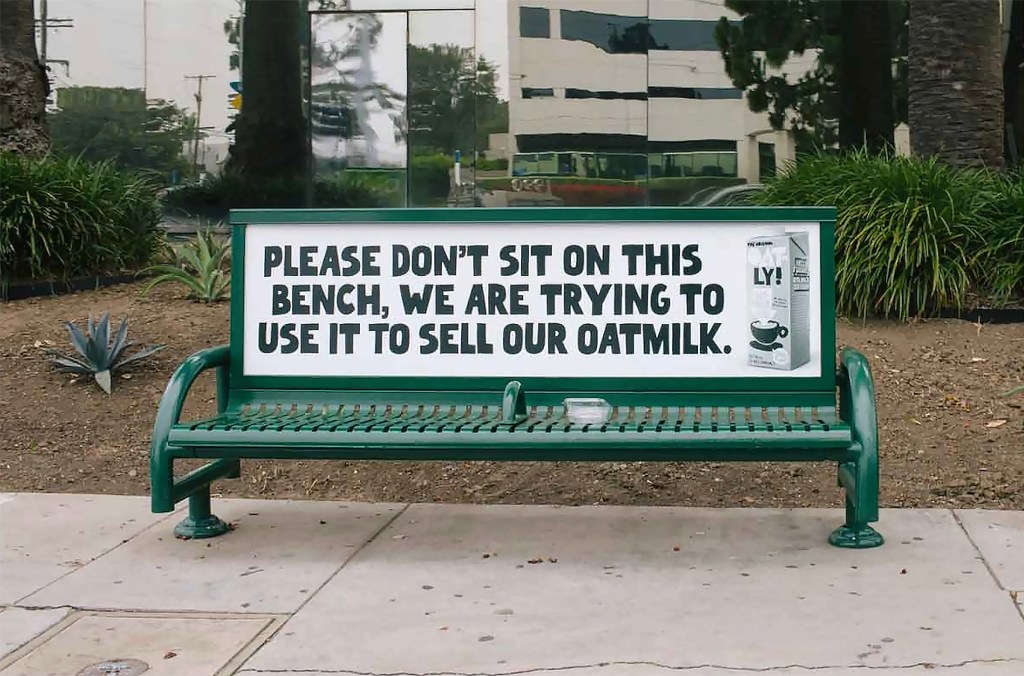
  • Its marketing often follows suit. One billboard said: “Why do giant oat-milk ads have to ruin cool neighborhoods?” Another said: “Maybe a social media celebrity will take a photo of this poster and you will see it on Instagram and like it way more than you do right now.”
  • Oatly once described oat milk as “like milk but made for humans.” That prompted a lawsuit from Sweden’s dairy lobby, which Oatly then (ahem) milked for a lot of public press and sympathy.

But despite Oatly’s distinctive voice, Lee says he can’t exactly explain what’s “on brand” for this brand. Nor does he want to.

“There is an Oatly idea, and there is… that is not an Oatly idea,” he says. “How do you know? I don’t know. It’s just you develop a feeling. You develop this sense for what feels Oatly and what doesn’t feel Oatly, and it’s hard to wrap words around it.”

This might sound frustrating for anyone seeking a repeatable process. But Lee’s point is that a real brand voice resists being reduced to a checklist. It must become a fluid, ever-evolving thing.

“A lot of what I’ve spoken about — a company acting human and doing human things — is easy to say, and it sounds kind of normal,” Lee says. “But the reality within corporations and businesses it is extremely difficult. Because as everyone knows, when you go into a company, suddenly it’s company speak. You talk like you wouldn’t talk at home.”

As a result, he says, brand leaders often become police officers: Their jobs are to create guidelines that feel safe and prevent bad ideas. But Lee thinks a creative leader should do the opposite, by building enough shared instinct for everyone to recognize a good idea. That way, they can collectively reject ideas that are safe but don’t feel true to brand.

Courage Gets Harder As You Scale

Startup founders often lament: If only I had the marketing budget of the big guys…

But Lee says startup founders should take advantage of their size. When you’re small, it’s easier to take large risks. “It is much harder to be disruptive and courageous with your brand at the $100 million level than it is at the $10 million level,” he says. “That, I think, is the most difficult challenge — to maintain that edge and continue to be disruptive.”

At scale, every campaign faces more scrutiny, more internal stakeholders, and more pressure to protect what’s already been built. This is when most brands quietly sand off their edges, he says. They trade their original voice for something safer.

So how do you preserve that creative integrity? Lee says it all goes back to fundamentals: How are you structured? And is the company truly built to support creatives? Commitment must come “not from just the creative director, but the entire company, from the top all the way down,” he says.

That’s one more reason he’s grateful for the structure at Oatly.

When there’s no brand book, the creative team must constantly shape and refine the brand itself. When there’s no layers of approval, the creative team feels a deep obligation to get it right. And when a new team member is told to “forget everything you know about marketing,” they can start to define a new way for themselves.

Key Takeaways

  • Oatly gives its creative team an unusual amount of autonomy, allowing it to develop and execute its own briefs.
  • The company intentionally avoids using a rigid brand book to maintain maximum creative freedom for its messaging.
  • As a company gets bigger, creative risks often become harder. You’ll only remain sharp if you bake creativity into the structure of the company.

When new creative employees join Oatly, the onboarding starts with a single instruction: “Unlearn everything you know about marketing.”

According to Oatly creative director Michael Lee, that’s the only way to build a truly distinctive brand voice: You must operate without the guidelines that bind most other companies — including how decisions are made, how teams are structured, and how the brand voice is even defined.

For example, most big companies have a “brand book.” It’s a style guide that defines how the brand looks and speaks, so that every touchpoint is consistent. But Oatly does not have one.


Source link

How Oatly Became a Creative Force, by Breaking All of Marketing’s Rules Read More »

Why Your Virtual Event Flopped — and 7 Ways to Make It Better

Why Your Virtual Event Flopped — and 7 Ways to Make It Better


Opinions expressed by Entrepreneur contributors are their own.

Key Takeaways

  • The biggest reason that virtual events fail is that companies try to simply produce them as a replica of an in-person event.
  • By clarifying the outcome, observing your audience, narrowing the content, nominating the right presenters, engaging with the audience throughout, communicating the value and taking action after the event is over, you will have a successful virtual event.

We have all been to traditional events — trade shows, in-person meetings, client gatherings. Sure, they play a significant role, but they are no longer the only way to build relationships and move opportunities forward. The world of business events has changed — permanently. The question isn’t whether to use virtual events; it’s how to use them effectively to build trust, create engagement and close business.

Done well, a virtual event can position your company as a trusted advisor, deepen relationships and accelerate the sales cycle. Done poorly, it becomes just another ignored webinar, a “non-event.”

Why virtual events fail

The biggest reason that virtual events fail is that companies try to simply produce them as a replica of an in-person event. That doesn’t work. I know this from firsthand experience.

I worked with a large customer during Covid-19 on a virtual presentation. It was a flop. They had planned an in-person event and just thought they would run it, as is, for a livestream. I tried to explain why that would not work but I could not get through to the key decision-maker. At the start of the event, things seemed to be fine, but it did not take long for attendees to start to drop off, and by the end, there were just a few diehards still there.

This experience illustrates some key learnings.

You cannot command the same attention virtually as you can when you are standing face-to-face with your audience. The content must be altered to be consumed virtually. And do not try to cover the same amount of information in a virtual presentation as you do in person.  Companies often choose presenters that are not “camera- friendly.” They might be passable with a live audience, but they put the virtual audience to sleep.

My CONNECT framework

Over the years, I have helped produce a variety of virtual events for global giants and smaller, innovative companies. The ones that really made an impact were packed with content, highly produced and fun. Yes, fun — not the dry, training type of presentation, but personal and interactive. To make virtual events repeatable and effective, I developed a simple framework called CONNECT. That is because the real goal of any virtual event is to create connection at scale. So, what does the acronym stand for? Here is the brief explanation.

C – Clarify the outcome

Every successful virtual event starts with clarity. Before you think about content or speakers, define the result you want. If you don’t define the outcome, the event becomes unfocused — and your audience will feel that. Clarity drives alignment. When your objective is clear, your message becomes stronger and your audience response improves. What do you want this event to do?

  • Generate new leads or qualify prospects
  • Move prospects further down the funnel
  • Move stalled opportunities forward
  • Create buzz for future efforts
  • Strengthen existing relationships
  • Position your team as the trusted advisor

Each of these outcomes requires a distinctive style of presentation. A focused objective will guide every decision you make—from content to speakers to follow-up.

O – Observe your audience

Your event should not start with what you want to say. It should start with what your audience needs to hear. Today’s customers expect relevance. They want to feel understood. Ask “What would be genuinely useful to them right now?” When you answer that well, your event becomes valuable. Use what you know about your customers to build an experience that makes them feel understood.

N – Narrow the content

One of the things I often say during my trainings is “less is more.” In this case, less content is more impactful. Content that works in a ballroom or the showroom does not work on a screen. That is why you must carefully design the content. Get to the point quickly, build in interaction and do something fun and surprising. I have lots of ideas, but spoiler alert: I won’t share them here.

N – Nominate the right presenters

Not all great presenters translate well to virtual. The best virtual presenters may not be immediately obvious.  You need people who can connect through a screen. Look for presenters, and most importantly — test and prepare them. A strong presenter builds trust. A weak one loses it quickly. One of the most overlooked factors in virtual event success is the presenter. Here’s the surprising truth: Some people who struggle on stage or in person thrive on camera, and some dynamic in-person speakers fall flat virtually.

E – Engage throughout

In a virtual event, engagement is not optional, it’s essential. There are no casual passersby and no room energy to rely on. You must create interaction intentionally. Engagement creates attention. Attention creates trust. Think beyond the slides and presentations. Try to break content into shorter segments and include live interaction. Ask questions early on and maybe use polling features or other technology tools to keep people engaged.

C – Communicate the value

If people don’t attend, nothing else matters. Your promotion must clearly answer: “Why should I spend my time on this?” Don’t sell the event. Sell the value of attending. Some people try to do cheesy giveaways. A discount on a product. A fifteen-minute consultation. A template for a process. A giveaway is fine, but it must have perceived value.

T – Take action after

The event is not the finish line — it’s the starting point for sales conversations. This is where many opportunities are lost. Have a clear follow-up plan because sales happen after the event.

Your event should lead naturally into the next conversation. I have seen clients do a great event and then walk away. Without follow-up even a major event loses momentum and value. Have a clear follow-up plan that includes an immediate thank you, a way to share the resources and a clear next step.

Here is the bottom line. Virtual events are not going away. They can be a great tool for your business, but virtual events don’t succeed because of technology. They succeed because they create connections. And when you consistently CONNECT, you don’t just host events… you create opportunities.

Key Takeaways

  • The biggest reason that virtual events fail is that companies try to simply produce them as a replica of an in-person event.
  • By clarifying the outcome, observing your audience, narrowing the content, nominating the right presenters, engaging with the audience throughout, communicating the value and taking action after the event is over, you will have a successful virtual event.

We have all been to traditional events — trade shows, in-person meetings, client gatherings. Sure, they play a significant role, but they are no longer the only way to build relationships and move opportunities forward. The world of business events has changed — permanently. The question isn’t whether to use virtual events; it’s how to use them effectively to build trust, create engagement and close business.

Done well, a virtual event can position your company as a trusted advisor, deepen relationships and accelerate the sales cycle. Done poorly, it becomes just another ignored webinar, a “non-event.”

Why virtual events fail

The biggest reason that virtual events fail is that companies try to simply produce them as a replica of an in-person event. That doesn’t work. I know this from firsthand experience.


Source link

Why Your Virtual Event Flopped — and 7 Ways to Make It Better Read More »

Take the Road Less Traveled — It May Bring You the Most Success

Take the Road Less Traveled — It May Bring You the Most Success


Opinions expressed by Entrepreneur contributors are their own.

Key Takeaways

  • There isn’t just one correct way to build a successful startup, despite what conventional wisdom might tell you.
  • Playing the long game, making teamwork part of my business strategy and saying “no thanks” to remote work helped make my startup, Jotform, a global success.

Anyone thinking about launching a startup will quickly discover there are a lot of rules. Find a cofounder, raise venture capital and go to Silicon Valley — stat. If you want to succeed, you’d do well to follow the playbook, or else face total, humiliating failure. 

I was aware of those rules back when I was starting my business back in 2006 — and I ignored them. As the acclaimed author Toni Morrison wrote in her 1992 novel, Jazz: “What’s the world for you if you can’t make it up the way you want it?” 

Contrary to conventional wisdom, there are actually a lot of ways to build a successful startup, and I’ve pursued more than a few of them. Here are three choices I’ve made that have bucked the trends, and why I’d make them all over again.

1. Play the long game

From its earliest days, I wanted to make sure Jotform wasn’t a flash-in-the-pan startup that entered the world with a VC-backed bang before quietly fizzling out. In other words, I always viewed my entrepreneurial journey as a long game. 

For me, this took a few different forms. For one, Jotform entered the world as a free product. That’s right — I didn’t earn a single cent on it for the first two years of its existence. Why? Frankly, I just wanted to see if people would use it, without the obstacle of a price tag standing in the way. 

Shortly after its release, I got my answer — a resounding “yes.” Giving Jotform away for free provided invaluable information about the features users wanted, so by the time I was ready to introduce a paid version, I knew exactly what direction to pursue. 

I also didn’t go to Silicon Valley. In fact, I went the other way. After I quit my full-time job in New York City, I hopped on a plane in the opposite direction of California’s land of tech, back to my parents’ home in Turkey. If I was going to be giving Jotform away for free, I needed to save money. 

Was it glamorous? Hardly. But I was far less interested in creating the appearance of success than I was in actually succeeding. I had faith in my product and my long-term vision, but as a bootstrapped founder, I didn’t want financial stress to cloud my creativity. Now, San Francisco is just one location of Jotform’s seven global offices — and yes, I did eventually move out and buy my own home.

2. Teamwork as a business strategy

For a long time, Jotform was run by an incredibly lean team. But as it began to grow from just a small handful of employees, I noticed our productivity was stagnating. 

Building a healthy company culture has always been one of my chief priorities as a founder, so this sudden drop in morale was deeply troubling. In order to get my growing team back on track, I took a hard look at how we functioned when we were smaller, and discovered that the secret to our success had actually been our size. 

The solution wasn’t to scale back, but to replicate the environment we had when there were only five of us — a team stocked with different roles, each bringing unique strengths, all in the service of a single product.  

Not only did I break our then-15-person company into groups of three teams; I doubled down on building cohesion by designing an office specifically to accommodate the new structure. I hired an architect to build rooms that could hold a maximum of six people, furnishing each pod with its own whiteboard and glass door. Each person’s workspace was visible to the others on their team — they didn’t have much individual privacy, but that wasn’t really the point. My goal was to make them feel like their own unit, working toward a common goal. 

It worked. Creativity and productivity immediately spiked, and from that point forward, I’ve preached the gospel of cross-functional teams to anyone who will listen. Now, we have 130 such teams, and I credit this structure to Jotform’s continued ability to grow and innovate, even after 20 years.

3. Saying ‘no thanks’ to remote work

In the years after the pandemic, working from home became the rule rather than the exception. As grateful as I am to have had the flexibility to allow our teams to WFH in 2020, these days, everyone is back in the office. 

It’s not that we weren’t able to function as a remote-first office; we were. But something was missing, and I noticed it most acutely with new hires. They’d be onboarded from their home offices or kitchen tables, without the warmth of in-person introductions or the ability to ask a nearby colleague about the ins and outs of the intranet. The disconnect was palpable. 

And so, once it was safe to do so, everyone returned to the office. Almost immediately, productivity increased and morale shot up. We resumed our tradition of weekly team lunches and product launch celebrations. Working from home may be an attractive option for some companies, but for us, it’s a no-go. Our company culture is simply too intrinsic to our success. 

I can’t tell anyone else how to run their organization, and I don’t intend to try. That’s the thing about being a founder: You get to make your own rules. If something isn’t working, change it. Build the business you want to be a part of.

Key Takeaways

  • There isn’t just one correct way to build a successful startup, despite what conventional wisdom might tell you.
  • Playing the long game, making teamwork part of my business strategy and saying “no thanks” to remote work helped make my startup, Jotform, a global success.

Anyone thinking about launching a startup will quickly discover there are a lot of rules. Find a cofounder, raise venture capital and go to Silicon Valley — stat. If you want to succeed, you’d do well to follow the playbook, or else face total, humiliating failure. 

I was aware of those rules back when I was starting my business back in 2006 — and I ignored them. As the acclaimed author Toni Morrison wrote in her 1992 novel, Jazz: “What’s the world for you if you can’t make it up the way you want it?” 

Contrary to conventional wisdom, there are actually a lot of ways to build a successful startup, and I’ve pursued more than a few of them. Here are three choices I’ve made that have bucked the trends, and why I’d make them all over again.


Source link

Take the Road Less Traveled — It May Bring You the Most Success Read More »

Why High Performers Often Struggle When They Become Leaders

Why High Performers Often Struggle When They Become Leaders


Opinions expressed by Entrepreneur contributors are their own.

Key Takeaways

  • Technical expertise doesn’t automatically translate into leadership effectiveness. The strengths that made someone a star individual contributor can undermine them as a leader.
  • The challenge is helping them recognize that this chapter in their career depends on something new — bringing out the best in others.
  • Tolerating poor interpersonal behavior from high performers — especially while claiming to value collaboration and respect — sends a clear message that results matter more than how they’re achieved.
  • These leaders need to see the true cost of the leadership gap, a compelling reason to change and specific feedback that contrasts their intent with their actual impact.

You’ll probably recognize this person. Technically exceptional, deeply knowledgeable and trusted with the company’s most important work. Whenever a difficult challenge arises, they’re the person everyone counts on to solve it.

Then they’re promoted into a leadership role and something changes. They begin to create problems for the people around them. They might interrupt, overcorrect or take over. They may overlook others’ contributions or communicate in ways that leave team members feeling diminished. Eventually there’s fallout: Talented employees stop speaking up, avoid them or leave the team altogether.

This leader isn’t the bad guy. Most of them are relying on the same strengths that have served them throughout their careers, because that kind of clear right-or-wrong, black-or-white thinking was essential. Calculations are accurate, or they aren’t. A system works safely, or it doesn’t. After all, no one wants a building that only “kind of” stands up.

But people aren’t buildings. The skills that made this person so successful are not necessarily the ones they need to be an effective leader. The challenge is helping them recognize that this chapter in their career depends on something new — bringing out the best in others.

Understand the hidden cost of ineffective leadership

A technically strong leader may continue producing excellent results, but a person’s individual output is just part of the story. 

What happens to the talent? Pay attention to how strong employees respond to the leader. Do they want to join the team and stay there? Or are they transferring, leaving or finding ways to work around the leader? When people stop raising concerns or contributing ideas, the team may still appear productive, but it is losing something important.

What happens to the team’s capability? Consider whether people are becoming more capable — or less capable — under this leader. If the leader always supplies the answer, corrects the work or steps in when the stakes rise, team members don’t get to develop their own judgment. That leads to a culture of dependence rather than confidence.

Stop treating high performance as an exception to leadership standards

While behavior belongs to the leader, tolerating it belongs to the organization. A company may spend years rewarding expertise, responsiveness and heroic problem-solving. Only when the interpersonal cost becomes impossible to ignore does it expect different behavior. The leader is responsible for changing, but the company also needs to own the pattern it reinforced. 

This matters even more when the organization says it values collaboration, respect or developing people. If an influential high performer is repeatedly exempted from those expectations, employees understand the real message: Results matter more than how those results are achieved. Employees learn what the organization truly values by watching which behaviors it rewards, excuses and addresses.

Require a broader definition of performance

At higher levels, success can’t be measured by personal output alone. Do talented people want to work with this leader? Can the leader influence without controlling? Does the team become stronger because they lead it?

Technical expertise still matters, but readiness for a higher level also depends on whether the leader can strengthen the people around them. It’s up to the organization to help make this happen. 

Build an honest diagnosis in 3 steps

That kind of change requires more than telling them to work on their people skills. It’s showing them where the gap is. There are three key steps to make a hard conversation as clear and productive as possible:

Step 1: Define the true cost of the leadership gap. Look at turnover, engagement, HR time, workarounds, succession risk and dependence on one person. Labels such as “This leader is difficult” or “This leader needs more emotional intelligence” don’t actually identify what needs to change.

Step 2: Provide a reason to change. High-performing experts often see themselves as protecting quality and keeping the work on track. Change becomes more compelling when it connects to something they want, such as greater influence, a larger role or a team that can perform without constant intervention.

Step 3: Show the gap between intention and impact. Give the leader specific feedback they can observe and practice.

  • You intended to move the meeting forward; people stopped contributing. 
  • You intended to protect quality; the team became dependent on you. 
  • You intended to help; others experienced it as taking over.

We all know that change is hard. And it doesn’t happen all at once. Learning a new behavior is much like learning a dance: At first, the leader may not notice a misstep until they have stepped on someone’s toes. With practice, they catch themselves slipping back into familiar habits and adjusting in the moment. Eventually, the new steps feel natural, and the leader can pay attention to how others are responding. That’s when lasting change begins to take hold.

Help leaders become value multipliers

We’ve seen why technical expertise and individual performance aren’t a substitute for leadership. The opportunity lies in organizations expanding the definition of what value is. When leaders develop new skills and take greater responsibility for their impact on others, it becomes visible in the confidence and capability of their teams. Only then can a leader’s expertise become a value multiplier — for themselves, their people and their organization.

Key Takeaways

  • Technical expertise doesn’t automatically translate into leadership effectiveness. The strengths that made someone a star individual contributor can undermine them as a leader.
  • The challenge is helping them recognize that this chapter in their career depends on something new — bringing out the best in others.
  • Tolerating poor interpersonal behavior from high performers — especially while claiming to value collaboration and respect — sends a clear message that results matter more than how they’re achieved.
  • These leaders need to see the true cost of the leadership gap, a compelling reason to change and specific feedback that contrasts their intent with their actual impact.

You’ll probably recognize this person. Technically exceptional, deeply knowledgeable and trusted with the company’s most important work. Whenever a difficult challenge arises, they’re the person everyone counts on to solve it.

Then they’re promoted into a leadership role and something changes. They begin to create problems for the people around them. They might interrupt, overcorrect or take over. They may overlook others’ contributions or communicate in ways that leave team members feeling diminished. Eventually there’s fallout: Talented employees stop speaking up, avoid them or leave the team altogether.

This leader isn’t the bad guy. Most of them are relying on the same strengths that have served them throughout their careers, because that kind of clear right-or-wrong, black-or-white thinking was essential. Calculations are accurate, or they aren’t. A system works safely, or it doesn’t. After all, no one wants a building that only “kind of” stands up.


Source link

Why High Performers Often Struggle When They Become Leaders Read More »

How Businesses Can Turn World Cup Lessons Into NFL Wins

How Businesses Can Turn World Cup Lessons Into NFL Wins


Opinions expressed by Entrepreneur contributors are their own.

The FIFA World Cup 2026 was an enormous moment for small businesses connected to sports and live events, including stadium vendors, sports bars, jersey shops, parking operators and hospitality businesses near arenas. Sales jumped 4.1% in June for small and midsize businesses (SMBs) in host cities, compared to just 1.8% for comparable cities that didn’t host matches, driven in large part by a 16.7% spike in spending from non-local visitors. The NFL season brings another huge opportunity for small businesses, provided SMBs apply the operational and technological lessons learned from the World Cup. 

How fans engage with sports has changed dramatically. Today’s fans don’t just watch; they also browse, stream, share and purchase in real time, both in-stadium and from their couch. Direct social media links drive instant impulse buys. Mobile apps handle food and merch orders without the wait in line. Digital drops and inventory alerts create urgency. The commerce surface has expanded, and for small businesses willing to meet fans where they are, so has the opportunity.

A challenge as big as the opportunity

Small businesses in FIFA World Cup 2026 host cities saw a substantial increase in sales, but those sales didn’t come without challenges. Handling surges of online volume and foot traffic was a test of preparedness, especially of one’s connectivity resilience. Nearly 500 terabytes of data moved across all World Cup hosting stadiums throughout the tournament. That’s the equivalent of streaming HD video continuously for more than 30 years.

While network providers, venue operators and local governments started planning years in advance to upgrade infrastructure for the World Cup, small businesses discovered they too had to beef up their own networks and connectivity solutions. The ones that did were ready when it counted.

Turning World Cup wins into NFL season wins

The small businesses that succeeded during the World Cup are heading into the NFL season with a smarter playbook, one that hinges on effective use of technology to capitalize on spikes in foot traffic and online visitors.

Those same tools and strategies can carry them through the NFL season and sustain the momentum the World Cup created.

AI-powered point-of-sale (POS) systems can alleviate the pressure of sales rushes, using pattern recognition and predictive analytics to anticipate spikes in demand, optimize supply chains and keep inventory levels in check so small businesses don’t fall short when it matters most. Smart POS systems also automate administrative tasks and enhance product look-ups, freeing owners and staff to focus on the customer in front of them. 

Beyond the register, contactless and mobile payment options keep the line moving – because with fans on the go and every second of game-day momentum counting, the last thing a small business needs is a bottleneck at checkout.

Meeting customers where they are

The World Cup also proved that the opportunity isn’t limited to whoever walks through the door. With 20 billion video views across platforms, fans were watching — and shopping — from everywhere. A well-built digital storefront or digital platform that loads fast, handles traffic spikes and integrates with social commerce channels lets sports-adjacent SMBs tap into that remote fan base, turning a local business into one with national reach. 

Anwar Dougsiyeh, founder of Lotus Rosery, an events and brand experience company in Atlanta, experienced this firsthand while coordinating a large-scale World Cup watch party and festival that welcomed more than 20,000 guests. Using AI to audit his festival’s digital customer journey, he discovered that visitors were dropping off before completing their RSVPs simply because the button wasn’t prominent enough. One design tweak later, RSVPs increased by 70% — a reminder that a great digital presence isn’t just about getting people to show up; it’s about making it easy for them to say yes when they do. 

More transactions bring more risk

An uptick in foot traffic and transactions is great for business, but it also attracts unwanted attention. The volume of financial activity that comes with large-scale sporting events makes SMBs a target for hackers and scammers, and most small businesses can’t afford dedicated IT or cybersecurity staff to fight back. Fortunately, artificial intelligence (AI) has lowered the barrier to entry for cybersecurity solutions that can automatically flag anomalies and identify fraudulent activity, giving SMBs an always-on line of defense. 

The right tech stack is a non-negotiable

Small businesses have more opportunities than they’ve ever had. They can even compete with larger competitors in ways that weren’t possible just a few years ago. Technology has evened the playing field and lowered the barrier to entry. For small businesses, that also means having the right tech stack is no longer a luxury. It’s a necessity.

Mario Jaramillo, founder of The Robot Agency, a creative and experiential agency based in Houston, used the World Cup as an opportunity to show what a small agency could do when backed with the right technology.

When a World Cup contract came his way with a razor-thin turnaround, his team used digital research, rapid prototyping and AI-assisted ideation to go from concept to visual prototype in just a few days – work that would have taken weeks through a traditional creative workflow. This allowed Mario’s agency to present something the clients could see, react to, and ultimately experience, rather than asking them to imagine it. It’s a mindset shift as much as a technological one, and it starts with having the right stack in place to move fast when the moment demands it. 

Think of it like a sports franchise: the best roster in the league underperforms without a strong coaching staff, a solid game plan and the infrastructure to execute. For small businesses, connectivity is that infrastructure. It’s what allows every other tool — AI, mobile payments, digital storefronts, cybersecurity — to perform when the pressure is on. Build that foundation right, and the rest of the playbook follows.

The FIFA World Cup 2026 was an enormous moment for small businesses connected to sports and live events, including stadium vendors, sports bars, jersey shops, parking operators and hospitality businesses near arenas. Sales jumped 4.1% in June for small and midsize businesses (SMBs) in host cities, compared to just 1.8% for comparable cities that didn’t host matches, driven in large part by a 16.7% spike in spending from non-local visitors. The NFL season brings another huge opportunity for small businesses, provided SMBs apply the operational and technological lessons learned from the World Cup. 

How fans engage with sports has changed dramatically. Today’s fans don’t just watch; they also browse, stream, share and purchase in real time, both in-stadium and from their couch. Direct social media links drive instant impulse buys. Mobile apps handle food and merch orders without the wait in line. Digital drops and inventory alerts create urgency. The commerce surface has expanded, and for small businesses willing to meet fans where they are, so has the opportunity.

A challenge as big as the opportunity

Small businesses in FIFA World Cup 2026 host cities saw a substantial increase in sales, but those sales didn’t come without challenges. Handling surges of online volume and foot traffic was a test of preparedness, especially of one’s connectivity resilience. Nearly 500 terabytes of data moved across all World Cup hosting stadiums throughout the tournament. That’s the equivalent of streaming HD video continuously for more than 30 years.


Source link

How Businesses Can Turn World Cup Lessons Into NFL Wins Read More »

How to See Your Business the Way Your Customers Do

How to See Your Business the Way Your Customers Do


Opinions expressed by Entrepreneur contributors are their own.

Key Takeaways

  • Before a customer says a word, your space is already speaking for you.
  • The difference between good and unforgettable often hides in the smallest details.
  • Your team is your experience in motion.

Your online presence gets your potential customers curious about your business. But the moment they walk through your door, the real story begins. Every glance, every greeting, every scuff on the floor tells your customer something about you before you say a word.

That is why the in-person visit is the second half of my client assessment at Fix Your Search. Once I know what the internet says about you, I go and feel the experience for myself, exactly the way a first-time customer would. Let me walk you through what to look for, room by room, moment by moment.

1. Start with the first 30 seconds

Before anything else, examine your own welcome. Stand outside the door of your business, walk in cold and count the seconds until someone notices you. This tiny window sets the entire tone.

When I do this for a client, I start a quiet clock the instant I cross the threshold and then I bring you back the stats. I have stood at store counters before for two full minutes while the staff chatted among themselves, making me feel invisible and a little annoyed. I have also been greeted by a warm hello called out from across the room before I even reached the counter. Both stay with me. One feels like being seen. The other feels like being tolerated. Decide which one your customers are getting.

2. Read the room the way a guest would

Next, take in the whole space and ask what it is quietly saying. Is it clean? Is it organized? Does it feel considered, or does it feel like nobody has really looked at it in a while?

When I step into a client’s business, I hunt for the small things owners stop seeing. A smudged glass door. A flickering bulb. A sign held up with peeling tape. A holiday promotion still hanging in the spring. On their own, these are tiny. Together, they showcase neglect, and customers feel that unease. Walk your space slowly as if you have never been there. Fix the three things that make you cringe first.

3. Put your signage to work

Now study your signage and promotional materials carefully. Is your specials board visible right where customers can see it to make decisions? Are your prices easy to read? Is everything current and clearly laid out?

I once worked with a café owner frustrated by a low average sale. When I visited, I spotted it in seconds. His specials board sat behind the ordering counter, only visible after customers had already ordered. We moved it to where people actually paused and decided. His upsell rate climbed within two weeks, and it cost him nothing but a little repositioning.

4. Sweat the small, sensory details

Here is where good becomes unforgettable. Tune into the little things that shape how a visit feels. Is the music at a comfortable volume, or is it so loud that talking is a chore? Is the WiFi password easy to find? Are your menus and brochures clean and current? Do your people look pulled together? When I assess these details for a client, I am reading the atmosphere like a mood. 

5. Make the journey to your door effortless

Before the greeting even happens, the arrival has already begun. So test the path a customer takes walking into your business. Follow your own directions. Check that your map pin lands on your actual entrance. See whether parking, entry points and accessibility are clear online and in real life.

When I assess a client, I do this before I even arrive. I have followed a listed address only to have the map drop me half a block from the real door. I have circled blocks looking for parking with zero guidance anywhere. A customer who arrives flustered is already starting the visit at a disadvantage, and none of that is their fault if you are not making it as easy as possible for them.

6. Watch your people in their element

Your team is your experience in motion. So observe how they move. Do they seem engaged and confident? Do they know your products well enough to answer questions naturally? Do they actually seem glad to be there?

When I watch a client’s staff, I am reading the culture on display. A flat, disengaged team communicates something even when nothing technically goes wrong. An enthusiastic, knowledgeable one makes customers feel certain they chose the right place to spend their hard earned dollars. This is where I get honest with clients, even when it stings. Culture shows up on the floor, and if your team is not reflecting your values, that is a leadership conversation worth having with warmth.

7. Finish with an honest debrief

Last, gather everything and tell the truth. After every in-person visit, I sit down with my client and share what I noticed, what I felt, and what a first-time customer would likely carry away.

Most owners find this eye-opening, not because their business is failing, but because they simply stopped seeing it clearly. Familiarity creates blind spots, and those blind spots are exactly where customers form their most lasting impressions. The good news I share almost every time is that the fixes are practical and low-cost. Reposition the sign. Refresh the materials. Brief the team on greetings. Correct the map pin. Deliberate, not expensive.

Your experience is the message

The best businesses I have ever walked into are rarely the flashiest. They are the ones where someone cared enough to think about the whole journey, from the parking lot to the goodbye, and kept caring, honestly and often.

Key Takeaways

  • Before a customer says a word, your space is already speaking for you.
  • The difference between good and unforgettable often hides in the smallest details.
  • Your team is your experience in motion.

Your online presence gets your potential customers curious about your business. But the moment they walk through your door, the real story begins. Every glance, every greeting, every scuff on the floor tells your customer something about you before you say a word.

That is why the in-person visit is the second half of my client assessment at Fix Your Search. Once I know what the internet says about you, I go and feel the experience for myself, exactly the way a first-time customer would. Let me walk you through what to look for, room by room, moment by moment.

1. Start with the first 30 seconds

Before anything else, examine your own welcome. Stand outside the door of your business, walk in cold and count the seconds until someone notices you. This tiny window sets the entire tone.


Source link

How to See Your Business the Way Your Customers Do Read More »

I’ve Built Websites for 25 Years. Here’s How I’d Make a Business Stand Out in an Internet Full of AI Slop.

I’ve Built Websites for 25 Years. Here’s How I’d Make a Business Stand Out in an Internet Full of AI Slop.


Opinions expressed by Entrepreneur contributors are their own.

Key Takeaways

  • A website is no longer a competitive advantage — it’s the starting point, and AI can now build one in minutes.
  • As AI makes online content abundant, real differentiation comes from the systems, relationships, trust and expertise that AI can’t manufacture.

I built my first website in 1999. I was just an art school kid teaching myself HTML in a bedroom. My competitive advantage was very simple: my sites looked better than the ones the programmers were making.

Back when most business websites looked like spreadsheets with hyperlinks, one that appeared professionally designed communicated authority. Traffic and revenue followed.

Between 1999 and 2005, I bought more than 200 domains and launched over 60 websites. Some became real businesses, and a few made some real money. Clearing the “does this look serious” bar was truly difficult, but I did it.

That advantage expired a while ago, but most business owners still haven’t realized what replaced it.

I’m now the CEO of Builderall, a marketing platform that’s hosted hundreds of thousands of small business websites. I get to watch patterns play out at scale, in real-time, across every industry and country. A huge number of operators are still running on a concept of the internet that stopped being true years ago.

They think, “If I get a website up, customers will find me.”

That was accurate in 1999, and it was still reasonable in 2015. However, it’s not applicable today, and pretending otherwise costs people their businesses.

Here’s what the actual internet looks like right now. According to Netcraft’s March 2026 Web Server Survey, there are about 1.43 billion websites online. Around 208 million of them show signs of active maintenance. The other 85% are parked domains, expired sites, redirect-only pages and abandoned projects. The internet is a graveyard of websites that nobody visits. AI is building lots more even as you read these words.

I’ve watched the barriers to putting a website online collapse through three distinct eras. Every time a visible limitation gets easier to overcome, the genuinely competitive advantage shifts.

First era: Hand-coded, 1999–2010

The first restriction was access. If you could get a site online at all, you were ahead of most of your competition. Once you cleared that barrier, the next question was quality. That was scarce because HTML was hard, and design sensibility was rare.

My art school background gave me an edge over programmers. Their websites worked, but mine looked like magazines. Guess whose phone rang?

The lesson was that professional design was difficult to produce, so it functioned as a meaningful signal. Pretty design was evidence that an actual operator had invested time and thought in the business behind the site. It wasn’t the reason the sites worked. It was the proxy for something harder. Once almost everyone could clear the visual bar, that signal lost most of its value.

Second era: No-code website builders, 2010–2022

Then no-code platforms and increasingly sophisticated content-management systems arrived. Wix, Squarespace, Builderall and better WordPress themes let anyone produce a site that looked professional without touching code or hiring a designer.

By 2015, WordPress was powering roughly 24% of the web. By 2025, it powered more than 40%. The floor moved up, and design became table stakes.

What separated businesses that grew from ones that stalled was whether the messaging was sharp and the audience was clearly defined. The offer answered a question the customer was asking. Positioning became the new scarce resource.

I watched this happen from the platform side. Two customers could launch the same template in the same industry on the same day. One would build a business, and the other would sit at zero. The difference was that the successful operator understood who they were selling to and what that person needed. They knew why their offer was different enough to deserve attention.

Now: The age of AI-generated everything

Today, I can open an AI tool and describe a business in one paragraph. It will generate a credible website in under 60 seconds, with no learning curve and no designer or copywriter needed. The site will look good.

15 years ago, this output would have been indistinguishable from a $10,000 agency project. And the speed keeps compressing. According to Wix’s first State of Websites report, the average time to publish a website on its platform fell from 8 days in 2025 to just 4 days in 2026, which is a 50% drop in a single year.

AI automated the entire visible surface of running an online business. Anyone can now generate a website, a logo, landing pages, a hundred blog posts, a social media presence and an email sequence in an afternoon. The barrier to appearing to have a functioning business is approaching zero.

Here’s the shift that most people are missing. AI is generating more content and websites than ever, but it’s not sending customers to them. Wix’s own data shows that large language models like ChatGPT currently drive less than 1% of website traffic. Search still drives 42%. Direct still drives 40%. The gap between AI-generated supply and demand is enormous, and it’s still widening. Which means the barrier to creating a meaningful business online is higher than ever.

The pattern nobody is naming

Every time this shift happens, the reflex is the same. Business owners rush to clear the new easy bar. They launch a site and then wonder why the phone isn’t ringing. Clearing the easy bar has never been what produced results. Value came from scarcity.

In 1999, a professional-looking site was a proxy for whether you were a serious operator. In 2015, sharp positioning was a proxy for whether you understood your customer. Today, having a website is a proxy for nothing. It’s the ticket into the room, and that room is packed with 1.43 billion tickets, most of which were free.

Having a website today tells the market roughly what having a phone number told the market in 1995. It’s a prerequisite, but not a business.

The website is no longer the business — it’s the front door

What distinguishes the businesses that are winning right now? The website is now the front door, and the business is the system behind the door.

Operators winning in 2026 have stopped thinking of their website as a completed project. They think of it as one node in a larger system, whose job is to earn attention and build trust until the customer is ready to buy.

The gap is huge. Research from RAIN Group and others puts the average B2B purchase at more than 62 touchpoints across 3.5 different channels before a deal closes. Even simpler SMB deals take 5 to 12 direct touches. Forrester has found that 82% of customers view five or more pieces of content from the winning vendor before making a purchase. 77% of B2B buyers won’t even speak to a salesperson until they’ve done their own research first.

If your website is your only touchpoint, you’re bringing just 1/62nd of what it takes to convert someone. AI can now generate that 1/62nd in 60 seconds. It can’t generate the other 61/62nds. Here’s what the system behind the front door should look like.

Capture attention before it disappears

Someone who lands on your website and leaves is worth almost nothing. If a site visitor gives you permission to reach them again, through email, a phone number, a follow, or a text opt-in, that person has started a relationship with your business.

At that point, your job is to give the visitor a compelling reason to continue the conversation. The job of a small business website in 2026 is to convert anonymous traffic into an identifiable audience. Almost every AI-generated site I’ve seen skips this entirely. It has a generic “contact us” form and treats the job as complete.

Build trust after the first visit

Once you have permission to be in someone’s life, most businesses waste it. They might send one automated welcome email and disappear, or they blast out promotions until the person unsubscribes.

Trust is built by showing up consistently and being useful before you ask for a transaction. You have to produce evidence over time that you can deliver what you promise. The ongoing relationship is the asset. The website is just one place where that relationship begins.

Convert at the moment of readiness

Most purchases don’t happen the first time someone encounters a business. They happen on the fifth touch, or the tenth, or the twentieth, when the customer’s situation finally lines up with what you sell.

If you don’t have a system for staying in the conversation between touch one and touch twenty, you don’t have a marketing system. All you have is a nice business card that AI can generate in 60 seconds. That’s not the same thing as building a business.

Good news for operators with depth

Here’s the part most people miss when they read pieces like this and get anxious. This shift is good news if you have real depth.

For 15 years, operators with genuine expertise were drowning in a sea of tactical bloggers and template site builders who could produce enough surface-level content to compete for visibility, even if they lacked substance underneath. 

Depth was hard to see through the noise. Now the noise itself has become free and infinite. AI can produce more surface-level content in a day than a human could produce in a decade. The reader has already learned to scroll past it. Real depth is winning again for the first time in a long time.

The operator who has done the work and understands a specific customer better than anyone else now stands out more sharply against an AI-generated background than they did against a human-generated one. The customer’s ability to sense authenticity in all this noise has gotten sharper, because it had to. The signal they’re now looking for is a real person doing real work.

AI can imitate the language of expertise, but it can’t manufacture your track record or the trust you’ve accumulated over years of showing up. The depth behind your system is one thing AI can’t fake.

What to do this week

If you launched a site with AI recently, or you’re about to, stop treating the launch as the finish line. That’s not even the start of the race. Ask yourself these questions.

How does someone who lands on this site give me a way to reach them again? If the answer is “they don’t,” fix that before you spend another dollar on traffic.

What am I sending to people I have permission to contact, and would I actually want to receive it? If you can’t answer this, you don’t have a nurture system. No amount of new traffic will fix that.

What proof of depth do I offer that AI could not credibly fake in five minutes? If the answer is “nothing,” you’re competing directly against free infinite AI slop, and you’ll lose.

Could a competitor slap their logo on my content and have it still make sense? If the answer is yes, your brand lacks a unique viewpoint. Content that’s “safe” enough to be viewed by anyone will be ignored by everyone.

I’ve watched this pattern shift three times in more than 25 years. The tools got easier every time, but the businesses that won never did.

AI didn’t eliminate the barriers to building an online business. It eliminated the visible barriers. That forced the competitive advantage deeper, into systems, relationships, trust and proof. The businesses that recognize this shift and build for it are about to have an easier time than they’ve had in a decade. The businesses that don’t will find themselves parked next to the other 1.2 billion sites nobody visits.


Source link

I’ve Built Websites for 25 Years. Here’s How I’d Make a Business Stand Out in an Internet Full of AI Slop. Read More »