Blog

Demand is weakening rapidly and housing is going into a deep freeze, says Moody’s Zandi

Demand is weakening rapidly and housing is going into a deep freeze, says Moody’s Zandi


Share

Mark Zandi, Moody’s Analytics chief economist, joins ‘Power Lunch’ to discuss the state of housing, what the supply and demand picture in housing is saying and where he expects to see the biggest price slides.


Source link

Demand is weakening rapidly and housing is going into a deep freeze, says Moody’s Zandi Read More »

Why Inflation Is Not Likely To Go Away Soon

Why Inflation Is Not Likely To Go Away Soon


The CPI reaching 9.1% in June made it clear that the inflation crisis gripping the nation is as bad as it’s been in 40 years. Despite lines from the chattering classes about inflation having “peaked” or being “transitory,” the truth is that there is little reason to think that high inflation will not be with us for the foreseeable future.

The problem is that every fundamental cause of inflation shows few signs of slowing.

If we look at the famous quantitative theory of money, we can evaluate each component separately.

M x V = P x T

M (money supply) x V (velocity) = P (price level) x T (volume of transactions)

P is the price level (i.e., how much inflation there is), so we can ignore that one and look at the other three.

Money (M)

Famous economist Milton Friedman once said, “Inflation is always and everywhere a monetary phenomenon.” While economists quibble over whether that’s an overstatement or not, no one doubts that all else being equal, more money in the economy equals higher prices. And, well, there’s a lot more money in the economy these days.

In March of 2021, Congress passed a $1.9 trillion stimulus package that was on the heels of a $900 billion package in December 2020, which was in the wake of the $2.2 trillion CARES Act passed in March 2020. All of these massive bills were to lessen the fallout of the Covid-19 pandemic. 

Before March 2020, there had never been a single trillion-dollar bill passed in U.S. history. 

For comparison’s sake, the entire federal budget is $6.82 trillion. The country ran a record $2.8 trillion deficit in 2021 and, as one column unironically (albeit rather humorously) put it, “The U.S. deficit will shrink to $1 trillion this year.” 

“Shrink.”

In addition, when the pandemic broke out, Federal Reserve chairman Jerome Powell lowered the discount rate to 0% and took the unprecedented step to remove bank reserve requirements

It’s too complicated to go into the mechanics in this article, but new loans actually create new money. (An explanation of how this works can be found here.) By the same token, loans being paid off or going into default destroys money.

If you remember back to March 2020, pretty much everyone thought that the real estate market and the broader economy would collapse. These moves were made to halt or at least slow that inevitable collapse. But the collapse never came. 

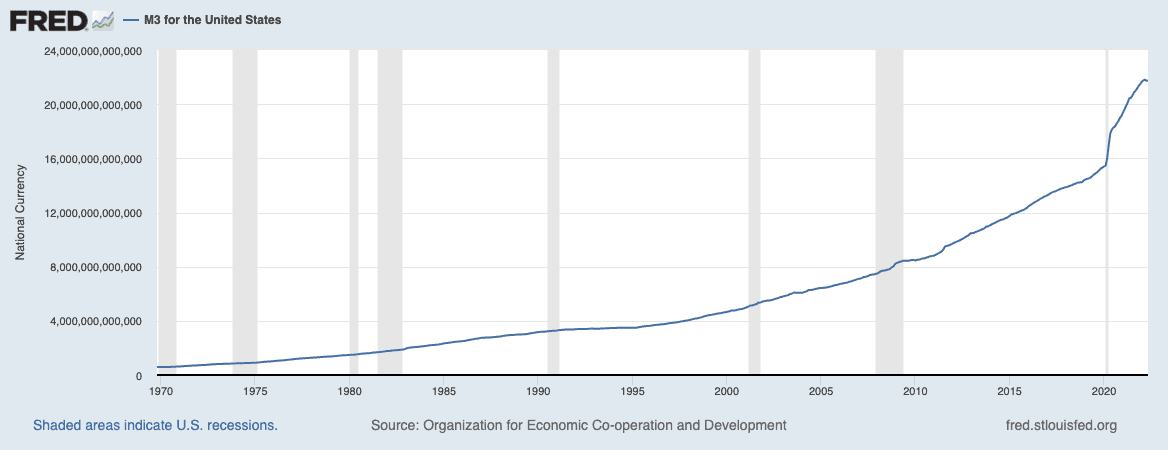
Instead, the economy was just littered with cash. TechStartups.com estimated that 80% of all dollars in circulation were printed since the beginning of 2020! While that figure has been challenged, what is plain as day is that the money supply has increased dramatically, as this chart from the St. Louis Fed shows:

US money supply
M3 for the United States – St. Louis Federal Reserve

Again, all things being equal, more money means more inflation. Oh boy, do we have more money.

Velocity (V)

Velocity is how fast money is spent. As I explained in a previous article,

“So, for example, if I have one dollar and buy a widget from you, and then you turn around and buy a piece of candy from John, that dollar has been used in two transactions. The velocity of that dollar stands at two, and there might as well have been $2 in the economy. On the other hand, if I had two dollars and then bought a widget from you and a piece of candy from John and both of you held that dollar, the velocity of each dollar is one.”

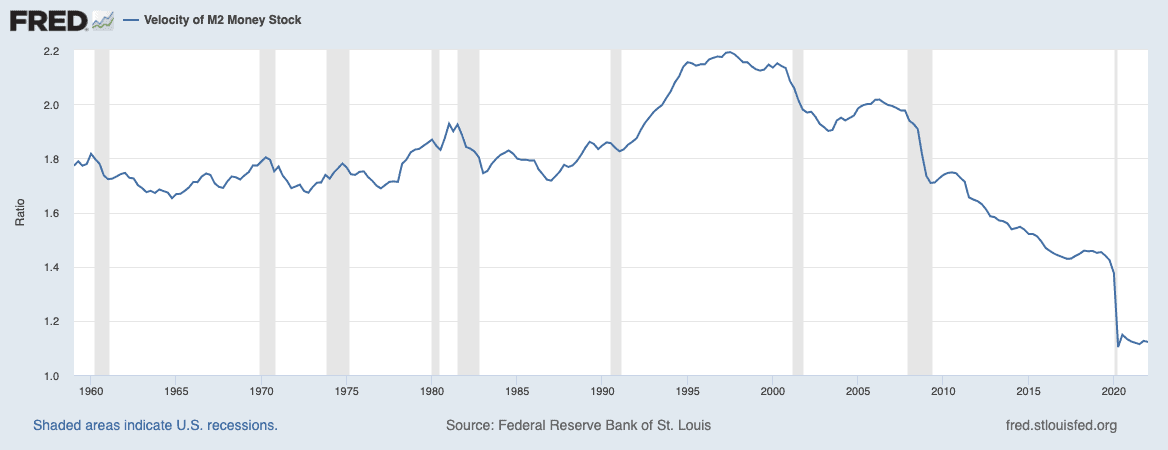
Currently, the velocity of money is still near historic lows. As Trading Economics notes, “Velocity of M2 Money Stock was 1.12200 Ratio in January of 2022, according to the United States Federal Reserve. Historically, United States – Velocity of M2 Money Stock reached a record high of 2.19200 in July of 1997 and a record low of 1.10300 in April of 2020.” 

Again, the St. Louis Fed makes this painfully clear.

velocity of m2 US
Velocity of M2 Money Stock – St. Louis Federal Reserve

Recessions tend to reduce velocity and thereby lower inflation, so while the U.S. is likely in a recession already, how much lower can the velocity of money go? Especially with unemployment at only 3.6% in June, it would seem more likely that velocity will go up and increase inflation than continue to decline.

With inflation at 9.1% while velocity is as low as it is, this bodes ill for any last hopes of inflation being transitory.

Volume of Transactions (T)

This is the other side of the equation. Whereas if the amount of money or velocity goes up, prices go up, if the volume of transactions goes up, prices go down, and vice versa.

This is where supply chain issues related to the after-effects of the pandemic and subsequent lockdowns and the economic sanctions related to the war in Ukraine come into play. 

The war in Ukraine was particularly noteworthy for its effects on gas prices, which are a significant driver of inflation since so many things are shipped over great distances. Higher gas prices make travel, logistics, and commerce more expensive, eventually passing on to the consumer.

While we can all hope for a quick end to the war in Ukraine, the geopolitical battle lines appear to have been drawn for the foreseeable future. The litany of sanctions put on Russia are unlikely to be lifted even if the war were to end tomorrow. It seems like a new cold war appears to be on the horizon (if it hasn’t already begun). This has led to what could be seen as a China-led trade bloc and the world fragmenting into specific factions. This is even happening with the Internet in what is now referred to as the “splinternet.” 

In short, while globalization may not be breaking down, it’s certainly stalling, and sales volume is likely to continue to stall with it.

And while gas prices will likely come down soon after the war in Ukraine ends, who knows when that will be and if the new cold war will shrink global trade and continue to keep production costs higher than they would have otherwise been.

Another Variable: Political Will

The last time the United States dealt with high inflation was between 1973 and 1982. Right off the bat, it should be noted that that was a full decade of high inflation. Once inflation takes hold, it’s very hard to get rid of as businesses and individuals begin to anticipate continued inflation. Workers expect higher prices for goods, so they demand higher salaries. Companies, in turn, expect higher labor costs, so they increase prices again, and so on.

The only way to get rid of it is to decrease the money supply drastically, decrease velocity (unlikely given how low it already is), or increase productivity (unlikely to change substantially in the near future). 

So that means to halt inflation, we would need to cool down the economy and reduce the amount of money in circulation. The most efficient way to do that would be to increase interest rates, which slows lending and the money creation that comes along with lending. And this is exactly what the Federal Reserve is doing, sort of.

In April 2022, Federal Reserve chairman Jerome Powell announced the Fed would increase the discount rate to 1.9% by the end of 2022 and 2.8% by the end of 2023. Already, they’re exceeding that pace as the discount rate stands at 1.75%, with more increases expected this year.

The issue here is that the discount rate is still near historic lows. Even if they get up to 2.8%, that is still below the historical average.

interest rates, discount rate US
Interest Rates, Discount Rate for the United States – St. Louis Federal Reserve

Final Thoughts

To “break the back of inflation” in the 70s and early 80s, former Federal Reserve chairman Paul Volker had to increase the discount rate into the teens. It was not uncommon for 30-year fixed mortgages to be over 15%, with the average hitting 18.5% in 1981.

Not surprisingly, this threw the United States into a deep, albeit short, recession in 1982

While the U.S. is likely already in a shallow recession, raising interest rates as Volcker did would probably send the economy over a cliff into something akin to the 2008 Great Recession or worse. 

But there are more concerns than just economic. For one, the United States has astronomically more debt now than in the early 1980s ($29.6 trillion in 2021 vs $908 billion in 1980). Increasing rates will increase the interest payments on the federal debt, which could become unsustainable, especially if the country is plunged into a deep recession and tax receipts subsequently fall.

Furthermore, political divisions are as high as they have been in the postwar era, with Democrats and Republicans growing further and further apart. A deep recession is not something any politician or Federal Reserve chairman wants to add to this already volatile brew.

On the other hand, high inflation erodes the federal deficit. While inflation is extremely damaging to regular people, particularly the poor and those on fixed incomes, it is less of a punch in the gut than the deep recession that would likely be required to stop it in short order. 

In other words, there’s no easy way to stop inflation now, and there certainly isn’t any political will to do so. Thereby, there’s no reason to think it won’t be with us for quite some time.

On The Market is presented by Fundrise

Fundrise logo horizontal fullcolor black

Fundrise is revolutionizing how you invest in real estate.

With direct-access to high-quality real estate investments, Fundrise allows you to build, manage, and grow a portfolio at the touch of a button. Combining innovation with expertise, Fundrise maximizes your long-term return potential and has quickly become America’s largest direct-to-investor real estate investing platform.

Learn more about Fundrise


Source link

Why Inflation Is Not Likely To Go Away Soon Read More »

Mortgage demand drops to lowest level in 22 years

Mortgage demand drops to lowest level in 22 years


Daniel Acker | Bloomberg | Getty Images

The pain in the mortgage market is only getting worse as higher interest rates and inflation hammer American consumers.

Mortgage demand fell more than 6% last week compared with the previous week, hitting the lowest level since 2000, according to the Mortgage Bankers Association’s seasonally adjusted index.

Applications for a mortgage to purchase a home dropped 7% for the week and were 19% lower than the same week in 2021. Buyers have been contending with high prices all year, but with rates almost double what they were in January, they’ve lost considerable purchasing power.

“Purchase activity declined for both conventional and government loans as the weakening economic outlook, high inflation and persistent affordability challenges are impacting buyer demand,” said Joel Kan, an economist for the MBA.

While buyers are less affected by weekly moves in interest rates, the broader picture of rising rates has already taken its toll. Mortgage rates moved higher again last week after falling slightly over the past three weeks.

The average contract interest rate for 30-year fixed-rate mortgages with conforming loan balances ($647,200 or less) increased to 5.82% from 5.74%, with points increasing to 0.65 from 0.59 (including the origination fee) for loans with a 20% down payment. That rate was 3.11% the same week one year ago.

Demand for refinances, which are highly rate sensitive, fell 4% for the week and were 80% lower than the same week last year. Those applications are also at a 22-year low, but the drop in demand from homebuyers caused the refinance share of mortgage activity to increase to 31.4% of total applications from 30.8% the previous week.

Mortgage interest rates haven’t moved much this week, but that could change very soon due to increasing bond market volatility. The Federal Reserve is expected to hike rates by another 75 basis points next week, and other central banks are taking similar action against inflation. A basis point equals 0.01%.

“This is especially true next week as markets digest the newest Fed policy announcement next Wednesday, but Thursday’s policy announcement from the European Central Bank could also cause enough of a stir to impact U.S. rates,” noted Matthew Graham, chief operating officer of Mortgage News Daily.


Source link

Mortgage demand drops to lowest level in 22 years Read More »

Is The Stock Market Drop an Opportunity for Real Estate Investors?

Is The Stock Market Drop an Opportunity for Real Estate Investors?


Does a stock market crash affect real estate? We’ve seen home prices hit record growth over the past two years, with a slight slowdown happening right now. But nothing in the real estate market compares to the stock market selloff that has happened over the past six months. Index funds are down over twenty percent year to date, tech companies are quickly losing valuation, and the stock market doesn’t show any signs of slowing down. Is this an opportunity for real estate investors?

Instead of letting landlords try to explain how equities work, we brought on Clay Finck from the Millennial Investing podcast to help educate us on what a good (or bad) buy looks like. Clay has spent years learning about value investing from the best stock trader of all time, Warren Buffett. He’s designed his portfolio to model the trading techniques Buffett engineered and thinks that this latest dip poses some interesting opportunities for investors of any asset class.

Clay talks about recession-resistant stock picks, how to know whether a company is under or over-valued, and why stock investing could be a more passive alternative for the stressed-out landlord. We also have our panel of expert guests give their take on the stock market, how real estate investors should invest, and what their own portfolios look like. If you’re heavy on the real estate investing side of things, make sure you listen until the end, as there are some serious stock buying opportunities you may have never thought of.

Dave:
Hey, everyone. Welcome to On The Market. I’m your host, Dave Meyer. Today, we are going to be trying something a little bit new. For the first part of our show we have Clay Finck joining us, who is the host of the Millennial Investing podcast and is an expert on the stock market. And he’s going to teach us and inform us about what is going on in the stock market right now.
And I know, listen, I work for BiggerPockets, I get that most of the people listening to this are active or aspiring real estate investors, but it is really important for real estate investors and investors of all type to understand what is going on in different asset classes. Because as Clay is going to explain to all of us today, you will see that there are correlations and that these asset classes, although they’re different, are really interrelated and a lot of the same principles about investing apply.
During the second half of the show, Kathy, James and Henry joined me to break down what we learned from Clay and talk about how real estate investors should use the information that we learn and how to use the stock market to further your real estate investing career. I think you’re all going to enjoy this new format, but if you have any feedback, thoughts about how we can improve, please make sure to let me know.
You can hit me up on Instagram, where I’m @thedatadeli, or you can always find me on BiggerPockets. With that we’re going to take a short break and then jump into our interview with Clay Finck from the Millennial Investing podcast.
Clay Finck, welcome to the On The Market podcast. Thanks so much for being here.

Clay:
David, so excited to be here. Thank you so much for having me.

Dave:
Of course. So, before we jump into what’s going on in the stock market, can you give our audience a little bit of background about you and how you got into being such an expert on the stock market?

Clay:
Yeah. So, growing up, I was always pretty good at math. Math was kind of my thing and never really knew anything about investing growing up. Wish I learned about it sooner, but we all go on our own journey and figure it out one way or another. And never really talked about money growing up. But when I was 18 or 19, I read this biography of Warren Buffet.
Since I’m from Nebraska, I was pretty familiar with Buffet and I was like, “How in the world did this guy become one of the richest people on the planet?” And I was reading about this idea of investing and I’m just like, “Why is no one talking about this?” So, I just wanted to learn as much as I could about investing. And that’s how I discovered the Investor’s Podcast Network. Stig and Preston started that podcast back in 2014, and it was just very clear to me that they really knew what they were talking about.
They were founded on studying Warren Buffet and I just loved learning about it, learning about the markets, and just loved this idea of having your money work for you. And it’s been said that the stock market is the most powerful wealth building machine that’s out there. Some of your listeners might not agree with that. I know many people have become millionaires investing in real estate as well. Both methods work very well. And one of our hosts actually, Robert Leonard, he’s my co-host on our Millennial Investing show, he actually provides these Buffet type principles to the real estate market where he invests in what he knows.
He invests in high probability type events where he can get high cash flow and has a high level of certainty. So, he has taken the ideas he’s learned from the stock market and applied it to real estate. So, I went on to college and went the traditional corporate path. I worked in insurance for a few years and TIP had an opening for a host on their Millennial Investing show. And I was like, “Heck, I’ll just throw my hat in the ring.” Didn’t really expect to end up getting it, but here we are speaking today. I’m about coming up on a year for being a host for the show and just having the time of my life, talking with some really good investors every week, it’s a lot of fun.

Dave:
Good for you. That’s an awesome story, I really enjoyed hearing that. And I do think that our audience would probably debate on the stock market vs. real estate. But personally I believe that it doesn’t have to be either/or, that these things are supplementary. And that’s the whole reason why we wanted to have you on to talk about how you can build wealth and even passive income through the stock market, which we’ll get to in a minute. But I’d like to start just by addressing the elephant in the room, which is the stock market’s recent performance, at least over the over 2022, has been a fairly significant decline. So, could you give us a summary of where the market is today and maybe provide some historical context about the era we’re in right now?

Clay:
Absolutely. So, I just checked prior to this recording, the S&P 500’s down roughly 20% year to date. A lot of investors are probably pretty spooked. And really what’s been driving the markets, from our view, over the past few years is really driven by what the Federal Reserve is doing. And this is where it kind of goes over people’s heads, but I’m going to try and simplify things as much as I can here. So, the Federal Reserve just really has its hands in the overall financial markets.
If you just simply plot the money supply or the assets on the Fed’s balance sheet, and you plot that against the S&P 500, which is just the general stock market trend, those are very highly correlated. So, if the Federal Reserve is printing more money, we’re seeing the prices of financial assets like the stock market go up, and when they stop printing money or they kind of taper things down or normalize, then you see the stock market throw a fit and pull back.
And right now we’re seeing that time where the Federal Reserve isn’t being as accommodative to the markets and we’re seeing the market pull back. And it’s not the first time we’ve seen this. Around March 2020, we had the COVID pandemic hit and financial markets were in a mess. We saw a really sharp draw down in stocks in March 2020, and the Federal Reserve was very accommodative during that time period, because they really needed to be, to prevent a global recession like 2008.
So, they were accommodative to the financial markets, they printed more money, they handed out these stimulus checks and these PPP loans, and the Fed said that inflation wouldn’t really be a problem. Well, it ended up being a huge problem, and that’s where we’re at today. You have inflation running at, call it 8%, and the bond market, which a bond is really just a contract. You put down $1,000 today, and you might get some sort of yield on that until the bond’s maturity and get your $1,000 back.
So, if bonds are yielding 3%, you lock in a contract to get a 3% yield. But inflation’s 8%, then that’s not really a good deal because you’re losing purchasing power. So, that just really throws the markets in for a loop. And once the Fed realized that inflation wasn’t really transitory, it looked like it was going to stick around, that’s when they decided they wanted to contract the economy and try and not be as accommodative. And, again, that’s why we’re seeing things pull back. So, to put it really simply, the Fed’s either expanding the money supply or they’re contracting the money supply.
Since March 2020, they were really just expanding it, and we saw asset prices explode, stocks go up, real estate as well is kind of correlated with that. So, real estate markets went up as well. And interest rates play into it too, because the Fed has influence on where interest rates are set. So, right now the Fed isn’t expanding or providing that easing, they’re doing the opposite. So, the money supply is contracting a bit, they’re taking some money out of the system. So, it’s natural to think that the prices of those financial assets that were influenced by the expansion of the money supply is now seeing the opposite.
And I guess I’ll also mention that if you look back at history, you look at, like I mentioned, March 2020, when the Fed needs to be accommodative to the markets, they will. So, it’s my expectation that eventually things are likely to break down, so we’re going to see some sort of breakdown in the economy. I don’t know where exactly it’s going to be. And once the Fed recognizes that liquidity needs to be added to the system, they need to provide more money to help fill the gap somewhere it’s needed, they’re going to do that.
They did that in March 2020. The repo market, which we don’t have to dig into, it’s essentially the plumbing of the financial system, that had liquidity issues in September 2019, and they stepped in and provided liquidity there, because that’s really their job. They’re the lender of last resort, they’re the bank for banks. And since our economy is largely driven by credit and all these loans out there, a lot of the money out there is just loans given out by a bank. You can run into issues when there’s liquidity issues, especially with these larger institutions.

Dave:
Thank you for that. That’s super helpful. So, it sounds like similar to the real estate market, we’re just seeing that the Fed was being very supportive to the economy, and in particular when monetary supplies increase, you see asset values go up. That happened in real estate, that happened in the stock market. And now that the Fed is changing course, we are seeing that reverse in the stock market. Now it’s not reversing yet in the housing market. We’ve talked a lot about it on this show, so we’re not going to get into that here.
But it sounds like what you’re saying is that the Feds raising rates until inflation goes down, or until economic activity declines to the point where they’re like, “Okay, we can live with a little bit of inflation, but we have to add monetary supply to make sure this recession that we are likely in, or going into, doesn’t get too deep and too serious.” And if that’s the case, do you expect the stock market to be in a bear market, or remain relatively flat until the Fed again changes course and starts adding liquidity in the market by lowering rates?

Clay:
Yeah, 100%. I think we could definitely see more downside given that the Fed is taking money out of the system and they’re raising interest rates, and we can talk about that relationship if you’d like, but yeah, I expect… I guess I shouldn’t say I expect, I wouldn’t be surprised to see more downside from here. The Fed is really trying to tackle the inflation problem. They don’t really mind or care if people’s stocks are going down now, because they really need to get a grip on inflation. But like you said, they’re going to try and tighten as much as they can until something breaks in the economy.

Dave:
That’s just a terrifying statement, right? I keep hearing people say that. It’s like, “They’re going to tighten until something breaks.” I can’t believe that our economy is basically like inflation or breaking right now. Those are the two options it seems like.

Clay:
Right. Well, in 2008 they started their quantitative easing program. They printed over a trillion dollars. So, they turned on that spigot and we’ve come to find out over the last, call it 14 years, that it’s really, really hard for them to turn that spigot off. And that’s just the reality of the situation and the way I see it. So, I could see more downside for any financial asset market. It could be real estate, stocks, crypto, or whatever, but I do expect once they do reverse course, we’ll see a strong rebound in the stock market for sure.

Dave:
Yeah. I mean everything you’re saying makes a lot of sense logically. So, we’re seeing the stock market on a whole has a lot of interest rate sensitivity. Are there certain segments of stocks or certain types of stocks that do better or worse in this type of rising interest rate environment?

Clay:
Yeah. So, from a high level, I would say the valuation of stocks is really driven by two things currently. I talked about the money supply and how that has an effect on the stock market and how those are really correlated. But the other major driving factor is interest rates. The value of really any asset is based on the discounted future cash flow. So, if you’re a real estate investor, say you have a, call it a property, that’s $100,000. That might be the price someone’s offering it to you. You can look at what’s that going to produce per month or per year, and kind of project that out.
And using those cash flows, you can come up with some sort of reasonable or conservative value what you would pay for that property. So, it’s the same idea for the stock market. In terms of which types of stocks are hurt more by higher interest rates, it’s pretty obvious just looking at the past performance of some stocks. In the low rate environment we saw in 2020 and 2021, the “growth names” are the ones that tend to do really well in that environment. So, the companies that ARK invest in that grow at 100% per year, don’t really have much earnings today. They may in the future.
Companies like Tesla growing very fast, don’t really have too much for earnings today. Very fast growing companies do well in a low rate environment. And when you look at it through the discounted cash flow lens, that makes sense, because they have earnings really far out into the future. Tesla, they may have a lot of earnings in 10 years. When you discount that at 2%, that really doesn’t bring down those earnings too much. But if you discount it at 6% or 8%, that really hurts the value of Tesla today. So, that’s why you’ve seen the higher growth companies get hurt more.
And then you look at say a stable company that isn’t growing near as fast, you can call that a value stock. I’ll just pull a company like Costco. It’s a very stable company, they have strong cash flows and it’s very reasonable to think that those cash flows are going to continue to grow over time. Well, Costco isn’t down near as much as many of these other growth names, because of the way it’s valued and also how the market perceives the riskiness in that sort of company. So, I guess the big takeaway here is that the value of stocks are really driven by Federal Reserve policy, for sure, and then also interest rates as well.
So, a big question might be, where are interest rates going to go in the future? You have some people saying that we’re going to see higher rates because of the high inflation. I would maybe push back on that, because the Fed wants to maybe be accommodative in the future. So, that would mean they would need to lower rates to stimulate the economy. But in terms of my strategy, I just look to try and buy and hold really good companies, or just simply index funds. And we can dig into that if you’d like as well.

Dave:
Yeah, that’s a great segue, because I do want to talk to our audience who is mostly real estate investors, aspiring investors, but I would imagine that the vast majority of people listening are also interested in investing in the stock market. And even if you’re not, understanding the stock market is vitally important because what happens in one major asset class like the stock market, or you reference the bond market earlier, has a huge implication on what happens in the real estate market and vice versa.
Because investors are always chasing yield, they’re chasing the best opportunity, and so if some asset classes are performing poorly and other ones are doing well, you could see money going from the stock market or crypto into real estate or vice versa. So, even if you’re not interested in investing, it’s super important to understand this. But I do want to talk about if there are opportunities right now, because I am a complete novice, but I look at the stock market and I’m fortunate because I’m not trying to retire anytime soon.
And so, although I don’t like seeing my portfolio go down, I have confidence that it will go back up in the future. And I’m looking at some of these stocks, I’m like, “Ooh, it’s a sale.” There’s all this stuff discounted. Is that a stupid way to look at it, or are there actually opportunities right now?

Clay:
Yeah, absolutely you can find opportunities out there. I guess zooming out a bit, TIP was really founded on studying Warren Buffet’s value investing principles. So, we are looking to pay a fair price for the investments we have. For those who aren’t familiar with Buffet, he’s really looking for businesses that are really easy to understand, companies that have a strong moat or competitive advantage, so their earnings are expected to continue far into the future. And he is looking for a company that’s trading at a price that’s attractive to him.
And then it’s also companies that are growing and have stable earnings and have good management. So, I do have like a watch list of stocks that I’m keeping my eye on. And we have a tool here at TIP, there are a lot of stock investing tools, but TIP has one called TIP Finance that I use to determine an expected return I can get on a stock. So, I could punch in what’s the stock going to earn maybe next year? What do I expect those earnings to grow at? And then essentially there’s a calculator that says if you bought the stock today, you would get this return.
So, that’s kind of my process for how I’m looking at stocks. At any point in time you might have good opportunities, it’s just depending on what sort of yield or rate of return you’re looking to get. Apple might be trading at $150 today, say I could punch it in the calculator, say I come up with a call it a 6% or 8% expected return. Obviously the price could go even lower, but that pushes my expected return even higher. So, when you find those companies that you want to own for the long term and they’re really good businesses and they aren’t materially affected by these short term swings in the market, then you can treat any dip as a buying opportunity given you’re applying those strict principles and buying those really good businesses.
Outside of that, I’m always dollar cost averaging into index funds. I specifically do VOO and QQQ. VOO is just an S&P 500 fund, which is just the general stock market. And then QQQ is just a technology ETF, which is like the Nasdaq, so it’s many of the big tech companies.

Dave:
I love the idea of dollar cost averaging. It’s actually something I do both in the stock market, still doing it now buying in at a regular interval. I do it with real estate as well, but could you just explain to our audience what dollar cost averaging is?

Clay:
Yeah. So, dollar cost averaging is essentially taking the timing out of the market completely. So, say you get paid from your job every two weeks on Friday, you can set up, say with Vanguard, you can set up an automatic purchase of say an index fund, like VOO. So, I can set up on Vanguard every two weeks the day I get paid, I’m going to put this much into the ETF. There’s a ton of benefits to this. You’re taking timing and the emotions completely out of it. If you just let the money pile up in your bank account, you might try and buy when things are really hot. So, you’re buying really high, which is not a good thing obviously. And then when things dump down to the drain, you might be trying to sell.
So, it really just automates your whole process and takes the human emotions out of it. So, I think both of those are really key. And you mentioned the real estate. I hear so many people saying that, “Oh, I don’t want to get into real estate, because the market’s going to crash,” or whatever. Well, eventually it might crash. It’s crashed occasionally in the past, but if you apply that dollar cost averaging strategy, say you buy one or two properties a year for five years, maybe you have one bad year, but all the other years are going to more than make up for that. So, that’s kind of how I think about it in terms of real estate, and I think dollar cost averaging is a really good strategy for real estate investors as well.

Dave:
Totally. It makes so much sense. I mean I’m someone who spends half of my life analyzing the housing market and data and what’s going on there. And I think I know what might happen in the housing market, but no one knows for sure. And I imagine you probably feel similarly about the stock market. You are informed, educated, have good opinions and logical thoughts, but things happen that you can’t foresee. And I think that the dollar cost averaging is so great, because it’s just the humble approach.
It’s just admitting that you don’t know what is going to happen in the market. But what you do know is that over time asset markets, both the stock market and real estate market, go up. And if you could just attach yourself to the average over time, you are going to have tremendous benefit to your financial situation. So, thank you for explaining that. That’s something I really like. One specific part of the stock market I wanted to ask you about was dividend stocks. Because a lot of people who listen to this, and myself included, get into real estate because they’re interested in financial independence and the FIRE movement, and that is centered a lot around cash flow.
And that’s why a lot of people love real estate so much, is because it offers cash flow in addition to appreciation and tax benefits and all the rest. But to me, dividend stocks are sort of the equivalent of a cash flowing house in the stock market. So, I’m curious if you could just first tell our audience what a dividend stock is, and is now a good time to look at any particular dividend stocks?

Clay:
Yeah. Well, I wanted to say to your point earlier, people look at the real estate market or look at the stock market and they just see all this risk. The market could crash this year. Well, what’s your alternative? Just hold cash your whole entire life? Well, you have to look at what are the opportunity costs? What are you going to do if you don’t invest in real estate, or don’t invest in stocks? Holding cash is a guaranteed losing strategy.
So, like you said, dollar cost averaging helps reduce that risk in the market. And then having that long term approach also almost eliminates your risk. Buying and holding quality real estate or quality companies and holding them for a very long time takes that risk out of it. So, having the right mindset and just being educated on why you’re buying what you are, I think is really powerful. In terms of dividend stocks, so companies essentially earn money, earn profits, and they can do two things really, I guess, three things with that money.
They could either pay out those earnings as a dividend. So, if you own Coca-Cola stock and they pay out a dollar per share in dividends, then the shareholders get that dividend. Other things the company could do with those earnings is either buy back shares. So, many companies do this. Apple is one that is very popular for doing this and has led to the stock performance doing very well. So, they can take some of those earnings and buy back the shares. That makes the existing shareholders own more of the business. Buffet’s a huge fan of share buybacks.
And the third thing a company can do with their earnings is just simply reinvest back into the business. And different strategies are good for different companies. A company that’s more in growth mode, say like Tesla, they do not want to pay a dividend because they have all these opportunities in the market in terms of electric vehicles and reinvesting back into the business. And essentially they believe they can get a high rate of return on their money should they just reinvest back into the business and go out and produce more cars, or do whatever Elon thinks is best.
While a company like Coca-Cola is a whole lot more mature, so they’re going to want to reward shareholders for owning their stock and pay a dividend. So, that’s the reason dividends even exists in the first place. For someone who’s newer to investing, I think index funds are a really good place to start for dividends. I’m going to mention two here. One is VYM, which is a Vanguard high dividend ETF. I think it’s a really good option. They pay a dividend quarterly, which is every three months. So, you get four dividend payments per year.
And at the time of this recording the yields about 2.7%. So, every $100 you put in, you’d get around $2.70 In that first year based on what the dividend performance has been over the last 12 months. And it looks like the stock price right now is around $100 actually. And I did add up the dividends over the last 12 months and it was actually $3.20. And just to try and look at how has that changed over time, the dividend five years ago was $2.30. So, the dividend itself has increased by 40% over time, meaning that those companies earnings have grown over time, they’ve decided to increase those dividends over time.
So, a lot of these really good companies that pay dividends are going to increase the dividend rate at least by, call it 5%. At least the rate of inflation is what I would expect. And another option newer investors might consider is VIG. This one is geared more towards dividend appreciation. It’s another Vanguard ETF, and the yield on this one’s about 1.7% and their dividend per share has grown even more than that 40% for VYM. And outside of that, investors might consider individual stocks. To get a start, you could just look at the holdings of these index funds to get ideas.
And some companies that stand out to me are Home Depot, Walmart, Microsoft, and Lockheed Martin. Some of these might pay a dividend higher or lower than these index funds, but I just wanted to run a few rules of thumb I have when it comes to picking dividend stocks. Number one would be do not chase a yield. If a stock has a yield of over 5% in today’s market, that is a huge red flag to me. So many people I see got suckered into buying AT&T. It had a 6% dividend yield at 30 bucks a share and people were thinking that there was no risk buying this company, they paid an incredible dividend, it will be around forever.
Well, they ended up cutting their dividends substantially, and now the stock’s trading at around $21 per share. So, when the dividend yield is 5% or more, that’s the market’s way of telling me that this is probably not a great stock to hold and it’s probably a lot riskier than you might think. Then again when it comes to dividend investing, you want to be in it for the long haul. So, it’s probably not the best place to park cash that you need within the next year or two. Dividend stocks probably aren’t your best bet for short term cash.
And then if it were me, I’d, again, try and stick to Buffet’s principles. Companies that are easy to understand, they have a strong moat and competitive advantage, and they have generally a lower PE and they’re more of a value stock rather than a gross stock.

Dave:
That’s awesome. Thank you so much. I think there’s this thought process in the world of real estate that there’s no way to get cash flow from the stock market, but clearly there is, but the cash flow rates are probably not what you would expect in real estate. I actually tend on the lower side of caring about cash flow right now, but you still want 5%, 6% cash flow minimum. Some people are only looking for deals over 10%.
But if you are looking for a diversified portfolio that produces cash flow, dividend stocks can provide the dual benefits that cash flow in real estate do, which is the ability to generate some cash, albeit probably less in terms of cash on cash return, but still can appreciate and provide appreciation as well. Clay, this has been super helpful. We do have to go soon, but is there anything else you think our audience should know about the current state of the stock market or any opportunities you see?

Clay:
Yeah. I guess one thing I wanted to mention is that given all this stuff with the Fed, two billionaires that have had a huge impact on TIP is obviously Warren Buffet, but another one’s actually Ray Dalio. And Ray Dalio is actually very popular for this thesis he put together related to the long term debt cycle and what I was talking about earlier. Essentially the Feds kind of in this really difficult situation where they want to tackle inflation, but they want to keep markets stable.
And they just really have this big conundrum. And what I will say is that I think we could be heading for a really inflationary time period. They really want to tackle inflation now, but they might not have a good way to really do that. They might not have a way to tackle that inflation problem without things really breaking down and we enter a really bad recession. So, given what we’ve learned from Ray Dalio, we think money printing is likely to continue and that might mean a really inflationary time period.
And you might think about how you might position yourself if we enter that sort of time period. And I can’t help but think about real estate investors. They are in the perfect situation for this type of scenario where they’re taking on a loan and they have these, it’s likely a 30 year fixed loan or 15 year, whatever the loan term might be, but oftentimes it’s a fixed mortgage. So, you’re making those fixed payments every month. So, if you have high inflation, that means your payments are getting easier to pay off over time.
If you have good real estate, you likely have tenants occupying that real estate every single month. So, rents are increasing over time, because there’s inflation. So, that’s just extra profit for you. Also, obviously your expenses are going to increase some as well, but I guess extra icing on the cake is what you real estate investors might call it is the appreciation. If there’s an inflationary time period, the dollar becomes worth less over time. It might be a different currency for you given you’re in Europe, depending on where you’re investing, but the dollar’s becoming worth less over time.
So, that means the appreciation of real estate. So, it’s just this really good scenario for real estate investors, I think, given they’re buying and holding quality properties. And then the same thing kind of applies to quality individual stocks. The great companies are able to increase their prices over time, they have that pricing power to be an inflation hedge and help them weather through that storm.

Dave:
Clay, that was awesome. I wasn’t expecting a real estate investing pitch from you, but I certainly appreciate it. This has been super helpful. And I think on behalf of our audience, who might not be as familiar with this topic, this has been a great primer and helps understand the state of the current stock market and the economy as a whole. If people want to learn more about the stock market or you, Clay, where can they do that?

Clay:
Yeah. I host the Millennial Investing podcast. That’s the name of the show. It’s under the Investors Podcast Network is the company. They have two different shows under their network. My co-host, Robert Leonard, actually has a real estate show as well. It’s called Real Estate 101. So, he hosts a show that’s released on Mondays, and then I host a show on the Millennial Investing feed that we release on Tuesdays and Thursdays.

Dave:
Awesome. Great. I was actually chatting with Robert earlier today and hopefully we’re going to have him on the show at some point too, because he seems like a great investor to connect with. Clay, thank you so much. If you want to learn more, check out Clay’s podcast. We really appreciate you being here.

Clay:
Thanks so much, David.

Dave:
For the second part of our episode today, I am joined by Kathy Fettke, James Dainard and Henry Washington to talk about what everything we just learned from Clay means for aspiring and active real estate investors. Henry, what do you think of the conversation with Clay?

Henry:
I enjoyed it, man. Here’s why I enjoyed it. One, he was a bigger fan of real estate than I thought he was going to be, so that’s awesome.

Dave:
Totally. I thought he was going to just be slamming on real estate the whole time, but he’s kind of supported us.

Henry:
Absolutely. I love the way he summed up the economic market that we’re in and that we may see an inflationary period continue and the best hedge in his eyes for doing that. He felt like real estate investors were in the best position given that economic environment, because we’ve talked about it many times as real estate being an amazing hedge against inflation. So, that’s comforting to hear in a world of not comforting news every day. And also there was a lot of reinforcement around, because I get questions a lot around real estate versus a stock market versus crypto and where should I be putting my money and should I be investing in any of them, because they all seem to not be doing great based on some sort of outsider’s perspective.
And the theme that I heard was longterm investing, no matter your market or investment platform, seems to be what people should be looking at. Is you buy things that you feel like, A, are good companies or are good properties and you buy them when you feel like the market conditions best suit you. And then you hold those things for the long term and you see the trajectory of the stock market. If you take a zoomed out look at the stock market over the last 50 years, you’re going to see a growth, right? Same thing with real estate. And so be smart about your injuries, buy things that you feel like are valuable that fit your investing strategy, and then hold those great things and you should see a decent return.

Dave:
That’s great input. Yeah, it seems like the same foundational principles hold true whether you’re talking about rental property investing or holding onto a good stock, it’s really about long term growth. And I know that in the stock market, people do day trade or swing trade during good times. Maybe that’s not true right now and they should be focusing on those principles, like Clay said. James, what did you take away from the conversation?

James:
At the end of the day, investors are just looking for the same types of investment engines. As he walked through the simplicity of the stock market and just the basic investment engines, it’s just so similar to real estate in general. There’s the growth stocks that are just like flipping properties, there’s the dividend stocks that are like holding properties. Like for me as an investor, I’m doing buy and hold, I’m doing development, I’m doing fix and flip. And I kind of have this pie chart I work with of how I want to work my capital, and it’s really no different than what they do in the stock market. And it’s amazing that they’re all tied together so dramatically.
With the stocks, like what he was talking about with the Fed and how they printed too much money and how much these growth stocks increased rapidly, it was the same things with flips. Flips did the exact same thing. As the Fed printed more money, these things grew so quickly, and so everybody has been crushing it the last couple years. And now everyone’s trying to also figure out what’s that magic portfolio. Where do you put your money? How do you grow it steadily? And the growth stocks or those flip properties are going to be harder to do in the near future.
But the biggest takeaway I had was, at the end of the day we’re just investors buying different types of assets and we’re all trying to beat inflation. And there’s tons of different ways that you can cut up your investments, it’s a matter of what you want to do and how much risk you want to have.

Dave:
Yeah, I love the parallel. He did really make it simple. I sometimes feel like I know something about the stock market, then I’m quickly reminded that I don’t know anything about it. But he did really make it understandable in a way that you can relate to, like you were just saying, like there are flips and growth stocks, there’s different levels of risk. And it seems like when monetary policy was so easy recently, just like it was in real estate, people were just taking risks and now people are becoming more risk averse. And it’s easy in the stock market to sell something when you become risk averse. And that’s why prices can fall so much faster, relatively to real estate. Kathy, what about you? What do you think of the conversation with Clay?

Kathy:
Well, it just reminded me that there’s a big difference between active and passive investing. And a lot of what we talk about here and at BiggerPockets is active investing, but when you’ve got lots of people who are busy with the job that they’re doing, the stock market exists for them because it’s really passive, right? And you can have somebody manage that for you if you don’t have the time to study it. Like I wouldn’t. Today obviously there’s a lot of options that didn’t exist when I was in my twenties where you could just go on your phone and all of a sudden you’ve bought a stock or sold a stock.
It’s really easy to do today. But the bottom line is stocks are investing in businesses. So, if you pick a business that you believe in or that’s relevant, it’s got to stay relevant. So, any investment, it’s so important to pay attention if you don’t have somebody managing it for you, because big companies that seem steady can become obsolete when new technology wipes them out. Look at Netflix, for example. They were able to adapt with the times. But think of all the companies that went under, who didn’t. Netflix went to streaming and they really nailed it, although I don’t know if they’re making any profit and I wouldn’t necessarily invest there because I would need somebody to manage my stocks, because I don’t have the time to study.

Dave:
Do you invest in the stock market though?

Kathy:
Yeah, we do a little, because we wanted to play with the new things that are out there and then just buy stocks on our phone and see what people are doing. And in 2020 it just made sense. So many solid companies were down, so we bought the dip and that worked out really well. And even with stocks going down this year, we made money. So, that was just fun. I look at it more like a gamble, a fun little gamble that we were trying to learn. But if I were going to put millions in the stock market, you better believe I would have someone manage that for me, who has an excellent track record. And that’s the same in real estate. I feel like sometimes passive investors get snubbed a little bit, because they have to trust someone else. They’re busy or they’re retired and they don’t have time to be active.
And that’s why syndications can be so great, because it’s like a stock. It’s usually in an LLC, which is you’re buying a unit versus a stock, because it’s, again, in a LLC. But it’s the same idea, you’re trusting someone else to manage this investment for you because they know it better, they have more experience, and they have the time and maybe you don’t. That’s what I’ve been doing for years. And I sometimes see in the comments, “Why would someone buy a “turnkey” property? Well, because they’re busy.
I have people from all over the world that can’t come to America to do the things that active investors do. There’s lots of passive investors out there that need the stock market, that need syndications, that need turnkey property.

Dave:
Totally. I mean BiggerPockets was basically invented because most people don’t want to take the time to learn about other asset classes. It’s just like sort of the default, right? You grow up and you’re taught the way to invest is the stock market. You don’t even really necessarily learn that there are other ways to invest. And I think that’s changing largely because of BiggerPockets and crypto and what you all are doing. But I think that’s a really interesting point about how syndications and passive real estate investing is a good alternative for people who might have heard this episode and think, “No, stock market’s not for me.” Henry, what is your personal experience and exposure to the stock market?

Henry:
I started investing in the stock market, well, probably late 2020, early 2021, and I did it. Like a lot of people we were home during the pandemic and I found myself with more time to research things than I typically had. And so I had also started a side hustle that started to produce income, more income than I was expecting it to produce. And so I had cash sitting in a bank account and that scared me. And so I wanted to put that somewhere where I could put it fairly quickly and yield and get a return on it. And so like with real estate, yes, I could have put it to work in real estate, but not as quickly. I’ve got to go out and I’ve got to find a good deal to put the money into and those sorts of things.
And so I started to learn about the stock market, and what I learned was there’s a lot to learn, just like with real estate. And so I wanted to be as simple and as hands off as possible while still managing it myself. And so I just decided to buy about two to three companies that I believe in, and I would dollar cost average into those. They talked a little bit about that on the show, what dollar cost averaging is. And so I dollar cost averaged into two to three stocks that I believed in, or individual companies, and then as well as two to three ETFs.
And I haven’t veered from that strategy. The plan is to hold them for at least 10 years. And so I don’t pay attention to when it’s up and when it’s down, because I haven’t hit my time to look at whether I should liquidate those or not. And so it literally takes the emotion out of it for me. If things are tanking, the news doesn’t scare me, because my plan is to hold and I will just stick to that plan regardless of what the market’s doing. I

Dave:
I am surprised, honestly, Henry and Kathy both pick individual stocks. I thought all three of you would say, “Oh, I just put in an index fund, or I just use betterment,” or something like that or one of those robo-advisors, but I respect it. But I guess if you’re just treating it as something fun, Kathy, you would just pick something because that is more fun. James, are you the same way? Do you pick individual stocks?

James:
Unfortunately I do. One of the worst things I ever did was download the trading app on my phone, because like Kathy say, it’s kind of gambling for me.

Dave:
It’s just a game. Yeah. They make it into a game. It’s fun.

Kathy:
Yeah.

James:
It is a game that I’m not good at, that’s what I’ve learned. Because I’m a buy it whole guy, but I’m also a flipper and on the short term I’m not good at being patient. I would say I have made the mistake and the funny thing is when people come into my office as a real estate broker, I always tell my clients, “Don’t buy what you don’t know, because it’s high risk. And if you don’t really understand it, learn about it, go to BiggerPockets and get educated. Because if you make uneducated decisions, you can have some major consequences out of that.” And then soon as I tell people that, I turn around, get on my little app, and I start buying stuff and selling stuff and it goes red.
I pick the individual stocks. I have a self-directed IRA. I did roll into one that’s in just more of an index fund, works for steady growth. I kind of go that route. It was a very small IRA. Other than that, I have slowly pulled my cash out of my app and what I have learned is, Henry is completely right, buying the long term, like buying and steadily growing is the right move, because I don’t know what I’m doing. If I’m a flipper and I get into the market, or I’m a buy it whole person, I get into start flipping and I haven’t learned my processes, it’s not going to go that well.
And if I don’t know it, I go for steady growth. Because other than that, I’m just making uneducated… Actually a good buddy of mine, he’s a financial planner, he just said, he goes, “What you’re doing is no different than gambling, and you might as well have more fun and go to Vegas.” He’s like, “Because you’re sitting in your bed playing on your app when you could be having this great time in Vegas.” He goes, “And your odds are better there than what you’re doing right now.”

Kathy:
And you get free drinks.

James:
Free drinks. But I have definitely got some tax write offs this year from the trading app.

Henry:
Took some losses.

James:
I took a bad one. I went up against Elon Musk and that was a bad idea.

Dave:
Oh, I sold my Tesla stock way too early. It was a huge mistake.

James:
You know what’s a bigger mistake, shorting the Tesla stock.

Dave:
Oh, okay. I didn’t do that bad. So, I actually saw something, and we all mentioned like going on these trading apps that make it super easy, and I saw this study that showed that there is a negative correlation between how frequently you look at your portfolio and your returns. So, it’s basically like they get you to open it and the more you open it, the worse you do. Because you’re just, like Henry said, you’re supposed to buy it for long term, unless you are a super sophisticated day trader and you really know what you’re doing there.
But I thought that was super interesting. So, one thing that I started looking through old BiggerPockets forums to look at questions about the stock market before we recorded this episode. And one thing that people have asked is should they put money into the stock market to save up for a deal? Maybe you’ve done one deal, you’re waiting for that second deal, you’re putting money in. Would you put it in the stock market? Have you ever done that, or is that something you would consider, Kathy?

Kathy:
Oh no, I haven’t done that. I really like, talking about passive investing, I would prefer to do notes and lend to flippers who have a track record. Because to me that’s a solid, safe return, it’s secured generally to the property, and it would be three or four month hold. That’s where I put it and generally get about 10 to 12% that I can really count on and I don’t have to worry. One of the things they said is we’re talking about the Fed and when the Fed makes decisions, it affects the stock market a lot, and we have no control over that. We don’t know what they’re going to do and sometimes they don’t get it right.
And you can see people in the stock market follow every single word that is said at any Fed meeting, because they know that then it’s going to matter in a moment. So, I don’t want to be nervous all the time. So, I had a roommate who was a day trader and he would just be depressed all the time. It was like bipolar, he’d be up and he’d be down. I can’t do that. So, something like just lending, that’s where I put my short term money.

Dave:
That’s fantastic advice, because I honestly have put money into the stock market between deals, because it’s more liquid. But that’s obviously when it’s easier to do that in a bull market that you have confidence is going to continue like the last couple of years, because there’s, sure, short term fluctuations, but you can wait a week and sell it and probably do okay. Right now, I mean according to Clay, he thinks there’s more downside risk in the stock market. So, right now just parking it somewhere to buy something in six months you could come away with less. So, definitely a little bit riskier. James, do you have anything you do to in between deals, or anything you recommend to people, like Kathy said, for parking your money in between investments into real estate?

James:
Yeah. I think when you’re making that decision, the first thing that you want to really look at is if I’m trying to get to buy into another deal, I need to figure out how much money do I need to buy that deal. So, I have to figure out what kind of deal do I want to buy? How much capital do I need for that? Is it a cheap single family house where I can put very little money down, lever it up and get most back? Is it a multi-family where I’m going to leave more money in? And then based on that you have to go the stock market is going to make me 5% or 6% for the year. Is that going to grow fast enough for me to get to that down payment?
And many times, for me, it doesn’t get there fast enough. And so you have to kind of move your money around into higher yield items, like Kathy said. I do a lot of hard money lending. I’m buying and selling notes all the time. I’m doing short term loans. I like it, because I know how to underwrite it correctly and I can mitigate my risk. If I’m buying that stock and it’s going down or there’s a probability it’s going to go down if I’m buying it, I don’t know that as well as I know underwriting. So for me, I’m a real estate professional that’s actively in the market, so I can look at things, I can evaluate the risk on those a lot better as far as lending on a house than I can evaluating a stock.
And so if you want to grow that nest egg, you want to do what you’re good at, because you don’t want that to go down. And as an investor, you want to evaluate what are you good at? What is your talent? And then I would invest in those sectors. If you’re good at shorting stocks, then go short some stocks and try to earn a little bit more money that way. If you’re not good at it, but you want steady yield, the one big thing you want to do is make sure you’re beating inflation or staying with inflation right now.
Because if you are saving up for that next deal and your money’s going down every year, that’s a problem. And so depending on your talents, you want to pick the right engines and either just mitigate risk by not getting eaten alive by inflation, or if you want to grow faster, which I’m a fast person, I’m always looking for those high pop, high profit things or high yield, because I’m trying to grow that nest egg bigger so I can go buy more. And I’m always about trying to get that nest egg as big as possible. And so the higher, the yield, which are short term notes, flips, shortening stocks, could be crypto bubbles, those things, those growth, that’s what’s going to get you a little faster.
But you have to be comfortable with risk. Just like anything, you can lose it as quick as you can make it. And so you want to evaluate yourself and then make the right investments.

Dave:
That’s really interesting, because it sounds like all three of you are saying that the traditional idea that you should diversify your portfolio, at least across different asset classes, is not how you look at your portfolio and how you allocate capital to your investments. Henry, I saw you laughing. What do you think about that?

Henry:
Yeah, no, I totally agree with you. So, I would say less than 10% of my net worth is invested in the stock market and crypto combined. And so I don’t have a ton of my wealth in those markets, because I just love real estate, I understand real estate, for all the reasons James just said. If I need money quick, I know how to do that in real estate better than I know how to do that in any other type of market. If I need money long term, I know how to do that in real estate better than I know how to do that in the stock market or crypto or anywhere else.
And so I am going to diversify my portfolio within real estate first, because I understand most investment strategies in the real estate realm well. Whereas in the stock market, I understand one strategy, and it’s not a strategy that returns me tons and tons of dollars a month over month. It’s a long term play. And I don’t even know if that worked yet, because it hasn’t been 10 years of me holding those stocks, right? So, like you said during the interview, it’s putting the average to work for you.
If I zoom out 10 years, I can see that there’s probably going to be growth within that 10 years based on history in the stock market, and I’m betting that that continues over the next 10 years. It’s just taking the averages and putting them in my favor. TBD on how well it works and/or doesn’t work. So, if I need money quickly, I’m going to look within real estate, just like Kathy or James is, to turn some money around quickly, versus anywhere else.

Dave:
Kathy, I’m curious with the people you work with, you often, correct me if I’m wrong, raise money from a lot of passive investors. Are a lot of just generally speaking the people who invest with you, primarily invested in other asset classes and then they turn to you for real estate diversification? Or are these people who are like primarily real estate investors?

Kathy:
It kind of started with people who maybe sensed something was wrong. Our company started in 2003, so you could kind of see this might not turn out well. And people who could sense that wanted to get their money out of the stock market and into something else that just felt more stable. And at the time we were helping people buy cash flow properties in Texas [inaudible 00:57:55]. They were brand new and they cash flowed, and it made sense. So, we had a lot of people self-direct their IRAs, get it out of the market, buy these solid properties in Texas, and they didn’t even feel that downturn.
So, that was exciting to be able to help people avert catastrophe. And if you’re in your fifties and sixties and seventies, you are not taking risks. My nephews take big risks. They live in their cars, they make over $100,000 and they totally gamble with it. And my sweet nephew, he lost all of it because he betted against some things and he was wrong. But that’s okay, he’s young, he’s in his early twenties. But when you’re in your fifties and sixties, you don’t want to start over.
So, a lot of these people just saw what happened in 2008, are starting to get the jitters again, just don’t want to lose everything again. So, when we can show them, look, we have syndications where you’re secured in a first position, or there’s low LTVs on this. When we can show them it’s a hard asset, that cash flows and isn’t a growth market, that feels better to people who are looking at retirement or well into retirement.

Dave:
And do you see it as risky yourself being almost primarily invested in real estate? Almost entirely, I should say, almost entirely invested in real estate.

Kathy:
The biggest risk I’ve taken in real estate is not listening to myself, honestly. I give all this advice and then sometimes don’t take it. But a lot of the syndications we first did were slam dunks, because we were buying in 2010, everything was so cheap. Then we’ve been very much into land development and that has been highly challenged and doesn’t cash flow. So, I’m not looking for more ground up development deals, even though I’m sure people have made lots of money in them. That tends to be a little bit more risky. So, just as a passive investor, you just kind of got to know which investments are riskier than others. If you’re going to go into an apartment, say that’s a C class apartment, and it has a deep, deep renovation. There’s a little bit more risk there, because you’re renovating something.
We had a lot of challenges with something like that that we did, whereas you’re going to buy more of a B or A class newer property that only needs a little bit of renovation and is in a really good part of town, that’s going to be less risk, especially if the loan is lower. So , if the LTV is going to be… I have older investors who they don’t want to invest in anything where the LTVs over 65%, and others just don’t want risk. And that’s fine.
And so that’s a lot of what we focus on is we offer different things where it’ll be just a lending fund at 60% LTV, that’s… You’re not supposed to say safe, but that’s pretty secure versus the land development where I’ll go into it saying, “Look, this is risky, but the return could be really amazing.”

Dave:
That’s great advice. I mean within every asset class, crypto, stock, real estate, there are levels of risk. And even if you want to pick one, if you want to invest entirely in real estate, you can diversify your portfolio across types of real estate investing, just like you can do in the stock market too. I don’t know enough about crypto to really comment on strategies there, but I’m with James. My crypto record looks like James’s stock record, I think. But I will just say before we go, I guess I take a little bit more diverse approach here.
I’d say probably 25% of my net worth, 30% maybe is in the stock market. And honestly, I think it’s mostly because of FOMO. I don’t want to like miss out if the stock market goes on some run. But I do generally, at least over the last few years, have put money into the stock market, tried to let it improve while I’m waiting between deals. But that’s because the stock market was clearly in a bull market over the last decade and it was pretty, relatively safe to just buy into index funds.
So, there are definitely different approaches to it. It sounds like the three of you almost entirely in real estate, but I do think there’s a good amount of smaller investors, myself being one of them, who do a little bit more diversification. Because I am a lot passive, just like Kathy was saying, have a full-time job and like to look for different ways to invest passively. Okay. Well, thank you, all three of you for that. That was super helpful. And if you all listening to this, like this kind of episode, we’d love to hear from you.
You can find any of us on Instagram, but I think what we’re really looking for is are these types of shows where we look at other asset classes or alternative types of investment through the lens of real estate investing, are helpful to you? We would love to know. So, please reach out to us. Before we go, we do want to go back to our real estate roots. We actually have a deal scenario, but first let’s take a quick break and move to our crowd source.
All right, today’s deal scenario for our crowd source is contributed from the BiggerPockets forums by a member named Ryan Williams. And Ryan says that this scenario is very common in his market, which is Denver. And he says that multifamily prices are very high. For the most part they don’t cash flow with just traditional rentals. If you had the capital to swing an initial loss or get close to breaking even, is trusting future appreciation and rent growth enough to make purchasing these high price multi-families a good deal for investors? James, let’s start with you. What do you make of the situation?

James:
I think my first question would be is how much liquidity do you have to feed this engine? And is that going to prevent you from doing other investments in general? I know in 2008 I made a big mistake and bought a lot of properties just for appreciation and long term investments, and wasn’t considering the cash flow as much. It was more about accumulating wealth and property, and that hurt at the end of the day, because when we go into any kind of recession, the economy slows down and things happen. And every time it slows down, the negative cash flow can really hurt and it can snowball very quickly. And so you want to make sure that minimum, if you’re going to buy that way, I would have at least 12 months of mortgage payments set aside to cover that gap.
I personally do not buy assets unless they are paying me, because for me it’s a liability, it’s not an asset. I need to generate cash flow off of it. If I’m buying something for appreciation and that I’m not making income on it, then it’s a turn. I make an income by selling that property at that point. I won’t feed the beast, I want the beast to feed me. And especially as you go forward as in your investment career, it really depends on where you’re also at. When I was younger, I had a lot more appetite for getting higher equity position properties rather than cash flow, because I was really trying to springboard that wealth, but big profit hits, then I could reinvest that into more stable investments. But be careful buying on appreciation.
Right now we’re probably not going to have a whole lot of it over the next 24 months. And so you’re going to be just feeding an asset to where you can get better growth somewhere else. So, make sure that the assets are paying you or they’re not assets. Another thing you can do is maybe just forget… people often time they hear like, “I’ve got to go buy a multifamily,” because that’s what I hear online. That doesn’t mean that’s the right strategy for you. You might want to look at a different asset class that can pay you to get you going, gets you into real estate, gives you an investment and you don’t have to feed it.
Like single family housing, we’re starting to see good cash flow on those again, because the rates have spiked, things are slowing down, and now we can kind of get into the right type of deal. So, look at different types of assets and explore your other options rather than just being fixated on one specific type in a specific market that might not be right for you.

Dave:
That’s good advice.

Kathy:
Yeah. I have so many questions about that.

Dave:
All right. Well, Kathy, I wanted to bring this to you next, because you just gave a great answer about the spectrum of risk in real estate investing. Where does this one fall on your spectrum?

Kathy:
It’s so funny, because I’m in California and I go to these groups and people are buying like that all the time. Where are you going to find something here that cash flows? I watch people do it and they seem to make money. It’s not my thing, but California has been known for appreciation over time, so people take that risk and they just assume that rents are going to go up and values will go up over time. Again, it’s not for me. In Denver, there’s so many questions I would have about this property. Is it new? Is it old? Does it need fixing? Are you going to be, like James said, are you going to be feeding it? So, it’s actually going to be severely negative cash flow over time, or is it newer in an up and coming area?
Are you going to get bonus depreciation? That’s the big one. If you have a tax problem, this apartment might be your saving grace. It might be the thing that makes you so much money just from the tax benefits alone if it qualifies for the bonus depreciation. So, I would look into that. But my first reaction was doesn’t sound like a great deal to me, it sounds like a headache. But, again, if it’s a really well located property that doesn’t need a lot of work, it could make sense. So, too many factors there that we just don’t know the answers to. If it’s an old building, not in a growing area and it just breaks even, I would run and I’d run fast.

Dave:
All right, Henry, what’s the last word on this?

Henry:
So, my gut’s telling me I wouldn’t buy that, and here’s why. For exactly what James said, you’re typically going to have to feed that for a while. And so even if you rent it out, there’s some additional, you’ll have to add to that mortgage payment every month since it’s not going to cash flow. And then you have to consider your maintenance, your taxes, your insurance, your vacancy, all these other things that are going to cost you money every month. So, all that leads me to believe if that’s a strategy that you’re looking at because you’re banking on the appreciation long term, then you probably have some cash sitting in your bank account. And if you’ve got some cash sitting in your bank account, I always tell people like, “Yes, you can’t find some cash flowing multi-families on the market in a lot of areas of the country, but you can find them off market.”
And so your strategies are, it’s not that there aren’t properties for you to buy, it’s that just you haven’t figured out how to go find those properties that meet that criteria that you’re looking for yet. And if you’re in a position where you’ve got a day job, you don’t have the time to go figure out how to find those properties, and you do have that cash, which I’m assuming you do, then do exactly what Kathy talked about earlier and partner with somebody who already does that for you. So, find somebody who has a fund, who’s going out and they’re finding these off market properties that do hit the numbers and get you the return. And you can put that money to work in that fund that still produces you monthly cash flow.
And some funds will pay you monthly, some funds will pay you quarterly. So, do your research and find a fund who already does the hard part for you and goes out and finds those good deals, and you can get a return on your investment on the money you have sitting in your account, all through real estate, without you having to go and buy something that’s going to cost you money month over month. And then as you build up that capital, maybe things change in the market and you can start to find more cash flowing assets later. Real estate’s just like any other thing you’re going to buy.
Somebody’s figured out how to go buy that thing at a discount, right? If you want to buy cars and you say, “Well, cars are crazy overpriced right now.” Well, dealers are buying them cheap, right? They figured out the way to go buy cheap property. So, it’s just you’ve got to find that method to finding the deals in the type of product you’re looking to buy. And if you don’t have the time to do that, then leverage somebody who does, that you trust.

Dave:
All right. That’s great advice for Ryan who is mostly investing in Denver. So, Ryan, hopefully this is helpful to you. This is great advice. Generally agree with all of you. I think if this is one of your first deals, that is a lot of risk that I would take on. If, like Kathy said, this is part of a tax strategy or part of a much broader, more sophisticated portfolio strategy, there could be ways that this works. But if this is relatively new to you, one of your first properties, I think that’s going to be a little too risky, at least for me.
All right, Henry, Kathy, James, thank you all so much for being here. We threw you all a curve ball, made you talk about the stock market. You all handled it very well. So, thank you very much. And if you are listening to this and have any feedback for us on this show, make sure to reach out to us on Instagram. I am @thedatadeli. James what’s your handle?

James:
It is @jdainflips.

Dave:
Henry?

Henry:
@theHenryWashington.

Dave:
And Kathy?

Kathy:
@KathyFettke.

Dave:
All right. Thank you, everyone. We will see you again soon. On The Market is created by me, Dave Meyer and Kailyn Bennett. Produced by Kailyn Bennett, editing by Joel Esparza and Onyx Media. Copywriting by Nate Weintraub and a very special thanks to the entire BiggerPockets team. The content on the show, On The Market, are opinions only. All listeners should independently verify data points, opinions, and investment strategies.


Source link

Is The Stock Market Drop an Opportunity for Real Estate Investors? Read More »

5 Simple Ways to Find Private Money

5 Simple Ways to Find Private Money


Most new investors don’t know how to find private money for real estate. They think private money is only reserved for those with a Rolodex full of rich or well-off business people, investors, or relatives. Using this line of thinking, most real estate investors will simply buy a deal, save up for years, and do it again. If you want to get on the fast track to a respectable real estate portfolio—private money is the way to go.

But you don’t have to take our word for it. Amy Mahjoory, private money expert, is back on part two of her financing and funding masterclass. Amy has grown her real estate portfolio quickly, thanks to private money. On just her second deal she was able to pay for a significant portion of the property using her private lender. Now, she urges investors, no matter their experience level, to do the same.

This time, Amy walks through five strategies that any investor can use to connect with private money lenders today. These strategies are simple—so simple that almost anyone can use them and find success quickly. They don’t require lots of money, time, or experience, but you need to be aware of them next time you’re in a perfect situation to make your pitch. Try these five strategies today, and you may see your inbox flooded with private money offers!

David:
This is the BiggerPockets Podcast Show 637.

Amy:
So there are a lot of that investors out there who may be thinking, “Why do I need to learn how to raise capital? I don’t want to flip. I don’t want to wholesale. I don’t want to even implement the Burst strategy. I want to go by turnkey rental properties. I want to go invest in a commercial syndication. I want to go start a fund.” Okay, fine. You still need to know how to raise capital to do all those things, right? So we’ve all heard cash is king. It is endless opportunities when you know how to raise capital. You’re going to start getting approached like I did from people out there who want you to be their capital partner and compensate you very well to raise money for their business.

David:
What’s going on everyone? This is David Greene, your host of the BiggerPockets Real Estate Podcast here today with my amazing co-host Rob, Roberto, Abasolo. Rob, how are you today?

Rob:
Good, man. I am still recovering from our two-hour conversation on the phone the other night where I biked the entire time. My legs have been like jello ever since.

David:
Bro, I got to compliment you. You were on a bike the whole time and I didn’t know it, meaning you never actually got out of breath, which would lead me to believe you might not be a human being, which would actually explain your amazing hair all at the same time, like if we were on the phone for two hours, which is quite the feat as it is. But you were on a bike the entire time and I didn’t know.

Rob:
Well, it helps that you were just doing one, two hour metaphor the whole time. I don’t know if you remember this. I never actually said anything on that call so that’s probably why.

David:
It was a two-hour monologue where you were just forced to listen, just like the Seeing Greene episodes that I make you show up and listen to me and praise me without actually allowing you to speak.

Rob:
Oh, now that’s what we call a callback. And a good one, a good one at that.

David:
All right. In today’s episode, Rob and I continue our conversation with Amy Mahjoory about raising money to invest in your real estate deals. In the last episode we just did with Amy, she explained her framework and how to build a foundation with people, including an elevator pitch that you can use. I believe hers was 14 words and made a lot of sense. And today we get deeper into how to put yourself in positions to use that information. Rob, what was some of your favorite parts of today’s show?

Rob:
Yeah, I think we’re really just breaking down barriers here. Honestly, it’s very simple. Because when we started in the last episode, she talks about, it was actually 13 words, 13 very specific words with a 20 word follow up. And then today’s episode, we actually talk about how to go from follow up to actually taking action in five very tangible steps you can take today to go out and raise millions and millions of dollars if you do it correctly. This ranges everywhere from basically putting yourself out there online, to hosting local meetups. I don’t want to give too much of the good stuff away because, yeah, some of these I don’t think some of you will be expecting.

David:
Yeah. And this is a great show because we get it to tactical advice. This isn’t just the overall, “Yeah, put yourself out there. Yeah, go to a meetup.” Nope. This is exactly what type of events to look for, how you should dress when you go, what you should say and how to cater it to your individual personality. So if you’re someone who’s serious about wanting to raise money and invest in real estate, this is a must listen episode. So please listen all the way to the end because we keep it rolling all throughout.
Before we bring in Amy, I’ve got a quick tip for you today. Go to biggerpockets.com/reshow. That is the podcast page where you can find out about the other BiggerPockets Podcast, but even more importantly, there’s free stuff. So if you go to biggerpockets.com/reshow, you’ll find some free information for you, a masterclass from Brandon Turner himself about building a brand. We’re working on getting him to do one about building a beard, but for now we have the Brand class, as well as some free stuff that Amy has given that will supplement your journey into raising private money. Rob, anything you want to say before bringing Amy?

Rob:
No, I’ve got nothing to say. Let’s get into the episode. Leave me alone. Don’t laugh at me. I’ll laugh at you.

David:
All right, Rob smooth as a jagged knife, Abasolo rolling into the show.
Amy Mahjoory, welcome back to the BiggerPockets Podcast. Excited to have you here for Part 2 of your four-part frame work. Would you mind doing a little recap on what we covered on the last episode and then giving people an idea of what they can expect in today’s episode?

Amy:
Yeah, absolutely. It is great to be back with you guys today. And really, we’re just going to continue the conversation around private money. In the last episode, we talked about what is private money, what isn’t it, who are we going to target, what are those initial conversations going to look like. We ended it with an overview of our FACT framework, specifically building your foundation. And there are a lot of moving parts that go into building your foundation which is step one of my FACT framework, such as really knowing your role, being confident in who you are and what you’re doing, making sure you’ve got the right mindset, making sure you’ve got your goals in place, your business plan, your target market identified. It really ends with us starting to plant seeds and really announce to the world who we are and what we do. And the way we did that under building our foundation was through our four second power pitch. So here we are today and I’m excited to get into step two of my FACT framework, which has taking action.

Rob:
Right. So just to recap, let’s see if I’ve got this correctly. I was paying very close attention when we did this the first time. So F is for foundation, A is for action, C is for Chipotle or credibility, whichever one you want, and then T is for transaction. Is that right?

Amy:
Yes. Thank you. And then we also touched on some common fears and objections that hold investors like us back from taking action.

Rob:
So let’s jump into action. Yeah, let’s get into that because I know we started touching on that a little bit towards the end of the last episode.

Amy:
Yeah. So now that we’ve built a solid foundation, we’re confident in who we are and what we’re doing and 24/7 we’re dropping that four second power pitch on anyone and everyone above and beyond our friends and family members, we want to focus on continuing to build our list of prospective private money lenders. Because a friendly reminder, I’m going to be one of the very few people who will tell you raising money is easy when you have step systems and strategies, but you don’t need to depend on your friends and family members, right? So how do we take the 70 trust and rapport building strategies that I’ve created and start implementing them so we can start to convert some of these individuals. So what I want to share with you guys today are five very specific strategies that you can start to implement right now in order to build your list of real private money lenders.
And the very first one, it sounds easier said than done, you guys. And ask yourselves, how often have you done this once I share it with you. Step one of taking action is getting referrals from everyone you talk to. So you’re going to see that everything is very closely linked to one another. So the end of building our foundation is the four second power pitch. We end that four second power pitch with a request for a referral, which is step one of taking action. So everyone we talk to in person or over the phone, we want to make sure we ask for anywhere from one to three referrals of somebody else who may be interested in knowing how to earn double digit returns backed by real estate.
And this is very powerful, you guys, because earlier I mentioned that I didn’t start prioritizing raising capital until my second deal. When I actually implemented the strategies I’m sharing with you today on my very first deal using private money from a complete stranger because I asked for referrals of a referral of a referral of a referral, in just three weeks, you guys, in 21 days, I was able to raise $390,000 in private money. And for me, that was huge because we all have different goals, right? One of my goals was I wanted to be on TV. I wanted to work with HGTV. And had I not been able to raise that money, that was the very first property that was showcased on HGTV, and I would’ve missed out on that opportunity. In addition to, a great profit as well. So word of mouth goes a very long way. Don’t shy back from asking anyone and everyone you talk to for that.

Rob:
So a tangible example of this would be you say, “Hey, I teach people how to make a double digit return in real estate.” “Oh, tell me more about that.” And then you say, “Oh, I’m a real estate developer in Chicago,” insert city here. They might say, “Oh, you know what? I actually have an uncle that does that.” And so if you find out that the person that you’re talking to doesn’t necessarily want to invest or they show no interest, then at that moment you would then kind of push a little bit further and say, “Well, hey, actually sounds like him and I would have a lot of things to connect over. Would you mind putting us in touch?” Would that be an example of a referral or do you like it to even feel a little bit more organic than that?

Amy:
No, that was actually perfect. I also like to incentivize my audience and the people we’re talking to. Now, there is a way we want to go about this so that we are not violating any SEC regulations. But you can still tell people at a very high level, “Hey, I also pay marketing fees or consulting fees for any referral that you send to me who ends up investing.” So whether maybe it’s, pick a number, a $500 thank you fee for your referrals that they end up investing, but just make it a flat rate instead of a percentage of the loan amount.

Rob:
So a bit of, yeah, like an incentive, “Hey, I’ll pay you $500 if I end up closing a deal with X or X person that you mentioned or you set me up with.”

Amy:
Absolutely. Regardless if the deal makes money or loses money. We’re not going to base the referral fee on that, because that is a violation of SEC. So just a flat fee to thank you for the intro if they end up investing with me.

Rob:
Okay. Okay. And have you raised a lot of money through the actual… I mean, I know you did on your first one. You talked about the $390,000. But is this a pretty common place where you’re usually finding success?

Amy:
It’s very common and that’s also a great segue into the second strategy. And I’m going to share that with you guys right now because it just makes sense to do so. In the last episode, I talked about consistency and how I consistently implemented these strategies for 18 months. After a year and a half, I no longer had to do what we’re talking about today. I could pick up the phone and have whatever I wanted, whenever I wanted. Now, do referrals really work? Did that result in a big chunk of the private money I have invested? Absolutely.
So a second strategy I will share with you as it pertains to getting out there and taking action, specifically getting creative and thinking outside the box. So how do we network and raise money with non real estate related individuals? Because it’s very common for us to think, “Oh, I’m going to raise money. In addition to asking my friends and family members, I’ll go to my local RIA or I’ll go ask another investor or I’ll ask someone at my local meetup.” So let’s go above and beyond that.
So I’ve got a LinkedIn strategy. This LinkedIn strategy, everyone that I connected with on LinkedIn, the sole purpose of this strategy which I will share with you in just a minute, is to get referrals. So here’s what I would do. Actually, let me ask you guys this. So to Rob and David, put yourselves in the shoes of a brand new investor. If I were to ask you, “Hey, you guys, we need some private money. Go on to LinkedIn and see if you can find private money lenders on LinkedIn.” If we’re looking for private money, what are some key terms you would search for on LinkedIn?

Rob:
Real estate.

Amy:
Perfect.

Rob:
Real estate investor?

Amy:
Perfect.

Rob:
I don’t know. I guess real estate… Do people say they’re flippers on LinkedIn? Like a house flipper?

Amy:
You’re absolutely right. And that’s what a lot of people do. I love it. They may even search for private money, but the three that you mentioned are perfect. Now, this is such a good example of what we don’t want to do because we want to start to think about who has money, who is someone of influence, who is someone of success and power for example, above and beyond real estate investors. So instead of searching for those traditional words that you just shared, Rob, go into LinkedIn and do a key term search on investment banker, financial advisor, stock broker, right? They don’t necessarily work in real estate, but they know people with money, right?
My whole purpose of getting in front of them is to ask for a referral, “Hey, I’m not here to dilly daily. I’m not here to waste your time.” Now, I don’t do this in my first message. What I’ll do is I’ll connect with someone on LinkedIn. And I do not outsource this, you guys. I don’t set up bots. I don’t set up automations. I do this myself. Still today if I were to do this and I do for some of my students, I’m typing these messages up myself because people can tell. When I get those automated messages on LinkedIn, I don’t know about you, but I delete or I do not open the majority of them.
What’s cool about this strategy that I’m sharing with you is as of late, the response rate is a 50, 50% response rate. When I implemented this 10 years ago, it was only a 20% response rate. So what I do is I put in a request to connect, and it’s two sentences. “Hey, Rob, I’m reaching out due to common connections. There may be a way for us to work together and leverage off of one another’s network.” I just put that out there. “Do you have five minutes” I’m very specific, “for an exploratory conversation on how we may be able to help each other out?” Copy paste, copy paste, copy paste. All I’m changing is the name. Set a goal to do that 10 people a day.

David:
What I like about that is most people are on LinkedIn, at least this is my impression, specifically because they’re trying to make money out of their network. I think there’s a handful of really successful business people that have it dialed in and they have a LinkedIn profile to showcase what they’re already doing. But I think the majority of people are trying to get to that point and they’re like, “Well, Facebook is for my high school friends and my family. Instagram is when I want attention. And LinkedIn is when I want to try to make money.” So by saying, leverage each other’s networks, you’re dangling the very fruit in front of their nose that they went on LinkedIn to find.

Amy:
Totally. I love it. The results are insane, you guys. I just had somebody fly out to shadow me for a full day. He’s actually one of my active students. He couldn’t believe the results that he was getting real time. It was insane. So once the person you’re addressing responds, and again it’s going to be about a 50% respond rate. And no, those who do not respond, I do not follow up. This is just my style. I don’t have time for that. If they don’t see the value in responding, I’m moving on to the other 50% that do. So when they respond, we hop on a call. And what I say to them is, “Hey, thank you so much for your time. I’m not here to waste your time. Just so you know, I’m a real estate investor.” Basically your 22nd power pitch, right? Your follow up.
“All of our deals are funded through investors, which is what allows us to grow and scale. So I know you may not be a real estate investor, I wanted to reach out to you in case you have a client that wants to diversify their portfolio and invest in real estate. You have a client who wants to do that? Use me as your go-to real estate investor. Anytime your client invests with me, I will compensate you in the form of a marketing or consulting service.” Because they may have a license that may be an ethical violation. You can work that out with him or her, but there are still ways to compensate them. “And hey, by the way, I promise never to go to your client directly without going through you first.”
No one’s going to say no to that. No one has ever said no to that in the last 10 years. Now has every single person delivered? No, but enough of them have. And then it’s the same thing, referral, referral, referral. What do you say to these people? It’s the four second power pitch. What do you do once they’re interested? You take them through your private money presentation, right? We touched on this briefly in the last segment.

David:
And not to derail you Amy, but I just want to clarify for those that are not in the professional arena of real estate sales, many licensed professions have laws against receiving referral fees. So for instance, if you are a licensed realtor, you can receive a referral fee from another realtor who sends you business. But if you’re not licensed, it’s actually legal for you to receive compensation from a realtor. That’s one of the reasons realtors can’t pay you when you say, “Hey, my aunt wants to sell her house.” Same is true in lending. Lenders can’t receive referral fees from other lenders. There’s a lot of different rules about when you can and when you can’t. The Real Estate Settlement Procedures Act covers a lot of that. But it’s good that you’re highlighting this because if you call it a marketing fee, that often doesn’t fall underneath the umbrella of referral, which could get them or you in trouble if you’re receiving funds and you’re not a licensed person.

Amy:
Exactly. And David, thank you for highlighting that because this still happens to me. I am not a licensed realtor. And you better believe because of the network I’ve built and the blood, sweat, and tears I’ve put into my business the last 10 years, yeah, I’m taking a “referral fee” from a realtor. And many realtors don’t know. When you tell them, “Hey, no, no problem. I’m not a licensed realtor. I’ll take my referral fee in the form of a marketing or consulting service,” a lot of them don’t even know that that’s okay. And so they always say, “Let me go talk to my managing broker and I’ll get back to you.” And I say, “No problem.” And no, I don’t put contracts in place for that. This is the honor system. If they don’t pay out on it, word of mouth goes a long way. I just won’t do business with them again.

David:
But it’s good to note that because if you’re a person on LinkedIn and you get a message from someone that’s like, “Hey, this is what I can pay you for whatever,” they may be thinking, “Oh, this is a trap,” right? “This is somebody coming after me to see if I’m going to take the bait and then I’m going to get in trouble.” So by spelling it out clearly in the beginning, you can kind of lower those defenses. The verbiage matters, I guess, is what I’m getting into here.

Amy:
Absolutely. And again, I am not a real estate attorney. I am not a real estate professional. If you guys have any questions on this, talk to your real estate attorney.

Rob:
Okay. So we’ve talked about word of mouth, meetup, and LinkedIn. One of the things I was curious when you were talking about meetups, because I think a lot of people will get in their head on this specific point and they say, “Well, what if I decide to host a meetup and nobody shows up?” Do you have any tips for someone that’s kind of nervous to do this on how they might be able to get people to that meetup?

Amy:
Great question. Meetups are amazing. Whether you’re new or experienced, the minute you start hosting your own meetup, you are instantly looked at as a subject matter expert in your market. You don’t have to have necessarily all the answers or all the experience. Create and host a meetup and invite a guest speaker. Invite a realtor, a designer, an architect, right? A hard money lender. And yeah, guess what, you guys? You can actually start to generate referral fees from all these guest speakers, because now you’re putting them into an environment where they have the ability to generate more business.
So meetups are great. I love it. Which leads me to strategy number three of today’s conversation. I actually have a meetup strategy. And here’s what we do. It’s again another creative way of thinking outside the box and building trust and rapport with people who have nothing to do with real estate. So go into meet up and do a key term search on entrepreneurs. Any event in your market. I’d even say get crazy. Go within a one hour radius. Any event in your market that has to do with entrepreneurs, go to it. I don’t care if it’s the food and beverage industry, the gaming industry, the tech industry. Because every entrepreneur has had to build a team or raise money, right? So if they can’t help you or they may not want to help you, they’re still going to know somebody who can. So again, it’s referrals, referrals, referrals. Putting yourself into unique environments where there are people who know people with money or people who have money.
And in addition to searching for entrepreneurs, also search for venture capital. Venture capital, venture capitalist. It’s a bunch of investors sitting in a room waiting to deploy their money, right? Go make them deploy it into your real estate business. What do you guys think?

Rob:
Yeah, that makes sense. I’m always a little timid to go to venture capitalist because I always hear that the terms aren’t quite so beautiful. What are your thoughts there?

Amy:
Oh, see, I love that because I don’t care what their terms are, right? So I always respond with, “That’s awesome. Thank you so much. My standard process is everyone receives the same rate of return, which is a 12% annualized return backed by real estate. If this is something you’d like to discuss more, I’d love to work with you. Let me know when we can chat about it.”

Rob:
Yeah. Yeah. Actually one thing we didn’t really cover earlier, just so I understand even your structure a little bit more and that might give a little bit clarity here moving forward, you give a 12% annualized return. So if someone invests $100,000 into one of your things, they should expect in one year, $112,000 back?

Amy:
Perfect. Yep. It’s 1% a month.

Rob:
Okay. And then do you, on top of that… Okay. So do you pay the 1% a month or do you give it to them at the very end?

Amy:
I always pay at the end in one lump sum. My private monies, the majority of them are just listed on the HUD statement as their payoff balance is listed, and I just let the title companies.

Rob:
And then lastly, when you are raising money, are you trying to get the investor to, like let’s say you’re doing the flip, to buy the entire house outright and then fund the renovation? Or are you trying to get them to give you 20% of the flips that you can go and get a hard money loan and renovate it with effectively another lender?

Amy:
God, I’m just filled with great questions today. That’s very, very good because that comes up often. So that’s your choice. If you live in a market where average price points for distressed property are $500,000, $600,000 and you’ve never raised money before, go put a hard money lender in first lien position. There’s nothing wrong with that. I love my hard money lenders. They were good to me. I still take care of them. I still send them business. That way all you have to raise is the gap funding, that 30%, 20%, plus all your caring cost. And then as you become an expert at raising capital, as much as you love your hard money lenders, you can phase them out. You can positively impact your bottom line and put more money in your pocket. No guarantees though, right? But then we still take care of our hard money lenders through referrals in our network.

Rob:
Okay. So ideally it’s a… I mean, you effectively start with both, but as you get really good at raising the private equity or the private money, you sort of phase out the hard money loan people, you take care of everyone with referrals. But you phase them out simply because you don’t necessarily want to keep paying points and origination fees and all that kind of stuff. Does that sound right?

Amy:
Yeah, because you don’t need to. That’s absolutely right. And you don’t need to because, you guys, if you think about it, if you borrow $100,000 which is nothing, I’m being uber conservative right now.

Rob:
Right.

Amy:
For some of the newbies, the cost of that capital is going to be, let’s say 13% annualized if you’re brand new with no assets and let’s say three points, the cost of that capital is $16,000. Now at the end of the day, I don’t care about the cost of the money. It’s about the availability of the funds. We can all have hard money tomorrow. I don’t care. I bake it into the deal. Whereas, the cost of that same $100,000 is only $12,000 when you’re working with private money. So the difference is $4,000. But is $4,000 going to make or break the bank? No, but that’s $4,000 on just $100,000 deal, right? So what if you’re raising a half a million dollars, which most of us do on one deal anyways? That’s 20 Gs, right? Or a million dollars? Or we do five deals a year? 10 deals a year? So the points really start to add up.

Rob:
Yeah, definitely. I mean, when David and I would close on our Scottsdale property, I think a point for us was like $30,000 or something like that.

Amy:
[inaudible 00:25:31].

Rob:
Yeah. On the luxury stuff, it can get pretty up there. And I didn’t mean to derail this, but I know that a lot of people are super interested in this topic. I don’t know if this goes into the T of FACT. Is that a little bit more on the transaction side?

Amy:
I could talk about this for hours, you guys, so it’s all good with me. No, this actually comes in under step three, the credibility piece, which I think we’re going to into later.

Rob:
Okay, cool. Yeah. Yeah. Okay, cool, just making sure. So a little preview I guess. Sorry, I get a little excited here when you talk about raising money because this is something that I think it’s very important for me right now. It comes at a pivotal time in my career where I move out of buying single family acquisitions and I move into scaling rapidly. For example, I mean by the time this comes out, I should have closed on a 20 unit, a motel in New York. And so we were able to acquire that property via raising money. I think a lot of people… This is kind of the difference between slowly building your portfolio, but there comes a time where if you don’t want to just buy your home after home after home, raising money is super important if you want to scale in a big way. Now, obviously your mileage may vary. It’s not the case for everybody, but for me it is right now. So I always get very curious about the actual nuances here.

Amy:
Yeah. And that’s interesting because you’ve talked about the Burst strategy. A lot of the examples I’ve shared revolved around fix and flips. So there are a lot of that investors out there who may be thinking, “Why do I need to learn how to raise capital? I don’t want to flip, I don’t want to wholesale. I don’t want to even implement the Burst strategy. I want to go by turnkey rental properties. I want to go invest in a commercial syndication. I want to go start a fund.” Okay, fine. You still need to know how to raise capital to do all those things, right? So we’ve all heard cash is king. It is endless opportunities when you know how to raise capital. You’re going to start getting approached like I did from people out there who want you to be their capital partner and compensate you very well to raise money for their business. So there’s so many ways that you guys can get creative and really just from this one skill set, start to generate so many multiple streams of income.

Rob:
Yeah. Yeah, totally. So I guess that kind of goes into the meetup side of things, which is kind of where we left off. When you said that you were going to these different events, you’re going to meetups that aren’t particularly, I guess they may be adjacent to what you do, but not necessarily. You go and you network with those people. You give your four second power pitch, maybe even the 22nd follow up. And then from there, you invite them back to your meetup that you’ll be hosting pretty soon. Is that right?

Amy:
Sometimes I will if they’ve expressed an interest. My main strategy is to place myself into environments where there’s money. And so going to other entrepreneurial events means I’m aligning myself and surrounding myself with other business owners who have been challenged with the same task as me, and as a result they know people with money or they have money of their own they may want to invest. And sure, if that conversation leads to it, I have absolutely invited them to my meetup. Maybe they’ll be a guest speaker. But it’s cool, it’s another great segue into the four strategy that I wanted to share, which is coming off meetups and [inaudible 00:28:59] that into attending high end fundraising events.
An example I often share is we talked about this earlier. How do we start to integrate these creative trust and rapport building strategies into our day to day lifestyle? Is it just something that we do without being as calculated the more we practice and the better we get? Yes, absolutely. So for example, when I started my real estate business, I was living in this high rise condo in Downtown Chicago. I was single at the time and I was maybe eating out a little more than I should have. I would always frequent this dive establishment that I loved. Once I started prioritizing the power of raising capital, I said to myself, “Amy, what are you willing to sacrifice? Is it really a sacrifice if you can’t go to Snickers your all time favorite dive bar three days a week, and instead one day a week, you go to a fancy restaurant,” right? During happy hour in a non creepy way and you start to talk to the locals, to the business owners.
Or every year I would invest in a VIP ticket and I’d go to the Chicago Auto Show. I could care less about cars. I don’t even know anything about cars. I don’t care. But when I spend, I don’t know if it was $200 or $400 to a black tie event and I go to the Chicago Auto Show by myself, which was very nervous as extroverted as I am for me, I’m placing myself into environments where there are people with money. And I would work the room, again in a non creepy way. 15 minutes, that’s it. I would try to shake as many hands as I could every 15 minutes. What am I saying to these people? I’m going to sound like a broken record, you guys. It’s the four second power pitch, right? I’m just planting seeds.
So going to fundraising events is a great strategy. I would challenge you to ask yourself, if you really believe that you’re sacrificing activity A with activity B when you maybe skip out on a family lunch or even a family dinner or a coffee talk with a girlfriend or guy friend, is it really a sacrifice? Because what does it mean if you’re working towards crushing that goal, right? There’s so much that you can tie to this. But fundraising events have been very fruitful for me as well. What about you guys?

Rob:
Yeah. I mean, when you say fundraising event, it’s not necessarily just quite like a literal charitable drive or anything like that. In your mind, the way you’re defining a fundraising event is just maybe like a high ticket event or something that’s a paid entry where there are wealthier individuals that might be more investment-focused. Is that correct?

Amy:
Yeah, you’re absolutely right. Yeah, high ticket events. I mean, depending on your market, there are a lot of high ticket fundraising events as well. But I would really focus it on high end because that’s where the other business owners and entrepreneurs are going as well. And if it’s not within your budget, again, what are you willing to sacrifice?

Rob:
Right.

Amy:
Don’t get [inaudible 00:32:22].

Rob:
Lunch for a month or go to this event and raise money, right?

Amy:
Thank you. Exactly.

Rob:
So I’m kind of curious on this. What are your thoughts on “looking the part”? If you’re going to an investor, is it okay to be like a casual dressed? Or do you really take on the philosophy of like, “Hey, look the part, be the part,” especially with these fundraising events?

Amy:
Oh man, I don’t know if you want to ask me that question. So here’s my response, because I told you I’m very direct. I’m going to give you the good, the bad, the in between.

Rob:
Okay.

Amy:
Now, I’m always going to dressed respectful. And at a black tie event, I’m going to dress up. But once I quit my job at Dell, I mean even still today, I’m wearing a white t-shirt and black leggings. I mean, I don’t have fancy clothes. Maybe three dresses I use when I hop on a stage and do a keynote. But no, I’m casual. I’m respectful, but casual. Because what I have found is people want to know you. They’re investing in you. And as a result of investing in you, they’re investing in your business. I’m not going to show up in a dress or a suit. Or I may get crazy and wear heels with a pair of jeans, but that’s it.

Rob:
Okay. So really what you’re comfortable with, you know?

Amy:
Yeah. Just be you. Do you, I mean, there have been times where I’d literally be wrapping up a meeting with a general contractor in my gym clothes and I’d go straight into a private money meeting and I crack a joke about it. I mean, at the end of the day, we are all just normal people, right? And everyone can relate to our day to day lifestyles. So I crack jokes often, and I do that with my private money lenders as well.

Rob:
Yeah, that’s good. That’s good. So David, you don’t have to wear a tuxedo every day, man. Just be yourself. I think that’s the tip here.

David:
Okay. So my thoughts on this question is really good. First off, I do think certain people do need to dress differently than others. I guess I’m just saying it’s not a blanket statement for everybody. So Amy can get away with wearing the top and the leggings that she described, because Amy, you’re very articulate. You are clearly confident and professional, and you’ve done this before. Your personality, the way that you come across, is very strong and confident. So that makes me feel safe if I’m going to let you borrow money.
There’s other people that have naturally withdrawn personalities. Maybe haven’t done this as much that are going to be a little more timid or pensive. They’re looking at their shoes when they’re talking. They have a harder time holding eye contact. What I tell those people is, “You need to be wearing a nice suit and you need to come across very strong” because that will add strength to the impression that you’re giving to somebody. Someone like me that just kind of like steamrolls everyone, I know that’s a thing that I tend to do, it’s almost better if I’m not wearing really nice clothes because it’s too much. It’s like looking directly at the sun. You’re like, “Oh, I can’t even listen to you because you’re just like pounding me.” So I noticed I could get away with wearing way dressed down from everyone else, right? But I do think that it’s custom fit for every personality. And this is the same thing I tell real estate agents that are on my team.
Amy, you’re amazing me with how many of the strategies that you’re using to raise money are the same things that other businesses do when they’re just trying to find leads. What you’re really talking about is a lead for your business when it comes to money. These strategies are so similar. What I tell them is if you are a sort of not as confident person, maybe a little more shy and introverted, having a nice car will really help you because it’ll make people say, “Well, what is it about that gal? She’s driving a really nice car, even though she doesn’t talk much. Maybe she’s just a genius and she doesn’t communicate well.” Or if you’re someone who is very bold, I actually dial it back. I drive a Camry. I don’t want to show up somewhere in a Ferrari where now people think that I’m this pretentious a-hole and I have to do a lot of work to overcome the objections that you got when you just saw me walk in the door. I want to make it as easy as myself as possible to get my point across.

Rob:
I mean, it really seems like it boils down to authenticity though, right? I mean, I’m in the midst of getting my real estate license and I have kind of an apprentice that I’m training who’s going to be doing a lot of the transactional work by my side. I was talking about creating content and how I plan on starting a YouTube channel that focuses on the Houston market. And she was like, “You’re going to wear that?” And I’m like, “Yeah, I’m going to wear a graphic tees, tees with funny things on it, tees with skulls on it, my black pocket tee. It doesn’t matter.” Because I was like, “I don’t want to be the realtor that wears the suit. I want to be the millennial realtor that’s super casual.” And I think she was like, “Okay, if you’re sure.” And I’m like, “Yeah, I’m sure. I do it every day.” People don’t really consider what I wear because I think it’s all about the conversation and the authenticity that drives that conversation.

Amy:
Yeah. Both of you just gave really great pieces of advice. It ultimately does come down really to your personality and things you need to strengthen. So for those of you out there who are newer or maybe you’re an expert real estate investor but you’re new at raising private money, if you’re not sure what approach to take, you’re a part of an amazing community. Turn to your BiggerPockets community or other communities that you’re a part of and ask for support, ask for advice. Ask for help and let them help you if you would like some support in that area.

Rob:
So have we covered off every strategy? I know we talked about word of mouth, meetup, LinkedIn, fundraising. Was there one that we were missing there?

Amy:
Yeah. I wanted to really wrap it with something you touched on earlier, Rob, which was pretty cool. Remember, I joked about you stealing my thunder?

Rob:
Oh, right, right. In Episode 1.

Amy:
Which is your online presence, because I come across so many real estate investors of across all ages who will shy away from social media. Social media is so powerful. There are such respectful and tactful ways that we can share what we are doing as individuals, as business owners on social media. And really when it comes to your online presence, this is the fifth strategy I wanted to highlight with you today, there are two things I would invite you to consider. Number one is making sure you have a credible website. It does not have to be a fancy website. It does not have to be a complex, big investment website. I don’t even care for newbies if it’s just a landing page. Because whether we like it or not, one of the very first things every private money lender is going to do when we speak to them whether it’s in person or over the phone is Google us and check out our website. So we want to make sure we have some sort of a landing page, a core website for them.
And then number two is we do want to make sure that we are active on social media. Specifically, and this can be debated or discussed, I have found success and I continue to find success on Instagram and LinkedIn. 10 years ago, Facebook was one of my strategies. I’m not converting anything on Facebook anymore, considered a weakness of mine. But with private money and other parts of my business, Instagram and LinkedIn have been amazing. I just had a conversation with my videographer yesterday. She’s trying to get me on TikTok and I’m like, “Girl, I don’t have time for that.” But your online presence is huge. And if you need help figuring out what to share or what to post, share other people’s content. Take a BiggerPockets post or podcast, share it. “Hey, you guys, check out this great read from BiggerPockets on the interest rates or the economic downturn or the trendiest paint colors for spring,” whatever, HGTV.
Take projects that somebody else in your network is working on. Share them. We’re all looking at properties, right? David touched on deal flow, lead flow, marketing for deals earlier. The next time you walk a property, take your phone and take a selfie photo or video, “Hey, you guys, about to walk this distress property. Stay tuned for updates.” People love watching that. Put it on social media. You’re not saying you bought it. You’re not saying it’s yours. You’re not saying you’re going to buy it. You’re just saying, “Hey, check out this property.”
The next time you go to a meetup or a networking event or even when you’re on a podcast or a virtual event, take a screenshot, take a picture. Share it, right? You don’t have to say you’re talking to a coach for example. You can just say, “Collaborating with other like-minded investors. Excited about what the future has in store.” So there’s a lot we can do when it comes to building your online presence. The two key takeaways is having a core website, and then number two, having a social media presence. What do you guys think about that?

Rob:
Oh, 100%. So I always talk about putting yourself out there, letting people know what you did. I think I talked about this in Episode 1. And a lot of people are like, “Well, Rob, it’s easy. You got a YouTube channel and blah, blah, blah, blah, blah, blah,” right? And I’m like, “Well, I mean, I’ve got that channel because I put myself out there,” A, just to dismiss that, but B, most of the partnerships that I have, have not come from my platform. They’ve actually come from the interpersonal communications in my life because I was always posting photos of my tiny houses and of my glamping things and people are like, “Whoa, tell me more about that.”
So just right off the bat, posting on your social channels and letting people know, that’s going to be huge for you. But secondly, you do have to work for posting to social and creating a social presence. So I don’t want to necessarily simplify that, but I do think that it’s also not incredibly difficult to build that brand out. You can absolutely do reels in TikTok. And I know a lot of people that make seven figures from the marketing they do just off of reels in TikTok, right? Reels, that’s what Instagram is pushing right now. And so if you make a lot of reels, there’s a very high likelihood that Instagram is going to be pushing your content out to new audiences. It’s the same thing with TikTok. Most of the time when I post a TikTok, it’s going out to people that aren’t in my audience. And if it goes viral, it’s going viral from people that have never seen my content before. And then it gets served up to my audience.
And so a lot of people think you have to have a really big platform to do this kind of stuff, but it’s just not true. You can post something on TikTok and be an overnight sensation if you really hit the points right, if you’ve got a good hook, if you’ve got a good video overall. So I just think a lot of people tend to hold themselves back on the premise of comparing themselves to other real estate content creators and they say, “Oh, I’m not going to be really great when I get started.” And the reality is, you’re not going to be great when you get started doing this. You got to work towards it. You got to work at enhancing your brand and posting daily and consistently. And if you do that, you will see results.

Amy:
But you know what’s so crazy, Rob, is I just had this conversation yesterday. I mentioned earlier I was talking to my videographer and I said to her, “Should I start a YouTube channel? Because I have one, but I do nothing with it. And oh my God, my coaches and mentors are telling me I need to do this.” So it doesn’t matter how experienced or successful we are, you guys. We all have fear, right? And things that hold us back from taking action. It may sound silly to other people, but one of mine is, I don’t know how to start a YouTube channel. Am I going to get criticized by people? I can’t deal with the negative comments. What do I do? But I know I have all of this content that I want to share and raise awareness on. So even you just sharing your story and your experiences has motivated and inspired me.

Rob:
Well, and we actually just talked about this recently on Episode 629 with Brandon Turner. We talked about growing your personal brand and your social presence online. I mean, it was effectively a 45 minute masterclass on everything you need to know to really develop your personal, your ecosystem, whether it’s TikTok, Instagram, Facebook, YouTube, or everything. So if you’re interested in learning more about that, be sure and go download that and give it a listen after this episode.

Amy:
Yeah. Again, thank you for that. I selfishly appreciate that. At the end of the day, you guys, it’s all about our mindset, right? And remembering that we are providing others with an opportunity to invest. If they don’t see it that way, then we genuinely have to believe that’s their loss and we’re going to go respond to the other 15 people knocking on our door, ready to invest with us. Even if we don’t have 15 people knocking on our door.
And here’s the best part. Once these transactions start to come in, which is step four of the FACT framework, which I know we’ll get into later, then it’s going to have a snowball effect on everything you’re doing. And yes, you’re actually going to have more money coming into your business than you even want or need. And so there are going to be ways where you are respectfully going to work with private money lenders, and then also turn away private money lenders whose ethics and morale do not align with yours. Because remember, we don’t need them. We don’t need their money, right? Because we have the right mindset. They need us. We are the ones providing them with double digit returns, with a protected, secured, and insured asset. They’re not getting that in the stock market. They’re not getting it in the bank. So as long as you have the right mindset going into this and you remind yourself of who you are, what your ethics and what your morale consists of, you guys are going to have no problem getting out there and confidently raising money.

Rob:
Yeah. Well, this was awesome. I’m really excited to get to the C, the credibility step here in the next episode. But to quickly recap here, I just wanted to make sure I got the five action strategies correct, and in no particular order. I know you have a lot more of these, so we’ll definitely need to cover these at a later point.
But starting with number one, word of mouth. Referrals. Getting yourself out there, meeting people, asking if those people know people that might want to invest with you. Number two, having a meetup. And if you want to market that meetup, go to several different meetups around the world. Oh sorry, around the city within a one hour radius, I think is what you said. I mean, you could do around the world if you want, it’s just going to be a lot more expensive. But go and network with people outside of your network and see if you can get them to come to your meetup. And by doing so, you’ll prove that you’re a subject matter expert and people will more than likely build a little bit of trust and rapport with you because they see you as somewhat of a local leader in that space.
Three would be getting onto LinkedIn and making connections with a lot of people. Make sure that you’re not building any kind of bots or any VAs doing this. Try to have a personal message that you send to a lot of people. Let’s not say be on the nose here and hit up real estate investors or real estate flippers, but people that might actually have wealth in a different arena that are looking to diversify. So physicians, maybe even like you said, a venture capitalists, doctor, all that kind of stuff. Then we move into number four, which is fundraising events. Go to some high ticket events, high ticket events that you might have to go and buy a ticket. Maybe it’s a conference. Maybe it’s another event that’s a $500 car show in your city and try to network with as many people as you can.
And then lastly, online. Put yourself out there online, whether it’s posting to your personal pages or really just kind of digging in to the Instagram side of things or digging into TikTok or whatever that might mean. But really being consistent and intentional about your social posting. Does that sound right? Did I miss anything there?

Amy:
It was perfect. Thank you, sir.

Rob:
Thank you. Well, we appreciate it. I mean, this is really a master class. It’s going to be an amazing four part series. We’re super, super excited. Before we wrap up today, was there anything else that you wanted to just leave us with as we kind of get ready for the next episode?

Amy:
I don’t think so, you guys. Just really remember I guess what’s your why, right? We’ve all heard about that, right? What’s your why? What’s your driving force? Because you guys got this, whether it’s raising capital or other parts of your real estate business, you can do it. Tap into your why when you feel like you may be lacking motivation. And just turn to your community for support. And we got you and we’ll see you in the next episode.

Rob:
Awesome. Well, before we head out, can you tell us a little bit more about where people can learn about you online?

Amy:
Yeah, absolutely. I’m trying to, as much as possible, share as many tips and strategies on Instagram primarily. So I’m always sharing videos or pointers or graphics. So if you just check out my Instagram handle, which is just my first and last name, @amymahjoory, you can connect with me there. I don’t outsource any of that, so it’s a direct line to me. If you have any questions that went unanswered on this series, feel free to hit me up via Instagram and I’ll respond within 24 hours.

Rob:
Awesome. David, what about you, man?

David:
Find me, @davidgreene24. Check out my YouTube at youtube.com/davidgreenerealestate. And you can message me on the BiggerPockets’ platform. It was weird. I took a second there to try to remember what my YouTube thing was, even though it is the most boring name anyone could ever think of.

Rob:
Hey, you can find me at YouTube at youtube.com.

David:
That’s exactly what I did. I was trying to buy myself time to remember what the name was there. Doesn’t happen too often. All right, Amy, this has been a blast. I’m excited. We have more going on.
Personally, this is just my opinion, we’re probably entering into a market that’s going to be the best buyer’s market we’ve seen in at least eight or nine years. And if you are looking to ramp up, right now is a great time to be borrowing money. And for those that have money that don’t know how to invest in real estate, they have to earn a return on it because inflation’s eating it up. So on the people who need to lend money, they have pressure on the people who want to be buying houses. Like us, we have pressure because the market’s good. This is a very good time to be getting into the industry.
So if you guys like this content, stay tuned because we’re going to have Amy back for some more shows to complete her four step process. So my advice would be to go practice some of what you’ve learned right now on some of the people that are in your life. See if your elevator pitch can be improved. See if you can set yourself up to start attending some meetups, and maybe you can even start posting online. Getting some of the bugs worked out on your own game. And then the next time we have Amy on, you’ll have even more information to put into play.
All right, I’m going to get us out of here. This is David Greene for Rob Be Yourself, because everyone else has taken Abasolo, signing off.


Help us reach new listeners on iTunes by leaving us a rating and review! It takes just 30 seconds and instructions can be found here. Thanks! We really appreciate it!

Interested in learning more about today’s sponsors or becoming a BiggerPockets partner yourself? Check out our sponsor page!


Source link

5 Simple Ways to Find Private Money Read More »

Ivy Zelman says hold off buying battered housing stocks, more pain ahead

Ivy Zelman says hold off buying battered housing stocks, more pain ahead


Source link

Ivy Zelman says hold off buying battered housing stocks, more pain ahead Read More »

Inflation Up 9.1% Since Last Year

Inflation Up 9.1% Since Last Year


The Bureau of Labor Statistics has released the latest Consumer Price Index. Despite any chatter that may have predicted otherwise, inflation is still at a 40-year high and a 1.3% increase from the month before. Though inflation impacts everyone one way or the other, its effect on the housing market keeps getting more interesting, especially since it’s not fully visible through the statistics. 

After all, when the price of gas is so high that people can’t make it to their kids’ doctor’s appointments without taking out loans and food prices are 24% higher in school cafeterias, nothing could be worse than rent prices increasing for some of these families, unless you count now people having to give up their pets, too.

And, as we know, landlords have to keep up, so increasing rent is what’s going to happen anyway. In some cities, these increases are over 10%. Even those who may be in a position to get out of their leases and make a home purchase—as the housing market may finally start to show signs of cooling—interest rate hikes may keep them in their rentals longer. 

What Does the Latest CPI Data Tell Us?

The price increases we’re seeing is broad. Over the last 12 months, gas is up 11.2%, food is up 10.4%, shelter increased 5.6%, and energy as a whole increased by a whopping 41.6%. 

In total, prices are up 9.1% since last June.

Though we did get a bit of a reprieve from gas prices in mid-June and the Fed continued to raise rates to fight inflation, the bottom line hasn’t changed. Unfortunately, the average person’s ability to afford basic necessities continues to get worse. 

In Other News

Additionally, while not in the CPI report, the Euro is continuing to lose its value against the U.S. dollar, with one of the factors being the Fed raising interest rates, along with the Russian invasion of Ukraine. Whether this is a chicken-or-egg situation is beside the point. This may be great for summer travelers, but not so fast. Airlines have been taking a major hit since the pandemic began with a 9+ billion dollar loss and staffing issues to boot. Consequently, with gas up as well, airline tickets are the most expensive they’ve been in years.

Despite this, Americans are still planning vacations, as noted in a recent short-term rental report on BiggerPockets.

The Housing Market Is Still Wild, But Cooling

Alongside this report, the housing market has seen some changes over the last few weeks, but whether this is good or bad depends on whom you ask. Even though there are indicators that prices are starting to cool down, it’s still a war for homebuyers. 

Supply constraints continued to be plagued by construction costs, leaving many developers on the sidelines. As of April, the cost of building materials had gone up 19% year-over-year, according to NAHB, and it’s likely to continue increasing. Combine that with gas prices and a global supply chain that’s remained in limbo, building projects may start to get pushed back, and those in the midst of a project could be putting off the completion date. May saw housing starts of privately owned units decrease from 1.8M to 1.5M.

housing starts
New Privately-Owned Housing Units Started: Total Units 2017-2022 – St. Louis Federal Reserve

Investors: What Should You Do Now?

While sifting through the news has been confusing, and it seems like there’s not much positivity on the horizon, as long as your tenants are still paying rent, you’re still doing okay.

While housing prices are high in every market, some markets still have decent opportunities. As an investor, you should do some research and check out these top 10 markets in the U.S. to invest in now.

Be on the lookout for the next GDP report on July 28. If growth was negative in Q2, the U.S. will be in a technical recession. We’ll be covering what you need to know here on BiggerPockets.

recession proof 1

Prepare for a market shift

Modify your investing tactics—not only to survive an economic downturn, but to also thrive! Take any recession in stride and never be intimidated by a market shift again with Recession-Proof Real Estate Investing.


Source link

Inflation Up 9.1% Since Last Year Read More »